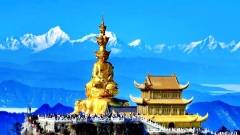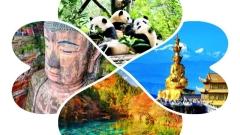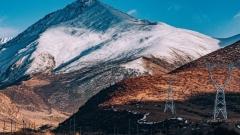

Jinding of Mount Emei stands at an altitude of 3,079 meters, located in the core of the western Sichuan mountain range. Its unique high-altitude terrain creates a climatic wonder of “one mountain embraces four seasons, and the weather varies every ten li”. The unpredictable weather at Jinding of Mount Emei is the most unforeseeable yet charming part of visitors’ experience. For overseas visitors coming across the ocean, grasping the weather rules here in advance can not only avoid travel risks but also accurately capture the perfect moments to witness the rising sun, the encircling Buddha’s Light, and the rolling sea of clouds. Standing in front of the Golden Statue of Samantabhadra at Jinding, one moment it may be shining brightly under a clear sky, and the next, you may be embraced by flowing clouds and mist. This experience of being in harmony with nature is the unique charm of Mount Emei.
Spring at Jinding: Blooming Flowers & Surging Clouds, Moisture Prevention Needed as Temperature Rises
Spring at Jinding of Mount Emei falls from March to May. During this time, the weather at Jinding of Mount Emei is characterized by a warming but unstable trend. The average daily maximum temperature gradually rises from 4°C in March to 11°C in May, while the nighttime minimum temperature may still drop to between -4°C and 4°C, with a temperature difference of over 7°C between day and night. Rhododendrons in the mountains spread from the low mountain areas to the high mountain areas step by step. From mid-April to early May, the alpine azaleas around Jinding enter their blooming period. The pink and deep purple petals sway in the spring breeze, contrasting beautifully with the flowing clouds and mist, making it a paradise for photography enthusiasts.
The most prominent feature of the weather at Jinding of Mount Emei in spring is the increasing rainfall. The average total precipitation in March is 53 millimeters, jumping to 172 millimeters in May. Rainfall is mostly concentrated in the afternoon, often accompanied by short showers and mist. Overseas visitors should note that the mountaintop roads become slippery after rain, and some viewing platforms may have a thin layer of frost. It is recommended to wear non-slip hiking shoes and carry a foldable umbrella or a waterproof jacket. In addition, clouds and mist occur frequently in spring. Jinding, which has as many as 314 foggy days a year on average, is more likely to have visibility below 500 meters in this season. If you plan to watch the sunrise, it is advisable to check the real-time forecast of the Mount Emei Meteorological Observatory one day in advance and set off in the early morning when there is no fog.
Notably, although the probability of seeing Buddha’s Light at Jinding in spring is not as high as in winter, when the sun comes out after rain, sunlight passes through the moist air, easily forming a clear colorful halo at Shengshen Cliff. If a sea of clouds spreads at this time, the halo floats above the sea of clouds and your figure is embedded in the ring—this is the unique “Shengshenguang” wonder of Mount Emei. It is recommended to carry a lightweight warm jacket and a camera, and wait at Shengshen Cliff between 10 a.m. and 2 p.m., when the sun angle is most likely to form Buddha’s Light.

Jinding of Mount Emei
Summer at Jinding: Cool Summer Resort, Protection Needed Against Thunderstorms
While most parts of the world are in the sweltering heat, Jinding of Mount Emei from June to August becomes a summer resort with its cool weather. The weather at Jinding of Mount Emei in summer is mainly characterized by coolness, frequent rainfall and thunderstorms. The average daily maximum temperature stabilizes between 13°C and 15°C, and the minimum temperature remains between 7°C and 9°C. Compared with the high temperature of 30°C in the plain areas at the foot of the mountain, it is a natural air-conditioned room. The mountains are covered with dense vegetation, and the content of negative oxygen ions in the air is extremely high. Walking on the circular trail at Jinding, the cool mountain breeze is accompanied by the sound of pine waves, allowing you to completely escape the stuffiness of the city.
Summer is the peak rainfall season at Jinding of Mount Emei. The average total precipitation in July reaches 376 millimeters, and August is as high as 441 millimeters. Rainfall mostly occurs in the form of showers and thunderstorms, often accompanied by strong winds. The mountaintop has an average of 60 days a year with strong winds of level 8 or above, which are particularly frequent in summer. Overseas visitors should pay special attention to staying away from tall buildings and metal railings at Jinding during thunderstorms, and avoid staying in open areas such as Shengshen Cliff. Huazang Temple in the scenic area provides temporary shelter from rain, so you can follow the on-site signs. In addition, the ultraviolet rays are strong in summer, the air at the mountaintop is thin, and direct sunlight is easy to cause sunburn. It is recommended to wear a sun hat, sunglasses, and apply high-factor sunscreen.
Despite the changeable weather, summer is still one of the best seasons to appreciate the sea of clouds at Jinding. Saturated water vapor condenses into a large area of sea of clouds in the mountains, and the sea of clouds in the early morning and evening will show gorgeous colors such as golden yellow and orange red due to sunlight refraction. In July 2025, a rare wonder of overlapping Buddha’s Light and fog bow appeared at Jinding. The colorful Buddha’s Light and white fog bow appeared at the same time for 30 minutes. The formation of this phenomenon relies on the high humidity air and suitable sun angle in summer. To encounter such wonders, you can pay attention to the forecast of the Sichuan Provincial Meteorological Bureau. 9 a.m. to 10 a.m. on clear days after rain is the golden time for observation.
Autumn at Jinding: Clear Sky & Fresh Air, Colorful Maple Viewing Time
Autumn at Jinding of Mount Emei from September to November ushers in the most stable period of the year. The weather is characterized by clear skies, little rain and good air permeability. The average daily maximum temperature gradually drops from 11°C in September to 4°C in November, and the minimum temperature fluctuates between 6°C and -3°C. Although the temperature difference between day and night is large, sunny days account for more than 70%. At this time, the leaves in the mountains begin to change color. The deep red of maple leaves, the golden yellow of ginkgo trees and the green of pine trees interweave. Overlooking from Jinding, the mountains covered with layers of dyed forests are like a spread colorful velvet blanket, forming a sharp contrast with the blue sky.
The weather at Jinding of Mount Emei in autumn is extremely favorable for watching the sunrise and star trails. At around 5 a.m., the sun leaps out from the direction of Gongga Snow Mountain, and the golden light sprinkles on the Golden Statue of Samantabhadra, making the whole Jinding seem wrapped in gold leaf. At night, the weather is clear and cloudless, the Milky Way stretches across the sky, and the starlight sprinkles on the mountain top after the first snow. Using long exposure photography, you can capture the shocking picture of star trails surrounding the golden Buddha. If overseas visitors plan to shoot night scenes, they need to prepare a warm down jacket and a frost-proof camera in advance. The nighttime temperature at the mountaintop can drop below 0°C, so it is crucial to take good cold protection measures.
Late October to early November is the best time to watch the red leaves around Jinding. At this time, the total precipitation gradually decreases, with an average precipitation of only 46 millimeters in November. The dry weather keeps the red leaves in good condition. It is recommended to choose a glass-floor cable car when taking the cable car from Jieting Hall to Jinding, and overlook the mountain paths covered with red leaves from a height, as if passing through a tunnel of colors. In addition, autumn is also a season with many Buddhist cultural activities at Mount Emei. If it coincides with the first and fifteenth days of the lunar calendar, Huazang Temple will hold Buddhist ceremonies. Visitors can experience the solemn religious atmosphere and the ritual of bell-ringing for blessings in the fine weather.
Winter at Jinding: Snow-Covered Scenery, Wonders Hidden in Frigid Weather
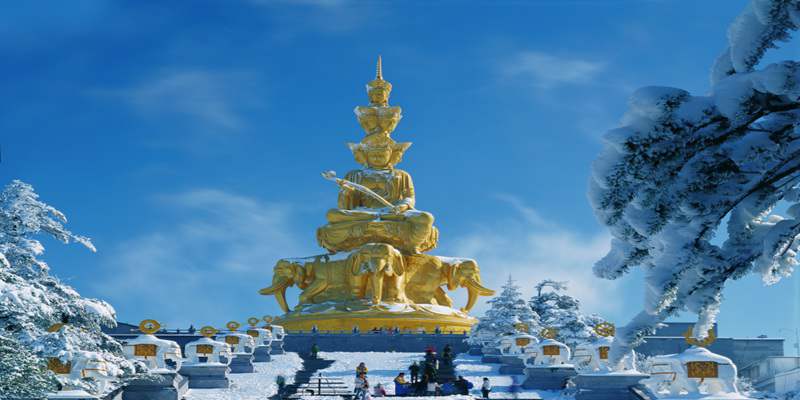
Winter at Jinding of Mount Emei from December to February of the next year ushers in the most spectacular snow scenery of the year. The weather at Jinding of Mount Emei in winter is marked by severe cold, heavy snow and strong winds. The average daily maximum temperature is only 0°C to 1°C, and the minimum temperature can drop to -9°C to -7°C, with an extreme low temperature of -19.7°C ever recorded. The annual average number of snowy days is as high as 144 days, the number of snow cover days is up to 242 days, and the maximum snow depth can reach 32 centimeters. The buildings and trees at Jinding are covered with thick snow, and the Golden Statue of Samantabhadra looks more sacred against the white snow, like a fairyland in a fairy tale world.
Faced with the harsh winter weather, cold protection equipment for overseas visitors is crucial. It is recommended to wear thick down jackets, windproof pants, snow boots, and a full set of cold protection supplies such as hats, scarves and gloves. Electronic devices such as mobile phones and cameras need to be protected from freezing, and you can carry a warm bag to extend their use time. Some viewing platforms at the mountaintop will be covered with non-slip mats after snow, but you still need to walk carefully to avoid slipping. In addition, the wind at the mountaintop is strong in winter, and sometimes snow fog formed by strong winds blowing snow will cause a sudden drop in visibility. At this time, the scenic area may temporarily close some areas, and visitors need to follow the arrangement of the staff.
Although the weather is frigid, winter is the season with the highest probability of seeing Buddha’s Light at Jinding. From November to March of the next year, the sea of clouds at the mountaintop is stable, and the sun angle from 9 a.m. to 10 a.m. is between 18° and 22°, which exactly meets the optical conditions for the formation of Buddha’s Light. The probability of encountering Buddha’s Light rises from a lottery-level in summer to a coin-level. In addition, the rime wonder in winter is also not to be missed. The low temperature makes water vapor condense on the branches to form crystal-clear rime, which shines under the sunlight. After enjoying the snow scenery, visitors can go to the hot spring resort at the foot of the mountain to soak in hot springs, feel the warmth of hot springs in the ice and snow, and experience the unique fun of “ice and fire”.
Jinding of Mount Emei
Essential Weather Coping Tools & Travel Tips for Jinding
No matter how the seasons change, the variability of the weather at Jinding of Mount Emei requires overseas visitors to be fully prepared. First of all, for weather inquiries, it is recommended to follow the official website or WeChat official account of Mount Emei Scenic Area, which provides the most authoritative real-time weather, temperature and visibility data of Jinding. It is advisable to check it one day before departure and early in the morning on the day of departure to adjust the itinerary in a timely manner. In addition, the Mount Emei Meteorological Observatory will issue early warnings for severe weather such as thunderstorms and strong winds. If you receive a warning, you can postpone your trip to the mountaintop and choose to visit scenic spots in the low mountain areas such as Qingyin Pavilion and Wannian Temple.
Transportation planning should be closely linked to weather changes. After snowfall in winter, the highway from Leidongping to Jieting Hall may be icy, and the scenic area will implement traffic control. At this time, you need to take the special anti-skid vehicles of the scenic area; during thunderstorms in summer, the cable car may suspend operation, so visitors need to plan alternate routes for hiking and taking vehicles in advance. Overseas visitors can buy tickets and cable car tickets on the Shitu Tourism Network of Mount Emei in advance to reduce on-site queuing time and avoid delays due to sudden weather changes.
Equipment carrying should be adapted to local conditions. Prepare waterproof jackets and lightweight down jackets in spring; bring sunscreen supplies, rain gear and thin jackets in summer; prepare thick sweaters and windproof pants in autumn; and a full set of cold protection equipment and non-slip shoes in winter. In addition, the air at the mountaintop is thin, and some visitors may experience mild altitude sickness. You can carry a small amount of glucose or anti-altitude sickness drugs and avoid strenuous exercise. Huazang Temple and the visitor center at Jinding provide hot water, and carrying an eco-friendly water bottle allows you to replenish water at any time.
The variability of the weather at Jinding of Mount Emei is both a challenge and a charm – it is this ever-changing climate that creates the natural wonders of sunrise, Buddha’s Light, sea of clouds, snow scenery and so on in turn. For overseas visitors who want to accurately capture the most beautiful moments of Jinding in different seasons, in addition to mastering the weather rules, choosing a professional travel partner can get twice the result with half the effort. China Dragon Travel has been deeply engaged in Sichuan tourism for many years, and launched exclusive itineraries for Jinding of Mount Emei for overseas visitors. It is not only equipped with multilingual tour guides, but also has a professional team to monitor the weather at Jinding of Mount Emei in real time and plan the optimal route in advance: in spring, it takes you to track the moment when rhododendrons and Buddha’s Light appear together; in summer, it avoids thunderstorms to enjoy the sea of clouds; in autumn, it takes photos of red leaves and sunrise at the best angle; in winter, it ensures cold protection and safety throughout the journey, allowing you to enjoy the natural and cultural charm of Jinding of Mount Emei without worrying about weather changes. Whether it is sunny or rainy, the magical scenery of Jinding is waiting for your arrival, and China Dragon Travel will be your most reliable partner to explore this sacred place.