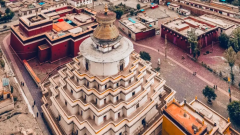

The night in Tibet is an unexpectedly shocking chapter in many people’s travels. The sky here offers top-tier stargazing conditions in Asia, mainly due to the combination of high altitude, low light pollution, and dry climate. For travelers, successfully observing and photographing Tibet’s starry sky requires specific planning and knowledge. From a practical perspective, this guide details where to go, when to go, what to prepare, and the safety precautions that must be taken, helping you effectively include this brilliant night sky in your travel plan.
Why Is It Essential to See the Stars at Hight When Visiting Tibet?
The outstanding starry sky in Tibet is determined by several clear geographical and climatic factors. High altitude is the primary condition. Most stargazing areas are above 4,000 meters above sea level, where the air is thinner, atmospheric disturbance is reduced, and starlight attenuates less during propagation, making the stars appear particularly bright and stable. Secondly, there is extremely low artificial light pollution. In lakes, grasslands, and mountainous areas far from major towns, there are almost no modern lighting facilities to interfere, and the night sky background is dark enough to make faint celestial bodies such as the Milky Way and nebulae clearly visible. Finally, there is the arid and sunny climatic characteristic of the plateau. Especially in autumn and winter, rainfall is scarce, cloud cover is minimal, and the clear night sky provides high reliability for long-term observation. The combination of these three factors forms an unparalleled viewing foundation for Tibet’s night sky.
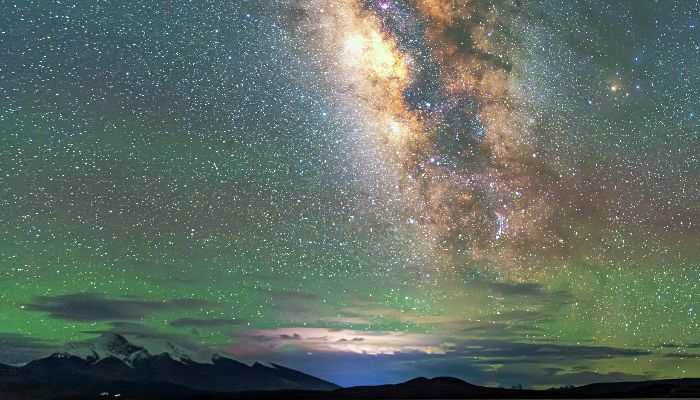
Milky Way Over Tibet’s Night Sky
Five Best Locations for Stargazing in Tibet
Choosing the right location is decisive for the stargazing experience. Below are five verified recommended spots with different focuses; you need to choose based on your own itinerary and bearing capacity.
By the Shores of Nam Co
At the lakeside of Nam Co, 4,718 meters above sea level, the mirror effect of the sacred lake can reflect the entire starry sky, forming a unique symmetrical landscape. The main body of the Milky Way often hangs over the Nyainqêntanglha Mountains, creating a magnificent visual effect. It should be noted that the night temperature here is extremely low and the wind is strong. Be sure to carry camping equipment and clothing sufficient to cope with the severe cold, and do not go alone.
Ngari Dark Sky Park
Located in Shiquanhe Town, Ngari Region, Ngari Dark Sky Park is an officially certified starry sky reserve. The park is equipped with public telescopes and basic interpretation facilities, suitable for travelers who hope to systematically identify constellations and learn astronomical knowledge, providing a more convenient and professional stargazing environment.
At the Foot of Mount Kailash
On the Tashilhunpo or the kora route around the sacred Mount Kailash, you can take starry sky photos with the sacred mountain’s silhouette as the foreground. The atmosphere here is solemn and quiet, combining natural scenery with cultural spirit, suitable for travelers pursuing in-depth experiences.
Everest Base Camp
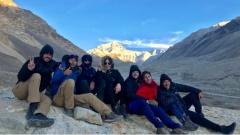
Stargazing at the Everest Base Camp area, about 5,200 meters above sea level, has unique symbolic significance. The air here is extremely transparent, and the center of the Milky Way often hangs high above the world’s highest peak, creating a highly impactful image. Activities here have high requirements for physical health; you must confirm that you have fully adapted to the high-altitude environment.
By the Shores of Yamdrok Lake
Yamdrok Lake is relatively close to Lhasa by car, with high transportation convenience. Its winding shoreline is convenient for finding ideal composition angles, combining the lake, distant mountains, and the starry sky. For travelers with tight schedules or those trying plateau stargazing for the first time, this is a choice that balances convenience and landscape effects.
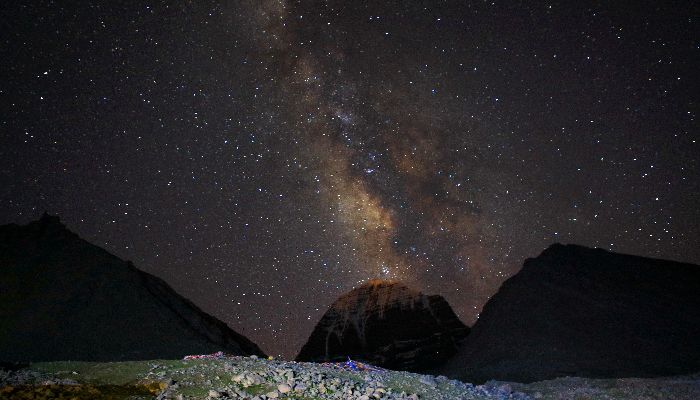
Starry Sky Over Mount Kailash
Best Seasons and Times for Stargazing in Tibetan Night Sky
Time planning is the key to successful stargazing. It mainly requires weighing two core factors: seasonal climate and moon cycle.
Recommended Stargazing Seasons: Autumn and Winter
- Autumn (September to October): The weather system is stable, with many clear nights and mild temperatures. During this period, the center of the Milky Way is still visible in the low southwest sky after sunset, making it an ideal time to shoot complete Milky Way arches.
- Winter (November to February next year): It is the driest season of the year with the highest sunny rate, and the observation success rate is close to 100%. Although the center of the Milky Way does not appear in the night sky, the bright stars and constellations (such as Orion and Taurus) in the winter starry sky are more prominent, and the night sky background is the darkest and purest. The main challenge is that the night temperature can drop sharply to minus 15 to 25 degrees Celsius, so top-level cold protection measures are a must.
- Not Recommended Seasons: Summer (June to August) is the rainy season, with a high probability of cloudy nights. Spring (March to May) may be affected by sandstorm weather, resulting in unstable atmospheric transparency.
Key Time Nodes: Moon Phase and Post-Sunset Period
- Avoid Full Moon Light Pollution: Bright moonlight will obscure most stars. The best stargazing period is about one week before and after the “new moon” in the lunar calendar. At this time, there is no moonlight interference throughout the night, and the starry sky is the deepest.
- Effective Observation Window: About 1.5 to 2 hours after sunset, the sky becomes completely dark, and observation and shooting can begin. The entire night until about 1 hour before sunrise is an effective observation time. Mobile apps such as “Star Walk 2” or “Sky Guide” can be used to confirm the position of celestial bodies.
Equipment and Core Parameters for Shooting Tibet’s Night Sky
If you want to record the starry sky you see, adequate equipment preparation and correct parameter settings are necessary.
Essential Photography Equipment List:
- Camera: A DSLR or mirrorless camera that supports full manual mode (M mode) and has good image quNgarity at high sensitivity.
- Lens: A wide-angle lens with a large aperture (such as 14mm f/2.8, 24mm f/1.4) is recommended. The larger the aperture (the smaller the f-number), the more starlight can be captured.
- Stable Tripod: There is often strong wind at night on the plateau. A sturdy and reliable tripod is the foundation for ensuring clear images, and carbon fiber material is lighter.
- Shutter Release Cable or Remote Control: Used to avoid vibration caused by pressing the shutter by hand. If not available, the camera’s built-in 2-second self-timer function can be used.
- Sufficient Batteries: Low temperature will drastically reduce battery power. Prepare at least two fully charged batteries and store them close to the body to keep warm.
Reference for Manual Camera Parameter Settings:
- Shooting Mode: Manual mode (M).
- Aperture: Set to the maximum aperture of the lens (such as f/2.8, f/1.4).
- Shutter Speed: Use the “400 Rule” to calculate the maximum safe shutter speed (400 / lens focal length). For example, when using a 20mm lens, the longest exposure time is about 20 seconds (400/20) to prevent star trailing.
- Sensitivity (ISO): Depending on the darkness of the environment, usually test and adjust between ISO 2500 and 6400.
- Focus: Switch to manual focus (MF). Turn the lens focus ring to the infinity (∞) symbol, then fine-tune back a small distance. Use the camera’s live view, zoom in on the screen to focus on a bright star, and fine-tune until the star point is the smallest and sharpest.
- File Format: Be sure to shoot in RAW format to retain maximum space for post-processing adjustments such as white balance, noise reduction, and detail enhancement.
- White Balance: Can be manually set to 3800K-4500K, or adjusted uniformly in post-processing.
Personal Essential Items List:
- Professional Cold Protection Equipment: Regardless of the season, must prepare a high-loft down jacket, windproof hard shell, fleece jacket and pants, woolen hat, waterproof and warm gloves, and high-top warm boots. Chemical warmers (hand warmers) can be used for hands, feet, and core areas.
- Red Light Lighting Tool: A red light flashlight or headlamp can protect night vision and not interfere with others’ observation.
- High-Calorie Supplies: Carry chocolate, energy bars, nuts, and a thermos filled with hot water to maintain body temperature and physical strength.
Safety Norms and Precautions for Night Stargazing on the Plateau
When conducting outdoor activities at night in Tibet, safety must be the top priority, and the following norms must be strictly followed.
Coping with High-Altitude Risks:
Ensure that you have fully adapted in lower-altitude areas (such as Lhasa) for at least 2-3 days without severe altitude sickness symptoms. Stargazing spots are often at higher altitudes, and low night temperatures will increase physical oxygen consumption. All movements should be gentle, avoiding strenuous activities such as running and jumping. If symptoms such as severe headache, vomiting, difficulty breathing, or confusion occur, you must immediately stop the activity, return to a lower altitude or oxygen-supplied area, and seek medical help.
No Solo Activities and Itinerary Reporting:
It is strictly prohibited to go stargazing in remote areas alone. Must go in groups, preferably led by a guide or driver familiar with local road conditions and the environment. Before departure, be sure to clearly inform your accommodation or companions of your specific destination, information of accompanying personnel, and expected return time.
Environmental Protection and Cultural Respect:
Follow the “Leave No Trace” principle, take away all personal garbage, and do not disturb wild animals and plants. Near cultural sacred sites such as sacred mountains, sacred lakes, and temples, keep quiet, abide by all sign regulations, and do not engage in any behavior that may be regarded as disrespectful.
Logistics and Itinerary Planning Suggestions:
Night road conditions in Tibet are complex, and self-driving by those unfamiliar with the area poses high risks. The safest plan is to arrange stargazing activities near your accommodation or plan the itinerary through professional agencies. For example, China Dragon Travel, when organizing such in-depth experiences, can reasonably arrange stargazing times and logistical support (including vehicles, emergency oxygen, and communication guarantees) according to the team’s overall itinerary and weather conditions, allowing travelers to focus more on the experience itself.
Planning and Executing Your Tibet Stargazing Trip
Tibet’s night sky is both spectacular and delicate; a successful stargazing trip depends on thorough preparation and respect for local conditions. Choosing the right season and moon phase, packing top-tier cold-weather gear and spare batteries, and mastering manual camera settings and focus are essential. Equally important is acclimatization: allow time at lower altitude, monitor symptoms of altitude sickness, and prioritize safety over photographic goals.
Practically, local knowledge reduces risk and enhances the experience. China Dragon Travel provides on-the-ground support tailored to stargazing needs — advising on weather and lunar windows, arranging safe observation sites near accommodations, and supplying logistical and emergency support such as transport, communication and oxygen when needed — so travelers can focus on the sky rather than the logistics.