
If you want to watch horse racing festivals in Tibet, you need to learn relevant information in advance. Naqu Qiaqing and Damxung Dangjiren Horse Racing Festivals are the two largest such events on the northern Tibetan grasslands. During the festivals, riders gallop on horses and spectators cheer on the grasslands. Many tourists do not know the exact venues or fail to get a good viewing experience due to insufficient preparation. This article introduces ways to enjoy horse racing festivals in Tibet, including time, venues, transport, accommodation, essentials and precautions for your reference.
Holding Time and Best Viewing Time of Tibet Horse Racing Festivals
Most horse racing festivals in Tibet are held in late summer and early autumn, when the grasslands are lush and the climate is suitable for outdoor activities. The dates of horse racing festivals vary in different regions:
- Naqu Qiaqing Horse Racing Festival: Opens around August 10 every year and lasts for about one week. The date is relatively stable according to the Gregorian calendar, making it easy to plan the itinerary in advance.
- Damxung Dangjiren Horse Racing Festival: Also held in August every year and lasts for about seven days, including four sections: traditional equestrian skills, competitive races, trade exchanges and cultural performances.
- Gyantse Dama Festival: Held around July every year, and horse racing is an important part of it. Gyantse has a relatively low altitude, which brings less physical burden to tourists new to the plateau.
If you travel to Tibet mainly to watch horse racing festivals, you should check the specific arrangements for the year in advance. Two to three months before departure, you can confirm the opening date and event schedule through the local tourism bureau or qualified travel agencies. Accommodation resources in Naqu and Damxung are very tight during the horse racing festivals, and accommodation prices are usually much higher than usual. It is recommended to book accommodation at least one month in advance.
Best Locations to Enjoy Official Horse Racing Festivals
Naqu: The Largest Horse Racing Event in Northern Tibet
The Naqu Grassland has an altitude of over 4,500 meters, and the local Qiaqing Horse Racing Festival is the largest and most attended horse racing event in northern Tibet. Originating from the legend of King Gesar, the festival has evolved over hundreds of years and was included in the National Intangible Cultural Heritage List of China in 2021. The competition is held at Gesar Horse Racing Track. During the festival, large numbers of tents are set up on the grassland, and riders from surrounding pastoral areas dress in festive costumes and ride carefully decorated horses to participate in the races.
Key Highlights:
- Official events such as speed horse racing, trotting race and traditional gallop, including 12,000-meter trotting race, 10,000-meter on-site speed race and other events of different distances.
- Traditional equestrian performances such as picking up hada on a galloping horse and shooting on horseback, where riders bend down to pick up hada on the ground or shoot targets sideways on horseback.
- Ethnic sports events such as stone lifting, tug of war, Tibetan wrestling and Urdo shooting.
Damxung: The Time-Honored Dangjiren Horse Racing Festival
Damxung is about three to four hours’ drive from Lhasa. The local Dangjiren Horse Racing Festival was founded in the 17th century and has a history of more than 300 years. “Dangjiren”means “grand gathering”in Tibetan. It was included in the National Intangible Cultural Heritage List of China in 2008. The Damxung Horse Racing Track is located in Are Wetland. Spectators can circle the track, and standing in the front row provides a clear viewing view.
Key Highlights:
- Difficult equestrian performances such as picking up hada on horseback and archery on horseback.
- Long-distance horse racing events such as 10-kilometer speed race and 15-kilometer endurance race.
- Cultural activities such as thousand-people Guozhuang Dance performance, Tibetan costume show and pastoral song duet.
Gyantse: Horse Racing Performances at Dama Festival
Gyantse Dama Festival is held around July every year. Although the festival is not limited to horse racing, horse racing and on-horse performances are important parts. Gyantse has a relatively low terrain, with an altitude of less than 4,000 meters, which brings less physical burden to tourists new to Tibet. In addition to horse racing, there are also archery, wrestling and other activities at the Dama Festival. Gyantse is home to Zongshan Ancient Castle and Palcho Monastery. Tourists can visit these cultural relics after enjoying the horse racing.
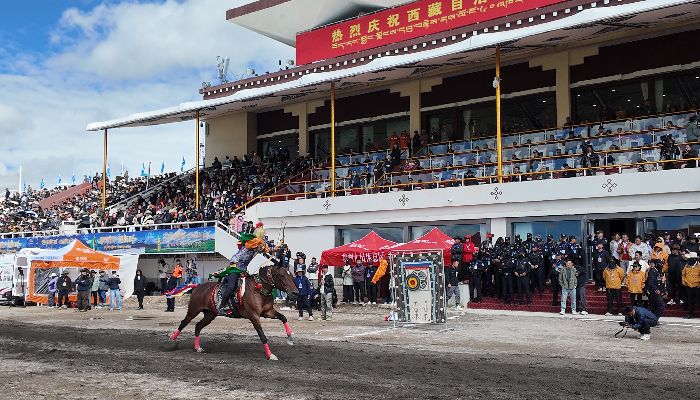
Naqu Qiaqing Horse Racing Festival
Transportation to Horse Racing Festival Venues
To enjoy horse racing festivals, you first need to enter Tibet. Tourists departing from abroad usually fly to major cities in China first, then transfer to planes or trains to enter Tibet.
Long-Distance Transportation (International and Domestic Sections):
- Departing from abroad: Fly to cities such as Beijing, Shanghai, Chengdu, Chongqing and Xi’an first. Chengdu and Chongqing are the most commonly used transfer points to enter Tibet, with numerous flights and sufficient tickets. Then fly to Lhasa from these cities. It is recommended to book air tickets more than one month in advance during the peak season.
- Arriving in Lhasa by plane: The flight from Chengdu to Lhasa takes about two hours, Chongqing about two and a half hours, and Xi’an about three hours. Lhasa Gonggar Airport is about one hour’s drive from the urban area, with shuttle buses and taxis available.
- Entering Tibet by train: Take the Qinghai-Tibet Railway from Xining, passing through Hoh Xil and Tanggula Mountains with spectacular scenery along the way. The train is equipped with an oxygen supply system, which helps to adapt to the high altitude. However, train tickets are very tight during the peak season and need to be booked as early as possible.
After arriving in Lhasa, the main ways to go to the horse racing festival venues are as follows:
- Charter a car or join group tours: This is the most worry-free and labor-saving way. Charter an off-road vehicle or business car from Lhasa to Naqu or Damxung, which takes four to six hours with good road conditions. Arranged by travel agencies, drivers are familiar with the routes, and you can enjoy landscapes such as Nyainqentanglha Mountains and Nam Co along the way. There are shuttle buses from Naqu County to the horse racing track at low fares.
- Take regular buses: There are regular buses from Lhasa to Naqu and Damxung with affordable fares, but limited shifts. You need to find another vehicle to the horse racing track after arriving locally.
- Self-driving: If you are confident in your plateau adaptability and driving skills, self-driving is also an option. However, note that altitude sickness will affect reaction speed and judgment, and avoid fatigued driving.
Accommodation Options and Booking Tips During Horse Racing Festivals
Accommodation is the main problem for tourists during horse racing festivals. Especially in small towns such as Naqu and Damxung, hotel beds are originally limited and even more scarce during the festivals.
Accommodation Options:
- Urban Naqu: There are hotels and guesthouses available. It is recommended to stay near the horse racing track. For example, Naqu Yuanfeng Hotel is about 300 meters away from Qiangtang Horse Racing Track with convenient transportation; Siji Oxygen-Enriched Hotel is close to the horse racing track with a comfortable environment. Prices rise significantly during the festival, so booking more than one month in advance is recommended.
- Damxung County: There are fewer accommodation options than Naqu, but it is closer to Lhasa. If you cannot book a room in Damxung, you can stay in Lhasa and make a day trip. Damxung Horse Racing Track Resort Hotel is about 3 kilometers away from the gate of Nam Co Scenic Area, providing ethnic song and dance performances and equestrian race viewing services.
- Herdsmen’s Tents: Herdsmen set up tents on the grassland during horse racing festivals, some of which provide accommodation for tourists. This is a special experience, but the conditions are relatively simple, and you need to prepare for warmth and washing by yourself. It is cold at night in Naqu, so you need to bring sufficient cold-proof clothes. If you want to try this, it is best to contact and arrange through China Dragon Travel in advance.
Main Attractions and Key Highlights of Horse Racing Festivals
Horse racing festivals are rich in activities, not limited to horse racing itself. Here are the main attractions:
- Speed Horse Racing: Dozens of horses rush out of the starting line at the same time with thunderous hoofbeats. Naqu Horse Racing Festival has 12,000-meter trotting race, 10,000-meter on-site speed race, traditional gallop and other events of different distances. The races are divided into three groups according to horse height: below 138 cm, 138-145 cm, and above 145 cm, as well as a group for foals under 4 years old. The whole audience cheers when the horses cross the finish line, and the champion rider circles the field to receive congratulations. The highest individual prize is 150,000 CNY, and the champion rider can get 20,000 CNY.
- Equestrian Performances: The most wonderful one is “picking up hada on horseback”— riders bend down to pick up hada on the ground while galloping, as well as difficult moves such as archery on horseback, dancing on horseback, standing upright without hands, and 180-degree rotation. Riders perform riding skills mainly based on experience by adjusting reins and stirrups slightly. These performances test the riders’ courage and skills.
- Traditional Costumes and Horse Decorations: Riders wear satin Tibetan robes, wear Tibetan knives at the waist and leather boots on feet. Horses are decorated with silver ornaments, manes are braided, and tails are tied with colored ribbons, forming a costume display on the grassland.
- Tent City and Market: Tents temporarily built on the grassland sell butter tea, yak meat, yogurt, tsampa, as well as souvenirs such as Tibetan carpets and Tibetan incense. Naqu Horse Racing Festival has a cultural experience area, where tourists can try traditional games in black tents, grind tsampa and make butter tea by themselves, even ride horses and listen to the recitation of the Gesar Epic.
- Cultural Performances and Guozhuang Dance: The opening ceremony cultural performance focuses on horse culture, divided into three chapters, integrating traditional horse racing performances with cultural performances. There are often Guozhuang dances at night, where local residents dance in circles, and tourists can join in.
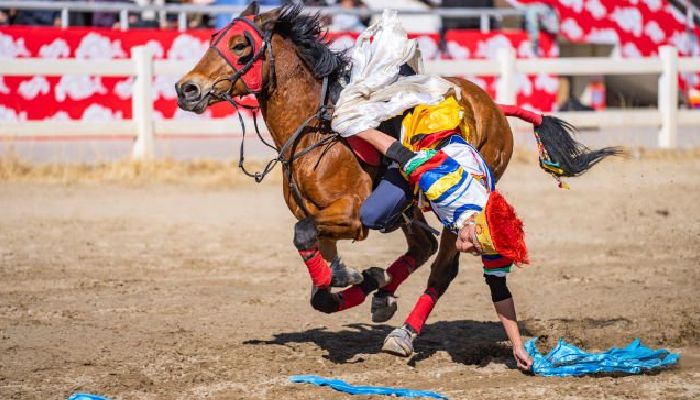
Tibetan Rider Picking Up Hada on Horseback
How to Find a Good Viewing Spot at Horse Racing Festivals
The horse racing festival site is crowded with spectators. Master the following methods to find a good viewing spot:
- Arrive Early to Survey the Venue: Many riders walk their horses and adapt to the track at the venue one day before the official opening. You can go to the site to check which sections of the track have many curves and which have long straight tracks. Riders slow down near curves, making it easy to observe the movements of riders and horses; the straight sprint section is the most exciting but also the most crowded with spectators.
- Occupy a High Position: Grassland horse racing tracks usually have no fixed stands, and spectators stand on the grass or soil slopes. Choosing a slightly high slope provides a much better view than flat ground. The rostrum has the best position, but you need a press card to enter. You can choose the sides of the rostrum for shooting angles instead.
- Avoid the Starting and Finishing Areas: Horses gather and dust flies at the start, making it hard to see clearly. The finishing area is crowded with spectators competing to watch who crosses the line first. Choose the straight section in the middle and rear, where you can observe the riders’ horse control skills without being too crowded.
- Follow Local Herdsmen: Local herdsmen attend the horse racing festival every year and know the best viewing angles. Following areas where many herdsmen gather is usually a good choice.
Photography Tips for Enjoying Horse Racing Festivals
If you want to take high-quality photos at the horse racing festival, the following tips are for reference:
- Set a Fast Enough Shutter Speed: Use at least 1/250s shutter for ordinary shooting. For fast-running horses, 1/500s or even 1/1000s shutter is recommended. A slow shutter speed will cause blurry images of horse legs and riders.
- Use Continuous Shooting Mode: For predictable movement tracks, focus in advance and wait for the best shooting moment, then use continuous shooting mode to capture wonderful moments.
- Pay Attention to Composition and Blank Space: Leave some space in front of and behind the horse when shooting horse racing scenes, especially more space in front of the horse’s head to avoid the horse’s head touching the edge of the photo.
- Use a Telephoto Lens with a Monopod: A telephoto lens can zoom in on distant riders, but it is easy to blur when held by hand. A monopod is more flexible and portable than a tripod, and can be attached to the camera all the time for fixed shooting on the ground.
- Shoot Human Subjects: There are many local residents in bright clothes among the spectators, and capturing festive costumes is also an important humanistic photography subject. The smiling faces of local people and well-dressed herdsmen are good shooting targets.
Preparations Before Enjoying Horse Racing Festivals
- Check the Date and Reserve Flexible Time: The specific dates of horse racing festivals may be temporarily adjusted due to weather or official arrangements. It is recommended to reserve one to two days of flexible time to avoid a too tight itinerary.
- Book Accommodation in Advance: Accommodation in Naqu and Damxung is very tight during horse racing festivals, and prices may double. It is best to book rooms more than one month in advance.
- Bring Warmth and Sun Protection Equipment: The grassland has a large temperature difference between day and night, with strong sunlight during the day and cold nights requiring a thin down jacket. Hats, sunglasses and sunscreen are essential items. It is recommended to bring a scarf or face towel for wind and dust protection. The horse racing track is dusty, and dust raised by running horses may cause coughing; wearing a mask can improve comfort.
- Prepare a Cushion or Folding Chair: Horse racing festival activities last for most of the day, and sitting directly on the grass will feel damp and cold after a long time. Carrying a moisture-proof pad or small folding chair can improve comfort.
- Carry Cash: Mobile phone signals are sometimes unstable on the grassland, and many snack and souvenir stalls only accept cash. It is recommended to exchange hundreds of yuan in change for buying drinks, roasted yak meat, etc.
- Prepare Common Medicines and Supplies: Bring glucose water, painkillers and carsickness medicine. Naqu has a high altitude and dry air, so it is important to replenish water frequently.
Complete Action Guide for Enjoying Horse Racing Festivals
It is not complicated to enjoy horse racing festivals during travel in Tibet. You can watch smoothly by mastering the right time, choosing suitable locations, and making good physical and equipment preparations. Tourists should check the specific dates of horse racing festivals in advance, book transportation and accommodation, bring warm and sun protection supplies and cash, and pay attention to altitude sickness and local customs. During the horse racing festivals, in addition to watching speed horse racing and equestrian performances, you can also grind tsampa and make butter tea by yourself in the cultural experience area, and join the Guozhuang dance party with local residents at night. These real grassland festival experiences cannot be replaced by watching videos. If you cannot catch up with the large-scale horse racing festivals due to itinerary restrictions, you can also try to find small-scale herdsmen horse racing activities, which can also feel the charm of grassland horseback culture. Plan your itinerary in advance and prepare all items in an orderly manner, and your trip to Tibet horse racing festivals will become an unforgettable experience in your journey.