

When people think of Yunnan, Lijiang and Dali often come to mind first. However, the true transportation hub and cultural heart of the province is Kunming. With a clear Kunming map in hand, you will discover that this “Spring City” is not only blessed with mild weather all year round, but also serves as a gateway where nature, ethnic culture, history, and modern urban life seamlessly converge.
This travel guide uses the Kunming map as its main narrative thread, leading you from the city center to lakes, stone forests, ancient towns, and highland frontiers—ensuring every journey is well-planned, intuitive, and effortless.
Understanding Kunming’s Urban Layout Through the Map
Kunming, a plateau city in Yunnan Province, is renowned for its year-round spring-like climate and is affectionately known as the “Spring City.” With an average altitude of 1891 meters, Kunming’s urban layout is radial. As a major tourism hub in Southwest China, Kunming’s urban structure is centered around the Wuhua, Panlong, Guandu, Xishan, and Chenggong districts. The old city, concentrated in Wuhua and Panlong, is the most historically and culturally mature area, while Chenggong New District is a rapidly developing new city, home to many administrative institutions and universities.
From the map, you can clearly see Kunming bordered by Dianchi Lake to the south, connected to the Stone Forest to the east, linked to the Western Hills and Longmen Grottoes to the west, and serving as a gateway to Dongchuan Red Land and Zhaotong to the north. This geographic layout makes Kunming the ideal base for planning in-depth Yunnan travel.
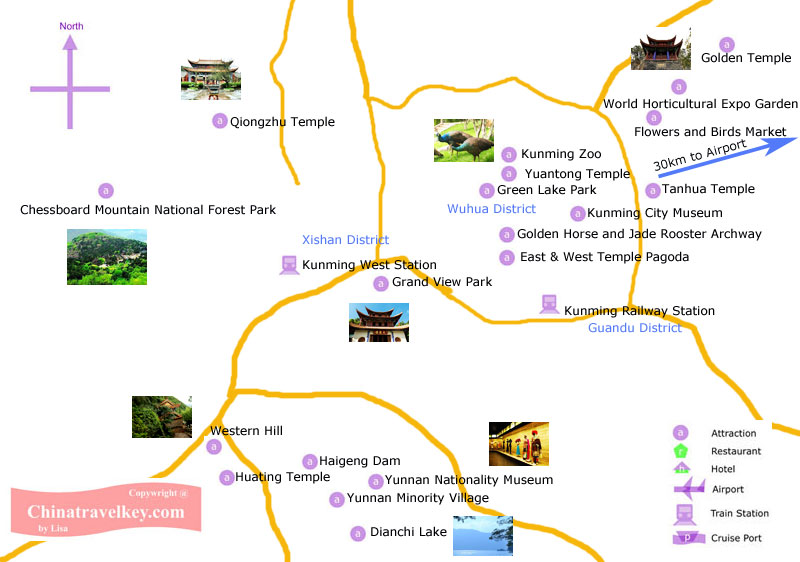
Kunming Tourism Map
Must-Visit City Attractions on the Kunming Map
Green Lake Park — The City’s Green Lung on the Map
On the Kunming map, Green Lake Park lies just north of the city center, like a tranquil oasis gently embraced by the surrounding urban landscape. It is an ideal place to begin a journey through Kunming, offering travelers a chance to ease into the city’s unhurried rhythm and experience the essence of the “Spring City.”
In the early morning, a light mist lingers over the water as gentle ripples reflect willow trees and nearby white walls with gray-tiled roofs. Along the lakeside paths, local residents practice tai chi, sword dancing, or take leisurely walks, their movements calm and measured. Birdsong and soft music drift through the air, awakening the park in the tender glow of the morning light.
By afternoon, the sky above Green Lake turns a brilliant blue, and sunlight dances across the lake’s surface, shifting in shades from emerald green to deep sapphire. Small islands and zigzag bridges punctuate the water, while visitors stroll at an unhurried pace, their reflections shimmering gently below. Sitting on a lakeside bench and watching clouds drift overhead captures one of Kunming’s most iconic moments of slow, contemplative living.
During winter, flocks of red-billed gulls migrate from Siberia, filling the lake and sky with lively motion. As the birds swoop gracefully above the water, laughter and camera shutters echo along the shore, creating one of Kunming’s most beloved and vibrant seasonal scenes.
Surrounding Green Lake are several important cultural landmarks seamlessly woven into the landscape. Yunnan University features towering old trees and elegant red-brick buildings; the Military Academy Museum reflects the weight of modern Chinese history; and Yuantong Temple offers a serene Buddhist presence amid the city’s bustle. Linking these sites on foot allows travelers to experience Kunming’s natural beauty, academic heritage, historical depth, and spiritual atmosphere within just a few hours.
For first-time visitors, Green Lake Park is more than just a city park—it is a gateway to understanding Kunming’s pace of life. By slowing down and wandering along the lakeshore, the city’s warmth and character gradually reveal themselves, setting the tone for a memorable journey through Yunnan.
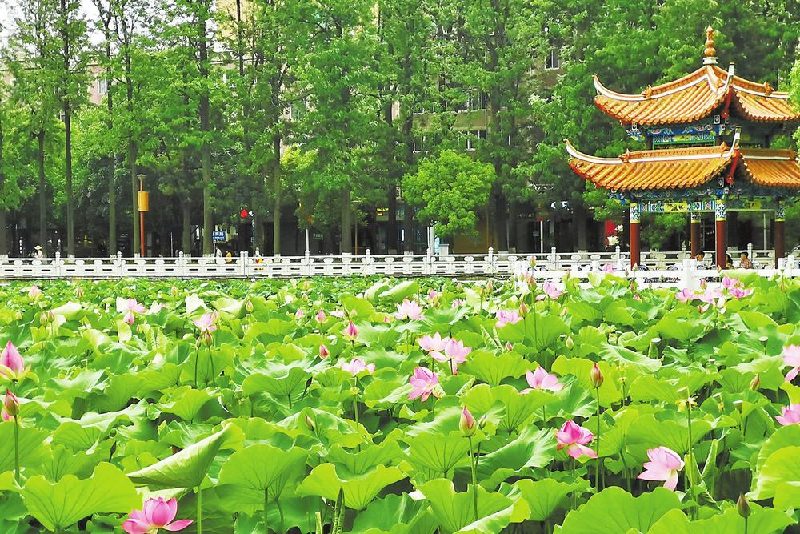
Green Lake Park
Kunming Old Street — Tracing History on the Map
Following the Kunming map southward, you will arrive at the Kunming Old Street district. The streets are paved with weathered cobblestones, each step echoing faintly as if recounting centuries of city history. Flanking the streets, century-old residences with gray-tiled roofs, whitewashed walls, intricately carved windows, and wooden doorways preserve the architectural style of the Ming and Qing dynasties. The contrast between historic charm and modern life gives the area a subtle, timeless appeal.
Around the corners and along narrow alleys, boutique cafés, artisan dessert shops, and small bookstores appear in harmony with the historic surroundings. The aroma of freshly brewed coffee mingles with the scent of aged wood, creating a leisurely atmosphere that invites visitors to slow down and soak in Kunming’s unique pace of life. Occasionally, street musicians provide soft background music, while artisans display handmade crafts, blending the old street’s historic aura with contemporary culture.
By marking the Old Street area on your map, you can easily connect Nanping Street, Jinma Biji Square, and the Shuncheng commercial district. Nanping Street is a hub of traditional snacks and local souvenirs, featuring specialties like Yunnan rice noodles and steamed pot chicken. Jinma Biji Square, a historic cultural landmark, retains ancient gate towers and intricate carvings, standing as a testament to the city’s evolution. The Shuncheng commercial district, meanwhile, combines modern shopping, dining, and leisure, offering a vibrant cultural experience.
The Old Street area seamlessly blends history, culture, and daily life, making it an ideal spot for travelers to explore architectural heritage, immerse in local culture, and savor authentic cuisine. Whether strolling along the cobblestones in the morning light or enjoying tea in a small café at sunset, visitors can experience the leisurely rhythm and distinctive charm that define Kunming.

Kunming Old Street
Dianchi Lake — The Blue Heart of the Yunnan Plateau
Viewed on the Kunming map, Dianchi Lake stretches like a vast mirror quietly embedded in the southern part of the city. Its surface changes color with the seasons and weather—emerald green under the morning mist, reflecting the blue sky and distant Western Hills in the afternoon. As a natural symbol of Kunming, Dianchi Lake not only carries the city’s history and culture but also serves as a key site for understanding the highland climate and observing wetland ecosystems and waterfowl.
Haigeng Dam is one of the best spots to enjoy panoramic views of the lake. Walking along its broad embankment, visitors are greeted with an endless expanse of water, occasionally interrupted by the slow passage of fishing boats creating sparkling ripples. In winter, flocks of red-billed gulls migrate from the north, filling the sky and lake with lively movement—an iconic scene for photography enthusiasts. At sunrise or sunset, golden sunlight reflects off the water while the reeds along the shore sway gently, creating a dynamic watercolor-like landscape.
Dianchi Lake Wetland Park offers an even closer experience with nature. Along its designated walking paths and cycling trails, visitors can observe waterbirds, reeds, and native plants up close, experiencing the rich biodiversity of this highland lake. Observation decks and interpretive signs provide educational insights into wetland conservation and ecological significance. Whether cycling or strolling along the lakeshore, the breeze, mountains, water, and sky merge, delivering a sense of relaxation and serenity.
Dianchi Lake is more than a scenic spot—it is the soul of the city. From misty mornings filled with birdsong to sunsets casting golden reflections across the water, the lake’s vastness and tranquility exemplify Kunming’s unique charm as the “Spring City.” By planning your route using the Kunming map, travelers can choose to walk or cycle along the lakeshore and fully savor every moment beside this highland mirror.

Dianchi Lake
Western Hills and Longmen — The Highest Viewpoint on the Map
On the western side of Dianchi Lake lies the West Hills Scenic Area, clearly marked on the Kunming map as a commanding high point south of the city. With its undulating terrain and overlapping ridges, it offers the perfect vantage to take in panoramic views of Kunming and the lake below. Famous for its stone peaks, lush forests, and ancient temples, the West Hills have long been a destination for travelers seeking both scenic beauty and spiritual refreshment.
Visitors can take a cable car to reach the mid-mountain or summit, with the view gradually expanding along the way. Dianchi Lake appears like a vast emerald mirror, its surface reflecting the distant mountains and the city along the shoreline, forming a picturesque panorama. Hiking along the winding stone paths through pine and cedar forests, one can enjoy the crisp highland air and birdsong, creating a sense of tranquility and rejuvenation. From different vantage points, the lake reveals new perspectives: small islands at its center, the Haigeng Dam, city buildings along the shore, and the contours of distant mountains—layers of scenery that unfold in breathtaking clarity.
The Longmen (Dragon Gate) viewpoint is the centerpiece of the West Hills. From the stone carvings at Longmen, the valleys stretch down to Dianchi Lake, the water glistening under the sun while clouds drift across the lake and mountains, forming a dynamic natural painting. In spring and summer, blooming flowers and fresh greenery adorn the forested slopes; in autumn, golden foliage complements the sparkling lake; in winter, distant mountains emerge faintly through mist, and the lake takes on a serene, deep-blue hue.
The West Hills are not only a concentration of natural beauty but also the best platform to appreciate the interaction between Kunming’s urban landscape and its highland lake. Whether at sunrise, during a leisurely afternoon walk, or at sunset, standing at West Hills Longmen and overlooking Dianchi Lake is one of the quintessential experiences of a Kunming journey.

Western Hills and Longmen
Extended Route from the Kunming Map
Stone Forest — A World Natural Wonder
Located approximately 80 kilometers east of Kunming on the map, the Stone Forest Scenic Area rises like a kingdom of stone shaped by time itself, quietly standing on the Yunnan Plateau. As you leave the city behind, open plains and rolling hills gradually replace urban scenery, and the silhouettes of the stone pillars begin to emerge in the distance, resembling a vast forest carved entirely from rock.
Formed from ancient limestone once submerged beneath the sea, this karst landscape features countless stone peaks of varying heights and forms. Some rise sharply like blades piercing the sky, while others resemble animals frozen mid-stride. Walking among them, light and shadow weave through narrow corridors and open spaces, creating a sense of constant surprise. Without a clear internal map, it is easy to miss many of the area’s most iconic formations.
It is highly recommended to plan your route in advance using the site map, incorporating the grand Major Stone Forest, the gentler Minor Stone Forest, and the nearby Ethnic Cultural Village into one cohesive visit. More than a visual spectacle, the Stone Forest is deeply rooted in Yi ethnic culture, serving as both a homeland and a spiritual landscape. Only through the combined use of maps and guided interpretation can visitors fully appreciate the cultural meaning behind these dramatic stone formations.
Ethnic Villages and Cultural Experiences
Along the shores of Dianchi Lake, the Kunming map highlights another key cultural destination—the Yunnan Ethnic Village. Set against shimmering waters and softened by lake breezes, this open-air cultural park offers a condensed yet vivid portrait of Yunnan’s remarkable ethnic diversity.
The village is thoughtfully arranged according to terrain, with traditional settlements scattered across gentle slopes. Dai stilt houses stand beneath open skies, Bai courtyards appear clean-lined and harmonious, while Yi and Naxi structures reflect the rugged character of mountain life. Brightly colored traditional costumes, rhythmic music, and demonstrations of traditional crafts bring the village to life, creating an immersive cultural atmosphere.
For travelers seeking a comprehensive understanding of Yunnan’s many ethnic groups within a limited time frame, the Ethnic Village is an ideal choice. With careful route planning on the Kunming map, it can be seamlessly combined with Dianchi Lake and the Western Hills, forming a well-rounded one-day itinerary that blends natural scenery with cultural discovery.
Kunming Specialty Food Discovery
On a journey, maps do more than guide the way—they also lead to the flavors of a city. Kunming’s culinary landscape, much like the city itself, is hidden within street corners, local markets, and ancient towns. Using the Kunming map to mark food districts allows travelers to explore the city’s gastronomy with clarity and purpose.
- The Nanping Street and Zhengyi Square area forms the vibrant heart of downtown Kunming. Steam rises from busy eateries, where Crossing-the-Bridge Rice Noodles are served with crystal-clear broth layered with depth and aroma, while Steamed Pot Chicken slowly releases its rich fragrance through gentle heat, reflecting the subtle and refined nature of Yunnan cuisine.
- Zhuanxin Farmers’ Market offers the most authentic glimpse into everyday Kunming life. In the early morning, voices and vendor calls mingle as stalls overflow with fresh produce, wild mushrooms, and rice-based snacks. The flavors here are bold and honest, shaped by Yunnan’s diverse terrain and climate.
- At Guandu Ancient Town, narrow lanes and preserved old residences create a sense of timelessness. The air carries hints of firewood and simmering sauces, while traditional Yunnan dishes are prepared with patience and care. Less commercial and more rooted in daily life, Guandu rewards slow exploration, where a simple turn down a side street may lead to the most memorable meal of the journey.
Practical Kunming Map Guide: Transportation and Accommodation
Transportation
The Kunming map shows a metro system covering major urban areas and the airport, making it highly convenient for independent travelers. For trips to Stone Forest, Dongchuan, or nearby prefectures, private transfers or local tours are recommended to save time and energy.
Accommodation Suggestions
- City Center (Wuhua & Panlong): Ideal for first-time visitors and short stays
- Dianchi Lake Area: Best for leisure and vacation-oriented travelers
- Chenggong New District: Suitable for transfers or longer stays
Recommended 8-Day Yunnan In-Depth Itinerary: Kunming – Dali – Lijiang – Shangri-La
- Day 1: Arrive in Kunming. Begin your journey at the Golden Temple on Mingfeng Mountain, a famous Taoist complex cast entirely in bronze. Later, stroll through Bibo Park, known as “Kunming’s Jade.” Nearby, enjoy Yunnan cuisine at the historic Jade Pavilion Restaurant, a Ming-dynasty landmark.
- Day 2: Visit Zhuanxin Farmers’ Market, the largest market in Kunming and Yunnan, where locals shop daily for fresh produce, meat, seafood, and fruits. Then travel to the Stone Forest, a stunning example of China’s karst landscape.
- Day 3: Explore Dali’s Bai ethnic villages and ancient city. Walk along stone-paved streets, admire traditional residences, and visit the Three Pagodas. Later, enjoy cycling along the Erhai Ecological Corridor near Longkan Pier.
- Day 4: Visit Xizhou Bai Courtyard, experience traditional tie-dye craftsmanship, then travel to Lijiang and explore Lijiang Old Town, especially beautiful at night under glowing red lanterns.
- Day 5: Visit Baisha Ancient Town, once the Naxi capital. Experience Naxi family life and admire well-preserved murals blending Naxi, Han, and Tibetan styles.
- Day 6: Travel to Shangri-La, visiting the First Bend of the Yangtze River, Shigu Town, and Tiger Leaping Gorge.
- Day 7: Explore Songzanlin Monastery, the largest Tibetan Buddhist monastery in Yunnan, often called the “Little Potala Palace.” Continue to Pudacuo National Park, home to forests, grasslands, lakes, and wildlife.
- Day 8: Depart from Shangri-La.
Detailed itinerary reference:
https://www.chinadragontravel.com/tour/8-days-yunnan-tour-kunming-dali-lijiang-and-shangri-la/
Following the Kunming Map into a Deeper Yunnan Journey
Kunming has never been just a transit city—it is a city worth reading carefully, like a living map. When you truly unfold the Kunming map, every road, lake, and district leads to a different layer of scenery and story. Whether this is your first visit to Yunnan or the start of a highland adventure, Kunming remains the most reliable and welcoming beginning.
If you wish to transform routes on the Kunming map into smooth, immersive, and high-quality travel experiences, China Dragon Travel offers expert support. From Kunming city tours and Dianchi–Western Hills routes to Stone Forest, ethnic culture, and multi-destination Yunnan itineraries, China Dragon Travel designs tailor-made journeys based on deep local knowledge.
Let maps become more than navigation—let them be keys to unforgettable landscapes.Travel with China Dragon Travel, and start from Kunming to discover the true essence of Yunnan.