

Is the Stone Forest in Kunming worth visiting, and how do you plan your trip efficiently? These are some of the most common questions travelers ask before visiting Stone Forest Scenic Area. Famous for its dramatic limestone formations shaped over 270 million years, this UNESCO World Heritage Site is far more than just a geological wonder. It’s a place where surreal landscapes meet the living traditions of the Sani people. Without proper planning, however, it’s easy to miss the best viewpoints or waste valuable time.
Preparation for the Kunming Stone Forest
Proper preparation is key to a comfortable and hassle-free visit. The Stone Forest is vast, with intense sunlight and complex terrain. Located on the Yunnan Plateau, it requires thoughtful planning to enhance your experience.
- Essential Documents: Your passport is your most important legal ID for traveling to the Stone Forest. Make sure it is valid for at least six months and carry the original with you at all times. You will need it for ticket purchases, shuttle bus rides, hotel check-ins, and roadside checks. Take a photo of your passport information page and keep one or two photocopies in separate places as a backup.
- Ticket Booking: Entrance tickets cost 130 RMB, and the shuttle bus within the scenic area costs 25 RMB. It is highly recommended to book your tickets in advance through the official Stone Forest WeChat public account or other major travel platforms. During peak season, tickets sell out quickly—book at least one week ahead. After booking, you can enter directly using the QR code, with no need to exchange for a paper ticket.
- Sun Protection: UV intensity in Yunnan is much higher than in lowland cities. Use a sunscreen with SPF 50+ and PA++++, applying it to your face, neck, arms, and ankles before you head out, and reapply every two to three hours. A lip balm with SPF, sunglasses, and a sun-protective face covering are also essential.
- Medications: Carry personal medications, including remedies for stomach issues, colds, pain, and motion sickness. If you’ve traveled a long distance by air, jet lag and fatigue may affect your condition—allow extra time to rest and adjust.
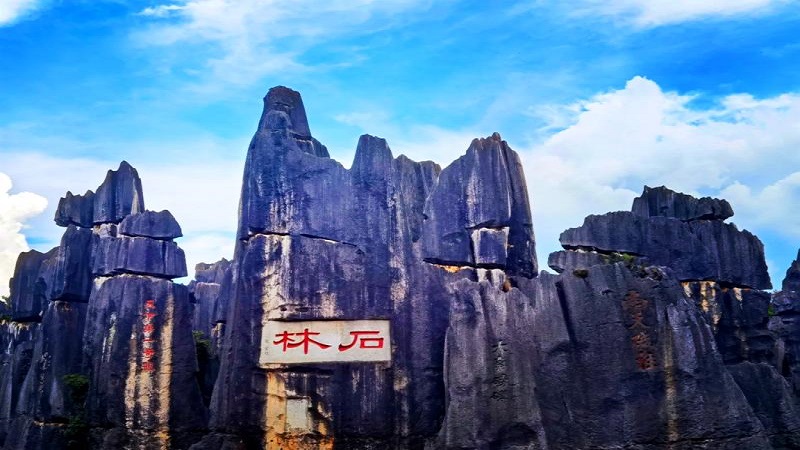
Kunming Stone Forest
Transportation to the Kunming Stone Forest
Getting to the Stone Forest from Kunming is very convenient. You can choose from high-speed rail, long-distance bus, self-driving, or private car hire based on your needs.
- High-Speed Rail: Take a train from Kunming South Station to Shilin West Station. The journey takes only 18–20 minutes and costs about 18 RMB. Kunming South Station is located in Chenggong District and can be reached via Metro Line 1 from downtown. Upon arrival at Shilin West Station, take Bus No. 99 (10 RMB, 50 minutes) or a taxi (40–50 RMB, 30 minutes) to the Stone Forest Visitor Center.
- Long-Distance Bus: From downtown Kunming, you can take a direct tourist bus to the Stone Forest from Kunming East Bus Station. Buses run every 30 minutes, the trip takes about 1.5 hours, and the fare is 25–35 RMB. The bus drops you off directly at the visitor center with no need for transfers.
- Self-Driving: If you prefer to drive, take the Kunshi Expressway (G78) from Kunming to the Stone Forest. The drive is about 90 kilometers and takes around 1.5 hours. Set your GPS to “Stone Forest Visitor Center.” The site has a large parking lot with a fee of about 10 RMB per day.
- Private Car Hire: You can also book a private car through various platforms. Prices range from 400 to 600 RMB per day for a 5-seat sedan or 7-seat van. Drivers are familiar with the route and can adjust departure and return times according to your needs.
Consider the size of your group, how much luggage you have, and your time and budget when choosing the best transportation option for you.
Best Travel Seasons for the Kunming Stone Forest
Located on the Yunnan Plateau, the Stone Forest enjoys a mild climate year-round and can be visited in any season. However, each season offers a distinctly different landscape, and choosing the right time can greatly enhance your travel experience.
- Spring (March to May): Spring is the most pleasant time of year to visit. Visitor numbers are moderate—neither too crowded nor too quiet. Average daily temperatures range from 15 to 25°C, rainfall is low, and sunlight is ample without being scorching.
- Summer (June to August): Summer is the peak travel season. Afternoon showers or thunderstorms are common, with rainfall accounting for about 60% of the annual total. The sun is strong, and UV levels are extremely high. Average temperatures range from 18 to 28°C. Wear light, breathable clothing, bring rain gear, and prepare insect repellent. Since it’s peak season, book tickets in advance and enter the park early.
- Autumn (September to November): Autumn is the golden season for visiting. The weather is stable, with the best air clarity and visibility of the year. Average temperatures range from 12 to 22°C, making it very comfortable. The rainy season has ended, and sunny days prevail. Visitor numbers drop, making for a more relaxed experience. Bring an extra layer for cooler mornings and evenings.
- Winter (December to February): Winter is the low season, with the fewest visitors and a quiet, peaceful atmosphere. Average daytime temperatures range from 5 to 18°C, with warm sunshine during the day and a noticeable drop at night. The air is dry. Wear a down jacket or heavy coat, along with a sweater, thermal underwear, hat, scarf, and gloves.
Each season has its own charm. Whenever you visit, this ancient stone forest, shaped over 270 million years, will greet you with quiet majesty.
Must-Visit Attractions in the Stone Forest
Main Scenic Areas
The main scenic areas consist of five sections: Greater Stone Forest, Lesser Stone Forest, Bushao Mountain, Liziyuanqing, and Wannian Lingzhi. This is the core of the UNESCO World Heritage site. You should stay 4 to 5 hours to explore it fully.
- Greater Stone Forest: The most spectacular and majestic section, with towering stone pillars reaching over 40 meters in height. Key highlights include Jianfeng Pond, Wangfeng Pavilion, Lianhua Peak, Stone Forest Scenic Spot, and Qianjun Yifa (a massive stone wedged between two cliffs).
- Lesser Stone Forest: In contrast to the rugged Greater Stone Forest, this area is gentler and more serene. The main attraction is the Ashima Stone, said to be the petrified form of a legendary Sani girl. It is the most culturally significant feature of the Stone Forest. This is also where Yi ethnic song and dance performances take place.
- Liziyuanqing: Located northeast of the Greater Stone Forest, this area is covered with strange rock formations across barren hills. Cliff faces feature ancient rock paintings left by the Yi people. It is also the area with the most stone inscriptions, preserving 31 carvings from the Ming and Qing dynasties to modern times.
- Wannian Lingzhi (Ten-Thousand-Year Ganoderma): Located near Liziyuanqing, this site features a 15-meter-tall rock pillar beside Bimu Pond. Shaped like a giant mushroom, it resembles a mythical “lingzhi” of immortality.
Surrounding Attractions
If you have extra time, consider spending another day or two exploring the surrounding areas for a richer experience.
- Naigu Stone Forest: Located about 8–10 km north of the main Stone Forest, covering about 10 km². The stone pillars here are dark gray. Highlights include the Stone Forest landscape, Baiyun Lake, Shifeng Mountain, and Yougu Waterfall. Allow at least 2 hours.
- Changhu Scenic Area (Long Lake): Located about 25 km north of the main Stone Forest in Weize Village, Changhu Town. The 3.94 km² area features a beautiful lakeside landscape and karst formations. Key sights include Dushi Mountain, Dajian Mountain, Penglai Island, and Yuan Lake.
- Dadieshui Waterfall: Located southwest of Shilin County seat, Dadieshui Waterfall has a drop of 87.8 meters—higher than Huangguoshu Waterfall. The area also includes Xiaodieshui, Xianren Cave, Baige Garden, Banyuan Garden, and Qingshui River. Due to the heavy mist from the falls, bring a waterproof camera or phone pouch.
- Guishan National Forest Park: Located within Shilin County, Guishan Mountain reaches 2,601 meters and spans 14 km north–south and 10 km east–west, covering 3,206 hectares. It is one of the most famous karst landscapes in the world and also an important site for “red tourism.”
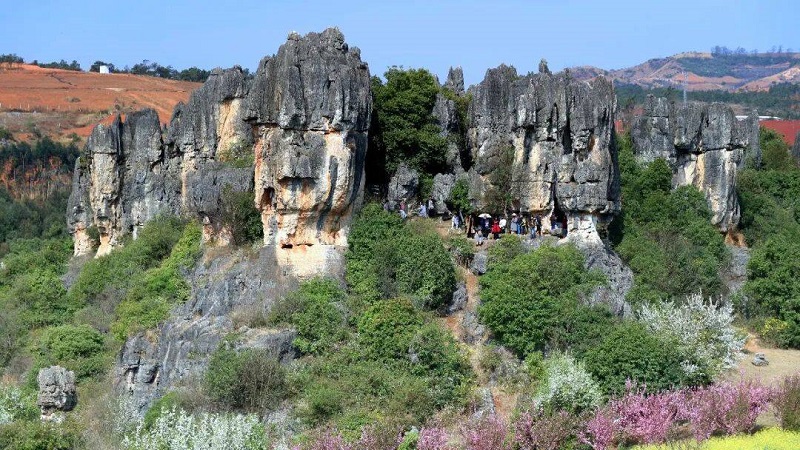
The Most Beautiful Flower Paths in Naigu Stone Forest
Tips for Visiting the Stone Forest
- Safety and Health: The scenic area features many stone steps, slopes, and narrow crevices. Some stone surfaces are quite smooth and become especially slippery after rain. Walk slowly, hold onto handrails, and never climb on the stone pillars or jump over guardrails. During hot summer hours, take precautions against heatstroke and carry drinking water with you. The Stone Forest sits at an elevation of approximately 1,700 to 1,900 meters. Altitude sickness is generally not a concern, but you may experience slight shortness of breath after strenuous activity, so know your limits.
- Weather Preparedness: Weather in the Stone Forest area can change quickly. Even if the sun is shining when you set out, afternoon showers may arrive unexpectedly. It is advisable to carry a lightweight raincoat instead of an umbrella—the narrow crevices and strong winds in the scenic area make using an umbrella difficult, while a raincoat is far more practical. Mosquitoes are more active in summer, so wearing light-colored long pants and applying insect repellent is recommended. Avoid staying too long near grassy areas.
- Rest Breaks: Several rest areas and small shops are located throughout the scenic area, primarily near the entrance to the Greater Stone Forest, the exit of the Lesser Stone Forest, and Wangfeng Pavilion. These shops offer basic snacks, drinks, and boxed meals, but the selection is limited and prices are relatively high. It is a good idea to bring your own light snacks. Drinking water dispensers are available for free refills, though they are not numerous, so carrying a thermos with you is recommended.
- Time Management: Peak crowds at the Stone Forest usually gather between 9:30 a.m. and 2:30 p.m. If you cannot enter before 8:00 a.m., consider arriving after 2:00 p.m. instead. By that time, most of the morning tour groups have left, the light becomes softer and more favorable for photography, and the temperature is more comfortable.
What’s the Smartest Way to Explore the Stone Forest?
The Stone Forest is not just about seeing unusual rocks—it’s about experiencing a landscape that feels almost otherworldly. Walking through the towering limestone pillars, you’ll notice how the scenery constantly shifts depending on the light, the weather, and even the path you choose. Some areas feel grand and overwhelming, while others are quiet and almost maze-like, inviting you to slow down and explore.
To truly appreciate this place, timing and planning make all the difference. Arriving at the right hour, choosing the right route, and knowing where to spend more time can transform your visit from a quick stop into a memorable experience. With a thoughtful approach, the Stone Forest becomes more than a sightseeing spot—it turns into one of the most unique highlights of your entire Yunnan journey.