
If you’re planning to take the train from Lanzhou to Lhasa, the journey itself is a unique experience. Traveling along the Qinghai-Tibet Railway, you can witness the scenery outside the window change from loess hills to snow-capped mountains and grasslands in just one day, while your body gradually adapts to the plateau environment as the altitude rises gently. To help you embark on this journey smoothly, we’ve compiled the latest train schedules, ticketing methods, carriage facility details, scenic spots along the way, and a practical packing list. This guide will assist you in making all preparations in advance.
Lanzhou to Lhasa Train Schedules Reference
Trains from Lanzhou to Lhasa are mainly originating from cities like Chongqing, Beijing, Guangzhou, and Shanghai, with a stop at Lanzhou Station for passenger boarding. Knowing the specific train services and schedules is the first step in planning your trip.
Reference Schedules:
| Train Number | Departure Time from Lanzhou | Arrival Time in Lhasa | Total Travel Time |
| Z223 | 08:40 AM | 07:41 AM | next day About 23 hours |
| Z21 | 12:31 PM | 11:42 AM | next day About 23 hours |
| Z265 | 03:32 PM | 02:54 PM | next day About 23 hours |
| Z165 | 04:36 PM | 03:30 PM | next day About 23 hours |
| Z917 | 12:17 PM | 12:30 PM | next day About 24 hours |
How to Query & Select Train Services:
Please note that the information in the table above is subject to change due to adjustments in the railway operation map. For the most accurate information, be sure to check via the official “12306 Railway” App or website before departure.
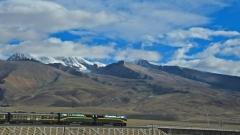
An important consideration when selecting a train is the scenery: it is recommended to prioritize trains departing from Lanzhou in the afternoon (such as Z265 and Z165). This way, you will be awake throughout the entire next day and can fully enjoy the most magnificent Qinghai-Tibet Plateau scenery between Golmud and Naqu, including the Kunlun Mountains, Hoh Xil No-Man’s Land, and Tanggula Pass. If you choose a morning departure train (such as Z223), you may pass through some of the highlights during the night.
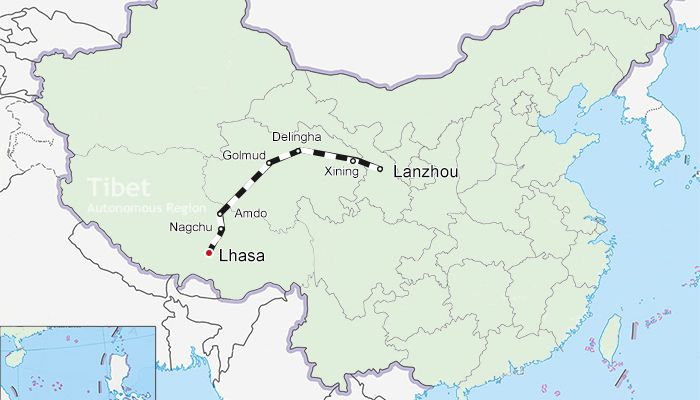
Lanzhou to Lhasa Train Route Map
Detailed Train Fares & Seat Class Options
Train fares from Lanzhou to Lhasa are fixed, mainly divided into three classes: Hard Seat, Hard Sleeper, and Soft Sleeper. You can choose based on your budget and comfort requirements.
Hard Seat: Fare is approximately CNY 240. This is the most economical option, but considering the nearly 24-hour plateau journey, sitting for a long time will be very tiring and not conducive to rest and altitude acclimatization. Therefore, it is generally not recommended for most travelers.
Hard Sleeper: This is the most cost-effective and popular choice. The carriage consists of open compartments, with six berths (upper, middle, and lower) in each compartment.
- Price: Approximately CNY 522 (this is the reference price for the middle hard sleeper; the lower berth is usually CNY 20-30 more expensive, and the upper berth is CNY 20-30 cheaper).
- How to Choose: The lower berth has the largest space and the most freedom of movement; the middle berth balances privacy and convenience; the upper berth is the quietest but relatively cramped with inconvenient access up and down.
Soft Sleeper: Offers a more comfortable and private resting environment. Each compartment has a door and four berths (upper and lower).
- Price: Approximately CNY 522. Suitable for travelers with high sleep quality requirements or those traveling in groups.
In summary, for most travelers, purchasing a Hard Sleeper ticket is the best way to experience the Qinghai-Tibet Railway. If traveling with a group or hoping for a better resting environment, choosing a Soft Sleeper will be more comfortable. It should be noted that tickets are in high demand during the peak tourist season from May to October each year, so be sure to plan and purchase tickets in advance.
Effective Ticketing Methods & Tips
Purchasing train tickets to Lhasa, especially during the peak season, requires understanding the rules in advance and mastering some tips to increase the success rate.
Pay Attention to Pre-sale Period: Train tickets are usually available for purchase 15 days in advance (including the travel date). For example, if you plan to buy a ticket for July 20th, you need to pay attention to the on-sale information on July 6th.
Use Official Channels: Always purchase tickets through the official China Railway platform, the “12306 Railway” website or mobile App, as this is the most reliable method. It is recommended to register an account and complete real-name authentication for passengers in advance.
Practical Strategies to Improve Ticketing Success Rate:
- Snatch Tickets on Time: Log in and submit your order immediately when tickets go on sale (usually at 7:00 AM or 8:00 AM, subject to 12306’s display).
- Make Good Use of the “Waitlist” Function: If the desired train service and seat class are sold out, submit a waitlist order immediately. The system will queue for you, and once other passengers refund or change their tickets, it will automatically fulfill the order in sequence. This is an effective method for purchasing tickets during peak periods.
- Flexibly Adjust Plans: You can try purchasing tickets for the day before or after the planned departure date, or accept other seat classes on the same train (for example, instead of insisting on a lower berth, choose a middle or upper berth).
- Consider Professional Assistance: If you fail to purchase tickets independently multiple times or find the process complicated and time-consuming, you can consult professional agencies like China Dragon Travel that provide ticketing services. They can usually assist with complex ticketing needs, especially when it is necessary to connect the train journey with the entire Tibet itinerary.
On-board Facilities & Plateau Acclimatization Notes
Trains on the Qinghai-Tibet Railway are specially designed with facilities adapted to the plateau environment. Understanding these will make your journey more peaceful.
- Dual Oxygen Supply System: The train activates diffused oxygen supply starting from the Xining section to increase the oxygen concentration in the entire carriage. More importantly, each sleeper berth is equipped with an independent oxygen inhalation interface at the head of the bed. If you experience altitude sickness symptoms such as headache or shortness of breath during the journey, you can request a disposable oxygen tube from the train attendant to connect and use.
- Basic Living Facilities: 24-hour hot water is available at both ends of each carriage, along with washbasins. The dining car serves Chinese stir-fries and rice at reasonable prices. However, due to the long journey, it is recommended to prepare some snacks, fruits, and bottled water as supplements.
- Allow Your Body to Adapt Gradually: Taking the train from Lanzhou to Lhasa itself is an ideal acclimatization process. Over more than 20 hours, your body will slowly rise from an altitude of about 1,500 meters in Lanzhou to 3,650 meters in Lhasa. During the journey, please drink plenty of water, ensure adequate rest, avoid strenuous activities or drinking alcohol in the carriage, and allow your body sufficient time to adjust.
Scenic Highlights Along the Route & Timeline
The moving scenery outside the window is the core value of this train journey. Below is a timeline of the main scenic highlights you will experience the next day, taking an afternoon departure train from Lanzhou (such as Z165) as an example:
- Golmud (Overnight Stop): The train usually stops here for about 25 minutes to replace with a high-power plateau locomotive. At this time, you can get off to stretch your legs and feel the cool plateau night air.
- Kunlun Mountains (Early Next Morning): At sunrise, the majestic Kunlun Mountains will gradually appear on the left side of the train window, with snow-capped peaks year-round, presenting a magnificent sight.
- Hoh Xil No-Man’s Land (Entire Next Morning): The train travels along the edge of the vast Hoh Xil, which is home to wild animals such as Tibetan antelopes and Tibetan wild asses. Please keep your camera ready at all all times.
- Tanggula Pass (Afternoon Next Day): The train will reach the highest point of this journey, Tanggula Pass at an altitude of 5,072 meters, which is also the administrative boundary between Qinghai and Tibet.
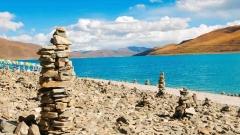
- Qiangtang Grassland & Cuona Lake (Afternoon Next Day): Entering northern Tibet, you will see the boundless Qiangtang Grassland, and the clear blue Cuona Lake will quietly appear in the distance, with peaceful and magnificent scenery.
- Approaching Lhasa (Before Evening Next Day): Vegetation and villages along the route gradually increase, with yaks and flocks dotting the fields, indicating that the destination Lhasa is about to arrive.
Practical Tip: During the day, most of the main scenery along the Qinghai-Tibet Railway is located on the left side of the train’s forward direction (left hand side when facing the locomotive). You can choose your berth based on this preference. At the same time, be sure to fully charge your mobile phone, camera, and other electronic devices in advance, and carry a power bank.
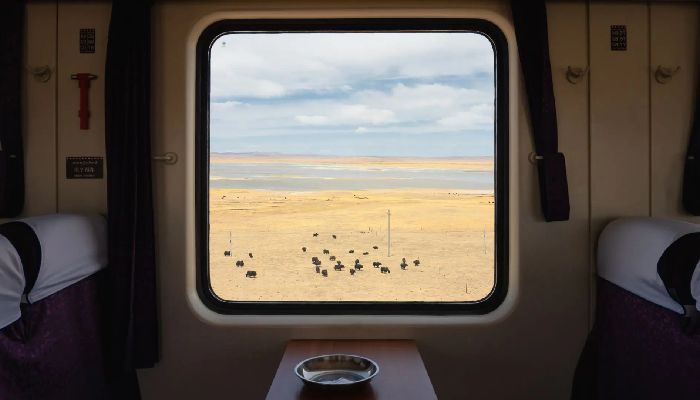
Scenery Outside the Window of a Qinghai-Tibet Railway Train
Must-Have Packing List Before Departure
Prepare a separate carry-on bag for the long-distance train journey and pack the following items to greatly enhance your travel comfort:
- Important Documents: Passport, valid Chinese visa, paper or electronic train ticket (it is recommended to take a screenshot and save it in advance).
- Suitable Clothing: The carriage is kept at a constant warm temperature, so a single layer of long-sleeved clothing is sufficient; you must bring a warm jacket for activities when the train stops at stations. A pair of comfortable slippers is essential in the carriage.
- Food and Drinks: Instant noodles, biscuits, chocolate, fruits, and other snacks, as well as a personal water cup (for filling with hot water) and bottled drinking water.
- Hygiene and Health Supplies: Wet wipes, mouthwash, eye mask, noise-canceling earplugs (to ensure sleep), and personal daily medications.
- Entertainment: Movies, TV shows, music, or e-books downloaded in advance, or you can bring a lightweight paper book.
Final Tips for Taking the Train from Lanzhou to Lhasa
Taking the train from Lanzhou to Lhasa is more than a means of transportation—it is a gradual transition into the Tibetan Plateau, allowing both body and mind to adapt while experiencing some of the most dramatic landscapes along the Qinghai–Tibet Railway. With the right train selection, berth choice, an understanding of onboard oxygen systems, and proper preparation for a long journey, this experience can be both comfortable and rewarding.
For travelers planning to connect their train journey with a broader Tibet itinerary, early and coordinated planning is especially important. If you need practical guidance on ticket arrangements, schedule connections, or altitude adaptation, China Dragon Travel offers experience-based consultation to help ensure your journey into Tibet begins smoothly and confidently.