
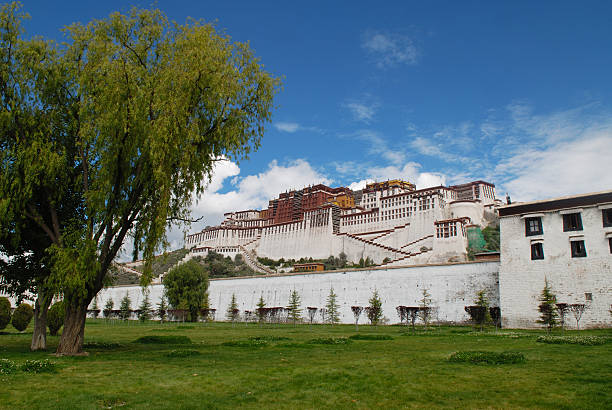
Lhasa is often introduced to the world through a single image: the Potala Palace rising against the highland sky. While undeniably powerful, this image can also be misleading. It suggests a city defined by a monument, rather than a living system of beliefs, spaces, and memory.
In reality, Lhasa is a city structured by sacred geography. Hills, valleys, caves, monasteries, and public squares are not placed randomly; they form an interconnected spiritual and political landscape that has evolved over centuries.
To truly understand Lhasa, one must look beyond its most photographed landmarks and explore the quieter spaces that reveal how Tibetans have understood health, devotion, governance, and daily life.
This journey focuses on five such places—each essential to grasping Lhasa not as a museum, but as a living city.
Tsemonling Monastery: The Political Intellect of Tibetan Buddhism
Located near the heart of old Lhasa, Tsemonling Monastery once played a role far greater than its modest appearance suggests.
Historically, Tsemonling was closely associated with the regency system of Tibet. Several Tibetan regents came from this monastery, making it a place where religious authority and political governance intersected. Unlike larger monastic complexes focused primarily on scholastic training, Tsemonling operated as a center of administrative influence.
Walking through its grounds today, visitors may find it quiet, even understated. Yet this silence masks centuries of political decision-making that shaped Tibet’s historical trajectory.
For culturally minded travelers, Tsemonling offers insight into how Tibetan Buddhism extended beyond spiritual life into the realm of statecraft—subtle, strategic, and deeply integrated.
Tsankgung Nunnery: Female Devotion in the Urban Fabric
Hidden within Lhasa’s old residential quarters lies Tsankgung Nunnery, one of the most important nunneries in the city.
Unlike grand monasteries built on hillsides or open plains, Tsankgung is woven directly into the urban environment. Its proximity to Jokhang Temple and Barkhor Street reflects the historical role of women in maintaining religious continuity within everyday life.
Here, devotion is quieter but no less profound. Nuns engage in daily prayers, ritual maintenance, and study, often balancing religious commitments with responsibilities to family and community.
For many Western travelers, Tsankgung challenges assumptions about Tibetan monastic life. It reveals a less visible, yet essential, dimension of Tibetan Buddhism—one sustained not by spectacle, but by persistence.
Chakpori Thousand Buddha Cliff: Medicine, Compassion, and the Body
Opposite the Potala Palace rises Chakpori, also known as Medicine King Mountain. Carved into its rocky face is the Thousand Buddha Cliff, a remarkable site where spiritual belief and medical knowledge converge.
Chakpori was historically home to one of Tibet’s most important medical institutions. Tibetan medicine, deeply influenced by Buddhist philosophy, views the body as inseparable from mind, ethics, and environment.
The cliff carvings serve not merely as religious symbols, but as expressions of healing and compassion. They remind visitors that in Tibetan thought, medicine is not only a science, but a moral practice.
Standing here, one gains a broader understanding of how Tibetans historically approached health—not as individual treatment, but as harmony between human life and the natural world.
Lup Yan Monastery (Drak Yerpa): Where Tibet’s Spiritual Origins Begin
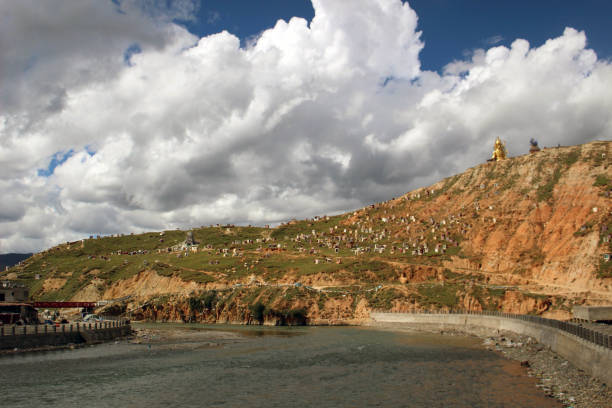
Located in the mountains northeast of Lhasa, Lup Yan Monastery, part of the greater Drak Yerpa cave complex, is among the most sacred meditation sites in Tibet.
These caves are believed to have been used by early Tibetan kings and Buddhist masters, including Songtsen Gampo and Padmasambhava. Long before large monasteries were built, these cliffs served as spaces for solitary retreat, contemplation, and transmission.
Visiting Drak Yerpa is a transformative experience. The journey itself—leaving the city, ascending into quiet valleys—mirrors the spiritual withdrawal practiced by generations of meditators.
For travelers seeking depth rather than convenience, this site offers an encounter with Tibetan Buddhism at its most elemental: silence, stone, and sustained practice.
Potala Palace Square: Power, Memory, and Modern Lhasa
In contrast to secluded monasteries and caves, Potala Palace Square represents the modern public face of Lhasa.
This vast open space frames the Potala Palace, transforming it from a religious structure into a civic symbol. It is here that ceremonies, gatherings, and public life unfold, reflecting the evolving identity of Lhasa in the contemporary era.
The square embodies contrast: ancient authority overlooking modern infrastructure; ritual memory set against daily routines.
For travelers, spending time here offers a chance to observe how history is actively negotiated in present-day Tibet—not erased, but reframed.
Reading Lhasa as a City of Layers
Taken together, these sites reveal Lhasa as a city built not in a straight line, but in layers:
-
Spiritual retreat spaces beyond the city
-
Urban monasteries embedded in daily life
-
Medical and philosophical landmarks
-
Political institutions disguised as religious centers
-
Public squares redefining tradition
This layered complexity is what makes Lhasa unlike any other city in the world.
Why This Journey Matters for Thoughtful Travelers
For experienced travelers—especially those who have already seen Tibet’s major highlights—this deeper approach offers something rare:
-
Cultural understanding beyond symbolism
-
Encounters with living traditions, not staged experiences
-
Insight into how belief, power, and space interact
This is not a journey of accumulation, but of interpretation.
Lhasa Is Not a Place to Be Consumed
Lhasa does not reward haste.
It asks visitors to slow down, to read the landscape, to observe how devotion shapes streets and silence shapes thought.
For those willing to engage on this level, Lhasa becomes more than a destination—it becomes a lens through which to reconsider the relationship between faith, society, and time.
And that understanding is the most enduring souvenir one can take away.