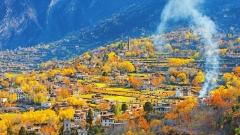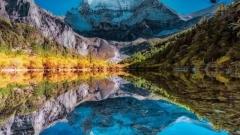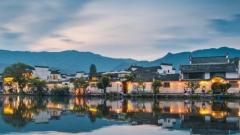

Want to visit Sichuan’s most iconic natural wonders and cultural landmarks in one trip? This practical guide focuses on renowned spots like Jiuzhaigou, Emei Mountain and Dujiangyan, with detailed tips on seasonal temperatures, outfits, travel budgets and transportation. Covering everything from itinerary planning to practical advice, it’s perfect for first-time visitors or repeat travelers, helping you efficiently arrange your trip and fully experience Sichuan’s world-famous landscapes and cultural heritage.
A Comprehensive Guide to Sichuan’s Must-Visit Classic Attractions
Natural Wonders
- Jiuzhaigou Scenic Area
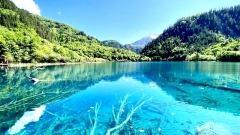
A UNESCO World Natural Heritage and 5A-level scenic spot, Jiuzhaigou is hailed as a “Fairyland” for its six wonders: turquoise lakes, cascading waterfalls, colorful forests, snow-capped peaks, Tibetan customs and blue ice. The 114 alpine lakes are distributed in steps—Wuhua Sea shimmers in blue, green and yellow hues with light changes, a paradise for photographers; Nuorilang Waterfall, 270 meters wide, rushes down like a galaxy (filming location for Journey to the West); Changhai, the largest lake, freezes into a giant sapphire embedded in snow-capped mountains in winter, boasting exquisite blue ice texture.
Ticket: Peak season (Apr-Nov): 169 CNY/person + 90 CNY/person for sightseeing bus; Off-season (Dec-Mar): 80 CNY/person + 80 CNY/person for sightseeing bus; Transport: Direct coach from Chengdu Chadianzi Bus Station or flight to Jiuzhaigou Huanglong Airport;
Travel Tips: Recommended 2-day visit, adopt “counterclockwise tour” (Zezhawagou Valley – Rizegou Valley – Shuizhengou Valley) to avoid tour group crowds; Autumn offers the most vibrant forests, while winter (Dec-Feb) showcases stunning blue ice; Stay at guesthouses near the valley entrance for easy access the next day.
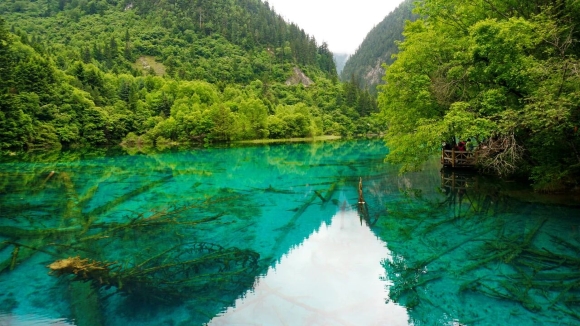
Jiuzhaigou Scenic Area
- Emei Mountain Scenic Area
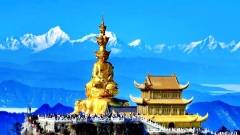
One of China’s Four Great Buddhist Mountains and a UNESCO World Cultural and Natural Heritage, Emei Mountain is renowned for its “peerless beauty” with the main peak Golden Summit at 3,079 meters above sea level. The Golden Summit is the highlight—witness “sunrise and sea of clouds” in the morning, and catch a glimpse of the rare “Buddha’s Light” (a colorful halo formed by sunlight through water vapor) if lucky, with the Ten Thousand Buddhas Puxian Statue looming solemnly in the clouds; Qingyin Pavilion, located in the low mountain area, is surrounded by mountains and rivers, offering an excellent summer resort with its “Two Bridges and Clear Sound” (one of Emei’s Ten Scenic Spots); Wild macaques often appear around Xixiangchi, allowing close interaction (keep personal belongings safe to avoid being snatched).
Ticket: 160 CNY/person, 90 CNY/person for sightseeing bus, 65 CNY/person for Golden Summit cable car (one-way up), 55 CNY/person (one-way down); Transport: High-speed rail from Chengdu East Station to Emei Mountain Station, then transfer to scenic sightseeing bus to the foot of the mountain;
Travel Tips: Recommended 2-day visit—take the sightseeing bus to Leidongping on the first day, and get up early the next morning to take the cable car to the Golden Summit for sunrise; The Golden Summit is covered in snow in winter, so wear non-slip shoes; Protect against mosquitoes in summer; Respect Buddhist customs—remove hats and keep quiet when visiting temples.
- Huanglong Scenic Area
Adjacent to Jiuzhaigou, Huanglong is a UNESCO World Natural Heritage and 5A-level scenic spot, famous for its travertine pools and hailed as the “Fairyland on Earth”. The core attraction, Wucai Chi (Five-Colored Pools), consists of 693 travertine pools, reflecting blue, green and yellow hues under sunlight due to different mineral contents, forming a spectacular terraced landscape; Jinsha Pudi (Golden Sand Beach) is a 1.3-kilometer travertine stream, shimmering like a golden carpet as water flows over it; Muni Valley, a branch scenic area, features Zhaga Waterfall (China’s highest travertine waterfall) and Erdao Hai (alpine lake group), showcasing primitive and pure natural scenery.
Ticket: Peak season (Apr-Nov): 170 CNY/person; Off-season (Dec-Mar): 60 CNY/person; 80 CNY/person for uphill cable car; Transport: Charter/carpool from Jiuzhaigou;
Travel Tips: The scenic area is 3,000-3,500 meters above sea level—prevent altitude sickness by walking slowly and carrying portable oxygen cylinders; The best visiting time is 8-10 am when light is soft and pool colors are most vivid; Wear non-slip shoes to avoid falling on travertine beaches.
Cultural and Historical Attractions
- Dujiangyan Irrigation System
A UNESCO World Cultural Heritage and the oldest existing water conservancy project without a dam, Dujiangyan is the source of the “Land of Abundance”. Constructed by Li Bing and his son in 256 BC, it has irrigated the Chengdu Plain for over 2,000 years. Its three core projects are hailed as “water control wonders”: Yuzui Diversion Dike divides the Minjiang River into Inner River (for irrigation) and Outer River (for flood discharge); Feisha Weir Spillway flushes sediment using curved flow principles; Baopingkou Water Inlet precisely controls water inflow—their synergy achieves the miracle of “water and drought following human will”.
Ticket: 80 CNY/person; Transport: Direct coach from Chengdu Chadianzi Bus Station or intercity railway to Lidui Park Station;
Travel Tips: Hire a guide to gain in-depth understanding of the project’s principles; Stroll along Nanqiao in the evening to admire the night view of the Minjiang River illuminated by lights, and taste local snacks like tofu pudding and brown sugar glutinous rice cakes at nearby stalls.
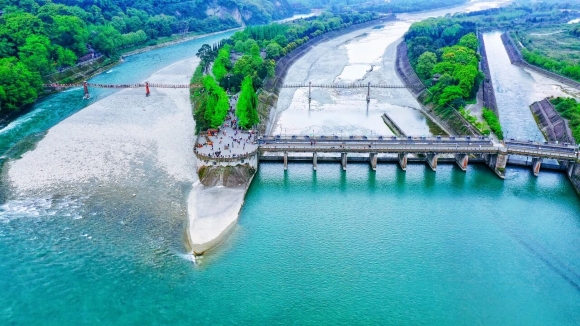
Dujiangyan
- Qingcheng Mountain Scenic Area
One of China’s Four Great Taoist Mountains and a UNESCO World Cultural Heritage, Qingcheng Mountain is adjacent to Dujiangyan and renowned for its “secluded beauty”, divided into Front Mountain and Back Mountain. Front Mountain is rich in Taoist culture—Tianshi Cave, the core Taoist temple, is said to be the birthplace of Taoism founded by Zhang Daoling, with towering thousand-year-old ginkgo trees; Shangqing Palace, located at the summit, offers a panoramic view of the Chengdu Plain, providing a cool retreat in summer; Back Mountain boasts superior natural scenery—Tai’an Ancient Town is built along mountains with streams flowing through, and Wulonggou Valley features dense waterfalls and springs, with moderate-difficulty hiking routes suitable for outdoor enthusiasts.
Ticket: Front Mountain: 90 CNY/person; Back Mountain: 20 CNY/person; Transport: Scenic shuttle bus from Dujiangyan Scenic Area;
Travel Tips: Choose Front Mountain for cultural exploration and Back Mountain for outdoor activities; Enjoy lush greenery in spring and golden ginkgoes in autumn; Experience local slow life with a cup of gaiwan tea at teahouses in the scenic area.
- Leshan Giant Buddha Scenic Area
A UNESCO World Cultural and Natural Heritage and 5A-level scenic spot, the Leshan Giant Buddha is the largest cliff-carved sitting Buddha in China, standing 71 meters tall. Carved during the Tang Dynasty (713-803 AD) over 90 years, it sits at the confluence of the Minjiang River, Qingyi River and Dadu River, presenting the stunning spectacle of “the mountain is a Buddha, and the Buddha is a mountain”; The Nine-Turn Plank Road winds down along the Buddha’s body, allowing visitors to touch the Buddha’s feet and feel its grandeur; Additionally, the scenic area offers a view of the “invisible reclining Buddha”—a natural contour formed by Wuyou Mountain and Lingyun Mountain, creating a unique “Buddha within a Buddha” scene.
Ticket: 80 CNY/person (on-foot tour), 70 CNY/person (boat tour for panoramic view); Transport: High-speed rail from Chengdu East Station to Leshan Station, then transfer to bus to the scenic area;
Travel Tips: Queues for the Nine-Turn Plank Road are long on holidays—arrive early or choose the boat tour; Visit the nearby Mahao Cliff Tombs to see Han Dynasty stone carvings and experience ancient funeral culture.
- Want to easily visit multiple highlights? Click the link below to learn about our carefully designed 7-day in-depth Sichuan Chengdu tour, helping you solve transportation and itinerary planning in one stop!
- Other recommendation(5-day tour):https://www.chinadragontravel.com/tour/5-day-sichuan-small-group-tour/
Sichuan Seasonal Temperature & Outfit Guide
Spring (Mar-May): Warm and Windy with Large Day-Night Temperature Differences
– Temperature: Daily average 8℃-20℃—warm days and cool nights in basin areas like Chengdu and Leshan; night temperature may drop below 5℃ in high-altitude areas such as Jiuzhaigou and Emei Mountain, with occasional light rain.
– Outfit Recommendations: Adopt “layered dressing”—inner layer: thin long-sleeve T-shirt or sweater; middle layer: thin woolen sweater or fleece jacket; outer layer: windproof jacket or thin down jacket; bottom: jeans or casual pants with thin thermal underwear; shoes: comfortable sneakers or hiking shoes for easy walking in scenic areas; accessories: thin scarf, baseball cap, foldable umbrella or waterproof jacket to cope with temperature differences and light rain.
– Notes: Spring is Sichuan’s flower-viewing season—wear light-colored clothes for better photos; UV rays strengthen in high-altitude areas, so apply SPF30+ sunscreen.
Summer (Jun-Aug): Hot and Humid with Frequent Heavy Rains
– Temperature: Daily average 22℃-30℃—hot and humid in basin areas; cool and comfortable with daily average 15℃-25℃ in western Sichuan’s high-altitude areas (Jiuzhaigou, Daocheng Yading), but occasional heavy rains.
– Outfit Recommendations: Basin areas: cool and breathable—inner layer: short-sleeve T-shirt, shorts or skirt; outer layer: thin sunscreen jacket (UV protection); Western Sichuan high-altitude areas: still layered dressing—inner layer: short-sleeve T-shirt; middle layer: thin jacket; outer layer: windproof and waterproof hiking jacket; bottom: long pants; shoes: breathable sneakers or hiking shoes (avoid sandals); accessories: sunhat, sunglasses, sun protection mask, SPF50+ sunscreen and portable rain gear.
– Notes: Summer is Sichuan’s rainy season—some roads in western Sichuan may suffer landslides or mudslides; confirm road conditions before departure; stay hydrated to avoid heatstroke in humid and hot basin areas.
Autumn (Sep-Nov): Cool and Pleasant with Little Rain and More Sunny Days
– Temperature: Daily average 10℃-22℃—cool and comfortable overall with increased day-night temperature differences; night temperature may drop below 5℃ in high-altitude areas, with clear skies and little precipitation.
– Outfit Recommendations: Continue layered dressing—inner layer: long-sleeve T-shirt or thin sweater; middle layer: thick woolen sweater or fleece jacket; outer layer: windproof jacket or thin down jacket; bottom: jeans or casual pants with thin thermal underwear; shoes: comfortable sneakers or hiking shoes (non-slip shoes for hiking in western Sichuan); accessories: scarf, baseball cap (woolen cap for western Sichuan), continue using sunscreen.
– Notes: Autumn is the best travel season in Sichuan—Jiuzhaigou, Daocheng Yading and other attractions reach their “most beautiful state”; book accommodation and tickets 1-2 months in advance; frost appears on some roads in western Sichuan—pay attention to road safety in the morning and evening.
Winter (Dec-Feb): Cold and Dry with Heavy Snow
– Temperature: Daily average 0℃-12℃—damp and cold in basin areas; extremely cold with daily average -10℃-5℃ in western Sichuan’s high-altitude areas (Jiuzhaigou, Huanglong, Emei Mountain), with heavy snow and possible temporary closure of some scenic areas.
– Outfit Recommendations: Focus on warmth and windproof—inner layer: fleece thermal underwear; middle layer: thick woolen sweater or fleece liner; outer layer: thick windproof and waterproof down jacket; bottom: fleece pants or down pants with thermal socks; shoes: fleece-lined waterproof non-slip hiking shoes (ice cleats necessary for Emei Mountain and Jiuzhaigou in winter to prevent slipping on ice); accessories: face-protecting ushanka, thick neck gaiter, waterproof ski gloves, snow goggles, warm patches (for waist, hands and feet), petrolatum (for western Sichuan to relieve dry skin and nasal discomfort).
– Notes: Some scenic areas (e.g., Huanglong) may shorten opening hours or close temporarily in winter—confirm with official channels before departure; oxygen content is low in high-altitude areas—prevent altitude sickness and avoid strenuous exercise.
Sichuan Travel Transportation Guide
Ways to Reach Sichuan
- By Air
Sichuan has two major international airports: Chengdu Shuangliu International Airport (CTU) and Chengdu Tianfu International Airport (TFU). Shuangliu Airport is close to the urban area with many domestic flights, accessible via Metro Lines 10 and 19; Tianfu Airport operates more international flights, about 60 kilometers from the urban area (50-minute drive), accessible via Metro Line 18 or airport shuttle bus. In addition, there are regional airports such as Jiuzhaigou Huanglong Airport and Daocheng Yading Airport, with more flights in peak season and fewer in off-season.
- By High-Speed Rail/Train
Chengdu East Railway Station is Sichuan’s main high-speed rail hub, connecting major cities like Beijing, Shanghai, Guangzhou and Shenzhen—comfortable and convenient with travel times ranging from 4 hours (to Chongqing) to 10 hours (to Beijing); Chengdu Railway Station (North Railway Station) mainly operates regular trains, suitable for budget travelers. Besides, cities like Leshan, Mianyang, Langzhong and Emei Mountain also have high-speed rail stations—choose to get off nearby to reduce transfers.
- By Self-Driving/Group Tour
Sichuan’s attractions are scattered with complex road conditions in some western Sichuan sections (e.g., National Highway 318). If self-driving, ensure rich driving experience, check the vehicle in advance and prepare snow chains; For a hassle-free trip, choose a group tour with professional guides to plan routes and arrange transportation—ideal for first-time visitors or those traveling to western Sichuan’s high-altitude areas.
Intra-Sichuan Transportation
- Metro/Bus
Chengdu’s urban metro network covers extensively with over 10 operating lines, directly reaching major attractions like Chengdu Giant Panda Breeding Research Base, Chunxi Road and Kuanzhai Alleys. Download the “Tianfu Tong” APP or use Alipay/WeChat transit codes for scanning—one-way fare 2-7 CNY; The bus network is dense with 2 CNY per trip, suitable for short-distance travel; Use map apps to check routes in real-time if unfamiliar.
- Scenic Shuttle Bus
Chengdu has multiple scenic shuttle bus hubs (e.g., Kuanzhai Alleys, Chunxi Road) with direct routes to popular attractions like Dujiangyan, Qingcheng Mountain, Jiuzhaigou and Leshan Giant Buddha. Equipped with comfortable coaches and tour guides, the fares are transparent (e.g., 25 CNY/person from Chengdu to Dujiangyan, 158 CNY/person from Chengdu to Jiuzhaigou)—more convenient than temporary taxis or carpooling; Book in advance via official WeChat public accounts.
- Charter/Carpool
Public transportation is inconvenient in some remote western Sichuan attractions—recommend chartering or carpooling. Local drivers are familiar with road conditions and can adjust itineraries flexibly; Prices vary by distance (e.g., about 300 CNY/person for carpooling from Chengdu to Daocheng Yading, 1,500 CNY/car for chartering); Book through regular travel agencies or platforms to avoid unlicensed taxis.
- Intra-Scenic Transportation
Most scenic areas require sightseeing buses—e.g., 90 CNY/person for Jiuzhaigou’s mandatory sightseeing bus (the scenic area is too large for walking), 90 CNY/person for Emei Mountain’s sightseeing bus (from foot to Leidongping), 80 CNY/person for Huanglong’s optional uphill cable car. Tickets are either included in the scenic area package or sold separately; Understand the transportation rules in advance to avoid missing buses.
Sichuan Travel Budget and Practical Tips
Transportation Costs (Per Person)
– Arrival Transportation: Domestic flight: 400-2,000 CNY one-way; High-speed rail: 200-1,500 CNY one-way (discounts for early booking).
– Intra-Sichuan Transportation: Urban area: 10-20 CNY per day; Scenic shuttle bus: 25-158 CNY one-way; Charter/carpool: 150-300 CNY/person/day; Scenic sightseeing bus: 20-90 CNY/person.
Accommodation Costs (Per Person/Night)
– Chengdu Urban Area: Economy hotel/guesthouse: 200-300 CNY; Mid-range hotel: 300-500 CNY; High-end hotel: above 500 CNY.
– Western/Southern Sichuan: Near scenic areas: 150-400 CNY; High-altitude areas: 300-500 CNY (some accommodations closed in winter).
Catering Costs (Per Person)
– Daily average: 150-300 CNY; Snacks: 10-20 CNY per serving; Main meal: 60-100 CNY per meal; Consumption is higher in scenic areas—bring dry food if needed.
Ticket Costs (Per Person)
– Total for must-visit attractions: 500-800 CNY (5-day trip), 1,000-1,500 CNY (10-day trip); 15%-25% discount in off-season, half-price for students/seniors.
Sichuan Travel Practical Tips
Attraction Reservation & Safety
– Reservation: Popular attractions require official reservation 1-3 days in advance—book early in peak season; Some scenic areas support QR code ticketing.
– Safety: Prevent altitude sickness in high-altitude areas and avoid strenuous exercise; Wear non-slip shoes/prepare ice cleats in winter, and install snow chains for self-driving; Do not touch cultural relics or feed animals.
Catering & Shopping
– Catering: Inform restaurants in advance if you can’t eat spicy food; Try Tibetan food in western Sichuan in small amounts to avoid gastrointestinal discomfort.
– Shopping: Choose characteristic souvenirs like Shu embroidery and yak beef jerky; Buy from regular stores and ask for invoices; Bargain for souvenirs in scenic areas.
Sichuan’s beauty lies in Jiuzhaigou’s turquoise lakes and colorful forests, Emei Mountain’s sea of clouds and Buddha’s Light, and Dujiangyan’s thousand-year-old wisdom. This guide covers Sichuan’s most classic attractions and practical information. If you need customized itineraries, guaranteed vehicles or experienced guides, China Dragon Travel provides one-stop full-service support to make your Sichuan trip worry-free and enjoyable.