
Cradled by the tender caress of the autumn breeze, the Populus euphratica forests that fringe the Taklamakan Desert flourish with a reawakened vitality. Celebrated as the “centennial sentinels,” they enthrall countless visitors and photographers, season after season, with their unique charm, all drawn to unravel the mystery they enshrine. This discourse delves into the panoramic allure of Populus euphratica in southern Xinjiang, showcasing captivating sites, offering travel and photography insights, and beckoning readers to indulge in this feast for the soul’s eye, to halt and revere the grand masterpiece crafted by nature.
Best Viewing Season for Populus Euphratica in Southern Xinjiang
Understanding the Populus Euphratica season in Southern Xinjiang lies in grasping the delicate and fragile connection between the trees and the climate. The discoloration of Populus Euphratica leaves is not just a turn of the calendar, but a biochemical feast co-directed by low nighttime temperatures and daytime sunlight. As autumn deepens, continuous cooling promotes the decomposition of chlorophyll, revealing the carotene and xanthophyll that were originally hidden, thus rendering a dazzling golden color. Therefore, the best viewing period each year is essentially a “golden window” with just the right temperature—too early, and the leaves are still mostly green; too late, and the leaves fall, leaving only bare branches.
To capture this fleeting peak beauty, you need a more delicate sense of time.
Core Golden Period: The Ultimate Scenery from Mid-October to Late October
Generally speaking, the symphony of color changes of Populus Euphratica in Southern Xinjiang begins in early October, but the climax of the movement undoubtedly converges in the two weeks from October 15 to October 31. During this time, from Luntai to Zepu, the Populus Euphratica forests around the entire Tarim Basin seem to receive a unified order, bursting out with the most saturated and pure golden color collectively. Under the sun, every leaf seems to be coated with warm honey, layer upon layer—against the vast blue sky and the boundless desert, it forms the most intense color contrast in the world. This period is a dream creative paradise for photographers, and also the best time for ordinary tourists to experience the most shocking visual impact of nature. The air is crisp with extremely high visibility; whether using a wide-angle lens to capture the grandeur of the forest sea, or a telephoto lens to capture the details of light and shadow, you can get satisfying results.
Prelude and Aftertaste: Different Ambiences of Early and Late Visits
- Early October (Prelude Begins): If you visit in early October, you will see the Populus Euphratica forest in a transitional stage of “intermixed green and yellow.” On the green background, bright yellow and orange-red begin to burst out like stars, as if a painter is carefully blending the final golden color on the palette. The scenery at this time is full of dynamic beauty of gradual change, with relatively few tourists—it is suitable for travelers who prefer tranquility and enjoy the process of color brewing. You can more clearly observe the difference in the discoloration rhythm of each tree, even each branch.
- Early November (Golden Aftertaste): Entering November, most leaves have turned golden, but as the nighttime temperature drops sharply to around freezing point, accompanied by possible autumn winds, the leaves enter a period of rapid withering. At this time, the scene shifts from “brilliant tree crowns” to “fluttering fallen leaves.” The ground is covered with a thick layer of golden carpet, making a rustling sound when stepped on; while the vigorous lines of the tree trunks become more prominent among the sparse leaves, presenting a unique beauty of “prosperity coming to an end and desolation beginning to appear”—it is very suitable for shooting pictures with a sense of story and time.
A variable to remember: The specific opening and closing time of this “golden window” fluctuates by about one week each year, mainly depending on the precipitation in the summer of that year and the frequency and intensity of cold air activities after autumn. If there is abundant rainfall in summer, the Populus Euphratica grows vigorously, and the autumn discoloration may be slightly later but more intense; if the temperature drops rapidly and stably in autumn, the golden period may come earlier. Therefore, the wisest way is to set the core time in mid-to-late October when planning your trip, and one to two weeks before departure, check the latest real-time report on leaf discoloration through a reliable travel information platform or a local professional organization like China Dragon Travel, to make final adjustments.
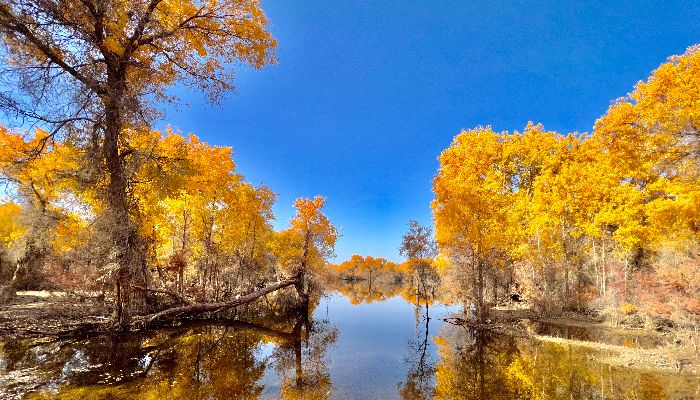
Populus Euphratica Forest in Tarim, Xinjiang
Chase the Golden Traces: In-depth Exploration of Core Viewing Spots for Populus Euphratica in Southern Xinjiang
Choosing where to go during the Populus Euphratica season in Southern Xinjiang is not just choosing a forest, but also choosing the personality of a scenery and the experience tone of a journey. The Populus Euphratica in Southern Xinjiang is not like the neatly pruned trees in a park—they grow wild, relying on water to survive, and present completely different temperaments due to differences in the environment. Some places stand out for their scale, magnificent and majestic; some take water as a mirror, delicate and gentle; others form a rich picture layer with deserts and villages. Understanding the unique endowments of each core spot can help you make the most suitable choice according to your travel preferences—whether you are pursuing classic postcard scenery, keen on multi-landform photography, or yearning for exploration in remote and quiet places—making your golden journey full of expected surprises, rather than hasty check-ins.
Luntai Tarim Populus Euphratica Forest Park: The Irreplaceable Classic First Choice
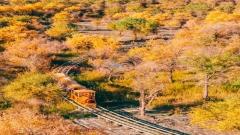
For travelers visiting the Populus Euphratica season in Southern Xinjiang for the first time, the Tarim Populus Euphratica Forest Park in Luntai County, Bayingolin Mongol Autonomous Prefecture is often the most stable and classic starting point. The advantage here lies in its mature viewing system and comprehensive experience. Taking the sightseeing train in the park to go deep into the forest area is a very ceremonial way of visiting. Along both sides of the railway, Populus Euphratica with different shapes pass before your eyes—sometimes dense like a wall, sometimes sparse like a painting. The Populus Euphratica here is accompanied by the ancient old course of the Tarim River; you can find many classic compositions where puddles reflect the golden tree crowns, especially in the early morning or dusk— the calm water can replicate a perfect world of upper-lower symmetry. The park has relatively complete facilities, suitable for family tourists or travelers who want to enjoy the beauty of Populus Euphratica easily.
Yuli Luobu Village: The Poetic Convergence of Multi-landforms
If you think seeing only Populus Euphratica is a bit monotonous, then the Luobu Village in Yuli will present you with a more grand and complex picture. Here, three extreme landscapes are cleverly integrated into one: golden Populus Euphratica forests, the boundless Taklamakan Desert, and the winding Tarim River. You can stand on the top of a sand dune, looking at the Populus Euphratica forest like a golden silk ribbon inlaid on the edge of the desert; you can also walk to the riverbank, watching the flowing water caress the roots of the Populus Euphratica. The landscape layers here are extremely rich—for photographers, almost every time you change an angle, you can get a work with completely different themes, foregrounds and backgrounds. In addition, the remaining traces of Luobu people’s culture in the village also add a touch of humanistic reverie to this natural landscape.
Zepu Golden Populus Euphratica Forest: Flexible Reflections in a Water Town
This national forest park located in Zepu County, Kashgar Prefecture subverts people’s stereotype that Populus Euphratica grows in arid environments. Benefiting from the abundant water sources of the Yarkant River, the Populus Euphratica here grows particularly luxuriantly—by autumn, it turns into a moist and intense golden color. The park has crisscrossing river channels and quiet lakes, so the reflections of Populus Euphratica become the absolute protagonists. When the light is soft, the water surface is like a mirror—the complete reflection is almost indistinguishable from the real scene, creating an ethereal and dreamy artistic conception. Compared with the vastness of Luntai, the Populus Euphratica in Zepu is more beautiful and vibrant; wandering among them, it is like being in a golden water town maze—it is suitable for tourists who like quiet scenery and reflection photography.
Mulei Populus Euphratica Forest: Listen to the Vigorous Echo of Immortal Life
If the above-mentioned places praise the glory of Populus Euphratica’s “life,” then the Populus Euphraticaforest in Mulei, Changji Prefecture is a magnificent ode to “immortality after death”. Here, there are a large number of ancient Populus Euphratica trees that have withered after being polished by wind and sand. They no longer have the decoration of leaves, only twisted and struggling branches and cracked and mottled bark—frozen in the wilderness in various incredible postures. During sunrise or sunset, the low-angle light stretches these silhouettes long, and the entire scene is full of epic tragedy and sense of power. The shooting themes here are more inclined to light and shadow modeling, texture and artistic conception expression, which can inspire profound creative inspiration—it is suitable for in-depth travelers or photographers who pursue unique visual impact and philosophical meaning.
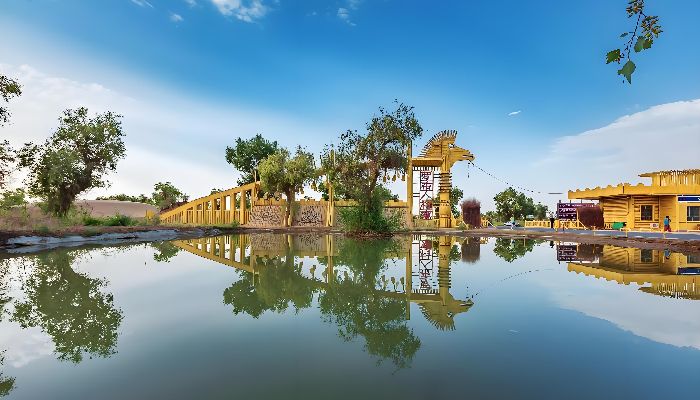
Luobu Village in Yuli, Xinjiang
Plan Your Golden Journey: Transportation, Accommodation & Practical Suggestions
To successfully capture the beauty of the Populus Euphratica season in Southern Xinjiang, you not only need to choose the right time and place—careful itinerary planning is also crucial.
Transportation Options
Southern Xinjiang has a vast area, and the distance between scenic spots is long.
- Plane + Self-driving/Chartered Car: The most recommended way. You can first fly to Urumqi, then transfer to a flight to Korla (convenient for going to Luntai and Yuli) or Kashgar (convenient for going to Zepu). After arrival, renting a car for self-driving or booking a chartered car service locally is the most free and efficient way to explore various Populus Euphratica spots. Chartered drivers are usually familiar with the road conditions and the best shooting spots.
- Train + Local Transportation: You can also choose to take a train to Korla or Kashgar, then join a one-day group tour or rent a car locally. However, the flexibility is relatively low.
Accommodation Preparation
The accommodation conditions near the core areas of Populus Euphratica are relatively limited, especially during the peak season.
- Luntai, Yuli: You can choose to stay in hotels in the county seat— the conditions are acceptable with more options.
- Zepu: There are hotels available in the county seat.
· Important Reminder: The Populus Euphratica season in Southern Xinjiang is an absolute peak tourist season, especially weekends in mid-to-late October. Be sure to book accommodation and vehicles at least one month in advance; otherwise, you may face the dilemma of no rooms or no cars available, or a significant price increase.
Clothing and Equipment
- Clothing : Southern Xinjiang has a huge temperature difference between day and night in autumn. During the day, you may only need light clothing under the sun, but it is cold in the morning and evening—you must prepare windproof and warm jackets, fleece jackets or thin down jackets.
- Protection : Sunglasses, high-factor sunscreen, and sun hats are essential. The climate in desert areas is dry, so moisturizer and lip balm are also important.
· Photography Equipment : In addition to a wide-angle lens for shooting large scenes, a medium-telephoto lens (70-200mm) is very useful—it can compress space and capture the details and light-shadow layers of the Populus Euphratica forest. Remember to bring enough spare batteries and memory cards.
Capture Golden Moments: Core Photography Tips for Populus Euphratica Forests
It would be a pity not to bring back satisfying photos when coming here. Mastering a few simple skills can make your works stand out.
Light is the Soul
- Golden Hour : The hour after sunrise and the hour before sunset are the times when the light is the softest and the color is the warmest. Shooting during this time, the leaves of the Populus Euphratica will glow with a golden light, with a strong sense of three-dimensionality.
- Backlight and Side Backlight : Try shooting with backlight— it can make the Populus Euphratica leaves show a translucent texture, with beautiful contour light. Side backlight can highlight the rough texture of the bark and the shape of the tree trunks.
Composition Adds Charm
- Use Reflections : In places with water (such as Zepu, the banks of the Tarim River), find calm water surfaces to shoot symmetrical reflections— the picture will be full of poetry immediately.
- Add Leading Lines : Use paths in the forest, rivers or the direction of trees as visual leading lines to guide the audience’s sight to the depth of the picture.
- Focus on Details : Don’t just shoot large scenes. Fallen golden leaves, mottled bark, and strange tree trunk shapes are all close-up subjects full of story.
Safety and Respect
When shooting, always walk on designated trails or hard ground to protect the fragile desert ecosystem. Do not climb or break branches for photos, or litter casually— let us jointly protect this hard-won golden wonder.
Start Your Southern Xinjiang Golden Populus Euphratica Journey
Embarking on the pursuit of the Populus Euphratica season in Southern Xinjiang is akin to partaking in nature’s annual sumptuous gala. A touch of foresight, a dash of perseverance, and an open heart poised to encounter awe are the prerequisites for this journey. The process begins with a thorough investigation into the fleeting, yet precise, golden phase, followed by the selection of the most poignant vantage points, and culminates in the meticulous organization of every aspect of travel and lodging—a sequence of preparations that is a voyage brimming with anticipation. Upon reaching that expansive sea of gold, as the desert autumn breeze caresses your cheeks and the sun filters a mosaic of light and shadow through the dancing foliage, the realization dawns that all anticipation and toil were justified. This odyssey transcends a mere excursion; it is a heartfelt homage to the indomitable spirit of life and the splendor of the natural world. In orchestrating inter-regional travel, pinpointing the optimal viewing moments, or securing firsthand insights into the landscapes, enlisting the aid of a local expert such as China Dragon Travel, with its deep roots in the region, frequently results in a more relaxed and meaningful golden odyssey—immersing you completely in this panoramic and soulful celebration.