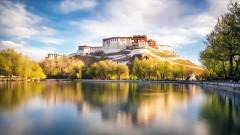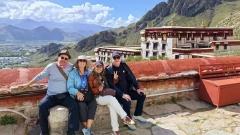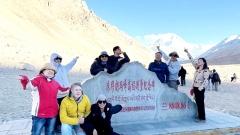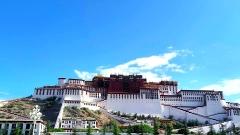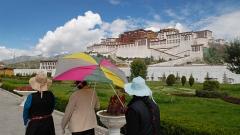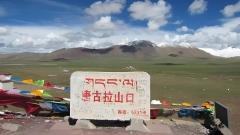

For many first-time visitors, Tibetan Buddhism feels very different from what they imagined. Instead of quiet temples and simple rituals, travelers encounter a culture where religion is deeply woven into everyday life.
Prayer flags cover mountain passes, pilgrims circle temples for hours, and monks debate energetically in monastery courtyards. Religious practice appears not only inside monasteries, but also along streets, villages, homes, and roadsides.
In Tibet, Buddhism shapes daily routines, landscapes, architecture, and local culture. Understanding this helps travelers experience Tibet as more than just a sightseeing destination.
Tibetan Buddhism Is Everywhere, Not Just Inside Temples
One of the biggest surprises for first-time visitors is how visible religion is in everyday Tibetan life.
In many destinations around the world, religion is mainly experienced inside designated religious buildings. In Tibet, Buddhism extends far beyond monastery walls.
Travelers quickly notice:
- Prayer wheels beside streets and mountain paths
- Yak herders carrying prayer beads
- Small shrines inside homes and shops
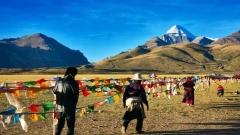
- Colorful prayer flags on bridges, rooftops, and mountain passes
- Pilgrims performing prostrations along roads
Religious activity is not separated from ordinary life. It exists continuously within the environment.
Even during long road trips across Tibet, travelers regularly encounter sacred mountains, mani stone piles, incense smoke, and local people stopping to pray beside lakes or passes.
This creates a very different atmosphere compared with the more museum-like temple experiences some travelers expect elsewhere.
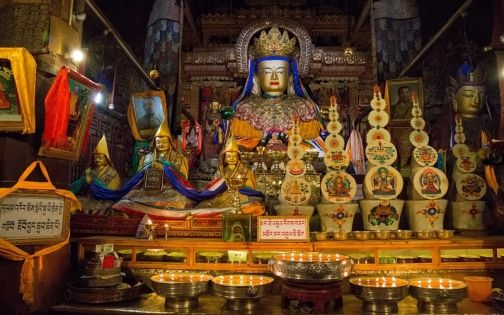
Tibetan Buddhism Bodhisattvas
Pilgrimage Culture Is Far More Intense Than Many Expect
Many travelers are surprised by the physical dedication involved in Tibetan pilgrimage traditions.
At places like Jokhang Temple in Lhasa, pilgrims may spend hours or even entire days performing full-body prostrations. Some pilgrims travel hundreds of kilometers across the plateau by repeatedly bowing to the ground along the route.
For visitors unfamiliar with Tibetan Buddhism, this level of devotion can feel strikingly powerful.
Pilgrimage in Tibet is not symbolic tourism—it is an active spiritual practice deeply connected to personal belief, karma, and daily identity.
Travelers visiting Mount Kailash especially notice this atmosphere. Many Tibetans save money and prepare for years to complete a single pilgrimage journey around the sacred mountain.
Understanding this context changes how travelers experience these destinations. They stop feeling like tourist attractions and begin to feel like living spiritual spaces.

Monasteries Are Often More Dynamic Than Travelers Expect
Some travelers arrive expecting monasteries to feel silent and meditative. While quiet moments certainly exist, Tibetan monasteries can also feel highly active and energetic.
Monks debate philosophy in courtyards using dramatic hand gestures and loud vocal exchanges. Prayer ceremonies involve chanting, horns, drums, and deep rhythmic sounds that fill entire assembly halls.
During festivals, monasteries become even more intense, with crowds of pilgrims, religious dances, giant thangka displays, and long ceremonial gatherings.
Rather than minimal or restrained, Tibetan Buddhist spaces often feel visually rich and emotionally expressive.
Walls are covered with colorful murals, butter lamps flicker constantly, and the smell of incense fills the air. For many travelers, the sensory intensity becomes one of the most memorable parts of visiting Tibet.
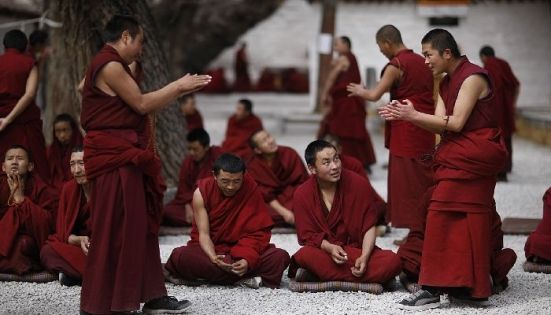
Monks Debating at Sera Monastery
Tibetan Buddhism Is Closely Connected to Nature
Another major difference travelers notice is the relationship between spirituality and landscape.
In Tibetan Buddhism, mountains, lakes, caves, and natural sites are often considered sacred. Certain peaks are believed to be homes of deities or spiritually significant locations.
This means nature itself becomes part of religious experience.
Travelers may notice:
- Prayer flags placed on mountain passes
- Pilgrims walking around sacred lakes
- Locals throwing wind horses into the air for blessings
- Restrictions on climbing certain sacred mountains
Even famous scenic locations like Yamdrok Lake or Mount Kailash are not viewed only as beautiful landscapes by Tibetans—they carry deep spiritual meaning.
For travelers, this changes how the environment feels. Scenery becomes connected to belief rather than existing only as visual attraction.
The Visual Symbolism Is More Complex Than Many Travelers Realize
Many visitors initially see Tibetan Buddhist imagery as decorative or exotic, but most symbols carry specific meanings.
Prayer flags are not simply colorful fabric. Prayer wheels are not souvenirs. Mani stones, white stupas, yak butter lamps, and hand gestures all have religious significance.
Even the direction people walk matters.
For example:
- Tibetans traditionally walk clockwise around monasteries and sacred sites
- Prayer wheels should also be spun clockwise
- Touching religious objects casually may be considered disrespectful
Learning small cultural details helps travelers interact more respectfully and avoid unintentionally inappropriate behavior.
Travelers Often Underestimate the Emotional Atmosphere
One aspect many travelers do not anticipate is the emotional impact Tibetan Buddhism can have during a journey.
Even people without religious backgrounds often describe Tibetan monasteries and pilgrimage sites as emotionally intense places.
Part of this comes from the environment itself:
- High altitude
- Incense-filled temples
- Continuous chanting
- Ancient architecture
- Visible devotion from pilgrims
Combined together, these elements create an atmosphere that feels very different from ordinary tourism.
Many travelers find themselves slowing down naturally, observing more quietly, and paying closer attention to the cultural environment around them.
Respect Matters More Than Perfect Understanding
Travelers do not need to become experts in Tibetan Buddhism to appreciate Tibet respectfully.
Simple behaviors make a significant difference:
- Ask before photographing monks or pilgrims
- Walk clockwise around religious sites
- Avoid loud behavior inside monasteries
- Do not touch sacred objects casually
- Dress appropriately when visiting temples
Showing curiosity and respect is generally more important than having deep academic knowledge.
Local guides can also help explain symbolism, customs, and monastery etiquette during visits.
Why Understanding Tibetan Buddhism Improves the Travel Experience
Without cultural context, many travelers only see Tibet at the surface level: beautiful mountains, impressive monasteries, and colorful prayer flags.
But once travelers understand even basic aspects of Tibetan Buddhism, the experience becomes much richer.
A mountain pass covered in flags becomes more than a photo stop. Pilgrims circling Barkhor Street become part of a living religious tradition rather than background scenery.
This deeper understanding transforms Tibet from a sightseeing destination into a place with emotional and spiritual depth.
Experiencing Tibetan Culture Through Travel
Traveling through Tibet is not only about landscapes—it is also about understanding how spirituality shapes everyday life across the plateau.
Routes including Lhasa, Jokhang Temple, major monasteries, Namtso Lake, and Mount Kailash offer opportunities to experience different aspects of Tibetan Buddhist culture in real-world settings.
China Dragon Travel provides Tibet cultural tours and customized itineraries that combine scenic routes with deeper cultural experiences, helping travelers better understand the traditions they encounter along the journey.
More Than a Religious Experience
Tibetan Buddhism often feels very different from what travelers initially expect because it is not isolated inside temples or reserved for special occasions. It exists continuously across landscapes, roads, homes, monasteries, and daily routines.
For many visitors, this becomes one of the most memorable aspects of traveling in Tibet.
The experience is not simply about observing religion—it is about entering an environment where spirituality remains deeply connected to ordinary life, movement, nature, and community.