Planning a trip to Xinjiang can be exciting—but also confusing. One of the first decisions you’ll face is whether to choose a loop itinerary (returning to your starting point) or a one-way route (entering and exiting from different cities).
Both options are popular, but they offer very different travel efficiencies. If your goal is to save time and reduce unnecessary travel, understanding how these routes work is essential.
This guide compares Xinjiang loop tours and one-way routes in terms of time efficiency, logistics, and overall travel experience.
What Is a Xinjiang Loop Route?
A loop route starts and ends in the same city—most commonly Urumqi. You travel in a circular pattern, covering major destinations before returning to your starting point.
A typical Northern Xinjiang loop might include:
Urumqi → Tianchi Lake → Kanas → Hemu → Sayram Lake → Yining → Urumqi
This structure is easy to organize and widely used in group tours.

Autumn Scenery of Kanas in Xinjiang
What Is a One-Way Route in Xinjiang?
A one-way route means you start in one city and finish in another, without returning to the original point.
For example:
Urumqi → Kanas → Yining → Kashgar
Or the reverse:
Kashgar → Pamir Plateau → Aksu → Urumqi
This style is often used for longer or more in-depth trips across regions.
Which Option Saves More Time?
If we focus strictly on time efficiency, one-way routes usually have the advantage—but it depends on your itinerary.
Loop routes involve backtracking:
Because you must return to your starting city, part of your journey often overlaps with previous routes. This can mean long driving days that don’t add new scenery.
One-way routes reduce repeated travel:
You move continuously forward, covering more ground without retracing steps. This is especially valuable in Xinjiang, where distances are vast.
However, loops can still be efficient for shorter trips:
If you only have 5–7 days and are focusing on a specific region (like Northern Xinjiang), a loop may actually save time by simplifying logistics.
Time Efficiency Comparison
Here’s a practical way to think about it:
- Short trips (5–7 days): Loop routes are often more efficient and easier to manage
- Medium trips (7–10 days): Either option works, depending on flight availability
- Long trips (10+ days): One-way routes usually save more time and reduce redundancy
In longer itineraries, avoiding backtracking can significantly cut down total travel hours.
Transportation and Flight Considerations
Time efficiency in Xinjiang is not just about distance—it’s also about transport logistics.
Loop routes are simpler:
Round-trip flights (e.g., Urumqi in/out) are often cheaper and easier to book. Transfers are straightforward, and tour operators prefer this structure.
One-way routes require multi-city flights:
Flying into Urumqi and out of Kashgar (or vice versa) may cost more, but it saves days of overland travel.
In many cases, spending slightly more on flights can save one to two full days of driving.

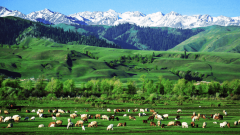
The vast grasslands of Xinjiang
Travel Experience vs Time Savings
Saving time doesn’t always mean a better experience—it depends on your priorities.
Loop routes feel more structured:
They are ideal for first-time visitors who want a clear, organized itinerary without worrying about complex logistics.
One-way routes feel more exploratory:
They allow you to experience the full scale of Xinjiang, moving from one region to another without repetition.
If your goal is efficiency plus depth, one-way routes often offer the best balance.
When Should You Choose a Loop Route?
A loop itinerary is usually the better choice if:
- You have limited travel time
- You want a simple itinerary with fewer logistics
- You are focusing on one region (e.g., Northern Xinjiang)
- You prefer lower flight costs and easier planning
For example, a Kanas loop from Urumqi is ideal for a one-week trip.
When Is a One-Way Route the Better Option?
A one-way route makes more sense if:
- You have 10 days or more
- You want to explore both Northern and Southern Xinjiang
- You want to avoid long return drives
- You are comfortable booking multi-city flights
This is especially useful for routes like Urumqi to Kashgar, which cover very different landscapes and cultures.
Practical Tips for Choosing the Right Route
Before deciding, consider these practical factors:
- Check flight prices for round-trip vs multi-city options
- Look at total driving hours, not just distances
- Avoid itineraries with excessive backtracking
- Balance time saved with cost and convenience
In Xinjiang, smart route design can make a significant difference in how much you actually enjoy the trip.
Choosing the Most Time-Efficient Xinjiang Itinerary
There is no single “best” option—only the one that fits your schedule and travel style.
If you want a simple, efficient trip within a limited timeframe, a loop route is often the best choice. If your priority is covering more ground with less repetition, a one-way route will save more time in the long run.
For most travelers with flexible schedules, a well-designed one-way itinerary offers the highest efficiency and the richest experience across Xinjiang’s vast landscapes.