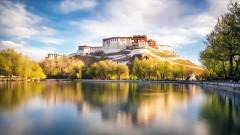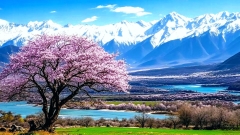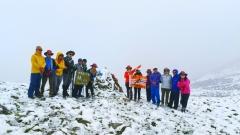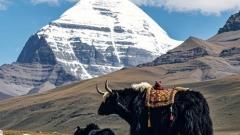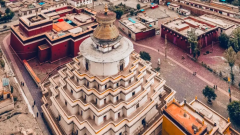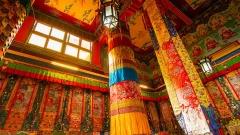

The Z324 train (Lhasa to Chengdu West) is hailed by railway enthusiasts as the “Most Color-Rich Scenic Train.”If travelling to Lhasa is for purifying the soul, then taking this train back to Chengdu is for allowing the soul a gentle landing amidst human warmth and everyday pleasures. Over the approximately 36-hour journey, the train acts as a magic needle, stringing together three of China’s most extreme geographical plates: the sanctity of the Qinghai-Tibet Plateau, the desolation of the Loess Plateau, and the mildness of the Sichuan Basin. You need only lie comfortably in your bunk and watch the world outside shift from ice and snow to yellow earth, finally dipping into mist-shrouded green bamboo groves. This is a grand tour of geography, climate, and cuisine.
Core Ticketing and Travel Information
The following is key travel information for Train Z324 running from Lhasa to Chengdu West, covering train operation details, ticket prices, ticketing rules, refund and modification policies, etc., for your trip planning reference.
Train Number: Z324 (Lhasa to Chengdu West), non-stop express train operated by China Railway Chengdu Bureau
Operation Data: Total distance of 3,028 km; total travel time of 36 hours and 3 minutes; departs Lhasa at 19:00 and arrives at Chengdu West at 07:03 on the third day
Ticket Prices:
- Hard seat: CNY 302.5
- Hard sleeper: upper CNY 627.5 / middle CNY 645.5 / lower CNY 663.5
- Soft sleeper: upper CNY 997.5 / lower CNY 1,034.5
Ticketing Rules: Official pre-sale period of 30 days; ticket release time for Lhasa Station is 10:00 daily; tickets must be purchased through official channels only, including the 12306 app/website and station ticket offices
Discount Policies:
- Children aged 6–14 are eligible for discounted child tickets
- Students may enjoy up to 4 discounted tickets per academic year with a valid student ID (advance qualification verification required)
- Disabled military personnel may purchase preferential tickets with relevant certificates
Refund & Modification Rules:
- Full refund for cancellations made 8 or more days before departure
- 5% fee for cancellations made 48 hours to 8 days before departure
- 10% fee for cancellations made 24–48 hours before departure
- 20% fee for cancellations made less than 24 hours before departure
- Only one ticket modification is allowed; fees are charged based on the time period
Key Stopover Stations: Nagqu (6-minute stop), Golmud (25-minute stop), Xining (20-minute stop), Lanzhou (23-minute stop), Guangyuan (27-minute stop)
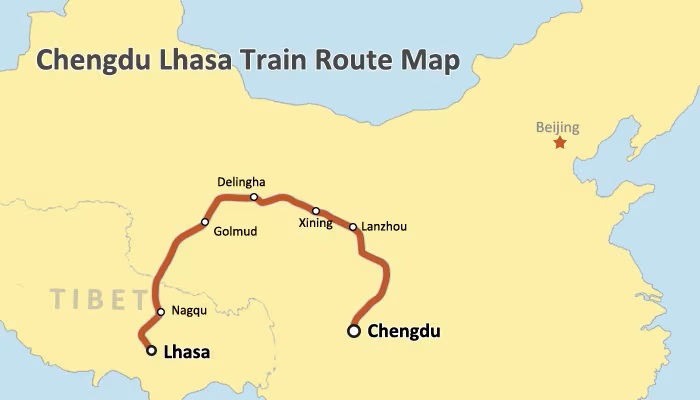
Chengdu Lhasa Train Route Map
The Exclusive Vibe of Z324: A “Homecoming” Train
This train differs significantly from other services leaving Tibet due to its strong “Sichuan flavor” and “human warmth.”
The Warmth of the Passenger Makeup: Besides tourists, the train carries many Sichuanese people who work in Tibet. As the train pulls out, you’ll find the atmosphere is noticeably more relaxed and lively than on the journey in. People chat in Sichuan dialect, share snacks, and discuss which hotpot restaurant they’ll hit first. This eagerness for home is highly infectious.
The Unique “Sichuan-Tibet Line” Vibe: It connects not just two geographical points, but two contrasting lifestyles: the devotion of Tibet and the leisure of Chengdu. Sitting on the train, you feel like you are gently sliding from a mythological world into a real world filled with the aroma of hotpot.
Car Hardware and Comfort: Settling In on a Moving Observation Deck
The Z324 train uses high-altitude oxygen-supplying cars, with hardware specially designed for long-distance travel. Knowing how to utilize the car effectively will turn these 36 hours into an enjoyable experience.
Bunk Choice: Soft Sleeper is the Best Balance of Scenery and Rest
Soft Sleeper (Highly Recommended):
Private Space: Four-person cabins with closable doors. For travelers tired after the high-altitude journey, the ability to close the door for sleep is the greatest luxury.
Scenic View: Soft sleeper windows are usually clean and large. You can watch the snow mountains and stars from your bed.
Facility Advantage: Equipped with independent oxygen ports and charging sockets. The Sichuan Basin is humid, and soft sleeper bedding tends to be drier and fluffier, enhancing comfort.
Hard Sleeper (High Value Option):
The Wisdom of the Middle Bunk: If choosing a hard sleeper, the middle bunk is strongly recommended. It avoids the noise of the lower bunk (used as a public seat during the day) and the effort of climbing to the top, while the height allows for perfect eye-level viewing of the scenery outside.
Practical Tips for Washing and Oxygen Supply
Consistent Oxygen Supply: The train provides a closed-loop oxygen supply system throughout the journey, and the air inside is fresh and humid. You don’t need to worry excessively about altitude sickness; this train is designed to guide you into “oxygen intoxication.”
Avoid Washroom Rush Hour: As the train approaches the Sichuan border, people will wake up to wash and prepare to disembark. It’s best to avoid the rush hour an hour before arrival, tidying up promptly to greet the humid air of Chengdu.
Part One Scenery: The Blue and White Symphony of the Qinghai-Tibet Plateau (Day One Daylight)
The first 12 hours after departure are the highlights of the Qinghai-Tibet Railway.
Nyenchen Tanglha Mountains and Qiangtang Grassland (Approx. 2 Hours after Departure)
Visual Focus: Leaving the Lhasa River Valley, the train quickly climbs. The main peak of the Nyenchen Tanglha Mountains will accompany the train for a long time. The permanently snow-capped peaks overlook the vast Qiangtang Grassland.
Highlights: Look closely at the black dots on the grassland—they are herds of yaks. The black yaks, white snow, and blue sky form the purest color palette of the plateau.
Cuona Lake: The Lake Closest to Heaven (Approx. 4-5 Hours after Departure)
Climax Moment: This is the most breathtaking few minutes of the entire route. The train runs tightly along the edge of Cuona Lake, at times just tens of meters from the water.
Color: The lake water is a stunning turquoise blue, like a gem. If you are lucky, you might see Black-necked Cranes gracefully walking along the shore. Get your camera ready and use burst mode; this spot is perfect for capturing wallpaper-worthy shots.
Dusk at the Kekexili (Towards Evening)
Peak Experience: As the train crosses the Tanggula Pass at an altitude of 5,072 meters, it coincides with sunset.
View: The setting sun dyes the wilderness a fiery orange, and the mountains are edged with gold. The train travels near the edge of the Kekexili Unmanned Zone, offering the chance to spot wildlife (Tibetan antelopes, wild yaks) running against the sunset—a deeply moving spectacle unique to the plateau.
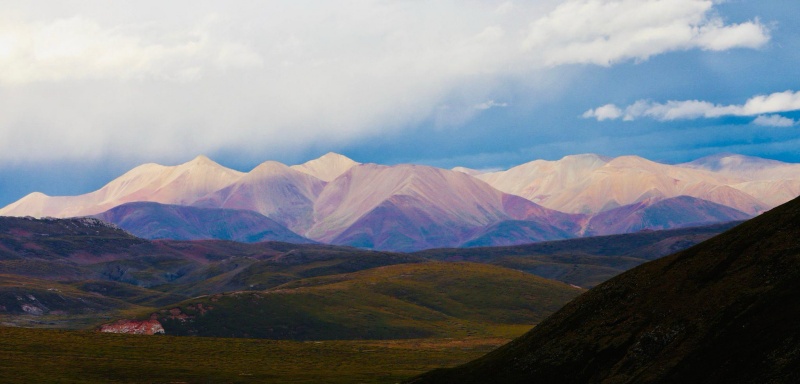
The Uninhabited Area of Qoqoqeri
Part Two Scenery: The Desolation and Depth of the Loess Plateau (Day Two Morning)
This is the key section that addresses your question. When you wake up on the second day, the scene outside the window will have dramatically reversed.
Gansu and Lanzhou: Where Yellow Earth Meets the Great River
Geographical Switch: After passing Xining, the train enters Gansu Province. The snow mountains and meadows disappear, replaced by the undulating Loess Hills.
Visual Impact: This is the western edge of the Loess Plateau. You will see the characteristic deep gullies, rugged yellow earth, and the slightly turbid tributaries of the Yellow River winding through the valleys. This dry, rugged, and deep yellow tone creates a strong visual contrast with yesterday’s blue and white.
Baoji-Chengdu Railway/Lanzhou-Chongqing Railway: Crossing the Geographical Divide
Terrain: As the train continues south, the loess scenery gradually transitions towards the Qinling Mountains. The mountains become steeper, and tunnels increase.
Significance: This marks the crossing of China’s north-south geographical divide. Each tunnel feels like a time-space portal, transporting you from the arid North to the humid South.
Part Three Scenery: Mists and Emerald Green of Ba and Shu Lands (Day Two Afternoon)
Crossing the Qinling Mountains, welcome to the Sichuan Basin.
Entering Sichuan: A Green Fairy Tale
Instant Change: As if by magic, the world outside suddenly turns green. The dry yellow earth is gone, replaced by dense forests, emerald bamboo groves, and mountains covered in lush vegetation.
Ink Wash Scroll: The Sichuan Basin is perpetually misty. The train winds through cloud-shrouded green mountains, dotted with white-walled, blue-tiled houses characteristic of western Sichuan. This humid, hazy green is the unique tenderness of the Ba and Shu lands.
The Changing Air: Awakening the Senses
Experience: Even inside the closed train car, you can almost feel the air becoming more humid. Your nasal passages, dry from the plateau journey, are instantly soothed. Watching the water-filled paddy fields outside, you’ll gain an intuitive understanding of the “Land of Abundance”(Tianfu zhi Guo).
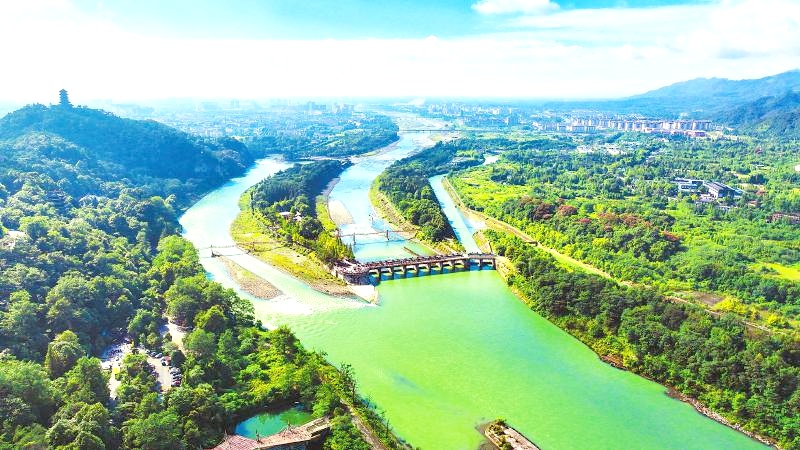
Dujiangyan
Dining on Z324: The Awakening of Flavors with Spice and Heat
Since the train’s destination is a world culinary capital, the dining culture on board is flavored with a hint of Sichuan spice.
Authentic Sichuan Cuisine in the Dining Car
Chef Team: The catering staff on Z324 are often from the Chengdu Railway Bureau, making Sichuan cuisine their specialty.
Must-Order: Strongly recommend ordering freshly stir-fried Twice-Cooked Pork (Huiguo Rou), Mapo Tofu, or Shredded Pork with Fish Flavor (Yuxiang Rousi).
Flavor: When the familiar aroma of spicy bean paste drifts over, paired with a bowl of steaming rice, it’s not just about satisfying hunger. It’s about reawakening your palate, dulled by the high altitude, in preparation for the hotpot feast awaiting you.
Station Stops and Self-Prepared Delicacies
Lanzhou Stop: If the train’s layover in Lanzhou allows, you might find vacuum-sealed beef noodles or Niang Pi (cold rice noodle salad) on the platform.
Self-Prepared Guide: It’s advised to bring “strong-flavored” snacks like pickled chicken feet (Paojiao Fengzhao) or spicy dried tofu. Eating spicy snacks and sipping a cold drink while watching the Loess Plateau or the Qinling Mountains roll by is a premium train travel experience.
The Body’s Marvelous Reaction: From Oxygen Deprivation to “Oxygen Intoxication”
The most magical part of this journey is the physiological change the body undergoes in response to the changing air pressure.
What is “Oxygen Intoxication”?
As the altitude drops from Lhasa’s 3,650 meters to Chengdu’s 500 meters, the oxygen content in the air increases significantly. Your body will feel an unprecedented sense of relaxation.
Symptoms: You may feel sleepy, drowsy, and generally lethargic—a feeling akin to being slightly tipsy.
How to Enjoy “Oxygen Intoxication”?
Go with the Flow: Do not resist the drowsiness. In the latter half of the journey (especially entering Sichuan), you will find the entire car becomes quiet and languid.
Best Activity: This is prime time for sleep; your sleep quality will be excellent. Alternatively, simply lean against the window and gaze as the bamboo groves and rivers pass by, enjoying this rare pace of “slow living.”
Frequently Asked Questions About Lhasa to Chengdu Train
Q1: Will there be sand or dust when the train passes through the Loess Plateau?
A1: The train is fully enclosed and air-conditioned, so there will be no dust inside. However, you can safely enjoy the magnificent view of the barren, yellow landscape through the window—a safe form of “exploration.”
Q2: Is this train suitable for seniors and children?
A2: It is very suitable. The slow descent from the plateau to the plain is much easier for the body to adapt to than the rapid pressure changes of flying, helping to relieve stress on the heart and lungs, as well as ear discomfort for children.
Q3: Are the train washrooms clean?
A3: The Z324 train is generally well-maintained. However, since the latter half (Gansu, Sichuan sections) sees high passenger traffic, it is recommended to bring disposable toilet seat covers and disinfecting wipes for peace of mind.
A Reliable Rail Link from Lhasa to Chengdu
Train Z324 offers a reliable and well-structured rail connection between Lhasa and Chengdu West, combining long-distance efficiency with clear and transparent ticketing rules. With defined departure times, a full range of seating and sleeper options, and flexible refund policies when planned in advance, it remains a practical choice for travelers moving between the Tibetan Plateau and Southwest China. By understanding the ticket release schedule, available discounts, and key stopover stations in advance, passengers can better plan their journey and enjoy a smoother, more comfortable overland travel experience across one of China’s most remarkable rail corridors.