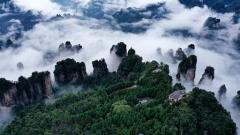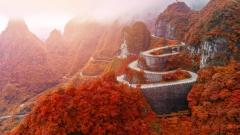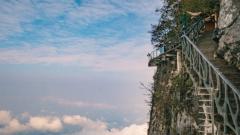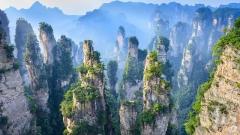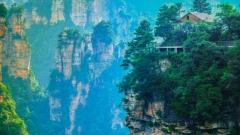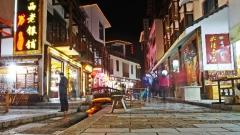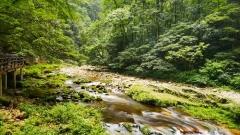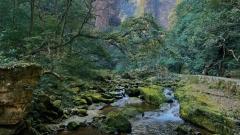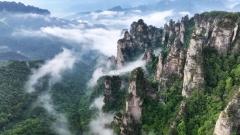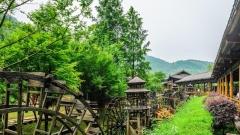

Zhangjiajie is famous for its quartz sandstone pillars, and weather conditions play a major role in shaping the overall sightseeing experience. Clear days offer wide panoramic views of the peak forests, while rainy or misty weather creates dramatic cloud-filled landscapes. In winter, snowfall transforms the mountains into a quiet and striking scene. Due to complex terrain and elevation differences, weather can vary significantly within the scenic area, making it essential for travelers to understand seasonal patterns before planning their visit.
Climatic Features and Annual Weather Overview of Zhangjiajie
Zhangjiajie is located in the northwest of Hunan Province and belongs to the mid-subtropical mountain-type monsoon humid climate. It has distinct four seasons and abundant rainfall, with a large temperature difference between mountainous areas and plains. According to the data of Hunan Meteorological Bureau, the annual average temperature in Zhangjiajie is 16-18℃ and the annual precipitation is 1400-1500 millimeters. Rainfall is mainly concentrated in spring and summer, among which April is the rainiest month of the year with a precipitation of about 236 millimeters.
Due to the complex terrain, the weather in Zhangjiajie often presents the feature of “a mountain has four seasons, and different weather within ten li”—it may be sunny at the foot of the mountain while raining on the top. The altitude difference in the scenic area exceeds 1000 meters, with an obvious vertical change in temperature. Therefore, it is necessary to carry rain gear and a thin coat with you when visiting in any season.
Practical Information:
- Dial 12121, the public welfare telephone of Hunan Meteorological Bureau, to query the three-day weather forecast trend of Zhangjiajie before departure
- Follow the WeChat official account of “Zhangjiajie Meteorology” to obtain real-time early warning information
- The weather in mountainous areas changes rapidly, so it is recommended to check the hourly weather forecast of the day every morning
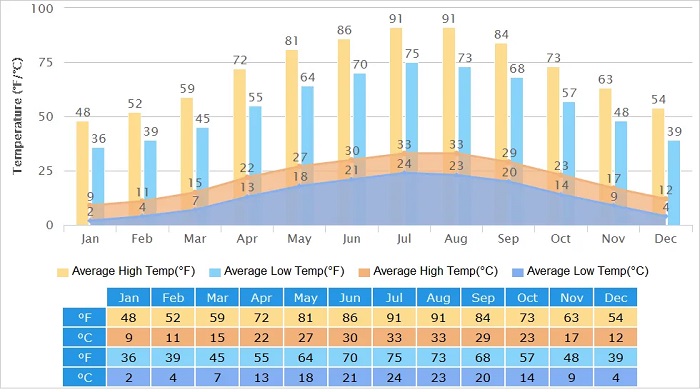
Zhangjiajie Weather by Month
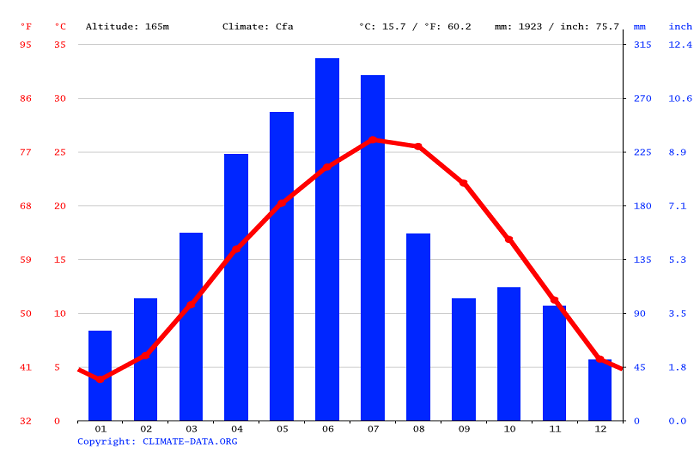
Annual Weather Overview of Zhangjiajie
Zhangjiajie Weather in Spring and Travel Tips
Spring is the season with the most lush vegetation in Zhangjiajie, but it is also one of the periods with the most abundant rainfall. The average temperature is 10-18℃ in March, 15-25℃ in April and 20-28℃ in May. April has the heaviest rainfall of up to 236 millimeters, and the spring rain is mostly shower, with a large area of sea of clouds often appearing after rain.
The most anticipated landscape in spring is the sea of clouds after rain. Mist surges in the valleys and the peak forest looms in and out, bringing a strong visual impact. From the middle and late April to the early May, wild azaleas bloom on Tianmen Mountain and Tianzi Mountain, with pink and white azaleas dotting the strange peaks all over the mountains, forming a unique scenery.
Suggestions on Dressing and Equipment:
- Upper wear: Long-sleeved T-shirt with waterproof jacket
- Lower wear: Comfortable long pants (avoid jeans, which are hard to dry when wet)
- Shoes: Non-slip hiking shoes or sports shoes
- Must-haves: Lightweight raincoat, waterproof bag to protect electronic products
Common Question from Tourists: Can we see the scenery on rainy days in spring?
Yes. On light rainy days in spring, the Golden Whip Stream is lined with fresh green plants, with fresh air and abundant stream water. A spectacular sea of clouds often appears after heavy rain. It is recommended to carry a lens cloth with you to take photos of the peak forest shrouded in mist.
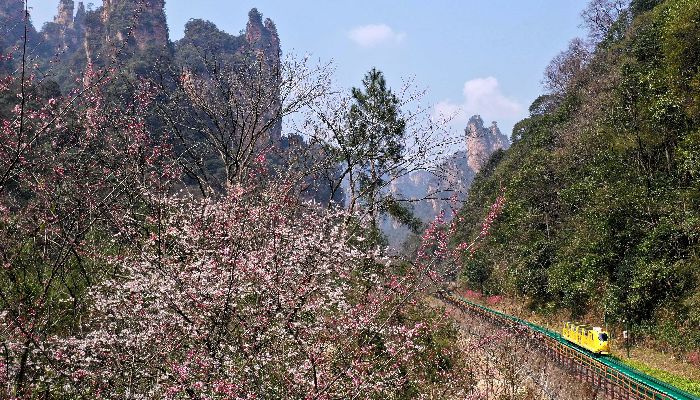
Spring Flowers in Zhangjiajie
Zhangjiajie Weather in Summer and Summer Resort Guide
The average temperature in Zhangjiajie in summer is 24-32℃, and the mountainous areas are 5-8℃ cooler than the urban area, making it a perfect summer resort. The average temperature is 28.8℃ in July and 29.2℃ in August, with a humidity of 70-80%, leading to a slightly hot body feeling. The plum rain season lasts from the middle and late June to the early July with frequent and heavy rainfall, while the rainfall decreases significantly in August, about 64.7 millimeters.
Practical Information:
- The average temperature in mountainous areas is 22-28℃, the water volume of Golden Whip Stream and Baofeng Lake is the largest throughout the year, and the waterfalls are magnificent
- The inside of Huanglong Cave is a constant temperature of 16℃, an excellent choice for summer cooling
Suggestions on Dressing and Equipment:
- Upper wear: Quick-drying short sleeves, sun protection clothing
- Lower wear: Quick-drying pants or shorts
- Must-haves: Raincoat, sunscreen, hat, sunglasses, mosquito repellent
- Recommendation: Bring a pair of sandals or wading shoes for playing in the water
Summer Travel Tips:
The canyon streams have abundant water volume, and the water-friendly routes of Golden Whip Stream and Ten-Mile Gallery are comfortable. In case of heavy rain, some high-altitude scenic spots (such as Huangshizhai) may be shrouded in heavy fog, so it is recommended to visit the scenic spots at the foot of the mountain first and go up the mountain after the fog disperses. Torrential rain may lead to the temporary closure of some footpaths (such as Tianbofu in Yangjiajie). You can check the announcement on the official website of “Zhangjiajie Tourism” before departure.
Zhangjiajie Weather in Autumn – The Best Season for Viewing Scenery
Autumn is the season with the most stable weather and the highest visibility in Zhangjiajie. The average temperature is 25.2℃ in September, 18.9℃ in October and 14.8℃ in November. Rainfall decreases, with 47.1 millimeters in September, 62.6 millimeters in October and 71.1 millimeters in November. The sky is bright blue and the air is clear.
The red leaf viewing period is from the middle of October to the early November. The maple leaves on Tianzi Mountain and Yangjiajie turn red, and the ginkgo trees on Yuanjiajie turn yellow, forming a sharp contrast with the blue-gray stone peaks. The proportion of sunny days in autumn is over 70%, and the canyon under the Grand Canyon Glass Bridge is clearly visible, making it an ideal season for photography.
Dressing Suggestions:
- September: Summer clothes with a thin coat
- October: Long-sleeved T-shirt with a thick coat (jacket or windbreaker)
- November: It is cold in the morning and evening, so it is recommended to bring a sweater or light down jacket
- Shoes: Comfortable non-slip sports shoes
Tips for Avoiding Peak Tourist Season in Autumn:
The National Day Golden Week (October 1-7) is the most crowded period of the year for tourists. The number of tourists decreases by about 40% from the week after the National Day to the end of October, and the accommodation price drops by 20-30%, bringing a better travel experience.
Common Question from Tourists: Can we see the sea of clouds in autumn?
Yes. Light mist often appears in the early morning of autumn, and golden sunlight sprinkles on the peak forest at sunrise, which is suitable for photography. It is recommended to enter the scenic area before 7:00 a.m., when the group tours have not arrived yet, and you can enjoy the sea of clouds and sunrise alone.
Zhangjiajie Weather in Winter and Snow Scenery Guide
The temperature in Zhangjiajie is relatively low in winter, with an average of 0-10℃, and it is often below zero in high-altitude areas. The average temperature is 6.9℃ in December, 6.6℃ in January and 6.3℃ in February. After snow, the peak forest is covered with snow, dotted with rime and ice pendants, forming a landscape like an ink painting.
According to the feedback from on-site tourists, December to February of the next year is the high-incidence period of rime and snow scenery. The cableway of Tianmen Mountain passes through the sea of clouds, and the glass plank road is more precipitous after being covered with snow; the “Hallelujah Mountain” on Yuanjiajie is more peculiar under the outline of snow; you can enjoy the frozen valley alone along the Golden Whip Stream and listen to the stream flowing under the ice layer.
Winter Travel Notes:
- Warm keeping equipment: Down jacket, thermal underwear, Lei Feng hat (with ear protection), waterproof gloves, scarf, warm patch
- Anti-slip equipment: Crampons (available for rent at the entrance of the scenic area, about 10-50 CNY per pair), mid-cut non-slip hiking shoes
- Electronic equipment: Stick a warm patch on the mobile phone (it is easy to shut down at low temperature), power bank is a must-have
Winter Travel Reminders:
- The number of tourists is small in winter, about 10,000 person-times per day, lower than the 30,000 person-times in the peak season
- Ticket prices are discounted. The winter ticket for the Forest Park is 128 CNY (valid for 4 days), nearly 100 CNY cheaper than that in the peak season
- Some sections may be closed due to icing (such as the precipitous sections like “Reach the Sky in One Step” in Yangjiajie). You can call the scenic area customer service at 0744-5712189 to confirm before departure
- The sunrise is at about 7:30 and the sunset at about 17:30 in winter. It is recommended to enter the scenic area before 7:30 a.m. and go down the mountain before 16:00 to avoid slippery roads in the dark.
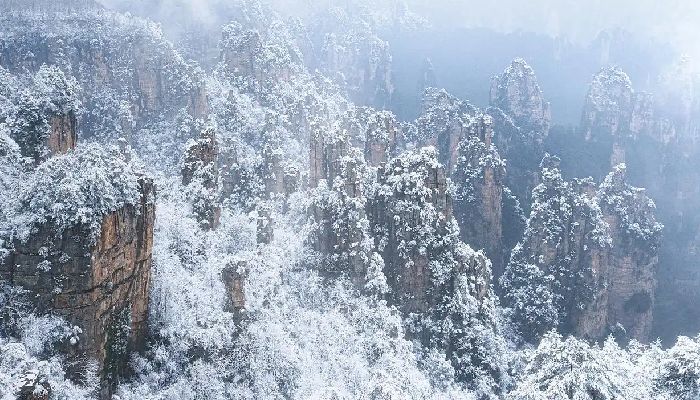
Snow Scenery in Zhangjiajie
Impact of Zhangjiajie Weather on Major Scenic Spots
The core scenic spots of Zhangjiajie include Yuanjiajie, Tianzi Mountain, Yangjiajie, Huangshizhai, Golden Whip Stream, Tianmen Mountain, etc., with different experiences in different weathers.
- Yuanjiajie and Tianzi Mountain: The viewing platforms on the top of the mountain are most easily affected by heavy fog. In case of heavy fog with low visibility, it is recommended to visit the scenic spots at the foot of the mountain first and take the Bailong Sky Ladder to the mountain after the fog disperses. After snow in winter, the sea of clouds and snow peak landscape here is the most shocking.
- Golden Whip Stream and Ten-Mile Gallery: The canyon routes are less affected by the weather, and the streams and vegetation are more fresh in the rain. The Golden Whip Stream is 7.5 kilometers long and known as “the most beautiful hiking route”. The stone steps are slippery on rainy days, so you need to pay attention to the moss-covered stone steps.
- Huangshizhai: There is a saying that “You can’t say you’ve been to Zhangjiajie without visiting Huangshizhai”. The top of the mountain is easily affected by mist and clouds. The view is the best on sunny days, and you may see the sea of clouds on cloudy days. In autumn, the ginkgo trees in Huangshizhai turn golden yellow, forming a strong visual contrast with the quartz sandstone peak forest.
- Tianmen Mountain: With a higher altitude, the weather changes more rapidly. There is often snow in winter, and the glass plank road may be closed due to icing. On the clear day after snow, the mountains are covered with snow and the sea of clouds surges. The cableway of Tianmen Mountain may be out of service due to strong wind and freezing weather, so you need to pay attention to the scenic area announcement before departure.
- Grand Canyon Glass Bridge: The experience is the best on sunny days in autumn, with the canyon under your feet clearly visible; it is more precipitous when covered with snow in winter, so you need to pay attention to the icing of the plank road. On rainy days, the glass bridge is surrounded by mist and clouds, as if floating in the clouds, with a unique feature.
How to Prepare Clothes and Equipment According to Zhangjiajie Weather
Travel in Zhangjiajie is mainly based on mountain climbing, and clothes and equipment directly affect the comfort and safety. The following is a summary of practical lists by season:
Spring Equipment List:
- Waterproof jacket (a must-have to deal with showers)
- Long-sleeved T-shirt with a thin fleece (easy to put on and take off)
- Non-slip hiking shoes (the stone steps are slippery after rain)
- Lightweight raincoat, waterproof bag (to protect mobile phones and cameras)
Summer Equipment List:
- Quick-drying clothes and pants (dry quickly and not stick to the body after sweating)
- Sun protection clothing, hat, sunglasses
- Mosquito repellent (there are many mosquitoes in mountainous areas)
- Portable raincoat (to deal with afternoon thunderstorms)
- Wading shoes or sandals (for playing in the water in Golden Whip Stream)
Autumn Equipment List:
- Long-sleeved T-shirt with fleece coat and jacket (layered dressing)
- Comfortable hiking shoes
- Camera with spare battery (the light is soft in autumn, a good time for photography)
- Insulated water cup (the mountainous areas get cooler gradually, hot water warms the body)
Winter Equipment List:
- Down jacket with thermal underwear
- Lei Feng hat, waterproof gloves, scarf
- Mid-cut non-slip hiking shoes with crampons
- Warm patches (stick on knees and the back of mobile phones)
- Insulated water cup (hot water is precious in the scenic area)
General Reminders:
Raincoats are more practical than umbrellas in any season, because it is difficult to hold an umbrella due to the strong mountain wind. A power bank is a must-have, as mobile phones consume power quickly at low temperatures. It is recommended to choose a waterproof backpack or one with a rain cover.
Traveling in Zhangjiajie on Rainy Days: Alternative Plans and Notes
Rainy days are common in Zhangjiajie, but the sea of clouds and mist scenery after rain have a unique style. According to the real experience of tourists, there are the following highlights on rainy days:
- Peaks shrouded in mist and clouds: The mountain peaks loom in and out of the mist, adding a mysterious atmosphere to scenic spots such as the peak wall in Yangjiajie and Tianzi Mountain
- Fresh and green vegetation: The rain washes away the dust, and the Golden Whip Stream is lined with bright green plants with high saturation
- Magnificent waterfalls and streams: Landscapes such as the Tiaoyutan in Golden Whip Stream are more magnificent, and the waterfall of Baofeng Lake has abundant water volume
- Sea of clouds wonder: A large area of sea of clouds often appears after heavy rain or showers
Alternative Plans for Rainy Days:
- Prioritize visiting scenic spots at the foot of the mountain: Golden Whip Stream, Ten-Mile Gallery, Baofeng Lake and other spots are less affected by rainy days. Baofeng Lake Scenic Area is the most poetic on rainy days, with drizzle weaving ripples on the lake surface.
- Experience karst caves: Huanglong Cave and Longwang Cave are karst cave landscapes, unaffected by the weather. The inside of Huanglong Cave is a constant temperature of 16℃, where you can take a boat to tour the underground river to avoid the rain.
- Watch folk custom performances: The performances of Fox Fairy of Tianmen Mountain and Charm of Western Hunan in the urban area are held as usual on rainy days, allowing you to experience the Tujia culture.
- Adjust the travel sequence: In case of heavy rain, visit the scenic spots at the foot of the mountain first, and go up the mountain when the rain eases or the next day. When the visibility is low in heavy fog, prioritize visiting low-altitude areas.
Safety Reminders for Rainy Days:
- The stone steps are slippery on rainy days, avoid running or frolicking
- Do not stay by the river to prevent rising water
- In case of severe weather such as torrential rain and strong wind, follow the arrangement of the scenic area staff to take shelter in time
- Do not take the risk of walking on undeveloped wild roads on heavy fog days
Practical Tools to Check the Real-Time Weather in Zhangjiajie
To grasp the weather of Zhangjiajie accurately, the following methods are recommended:
- Mobile weather App: Search for “Zhangjiajie National Forest Park” or “Wulingyuan” to check the hourly forecast. Check the 3-day weather trend in advance to prevent rain in spring and freezing in winter.
- Official meteorological services: Dial 12121, the public welfare telephone of Hunan Meteorological Bureau, enter the front mailbox and press key 1 to get the weather forecast, and press key 3 to query the weather of tourist attractions such as Zhangjiajie.
- Official scenic area channels: Follow the WeChat official accounts of “Zhangjiajie Tourism” or “Tianmen Mountain Scenic Area” to obtain real-time weather and opening information. You can check the Weibo of “Tianmen Mountain Scenic Area” in winter to see the operation of the cableway.
- On-site consultation: Ask the local operators about the weather experience when checking in at hotels or inns, as they usually know it well.
- Local travel agencies: Well-established agencies in Zhangjiajie such as China Dragon Travel can also provide reference on recent weather and travel suggestions. Tour guides usually have real-time road conditions and weather information on hand.
Understanding Zhangjiajie Weather for a Better Travel Experience
Overall, Zhangjiajie can be visited year-round, but each season presents a different visual character. Spring and summer bring abundant rainfall and frequent cloud seas, autumn offers the most stable weather and clear visibility, while winter rewards visitors with snow-covered peaks and frosty scenery. With proper clothing choices and flexible planning, most weather conditions can be comfortably managed without affecting the quality of the trip.
For travelers unfamiliar with mountain weather or visiting Zhangjiajie for the first time, reliable local insights can be especially helpful. Some visitors choose to consult experienced operators such as China Dragon Travel for up-to-date weather references and planning support, ensuring a smoother and more informed journey.