
For travel enthusiasts longing for the sacred scenery of Tibet, the Chongqing to Lhasa train is an ideal choice to connect the prosperous city with the plateau secret land. Chongqing attracts countless tourists with its gorgeous night views, spicy hot pot and unique culture. Taking the train from here to Lhasa allows you to experience the dramatic changes in scenery from the Sichuan-Chongqing hills to the Qinghai-Tibet Plateau. This journey is not only a transportation displacement, but also an immersive scenery experience and cultural exploration. This article integrates the schedule, ticket prices, ticketing skills, transportation guide, along-the-way scenery, transfer plans and travel notes of the Chongqing to Lhasa train, providing comprehensive reference for travelers of different identities.
Stations on the Chongqing to Lhasa Train Z223
The core operating train for Chongqing to Lhasa is the Z223 air-conditioned express train. This train connects multiple provinces and cities, with a total operation time of 33 hours and 45 minutes and a total mileage of 3394 kilometers. It is one of the most stable operating trains on the Tibet route.
After departing from Chongqing West Station, the train passes through 6 major stations including Nanchong North, Guangyuan, Lanzhou, Xining, Delingha and Golmud, and finally arrives in Lhasa. Among them, the stay time at Guangyuan Station is relatively long, which is convenient for passengers to get off and move around; Golmud Station, as an important node to enter the Qinghai-Tibet Plateau, has a 25-minute stay time, allowing passengers to replenish supplies, adapt to the environment, and prepare for the subsequent plateau section.
Detailed Ticket Prices and Seats for the Chongqing to Lhasa Train
Ticket prices for the Chongqing to Lhasa train vary according to seat types. Seats with different comfort levels can meet the diverse needs of passengers. The specific ticket prices are as follows:
- Hard Seat: 302.5 yuan. There are 98 seats in the carriage, and the facilities are the same as those of ordinary green-skinned trains. Although the comfort level is limited for long-distance travel, it is convenient to communicate with passengers from all over the world and experience the most authentic travel customs. It is suitable for young tourists with limited budget who love socializing.
- Hard Sleeper: 627.5 yuan. It is divided into upper, middle and lower berths, with 6 people in one compartment. The space of the berths gradually widens from top to bottom. Hard sleeper balances comfort and cost-effectiveness, and is the first choice for most passengers. The lower berth is convenient for getting on and off, suitable for the elderly, children and passengers with large luggage; the middle and upper berths have stronger privacy and relatively affordable prices.
- Soft Sleeper: 997.5 yuan. There are 4 people in one compartment, with only upper and lower berths, equipped with closable compartment doors, which combines privacy and comfort. There is a small table and rest area in the compartment, which is convenient for passengers to relax, dine or communicate. It is suitable for passengers who pursue high comfort and pay attention to privacy or family travel groups.
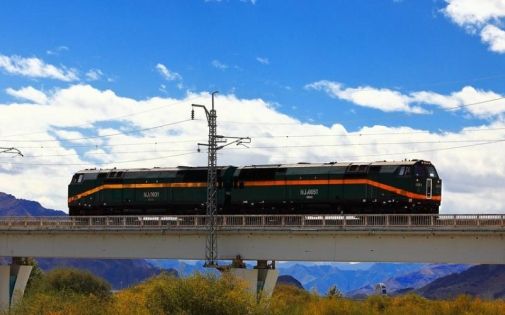
Trains on the Qinghai–Tibet Railway
Ticketing Guide and Notes for the Chongqing to Lhasa Train
Ticketing Methods for Different Passengers
Ticketing for Mainland Tourists
- Purchase through the 12306 official website or APP. Usually, reservations can be made 30 days in advance. The specific pre-sale period is subject to the website announcement. This is the most convenient ticketing method, supporting online seat selection, ticket refund and modification.
- Go to the railway station ticket hall or railway ticket agency to purchase tickets manually with ID card, which is suitable for passengers who are not familiar with online operations.
- Purchase tickets independently at self-service ticket machines in some railway stations. The operation is simple and can save queuing time.
- Purchase through third-party platforms such as Ctrip and Qunar. It should be noted that additional handling fees may be incurred, and the refund and modification rules need to be carefully confirmed.
- During the peak tourist season (June-August), when tickets are in short supply, you can entrust a travel agency to buy them. Although a service fee may be charged, the success rate is higher.
Ticketing for Hong Kong, Macao and Taiwan Tourists
- Tourists from Hong Kong and Macao can refer to the ticketing methods for mainland tourists, and need to provide Hong Kong and Macao Passes as valid documents.
- Taiwan tourists need to purchase tickets with Taiwan Compatriot Permits and Tibet Entry Permits. It is recommended to buy them through a travel agency to facilitate the simultaneous handling of Tibet Entry Permit related procedures.
Ticketing for Foreign Tourists
- Tickets can be purchased at railway stations or ticket agencies, but valid passports and Tibet Entry Permits must be provided at the same time. Since the processing of Tibet Entry Permits takes about 10 days and tickets go on sale 30 days in advance, it is easy to have a shortage of tickets when purchasing independently.
- To purchase tickets through the 12306 official website, you need to complete real-name registration and verification first, and have taken a train with an ID card once. Foreign tourists can ask friends in the mainland to help purchase.
- The most convenient way is to buy through a local Tibet travel agency. Because foreign tourists need to enter Tibet in groups, the travel agency can handle the Tibet Entry Permit and tickets simultaneously to ensure a smooth trip.
Ticketing Notes
- Passengers who purchase tickets independently are advised to arrive at the station at least 2 hours in advance to collect paper tickets. During the peak season, there are many people queuing to collect tickets to Lhasa, so as to avoid missing the train due to rushing for time.
- The Tibet Entry Permit is a necessary document for tourists from Hong Kong, Macao, Taiwan and foreign countries. The staff will check it irregularly during the train operation. It needs to be printed according to A4 standard and kept properly, and must not be lost.
- Tickets are in short supply during the peak season. It is recommended to purchase tickets immediately after confirming the itinerary to avoid affecting the travel plan due to ticketing problems.
Transportation Connection Guide for the Chongqing to Lhasa Train
Going to Chongqing West Station
The departure station of the Chongqing to Lhasa train is Chongqing West Station, located at No. 168 Fengzhong Road, Shapingba District, Chongqing. It can be reached by various transportation methods:
- Subway: Take Line 5 or the Rail Transit Loop to Chongqing West Station Subway Station. After getting off, you can walk to the waiting hall, which is convenient and time-saving.
- Bus: Many bus routes pass through Chongqing West Station, including No. 213, 325, 415, 441, 473, 499, 526, High-speed Railway Express G01 Night Shift, Airport Express K06, covering many areas of the urban area.
- Taxi/Online Car-Hailing: Directly enter the destination “Chongqing West Station” to take a taxi. It is flexible and convenient, suitable for passengers with large luggage.
- Group Transfer: For group travel, you can arrange a tourist bus for unified transfer through a travel agency, which is worry-free and efficient.
Transportation from Lhasa Railway Station to Urban Area
Lhasa Railway Station is about 30 kilometers away from the urban area. The following three ways can reach the destination conveniently:
- Bus: There is a bus station on the east side of the square after exiting the station. Buses No. 86, 89 and 91 directly reach the Northern Suburb Passenger Station (passing through the Western Suburb Passenger Station), the Municipal Public Transport Company and the Eastern Suburb Passenger Station respectively. The bus departure time is synchronized with the train arrival time. Even if you arrive late at night, there are still trains. The ticket price is 1-2 yuan.
- Taxi/Online Car-Hailing: You can find the waiting area immediately after exiting the station, which can directly reach hotels or scenic spots in the urban area, avoiding carrying luggage and walking, and reducing the physical burden of arriving at the plateau for the first time. The fare is about 50-80 yuan, which is adjusted according to the destination.
- Travel Agency Pick-up Service: Passengers who have booked travel agency products can enjoy free pick-up service. Tibetan tour guides will wait at the exit square and arrange a coach to directly reach the hotel, which is considerate and convenient for adapting to the plateau environment.
Stations and Scenery Along the Chongqing to Lhasa Train
The Chongqing to Lhasa train passes through Sichuan, Gansu and Qinghai provinces, and finally arrives in Tibet. During the 3394-kilometer journey, the scenery changes continuously with the terrain. Among them, the section from Lanzhou to Golmud and from Nagqu to Lhasa runs during the day, which is the golden time to enjoy the scenery; the section from Chongqing to Lanzhou and from Golmud to Nagqu runs at night, which is convenient for passengers to rest and store energy.
Lanzhou to Xining to Golmud Section
When the train arrives in Lanzhou, it is nearly early morning. The typical northwest scenery appears outside the window. The rugged Loess Plateau and the winding Yellow River set off each other, with cave dwellings scattered among them, showing the grandeur and simplicity of the northwest.
After passing Xining, you will be greeted by the long-awaited Qinghai Lake scenery. Especially in July and August, the lake is full of flowers, hundreds of birds are flying, and flocks of sheep and yaks are scattered on the meadow like stars, forming a picturesque scenery with the blue sky and white clouds. During the stay at Xining Station, you can also taste the local characteristic highland barley yogurt and feel the sweet and mellow flavor.
Continuing westward, the scenery gradually transitions to Gobi and desert, the terrain gradually rises, the air becomes fresher, and the vast sky and earth are full of a sense of vastness, making people can’t help but sigh at the grandeur of nature.
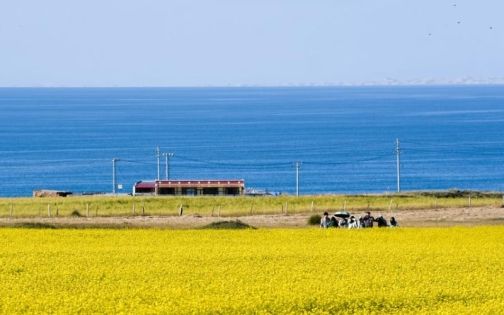
Qinghai Lake
Nagqu to Lhasa Section
Nagqu, with an altitude of 4547 meters, is an important station before arriving in Lhasa. Along the line, you can see the sacred Cuona Lake at the foot of the Tanggula Mountains. The lake and the high mountains set off each other, with abundant water and grass, and the scenery is magnificent. In summer, the Qinghai-Tibet Plateau dawns at about 5:30 in the morning. If you are lucky, you can enjoy the beautiful scenery of the morning light sprinkling on the lake. The lake water shimmers like a fairyland.
After the train passes the Lhasa River, Lhasa, the “City of Sunshine”, comes into view. Tibetan-style buildings are scattered in an orderly manner, and prayer flags are fluttering. A strong religious and cultural atmosphere comes to the face, marking that this journey on the sky road is about to end successfully.
Travel Guide and Notes for the Chongqing to Lhasa Train
Document and Luggage Specifications
Document Carrying: Mainland tourists need to carry ID cards, Hong Kong and Macao tourists need to carry Hong Kong and Macao Compatriots Travel Permits, Taiwan tourists need to carry Taiwan Compatriot Permits and Tibet Entry Permits, and foreign tourists need to carry passports and Tibet Entry Permits to ensure that the documents are complete and valid.
Luggage Requirements: It is recommended to avoid carrying oversized luggage for easy placement on the luggage rack or under the berth; the amount of liquid items carried should not exceed 50ml. Do not carry prohibited items such as knives, fuels and oxygen cylinders; for national restricted transport items, relevant transport certificates from the competent department need to be provided.
Luggage Arrangement: Put commonly used items on the train (such as toiletries, medicines, snacks) into a backpack separately for easy access at any time, reducing the trouble of frequently opening the luggage.
Response to Altitude Sickness
The Qinghai-Tibet Plateau is a low-oxygen area, and passengers may experience varying degrees of altitude sickness. It is recommended to have a physical examination before traveling and take anti-altitude sickness drugs (such as Rhodiola rosea) in advance under the guidance of a doctor. The train provides diffuse oxygen supply and independent oxygen inhalation services between Golmud and Lhasa. If you feel dizzy, weak and other discomfort, you can consult the staff in time.
During the train ride, avoid strenuous exercise, rest more, replenish water in small amounts and multiple times, eat a light diet, avoid greasy and spicy food, and do not drink alcohol or smoke to reduce the physical burden. After arriving in Lhasa, avoid walking fast, running or doing physical work in the first three days, and gradually adapt to the plateau environment.
Carriage Facilities and Services
Catering Services: The train is equipped with a dining car that provides three meals a day. At the same time, there are mobile dining cars selling steamed buns, steamed buns, boxed meals, snacks, instant noodles and drinks. The supply time and seats of the dining car are limited. It is recommended that passengers can bring some dry food, fruits and chocolates to supplement energy during the trip.
Charging Facilities: There are sockets in the soft sleeper compartments, and charging jacks are also equipped under the corridor seats and on both sides of the washing table. Some jacks may be faulty. It is recommended to carry a power bank and ensure that electronic devices are fully charged before boarding the train.
Other Notes: Smoking is prohibited in the carriage throughout the journey, and smoking passengers must strictly abide by the regulations; pay attention to the stay time when stopping at the station, and do not leave the train without permission; the temperature difference between inside and outside the car is large, so do a good job of keeping warm to prevent colds, so as not to aggravate altitude sickness.
Essential Items List
Documents: Carry relevant documents such as ID card, Hong Kong and Macao Pass, Taiwan Compatriot Permit, passport and Tibet Entry Permit according to your identity. It is recommended to prepare electronic backups.
Medicines: Anti-altitude sickness drugs (Rhodiola rosea, Gaoyuan’an, Gaoyuankang Capsules), special cold medicines, band-aids, gastrointestinal medicines, antidiarrheal medicines, motion sickness medicines, etc., to cope with various emergencies.
Clothing: Warm clothing (windproof jacket, down jacket, thick sweater) to adapt to the day and night temperature difference on the plateau; sun protection clothing (sun protection shirt, arm sleeves) to resist strong ultraviolet rays; bright-colored photo-taking clothing to facilitate taking good travel photos.
Electronic Devices: Mobile phone, camera, charger, power bank, memory card. If you plan to take starry sky photos, you can carry a flashlight.
Food and Daily Necessities: Insulated water cup (the train provides 24-hour hot water), fruits such as apples and oranges to replenish water and vitamins; quick-drying towels, wet wipes, toiletries, moisturizing skin care products, facial masks; sun protection products such as sun hats, sunglasses, high-factor sunscreen, and anti-ultraviolet lip balm; disposable fresh-keeping bags, packing bags, waterproof bags to facilitate luggage arrangement.
Embark on an Unforgettable Journey on the Sky Road
The Chongqing to Lhasa train is not only a means of transportation, but also a ten-thousand-mile scenery feast and cultural exploration journey. From the warm customs of Sichuan-Chongqing to the vastness of Qinghai-Tibet, from the prosperous city to the sacred plateau, this journey can bring an unprecedented experience. Whether you choose a direct train or a transfer plan, mastering practical information such as schedules, ticketing and transportation in advance, and making good preparations for plateau adaptation, you can smoothly embark on this unforgettable journey on the sky road and gain touch and surprises during the ten-thousand-mile journey.