
For centuries, reaching Mount Kailash meant weeks of hard overland travel across some of the most remote terrain on the planet. Today, that journey can be compressed into a matter of hours, thanks to a small but vital airport tucked into the far western reaches of the Tibetan Plateau. If you’re planning a pilgrimage or trek to this sacred mountain and wondering whether flying is an option, the short answer is: almost. There’s no runway at the base of Kailash itself, but with the right combination of flights and overland transfers, you can be standing in its shadow within a single day.
Why there’s no direct flight to Mount Kailash
Mount Kailash sits in one of the most isolated corners of Tibet, surrounded by high desert plateau, distant mountain ranges, and very few permanent settlements. Building an airport close enough to the mountain to allow a genuinely “direct” flight simply isn’t feasible given the terrain and the remoteness of the region. Instead, the closest air access point is Ngari Gunsa Airport, a facility that serves the entire Ngari Prefecture of western Tibet.
Ngari Gunsa Airport is roughly 200 kilometers from Mount Kailash, which translates to about two and a half hours by road once you land. That may sound like a long final stretch, but compared to the days-long overland journeys pilgrims once faced, it’s a remarkably fast way to reach the region. Depending on where your journey originates, the combination of flying to Ngari and then driving onward to Darchen — the small town that serves as the gateway to the Kailash trek — can get you to the mountain in as little as five to six hours door to door.
There are currently three realistic ways to approach Mount Kailash by air: flying in from Lhasa, flying in from Kashgar, or, for a smaller number of travelers, taking a helicopter-assisted route from Nepal. Each has its own advantages depending on where your trip starts and how your itinerary is structured.
Flying to Mount Kailash from Lhasa
For most international travelers, Lhasa is the natural starting point for a Mount Kailash trip, and it’s also the busiest gateway for flights into the Ngari region. The route between Lhasa Gonggar Airport and Ngari Gunsa Airport is short — around two hours in the air — and it’s flown regularly enough that it can be built into most Kailash itineraries without much difficulty.
What the flight looks like
Flights on this route are typically operated by Tibet Airlines, and they follow a consistent pattern: departures happen early in the morning, almost always before 8:00 a.m., with arrival into Ngari before midday. This scheduling isn’t arbitrary — mountain weather in western Tibet tends to be calmer in the early hours, and airlines schedule around that window to reduce the chances of delays caused by wind or turbulence later in the day.
Once you land at Ngari Gunsa, the adventure isn’t quite over. You’ll still need a further two and a half hours by road to reach Darchen, the small town at the foot of Mount Kailash where most treks and pilgrimages officially begin. Even so, arriving in Darchen by early-to-mid afternoon on the same day you left Lhasa is entirely realistic.
Flight frequency and seasonality
Flight frequency on the Lhasa–Ngari route changes noticeably with the seasons. During peak travel months, roughly May through October, airlines typically run two to three flights a day in each direction, reflecting the surge of pilgrims and trekkers who time their trips around favorable weather and festivals like Saga Dawa. In the low season, from November through April, that frequency drops to just one or two flights a day, and travelers should expect fewer options and a higher chance of needing to plan around available seats.
Typical Lhasa–Ngari schedule
Because airlines periodically adjust departure times, it’s worth checking current schedules close to your travel dates. As a general guide, flights from Lhasa to Ngari tend to depart in the 7:30–8:00 a.m. window and arrive by around 9:30–10:00 a.m., with the return flights from Ngari back to Lhasa departing shortly after, around mid-morning, and landing back in Lhasa before lunchtime. This tight turnaround structure allows the same aircraft to complete a round trip each day, which is part of why seats can be limited during busy periods.
Why this route is so popular
The Lhasa route works well for a simple reason: most Tibet travel already funnels through Lhasa, since it’s the primary hub for permits, guides, and onward travel arrangements. Combining a short flight to Ngari with the existing infrastructure of a Lhasa-based Tibet tour means less time spent on long-distance overland driving and more time available for the trek itself, acclimatization, or exploring other parts of the plateau.
Flying to Mount Kailash from Kashgar
For travelers approaching Tibet from the west — often those coming through Xinjiang or combining a Kailash trip with a Silk Road itinerary — Kashgar offers the shortest flight connection to the Kailash region.
A faster flight, but less frequent
The flight from Kashgar’s airport to Ngari Gunsa takes only about an hour and a half, making it the quickest airborne leg of any route to Mount Kailash. However, this convenience comes with a trade-off: the route isn’t flown daily by every carrier. Several airlines operate on this corridor, but between them, there’s usually at least one flight available per day, though the specific carrier and timing can shift, so it’s important to check current schedules well ahead of your trip rather than assuming a fixed timetable.
After landing
As with the Lhasa route, arriving at Ngari Gunsa is only part of the journey. From the airport, it’s another roughly two-and-a-half-hour drive to reach Darchen. Travelers flying in from Kashgar in the late morning can generally expect to arrive in Darchen by mid-to-late afternoon the same day.
Typical Kashgar–Ngari schedule
Flights on this corridor tend to depart Kashgar in the mid-morning, broadly in the 9:45–11:30 a.m. range, arriving in Ngari roughly an hour and a half later. Return flights from Ngari back to Kashgar generally leave around midday, arriving back in Kashgar in the early-to-mid afternoon. Because service isn’t guaranteed every single day, building in a little schedule flexibility — or a backup day — is a sensible precaution for anyone routing through Kashgar.
Who this route suits best
This option is particularly useful for travelers who don’t want to route everything through Lhasa, or who are combining Kailash with a broader trip through China’s far west. It’s also a practical choice if your overall itinerary already has you in Xinjiang and you’d rather avoid backtracking east to Lhasa before heading toward Kailash.
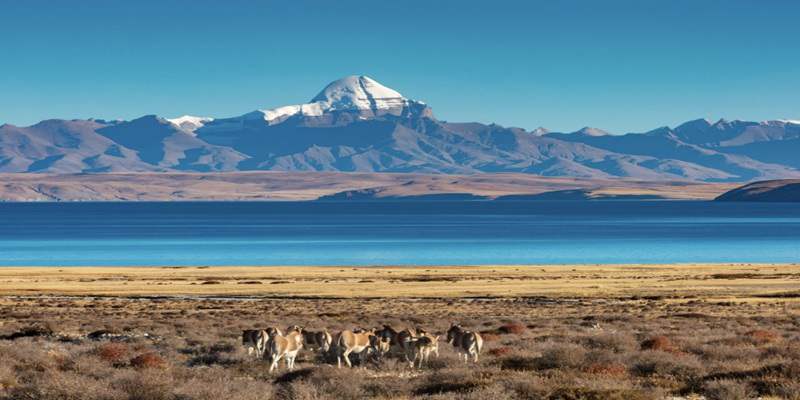
Mount Kailash
Flying to Mount Kailash from Kathmandu
Travelers coming from Nepal — a common starting point for pilgrims from India and Nepal in particular — have a different kind of “flight” option, though it’s important to understand its limitations. There is no direct flight from Kathmandu into the Kailash region. Instead, some pilgrimage operators arrange a helicopter-assisted route that shortens, but doesn’t eliminate, the overland component of the journey.
How the helicopter route works
This route typically starts with travel from Kathmandu to Nepalgunj, followed by a roughly one-hour flight to Simikot in far western Nepal. From Simikot, a short helicopter flight — around 20 minutes — carries travelers to the border village of Hilsa. From there, the journey continues by land, crossing into Tibet and driving onward to Darchen, where the Kailash pilgrimage itself begins.
Why this route is different from the others
Unlike the Lhasa or Kashgar options, this isn’t a conventional airport-to-airport flight; it’s a multi-stage journey that combines domestic Nepali flights, a helicopter hop, and a land border crossing. It’s also logistically more complex and typically arranged through specialized pilgrimage operators rather than booked independently. For these reasons, it tends to be used primarily by pilgrims from Nepal and India following the traditional Kailash Manasarovar Yatra route, rather than by general international tourists looking for the fastest way to the mountain.
If your priority is efficiency and a straightforward booking process, the Lhasa or Kashgar routes are generally the more practical choice for most travelers.
How to book your flight to Ngari
Flights to Ngari Gunsa Airport can be booked in a couple of different ways. Some travelers book directly through the operating airline’s official channels. However, many international visitors find it easier — and safer, from a logistics standpoint — to have their flight arranged together with their broader Mount Kailash tour package, since flights to this remote region are closely tied to permit requirements and guided travel arrangements in Tibet.
A few practical points are worth keeping in mind when booking:
Seats on flights to Ngari are limited, since aircraft serving this route tend to be smaller than those used on major domestic Chinese routes. During high-demand periods — particularly around the Saga Dawa Festival and the summer travel season — seats can sell out well in advance. Booking as early as possible is strongly recommended if your travel dates fall within these windows.
You’ll also need specific documentation to board a flight into the Kailash region. A valid passport is required, along with a Tibet Travel Permit, which is checked at the airport before boarding. Since foreign travelers cannot independently obtain a Tibet Travel Permit — it must be arranged through a licensed travel agency — this is another reason many visitors choose to book their Ngari flight as part of an organized tour rather than separately.
Is it safe to fly directly to Mount Kailash?
This is one of the most important questions to consider before booking a flight to Ngari, and the honest answer is: it requires caution. Ngari Gunsa Airport sits at an altitude of roughly 4,274 meters, making it one of the highest-altitude airports in China. Flying in directly means your body goes from sea level (or a lower elevation) to nearly 4,300 meters in the space of a couple of hours, which is a much faster ascent than what your body would experience on an overland route with gradual altitude gain.
This rapid change significantly increases the risk of altitude sickness, and it’s not something to take lightly. Symptoms can range from mild headaches and fatigue to more serious complications if ignored.
How to manage the risk
The key precaution, regardless of whether you fly in from Lhasa or Kashgar, is to slow down after landing. Resist the temptation to head straight into trekking activity. Instead, plan to rest at your hotel in Darchen and give your body time to adjust. Many experienced Tibet travel operators recommend building in an extra acclimatization day in Darchen before beginning the Kailash kora — a small addition to your itinerary that can make a meaningful difference in how your body copes with the altitude of the trek itself, which climbs even higher than Darchen.
If you already have some altitude experience from time spent in Lhasa (at roughly 3,650 meters) before your flight to Ngari, that prior acclimatization can help, but it’s not a substitute for taking it easy once you arrive in the Kailash region.
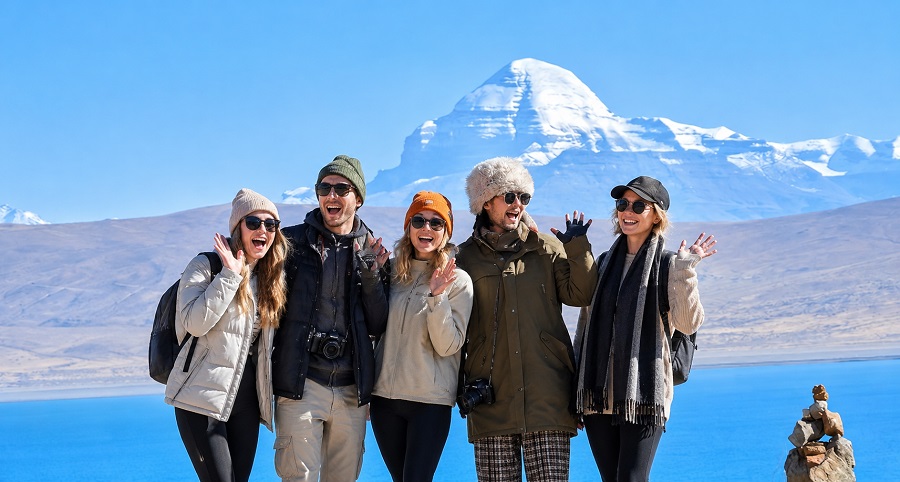
Mount Kailash Tourist Photos
Practical travel tips for flying to Mount Kailash
Beyond the safety considerations, there are a few logistical details that make flying to Mount Kailash smoother:
Morning departures are standard. Nearly all flights into Ngari depart in the morning and land around midday. This scheduling exists largely because mountain winds in western Tibet tend to pick up later in the day, and airlines aim to avoid flying through more turbulent afternoon conditions. Plan your pre-flight logistics — hotel checkout, transfers to the airport — with an early start in mind.
Budget time for the onward drive. Landing at Ngari Gunsa is not the end of the journey. The roughly two-and-a-half-hour drive to Darchen needs to be factored into your day, and it’s not a stretch to rush through, both for comfort and for altitude reasons. Treat the drive as part of your acclimatization window rather than an inconvenience to minimize.
Consider a one-way flight. If your schedule is tight but you still want to complete the Kailash trek without cutting corners on acclimatization, one strategy some travelers use is to travel overland to Kailash first — allowing for a slower, more gradual altitude gain — and then fly out afterward from Ngari. This approach front-loads the safer, slower ascent and uses the faster flight option only for the return leg.
Watch the weather, especially in shoulder seasons. Because of the high altitude and mountainous terrain surrounding Ngari, flights can be delayed or occasionally canceled due to strong winds or snow, and this risk rises in early spring and late autumn. If your trip falls during these transitional seasons, it’s wise to check forecasts in the days leading up to your flight and have a backup plan in case of delays — extra buffer days in your itinerary can prevent a weather delay from derailing the rest of your trip.
Confirm your permits before you fly. Since a Tibet Travel Permit is mandatory for boarding, make sure this documentation is fully sorted well before your flight date. Leaving this until the last minute is one of the most common — and avoidable — sources of stress for independent travelers heading to the Kailash region.
Choosing the right route for your trip
Ultimately, the best way to fly to Mount Kailash depends heavily on where your journey starts and how the rest of your Tibet itinerary is structured. If you’re already routing through Lhasa — which most international itineraries do, given its role as the main gateway for Tibet travel — the Lhasa–Ngari flight is usually the simplest and most reliable choice, backed by more frequent scheduling and easier integration with permit arrangements. If your trip is built around western China or a Silk Road route, Kashgar offers a faster flight and a logical extension of that itinerary. And for pilgrims following the traditional Nepal-based route, the Simikot–Hilsa helicopter option remains a meaningful, if more complex, path to the mountain.
Whichever route you choose, the flight itself is only the first step. The real journey — the trek around Mount Kailash, the time spent beside Lake Manasarovar, and the days of adjusting to one of the highest and most remote landscapes on Earth — begins once you reach Darchen.