
Bandir Blue Lake Self-Drive Photography Guide
A Blue That Stops You Mid-Turn on the Pamir Plateau
If you had to choose just one place in southern Xinjiang that is free, uncrowded, and visually overwhelming, Bandir Blue Lake would easily make the shortlist.
It doesn’t have the fame of Karakul Lake, nor the instantly recognizable dunes of White Sand Lake. Bandir Blue Lake reveals itself quietly—often right after a bend in the road—when an impossibly deep blue suddenly fills your windshield and makes you hit the brakes without thinking.
Cold, restrained, and unreal, it’s the kind of beauty that doesn’t shout, yet leaves a lasting mark.
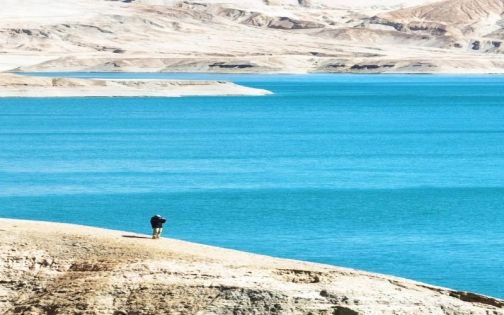
Bandir Blue Lake
1. Basic Information About Bandir Blue Lake
Bandir Blue Lake sits at an altitude of approximately 3,050 meters, about one hour’s drive from Tashkurgan County in Xinjiang’s Kashgar region, near Bandir Township.
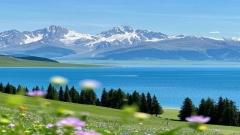
Its official name is Xiaban Reservoir, formed by glacial meltwater from the Tashkurgan River. What makes it extraordinary is the mineral-rich glacial water combined with the intense, clean high-altitude sunlight. Together, they create dramatic color shifts across the lake surface.
Depending on light, angle, and season, the water can appear deep navy, peacock blue, Tiffany blue, or even emerald green.
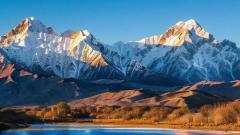
Surrounding the lake are pale gray rock formations, distant snow-capped peaks of the Kunlun and Pamir ranges, and almost no visual clutter. The landscape feels raw, minimalist, and cinematic—like a natural desktop wallpaper with zero filters.
2. Why Many People Fail to Capture the Blue
Here’s the honest truth:
If your photos look dark or dull, it’s rarely a camera problem.
Bandir Blue Lake is extremely demanding when it comes to conditions. To see its true color, three elements must align:
☁️ Weather: Clear Skies Are Non-Negotiable
Overcast, dusty, or hazy days will turn the lake almost black.
Sunlight is essential.
That said, the ideal scenario is clear skies with a few clouds—clouds add depth to the sky while preserving the lake’s vivid color.
⏰ Time: Don’t Arrive Too Early
Between 9:00–10:00 a.m., even on sunny days, the sun angle is too low. The lake will still look dark and flat.
The magic window begins after 11:00 a.m., once the sun clears the surrounding mountains.
👉 Best light: 11:00–14:30
At noon, the lake often reaches its most transparent, Tiffany-blue state.
🗺️ Position: Don’t Stand Right at the Shore
This is the most common mistake.
Near the shore, the water is shallow, revealing yellow lakebed sediment and greenish tones. The iconic blue appears over deep water, which means you need elevation and distance.
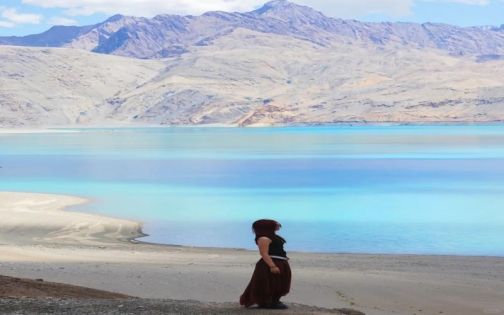
Bandir Blue Lake
3. Six Must-Stop Scenic Viewpoints Along the Drive
The real highlight of Bandir Blue Lake isn’t just the destination—it’s the road itself.
Here are six key pull-over points where the lake’s color and composition are at their best:
Spot 1️⃣|Turnaround Point
Wide, cinematic views with deep blue tones. Ideal for telephoto compression shots.
Spot 2️⃣|Lake Curve View
A transitional zone where blue fades into turquoise—great for shoreline compositions.
Spot 3️⃣|South Shore Cliff Platform
Elevated vantage point with strong depth. Many travelers see the lake’s true blue here for the first time.
Spot 4️⃣|Bandir Lake Bridge Overlook
One of the best compositions: blue lake + S-curve road + bridge. Perfect for horizontal framing.
Spot 5️⃣|North Shore Hillside (Highly Recommended)
Walk down the slope toward the lake while maintaining height.
This area overlooks deep water and consistently delivers the clearest Tiffany-blue tones.
Spot 6️⃣|Water-Edge Trees
Sparse vegetation provides foreground interest, adding scale and narrative to photos.
4. Don’t Miss This on the Way Back: “The Eye of the Pamirs”
After passing the official parking area, you’ll cross a bridge and enter Congling Tunnel No. 1.
🚗 As soon as you exit the tunnel, pull over safely.
Walk a few steps onto the roadside rocks and you’ll see what’s known online as “The Eye of the Pamirs.”
Lake, road, and mountains converge in a tight frame, creating intense visual pressure—one of the most popular short-video angles on Chinese social platforms.
Further along the descent from Panlong Ancient Road (about 10 minutes before the parking lot), the lake suddenly turns shockingly blue.
If the road is safe and wide enough—stop immediately.
These roadside views often look even better than the official viewpoint. You may also find wild black goji berries growing nearby.
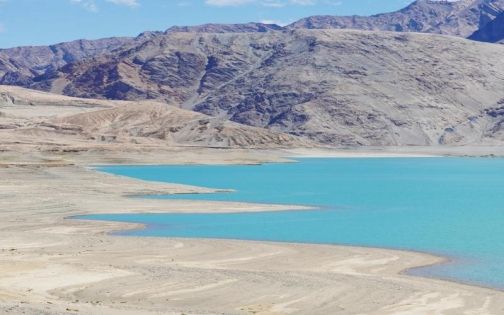
Bandir Blue Lake
5. Is the Official Parking Area Worth Visiting?
📍 Bandir Blue Lake Official Parking Area
- 🎫 Entrance: Free
- 🚗 Parking: Free (paved, fits ~50 cars)
- 🚻 Toilets available (a rare luxury in southern Xinjiang)
From here you can photograph:
- Snow-capped mountains + blue lake
- S-curve road
- The famous bridge (shoot from inside the car—no stopping)
However, due to light direction and signage, colors here can appear less intense than roadside viewpoints, and composition requires more effort.
6. Practical Photography & Travel Tips
- 🕐 Recommended visit time: 2 hours
- 📷 Lens: 24–200mm zoom covers most situations
- 🚁 Drone: Strongly recommended if conditions allow
- 🕶️ Sun protection: Mandatory—UV is intense at altitude
- 🫁 Altitude awareness: Avoid running or sudden exertion
Stay overnight in Tashkurgan town, preferably near the food street for convenience. On clear mornings, some hotels even offer views of sunrise over snow peaks.
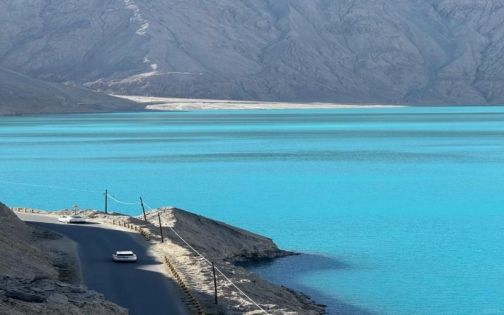
Bandir Blue Lake
7. Final Thoughts
After driving through southern Xinjiang, one lesson becomes very clear:
The best scenery is almost never at the official viewpoint.
Many “scenic spots” exist simply because the terrain allows parking. The moments that truly stay with you happen when you’re willing to pull over one more time, step out, and look again.
Bandir Blue Lake is like a sapphire hidden deep in the Pamirs.
Quiet. Unadvertised. Unforgettable.
Under the right light, at the right hour, it doesn’t just look beautiful—
it stops you in your tracks.
If you’re planning a Pamir or southern Xinjiang road trip, make sure you leave time for it.