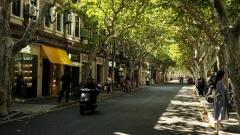

For many travelers, Beijing is all about the Forbidden City, the Great Wall, and imperial landmarks. But beyond the grand palaces and wide avenues, the city’s true character is hidden inside its historic hutongs. These narrow alleyways preserve the rhythm of old Beijing life in a way modern skyscrapers never could. Walking through the hutongs reveals traditional courtyard homes, local breakfast stalls, quiet teahouses, and centuries of history woven into everyday life. From the lively streets of Nanluoguxiang to the peaceful lakeside lanes around Shichahai, exploring Beijing hutongs is one of the best ways to experience the city beyond the usual tourist attractions.
Main Beijing Hutong Districts
Nanluoguxiang Hutongs
Nanluoguxiang is Beijing’s most famous hutong area, running north-south for 787 meters with 8 hutongs neatly arranged on each side. The main street is lined with specialty shops and creative stores. Qi Baishi’s former residence in Yuer Hutong is free to enter, preserving the painter’s later living environment. Wanrong’s former residence in Mao’er Hutong was the home of the last empress before her marriage, with architectural specifications rarely seen in residential alleys. Senggelinqin’s Prince Mansion in Chaodou Hutong is not open to the public, but the stone lions and mounting stones at the entrance show its former grandeur. The Central Academy of Drama in Dongmianhua Hutong is China’s highest institution for drama education, and the Iranian-style brick archway on campus is a hidden hutong gem.
Shichahai Hutongs
Hutong density around Shichahai is among the highest in Beijing. Ya’er Hutong on the north shore of Houhai preserves a relatively intact cluster of Qing dynasty courtyards, including Guanghua Temple, one of the largest lamaseries in Beijing. Yandai Xiejie on the east shore of Qianhai is one of Beijing’s narrowest hutongs, at its most narrow point wide enough for only two people to pass side by side. Scattered among the hutongs around Shichahai are several former residences of famous figures. The best way to explore Shichahai’s hutongs is on foot combined with a rickshaw ride; the rickshaw driver explains the history of each hutong, costing about 100 to 150 RMB per hour.
Dongjiao and Xijiaominxiang Hutongs
Dongjiaominxiang and Xijiaominxiang, collectively known as Jiaominxiang, are about 3 kilometers long, making them the longest hutongs in Beijing. After the Boxer Protocol was signed in 1901, this area became the legation quarter, where various countries built Western-style buildings of different styles. St. Michael’s Church is Beijing’s smallest Catholic church, with well-preserved Gothic architecture. The former French Post Office building features classic Art Nouveau style on its facade. The former Japanese Legation building now houses Beijing municipal government offices and is not open to the public. Jiaominxiang is the most architecturally unique of Beijing’s hutongs, forming a stark contrast with traditional courtyards. The section from Zhengyi Road to Taijichang Street, about 800 meters long, has the densest concentration of Western-style buildings.
Qianmen Dashilan Hutongs
Dashilan is one of Beijing’s oldest commercial districts. The hutongs here are mainly commercial in function. Hidden in the hutongs on both sides of Meishi Street are several century-old eateries. The century-old stewing shops in Menkuang Hutong and Chenji Baodu in Qudeng Hutong are flavors local people have grown up with. Dashilan’s hutong layout retains its Ming and Qing dynasty scale; even during peak tourist season, you can still find peace by turning into side alleys. It’s recommended to enter from Qianmen Pedestrian Street, walk along the main street, turn into Meishi Street, and exit through Qudeng Hutong, taking about 1.5 hours total.
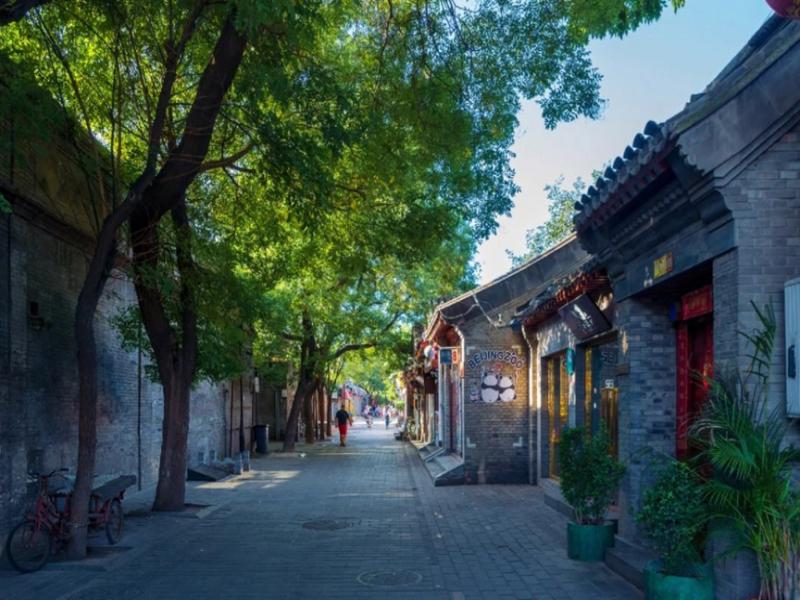
Nanluoguxiang Hutongs in Beijing
Must-See Sights in Beijing Hutongs
Archway of a Courtyard
The archway is the entrance to a courtyard and the most direct evidence of the owner’s status. Higher thresholds and more steps in front of the gate indicate higher official rank. Courtyards with stone lions in front were once home to military officials, while those with square stone blocks were home to civil officials. More complex and finely carved brick patterns above the doorframe indicate greater wealth. The gateways in Shijia Hutong and Lishi Hutong are best preserved. Those in Nanluoguxiang’s side alleys are also worth seeing, though some have been converted into store entrances. When taking photos, do not step over the threshold; even if the gate is open, it doesn’t mean outsiders are welcome.
Screen Wall
A screen wall is a wall directly opposite the entrance inside the main gate, blocking outside views to protect family privacy. Wealthy families’ screen walls were built with gray bricks, the center carved with auspicious characters like “Fu” (fortune) or “Shou” (longevity), or floral patterns. Commoners’ screen walls were built with adobe and covered with a layer of white lime. The height and width of the screen wall are proportional to the gate’s size; the larger the gate, the taller the screen wall. When entering an open museum courtyard, the first thing you see is the screen wall. In Ya’er Hutong around Shichahai and along the north shore of Houhai, some gates are half-open, allowing glimpses of the screen wall inside.
Drum-shaped Door Stones
Door stones are the stones on both sides of the gate, coming in two shapes: drum-shaped and box-shaped. Round, drum-shaped stones resemble a drum and are often carved with lions, qilins, birds, and flowers, mostly used by military officials. Square, box-shaped stones resemble a box and are carved with copper coins, books, scrolls, and ruyi symbols, mostly used by civil officials. The larger and more intricately carved the door stones, the higher the courtyard’s status. The drum-shaped door stones are best preserved in areas like Ya’er Hutong around Shichahai and along the north shore of Houhai. You don’t need permission to photograph them, as they are outside the gate and in public space.
Hitching Posts
Hitching posts stand on both sides outside the gate, standard equipment for officials’ residences in the past. The stone pillars stand about 1.5 meters tall, topped with carved stone lions or monkeys, with holes for tying ropes along the shaft. A stone lion facing inward on a hitching post signifies “wealth does not flow out,” while one facing outward welcomes guests. Well-preserved hitching posts can still be seen in Shijia Hutong and Lishi Hutong. Most hitching posts in Nanluoguxiang’s side alleys have been moved or damaged, with few remaining.
Mounting Stones
A mounting stone is a stepped stone placed next to the hitching post, with two or three levels. The owner would step onto the mounting stone to mount the horse, rather than jumping on from the ground. The surface of the mounting stone has anti-slip grooves, still clearly visible today. A complete pair of mounting stones remains in front of the courtyard at 129 Lishi Hutong; the three-step grade indicates the owner held a high official rank. The mounting stone in front of the Shijia Hutong Museum has only two steps, corresponding to the residence of a mid-ranking official. Mounting stones aren’t at risk of being crushed by cars because the hutongs are too narrow for vehicles.
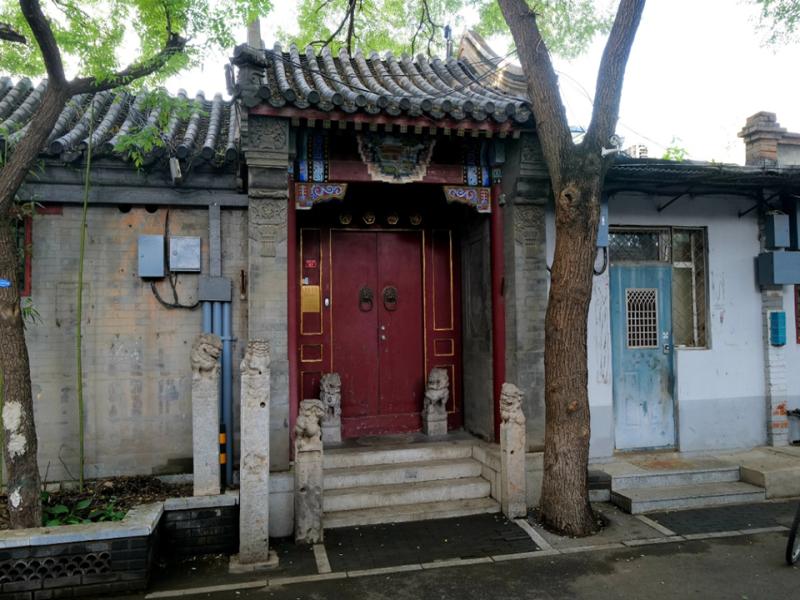
Hitching Post in a Beijing Hutong
Unique Experiences in Beijing Hutongs
Queue for Breakfast
From 7:00 to 8:00 am, queues form at food stalls at hutong entrances. The most common combinations are soy milk with youtiao (deep-fried dough sticks), jellied tofu with tangyoubing (sugared fried pancake), and millet porridge with meat buns. Each set costs no more than 10 RMB. Stand by the roadside, eat from the bowl, and return it to the vendor. This experience needs no reservation, no English, just waking up early. You won’t find such stalls on Nanluoguxiang main street; they are in the side hutongs and around Shichahai.
Haircut in Hutong Barber Shop
Hutong barbershops are tiny, with just one chair and a mirror. The barbers are almost all over 50 years old, charging 15 to 20 RMB for a men’s haircut. They don’t use electric clippers for a quick pass but cut slowly with scissors, finishing by shaving the back of the neck with a straight razor. No appointment is needed; just walk in when the shop looks quiet, typically between 2:00 and 4:00 pm.
Drink Tea from a Bowl
Real hutong teahouses are around Shichahai, with unassuming facades and a few solid wood tables inside. Pay 5 RMB at the door. The server gives you an enamel bowl and a thermos; you pour your own tea and drink. The tea is plain jasmine tea, its golden broth with a light floral scent. No tea ceremony performance, no introduction to the tea’s origin. Just sit and drink. The person at the next table might have a bowl of miancha (savory millet porridge) and jiaoquan (fried dough rings). A few teahouses on the east shore of Qianhai open from 2:00 to 5:00 pm. On weekends, they’re full of locals; on weekdays, there’s usually space. No reservation needed; just walk in, find an empty seat, sit down. Return your bowl to the counter when finished.
Ride a Bike
Bike-sharing stations are available around Nanluoguxiang main street and Shichahai. Scan the QR code to unlock, download the app, and link a credit card. The cost is 1.5 RMB per 30 minutes. It’s not advisable to ride deep into the narrow side hutongs as they’re too tight. A good stretch for cycling is from the north shore of Houhai to Ya’er Hutong, where the road surface is over 4 meters wide, with complete courtyard walls on both sides, no shops or stalls.
Tips for Visiting Beijing Hutongs
Don’t Disturb Others
Most courtyard homes in Beijing’s hutongs are still private residences. Do not enter courtyards with a sign saying “Private Residence, No Entry.” For those marked “Protected Cultural Site,” you may look inside but not step over the threshold. Ask permission before photographing residents’ daily activities. The morning rush hour from 7:00 to 9:00 am is the busiest time for residents entering and exiting. Try not to block the alleyway when taking photos during this time. After 9:00 pm, the hutongs become quiet; talking loudly or playing music will disturb residents’ rest.
Don’t Touch Cultural Relics
Most gateways, drum stones, hitching posts, and mounting stones in hutongs are classified as immovable cultural relics. Do not sit on drum stones to rest, stand on mounting stones for photos, or climb on hitching posts. The surfaces of brick and stone carvings have become fragile due to years of weathering. Maintain a distance of at least one meter from the architecture when visiting the well-preserved gateways of Shijia Hutong and Lishi Hutong. To see the details up close or touch them, view replicas or restored pieces in a museum.
Beware of Scams
Unlicensed guides often approach tourists around Shichahai and Nanluoguxiang, claiming they can show you otherwise inaccessible courtyards. These people lack tour guide credentials, and most of the places they take you are not authentic old courtyards but renovated shops selling souvenirs. Licensed rickshaw drivers wear a uniform, have a numbered vehicle, and a route map on display. For guide services, book at the official tourist information center at the hutong entrance.
Respect Local Customs
When visiting Beijing’s hutongs, do not spit or litter at a courtyard entrance, which is considered disrespectful to the household. Do not step on the threshold; old Beijingers consider it the household’s face. Do not point into someone’s home to gossip with your companions, even if the gate is open. Do not feed stray cats; residents have their own way of caring for them.