
Standing majestically within the Great Ci’en Temple in southern Xi’an, the Giant Wild Goose Pagoda is one of the city’s most iconic landmarks and China’s oldest and largest surviving Tang Dynasty square pavilion-style brick pagoda. For over 1,300 years, it has weathered countless storms and earthquakes, standing as a timeless testament to the spread of Buddhism eastward and a brilliant crystallization of Tang Dynasty culture. No trip to Xi’an is complete without visiting this ancient tower, where visitors can immerse themselves in its profound historical legacy and feel the grandeur of the Tang Dynasty’s golden age.
Historical Origins and Cultural Significance of the Giant Wild Goose Pagoda

The Giant Wild Goose Pagoda
Origins and Construction Purpose: Master Xuanzang & Great Ci’en Temple
The construction of the Giant Wild Goose Pagoda is inextricably linked to the renowned Tang Dynasty monk, Master Xuanzang, whose epic 17-year pilgrimage to India to obtain Buddhist scriptures has become one of the most celebrated stories in Chinese history. In the 22nd year of the Zhenguan reign of the Tang Dynasty (648 AD), Crown Prince Li Zhi, who later became Emperor Gaozong, ordered the construction of the Great Ci’en Temple to honor his beloved mother, Empress Wende, née Zhangsun. Upon his triumphant return from India in 645 AD, Master Xuanzang was warmly received by Emperor Taizong and appointed the first abbot of the newly built Great Ci’en Temple. Here, he dedicated the rest of his life to translating the 657 Sanskrit Buddhist scriptures he had brought back, producing over 1,300 volumes of Chinese translations that remain foundational to Chinese Buddhism today. To safely preserve these precious scriptures, as well as Buddha statues, relics, and palm-leaf manuscripts from India, Master Xuanzang personally designed and oversaw the construction of the Giant Wild Goose Pagoda, which was completed in 652 AD.
Architectural Evolution, Specifications and Ingenuity
Originally, the pagoda had only five stories and was built with a brick exterior and an earthen core. Over the centuries, it underwent numerous renovations and reconstructions due to damage from wars and natural disasters. In the early 8th century, during the reign of Empress Wu Zetian, it was rebuilt and expanded to seven stories, which is the form we see today. Standing approximately 64.5 meters tall, the pagoda has a square pyramidal shape, tapering gently from a base of 25.5 meters on each side to the top. Its design is simple yet imposing, exuding a sense of stability and grandeur that perfectly embodies the architectural aesthetics of the Tang Dynasty. A wooden spiral staircase winds its way up the interior, and each story features arched doorways on all four sides, allowing visitors to climb to the top and enjoy panoramic views of southern Xi’an. More than just a Buddhist structure, the Giant Wild Goose Pagoda is a masterpiece of ancient Chinese architectural art. It seamlessly blends the design elements of Indian stupas with traditional Chinese wooden pavilion architecture, creating a unique style that set a benchmark for all subsequent pavilion-style brick pagodas in China. The pagoda’s construction demonstrates the advanced engineering skills of the Tang Dynasty, as it has withstood at least 17 major earthquakes over the past 1,300 years without collapsing.
Precious Cultural Relics Inside the Pagoda
Inside the pagoda, a wealth of precious Tang Dynasty cultural relics are preserved, including fragments of the original scriptures translated by Master Xuanzang, Tang Dynasty stone inscriptions, and murals. Notably, the two stone steles flanking the south gate on the ground floor—Preface to the Sacred Teachings of the Tripitaka of the Great Tang and Notes on the Preface to the Sacred Teachings of the Tripitaka of the Great Tang—were written by Emperor Taizong and Crown Prince Li Zhi respectively, and inscribed by the famous Tang Dynasty calligrapher Chu Suiliang. These steles are considered masterpieces of Tang Dynasty regular script and are invaluable treasures of Chinese calligraphy.
Detailed Guide to Key Attractions in the Giant Wild Goose Pagoda Scenic Area
The Great Ci’en Temple
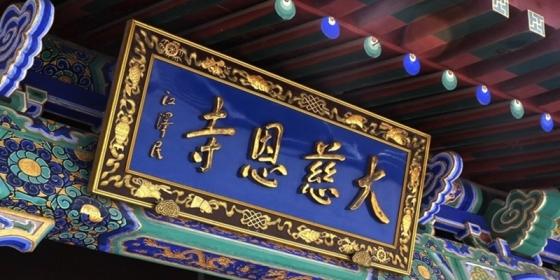
The Great Ci’en Temple
The Great Ci’en Temple, home to the Giant Wild Goose Pagoda, was one of the most prestigious and largest monasteries in Chang’an (modern-day Xi’an) during the Tang Dynasty. At its peak, it covered an area of over 340 mu (about 227,000 square meters) and housed more than 1,000 monks. Today, the temple complex has been restored to its former glory, featuring magnificent Tang-style architecture and lush gardens that create a peaceful and serene atmosphere. Upon entering the temple through the grand main gate, visitors are greeted by the bell and drum towers, which stand symmetrically on either side of the courtyard. The timeless sounds of the morning bell and evening drum still resonate throughout the temple grounds today, marking the beginning and end of the monks’ daily spiritual practices.
The Mahavira Hall is the main building of the Great Ci’en Temple. Inside, it houses gilded statues of the three Buddhas: Sakyamuni Buddha in the center, flanked by Medicine Buddha on the left and Amitabha Buddha on the right. The statues are solemn and lifelike, exuding a sense of peace and tranquility. The walls of the hall are adorned with exquisite Buddhist murals depicting the life story of Sakyamuni Buddha and the fundamental teachings of Buddhism, painted in the vibrant style characteristic of the Tang Dynasty. Behind the Mahavira Hall lies the Sutra Depository, a two-story building that houses a large collection of precious Buddhist scriptures and cultural relics. The upper floor contains a complete set of the Chinese Buddhist Canon, while the lower floor features an exhibition on the history of Buddhism in China and the life of Master Xuanzang.
The Giant Wild Goose Pagoda Itself
As the core of the scenic area, the Giant Wild Goose Pagoda is built entirely of high-temperature fired blue bricks, boasting remarkable sturdiness that has stood the test of time and even withstood more than 17 major earthquakes over 1,300 years. Its exterior walls are adorned with subtle lotus and Buddhist brick carvings, adding an elegant touch to its imposing structure, while the stone door lintels on the ground floor feature exquisite Tang Dynasty line carvings depicting Buddhist stories, flying apsaras and bodhisattvas, with smooth lines and vivid portrayals that showcase the superb craftsmanship of the Tang Dynasty. Climbing the pagoda is an essential experience for visitors: the first floor displays the pagoda’s historical evolution and a lifelike statue of Master Xuanzang, recording his extraordinary pilgrimage to India; the third floor houses precious Buddha relics and fragile palm-leaf manuscripts brought back by Xuanzang from India, which are invaluable cultural treasures. The fourth floor exhibits a variety of Tang Dynasty Buddhist relics, including porcelain statues and bronze mirrors, while the fifth floor allows visitors to closely observe the pagoda’s unique architectural details and brickwork structure. From the seventh and top floor, visitors can enjoy unobstructed panoramic views of southern Xi’an, with the rolling Qinling Mountains stretching endlessly in the distance and a striking mix of ancient city walls and modern skyscrapers in the foreground, evoking deep wonder at the passage of time and the blend of history and modernity.
Musical Fountain at the North Square of the Giant Wild Goose Pagoda
The North Square of the Giant Wild Goose Pagoda is home to Asia’s largest musical fountain and is one of Xi’an’s most popular leisure and entertainment destinations. Covering an area of approximately 252 mu (about 168,000 square meters), the square is a masterpiece of modern landscape design, combining the musical fountain with cultural plazas, landscaped gardens, and sculptures that celebrate Tang Dynasty culture. The musical fountain itself is an engineering marvel, featuring over 2,000 water jets that can shoot water up to 60 meters high. At scheduled times every day, the fountain comes to life, with water jets dancing gracefully in the air to the rhythm of uplifting music and dazzling lights. The performances feature a variety of water patterns, from gentle waves to dramatic explosions of water, creating a spectacular and unforgettable visual feast.
The fountain performances are held both during the day and in the evening, with the evening shows being particularly stunning thanks to the dramatic lighting effects. The colorful lights reflect off the water, creating a magical atmosphere that captivates audiences of all ages. It is recommended that visitors arrive at least 30 minutes early to secure a good viewing spot, as the square can get very crowded, especially on weekends and holidays. In addition to the musical fountain, the square is dotted with numerous sculptures, reliefs, and cultural landscapes that showcase the history, culture, and customs of the Tang Dynasty. The most prominent sculpture is the “Tang Dynasty Prosperity” relief, which depicts scenes of daily life in Chang’an during the Tang Dynasty, including merchants, scholars, musicians, and dancers. There are also several smaller sculptures of famous Tang Dynasty poets and historical figures, adding a cultural dimension to the square.
South Square of the Giant Wild Goose Pagoda and the Grand Tang Dynasty Ever-bright City
The South Square of the Giant Wild Goose Pagoda faces the North Square across the pagoda, presenting a symmetrical layout typical of traditional Chinese architecture. At its center stands a 7-meter-tall, 10-ton bronze statue of Master Xuanzang, vividly capturing his unwavering determination during his westward pilgrimage, with billowing robes and a firm gaze. To the south lies the 1,500-meter-long Grand Tang Dynasty Ever-bright City, a pedestrian street themed on Tang culture, lined with authentic Tang-style buildings featuring upturned eaves, red pillars and golden decorations, as well as numerous shops, restaurants, theaters and museums offering a comprehensive Tang cultural experience. When night falls, the street turns into a magical wonderland, illuminated by thousands of red lanterns and colorful lights, evoking the prosperity of Tang-era Chang’an. It comes alive with street artists performing singing, dancing, acrobatics and shadow puppetry in Tang costumes, along with regular parades and cultural shows. Various local snacks and handicrafts are also available, making it a memorable destination for visitors interested in history, culture, food or shopping.

Practical Travel Information for the Giant Wild Goose Pagoda
Ticket Prices
- Great Ci’en Temple Ticket: 40 RMB per person
- Giant Wild Goose Pagoda Climbing Ticket: 25 RMB per person
- Discount Policies: Students with valid student IDs enjoy half-price tickets; seniors aged 65 and above and children under 1.2 meters tall are admitted free of charge with valid ID.
Opening Hours
- Great Ci’en Temple: 08:00-17:30 (peak season: March 1st to November 30th), 08:00-17:00 (off season: December 1st to February 28th)
- Giant Wild Goose Pagoda Climbing: 08:30-17:00 (peak season), 08:30-16:30 (off season)
- Musical Fountain at the North Square:
- Monday to Friday: 12:00, 16:00, 19:00, 21:00
- Saturday and Sunday: 10:00, 12:00, 14:00, 16:00, 19:00, 21:00
- Note: Daytime fountain performances are suspended every Tuesday for equipment maintenance.
Must-try Experiences Around the Giant Wild Goose Pagoda
Local Specialties
Xi’an is renowned as a culinary capital of China, with a rich food culture that dates back thousands of years. The area around the Giant Wild Goose Pagoda offers countless opportunities to savor authentic Shaanxi cuisine, from hearty street food to elegant restaurant dishes. Below are the most recommended local specialties and their top spots:
- Roujiamo (Chinese Hamburger): Often called the world’s first hamburger, roujiamo is one of Xi’an’s most iconic dishes. It consists of a crispy, baked wheat bun stuffed with tender, slow-braised pork that has been seasoned with a blend of spices. The combination of the crunchy bun and the juicy, flavorful meat is simply irresistible. Recommended spots: Fanji Roujiamo, Qinyu Roujiamo.
- Yangrou Paomo (Lamb Soup with Unleavened Bread): A classic Shaanxi dish that is beloved by locals and visitors alike. It consists of rich, flavorful lamb soup served with shredded unleavened bread, which you break into small pieces and soak in the soup. The soup is usually garnished with green onions, cilantro, and chili oil, adding extra flavor and freshness. Recommended spots: Laosunjia Restaurant, Tongshengxiang Restaurant.
- Liangpi (Cold Noodles): A refreshing cold noodle dish that is perfect for hot weather. It is made from wheat or rice flour, which is steamed into a thin sheet and then cut into noodles. The noodles are tossed in a spicy and tangy sauce made from vinegar, chili oil, garlic, and sesame paste, and topped with shredded cucumber and bean sprouts. Recommended spots: Weijia Liangpi, Zhangji Liangpi.
- Biangbiang Noodles: A signature Shaanxi noodle dish that is famous for its wide, chewy noodles. The noodles are hand-pulled to be about 3 centimeters wide and 1 meter long, and are tossed in a savory sauce made from soy sauce, vinegar, chili oil, and garlic. The dish is usually topped with minced pork, green onions, and cilantro. Recommended spot: Biangbiang Noodles Main Store.
- Zenggao (Glutinous Rice Cake): A traditional sweet dessert that has been popular in Xi’an for centuries. It is made by steaming layers of glutinous rice, red dates, and red beans in a special steamer called a zeng. The result is a soft, sticky, and sweet cake that is perfect for breakfast or as a snack. Recommended spot: Southeast Asia Zenggao.
Shopping Recommendations
There are plenty of shopping options around the Giant Wild Goose Pagoda where you can buy unique Xi’an souvenirs and handicrafts to take home as mementos of your trip. Here are the top recommendations:
- Grand Tang Dynasty Ever-bright City: This vibrant street is lined with specialty shops selling a wide variety of Tang Dynasty-themed souvenirs, including traditional clothing, jewelry, handicrafts, and artwork. You can also find shops selling local specialties such as persimmon cakes, walnuts, and Chinese tea.
- Underground Mall at the North Square of the Giant Wild Goose Pagoda: This large underground mall offers a wide range of small goods and souvenirs at affordable prices. Here you can find everything from keychains and magnets to traditional Chinese handicrafts such as paper cuttings, clay figurines, and silk scarves.
- Qujiang Intime City: A modern, large-scale shopping mall that combines shopping, dining, and entertainment under one roof. It features both international and domestic brands, as well as a cinema, a supermarket, and a wide variety of restaurants serving cuisine from all over the world.
Nearby Attractions
Located in Xi’an’s Qujiang New District, the Giant Wild Goose Pagoda is surrounded by many other famous attractions that are worth visiting. You can easily combine a visit to the Giant Wild Goose Pagoda with a trip to one or more of these nearby attractions to make the most of your time in Xi’an. Here are the key nearby spots:
- Shaanxi History Museum: China’s first large-scale modern national museum, housing over 370,000 cultural relics spanning from prehistoric times to the Qing Dynasty. The museum’s collection includes bronze ware, pottery, porcelain, gold and silver artifacts, and murals, making it one of the best museums in China to learn about Chinese history and culture.
- Tang Paradise: A large imperial garden-style cultural theme park that showcases the history, culture, and customs of the Tang Dynasty. The park features beautiful gardens, lakes, and Tang-style buildings, as well as regular performances of traditional Chinese music, dance, and acrobatics.
- Qujiangchi Relic Park: A beautiful urban park built around the ruins of the Tang Dynasty Qujiang Pool, which was a popular recreational spot for the nobles and scholars of the Tang Dynasty. The park features lush gardens, lakes, and pavilions, and is a great place for a leisurely walk or a picnic.
- Small Wild Goose Pagoda: A famous Tang Dynasty Buddhist pagoda that rivals the Giant Wild Goose Pagoda in historical and artistic value. Built in 707 AD, the Small Wild Goose Pagoda is smaller and more elegant than the Giant Wild Goose Pagoda, with a slender, graceful shape. It is located in the Jianfu Temple, which also houses a collection of ancient stone steles.
Travel Tips
- The Giant Wild Goose Pagoda Scenic Area attracts large crowds, especially during holidays and peak tourist seasons (spring and autumn). It is recommended to arrive early in the morning to avoid the crowds and enjoy a more peaceful visit.
- A separate ticket is required to climb the Giant Wild Goose Pagoda. It is advisable to book tickets online in advance through the official website or authorized travel platforms to avoid long queues at the ticket office.
- The stairs inside the pagoda are quite steep and narrow, and can be slippery when wet. Please exercise caution when climbing, especially if you are traveling with elderly people or children. It is also recommended to wear comfortable walking shoes.
- When watching the musical fountain performance, please keep a safe distance from the fountain to avoid getting splashed by water, especially during the evening shows when the water jets are higher.
- Smoking and littering are strictly prohibited in the scenic area. Please protect the environment and travel in a civilized manner by disposing of trash in the designated bins.
- Xi’an has a dry climate with strong ultraviolet radiation, especially in spring and summer. It is recommended to take sun protection measures such as wearing sunscreen, a hat, and sunglasses, and to drink plenty of water to stay hydrated.
- Be cautious of unlicensed tour guides and travel agencies soliciting business around the scenic area. They may offer overpriced tours or take you to unnecessary shopping stops. It is best to book tours through reputable travel agencies or explore the area on your own.
The Millennium Heritage of the Giant Wild Goose Pagoda
After visiting the Giant Wild Goose Pagoda, you will be deeply impressed by the profound historical and cultural charm embodied in this thousand-year-old tower. It is not only a symbol of Xi’an but also a precious cultural treasure of the Chinese nation, representing the wisdom, creativity, and spiritual pursuit of the ancient Chinese people. If you want to gain a deeper understanding of Xi’an’s rich history and culture and enjoy a more enriching and hassle-free travel experience, China Dragon Travel can provide you with professional travel services. With an experienced team of tour guides who are knowledgeable about Xi’an’s history and culture, and a wide range of well-designed travel itineraries, they can customize personalized travel plans according to your specific needs and interests. Whether you are interested in historical sites, cultural experiences, or local cuisine, China Dragon Travel will ensure that your trip to Xi’an is relaxed, enjoyable, and unforgettable.