
What is the best way to understand Chengdu’s laid-back lifestyle? The answer lies not in its famous hotpot restaurants or panda sanctuaries, but in its traditional tea houses. With bamboo chairs, steaming gaiwan tea, and lively conversations among locals, these teahouses capture the true essence of the city. Whether you are visiting Chengdu for the first time or seeking an authentic cultural experience, spending an afternoon in a teahouse offers a deeper connection than any sightseeing itinerary.
Three Main Types of Chengdu Teahouses
- Century-old Teahouses: Retain bamboo chairs, wooden tables, tiger stoves and gaiwan. Most tea drinkers are locals, playing cards, having ear cleanings and chatting. Tea fees are affordable, 15 to 35 CNY for a bowl of gaiwan tea, and you can sit for a whole day. Waiters walk back and forth with thermoses, and water refills are free of charge.
- Open-air Teahouses by Rivers or in Parks: Distributed on both sides of the Jinjiang River, Culture Park, Wangjianglou Park. Quiet environment with bamboo or rattan chairs, drinking tea and enjoying river views under the shade of trees. Tea fees are slightly higher than old teahouses, 20 to 50 CNY for ordinary green tea or jasmine tea.
- Designer Teahouses or Tea Spaces: Concentrated near Taikoo Li and Kuanzhai Alleys. Modern decoration with air conditioning, a wide selection of teas (Pu’er, Oolong, black tea, aged tea), and some provide refreshments. Sold by pot instead of by bowl, 80 to 200 CNY per pot. Suitable for visitors who need quiet conversation or taking photos.
If it is your first experience, it is recommended to start with the first type. It is the traditional form of Chengdu teahouses.
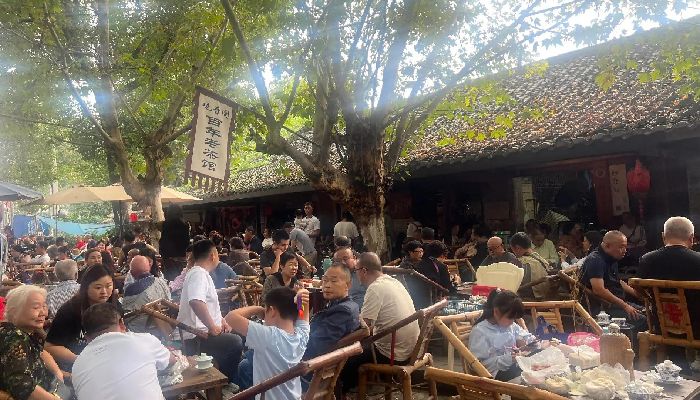
Guanyinge Old Teahouse
Pricing for Chengdu Teahouses
- Tea Fees: Ordinary gaiwan tea (green tea, jasmine tea, plain tea) 15 to 35 CNY, most old teahouses charge no more than 25 CNY. High-quality Zhuyeqing, Biluochun and other famous teas 40 to 80 CNY. When ordering by pot, one pot is usually equipped with two cups, 60 to 150 CNY, suitable for two people to share. The per capita consumption at old teahouses is 15 to 30 CNY with unlimited free water refills. It should be noted that most old Chengdu teahouses adopt the rule of “one tea for one seat”, you must order a cup of tea after sitting down, and you cannot sit without consumption.
- Refreshments: Teahouses usually provide boiled peanuts, sunflower seeds, edamame, 5 to 10 CNY per plate. Some teahouses provide cold noodles, jelly noodles, tofu pudding, 10 to 15 CNY. Heming Teahouse also has snacks such as Zhong Shuijiao and Lai Tangyuan, about 20 CNY.
- Ear Cleaning: A special service of Chengdu teahouses. Craftsmen use ear picks, goose feather sticks, tweezers, tuning forks and other tools to clean ears and massage shoulders and necks, 30 to 60 CNY, about 10 minutes for the whole process. It is recommended to have a try.
- Water Refills: Completely free, no time limit.
For one person for an afternoon, the cost of tea, refreshments and ear cleaning is about 60 to 100 CNY. If you only drink tea and eat sunflower seeds without ear cleaning, 30 CNY is enough. This price cannot even buy a cup of coffee in other cities in China.
Top Must-Visit Teahouses in Chengdu
Heming Teahouse (Inside People’s Park)
One of the oldest teahouses in Chengdu, built in 1923, it is one of the oldest existing teahouses in Chengdu. The morning tea period is from 6:30 to 8:30 every morning, tea is 3 CNY per cup during this period, and free for the elderly over 80 years old. It has sold an average of more than 300,000 cups of tea every year in recent two years. A bamboo chair in the teahouse costs about 200 CNY, and the gaiwan is custom-made in Jingdezhen, with the words “Century-old Heming”printed on the lid. Heming Teahouse is not only a place for drinking tea, but also a display window of Chengdu’s folk culture. Disadvantage: crowded on weekends, it takes patience to find a seat. It is more comfortable to go on weekdays.
Guanyinge Old Teahouse (Peng Town)
Located in Peng Town, 40 kilometers away from the urban area, this teahouse has been filmed and reported by CCTV, BBC, See Also Thirteen Ways and other media. The teahouse completely retains traditional utensils such as tiger stoves and bamboo armchairs, and opens for business at 4 a.m. every day with a fire lit. The business model is “10 CNY for tea, 10 CNY for taking photos”, and the traditional price of 1 CNY per day is retained for local regular tea drinkers. It won the UNESCO Asia-Pacific Awards for Cultural Heritage Conservation in 2024. Suitable for visitors who want to take photos of the old Chengdu style. Disadvantages: far from the urban area, you need to arrange half a day separately; the quality of tea is average.
Daci Teahouse (Inside Daci Temple)
Located in a thousand-year-old ancient temple next to Taikoo Li, separated from the luxury commercial district by a wall. There are only four types of tea, namely Huamaofeng, Sumaofeng, Zhuyeqing and Bitan Piaoxue, priced at 15 to 30 CNY. After ordering tea, the waiter will give a bag of tea leaves, customers find seats to brew tea by themselves and pour water independently. As it is located in a temple, smoking, playing cards and bringing meat food are prohibited in the tea hall, which is quieter than Heming Teahouse and other places. The tea hall sells snacks such as sunflower seeds and peanuts, and provides meals such as vegetarian noodles, tofu pudding and jelly noodles, all 10 CNY per portion.
Baihuatan Park Teahouse
Local regular tea drinkers go there more often because there are fewer tourists. Baihuatan Park is located near Qintai Road, the teahouse is by the river with a large area of tree shade. Tea fees are affordable, plain tea is 15 CNY. Go there between 3 p.m. and 4 p.m., sunlight shines through the leaves, river breeze blows, and the body feeling is comfortable. Disadvantage: closes early, starts to pack up at about 5:30 p.m.
Yuelai Teahouse (Huaxing Main Street)
An indoor old teahouse inside Jinjiang Theater, formerly the Old Lang Temple, the seat of Sichuan Opera Trade Association, founded in 1909, and has always preserved Sichuan Opera performances. The hall provides Sichuan teas such as Piaoxue, Zhuyeqing and Huamaofeng, priced at 12 to 25 CNY. There are Sichuan Opera performances by Chengdu Sichuan Opera Research Institute every Saturday, with ticket prices of 30 to 50 CNY. You can watch Sichuan Opera while drinking tea, and the teahouse is also quiet when there is no performance.
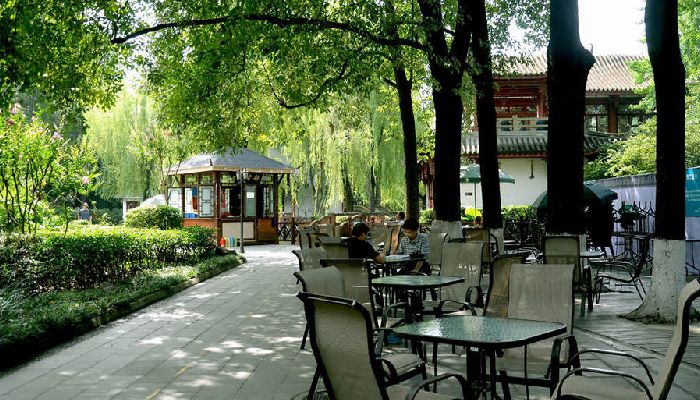
Baihuatan Park Teahouse in Chengdu
Steps to Order Tea at a Chengdu Teahouse for the First Time
- Find a Seat: Just find an empty bamboo chair and sit down. The waiter will come over after seeing the guest seated.
- Order Tea: If you do not know what to order, just say “a bowl of jasmine tea”or “a bowl of plain tea”. Jasmine tea is jasmine tea with obvious aroma and smooth taste. Plain tea is ordinary green tea with fresh taste. If you want to drink higher-quality tea, you can say “Zhuyeqing”or “Biluochun”. No need to hesitate, local regular tea drinkers often drink jasmine tea too.
- Pay: Most teahouses pay when ordering tea, cash or mobile code scanning is acceptable. Some old teahouses adopt the method of “drink tea first and pay later”, just tell the tea master the seat number when leaving. After payment, the waiter will give a tea bowl and a small thermos, or bring the brewed tea directly.
- Refill Water: When the water in the thermos runs out, open the thermos lid or hold up the empty thermos, the waiter will come to add hot water after seeing it. No need to shout or wave. Another way is to lean the tea lid against the edge of the bowl, and the tea master will come to add water after seeing it.
- Leave: There is no rule to urge guests to leave, you can sit as long as you want. Just leave the tea bowl on the table when leaving.
A Small Rule: The way to place the lid of gaiwan tea. The lid is closed means you are still drinking. The lid is turned over on the table means you need a water refill. The lid is placed next to the bowl means you are leaving, and the waiter will come to clean up. However, many teahouses do not care much about this rule now.
When someone adds tea for you, you can tap the table lightly with your index and middle fingers to show gratitude, which is called “finger tapping etiquette”, which is said to be related to the allusion of Emperor Qianlong’s incognito tour.
Best Visiting Time and Notes for Chengdu Teahouses
Best Time to Visit
From 9 a.m. to 11 a.m., there are fewer people and the environment is quiet, with more birdcalls than voices. Many teahouses provide morning tea in the early morning at a more affordable price. From 2 p.m. to 4 p.m., it is the busiest time, and you can see authentic folk life scenes. After 5 p.m., many old teahouses start to pack up, so it is not recommended to visit.
Recommended Length of Stay
There is no fixed rule. Locals sit for the whole afternoon, and visitors are advised to set aside at least two hours. No need to rush when drinking tea, you can scroll on your phone, read, daze, chat with friends.
Notes
- Mosquito Prevention: There are many mosquitoes in open-air teahouses in summer, especially in riverside areas. Carry a small bottle of mosquito repellent with you.
- Sun Protection: Direct sunlight in the afternoon, no shade for bamboo chairs, wear a hat or move to the shade of trees.
- Restrooms: Restrooms in old teahouses are usually simple, some are squat toilets. Be mentally prepared.
- Do Not Speak Loudly: Although teahouses are lively, locals rarely shout loudly in them. Keep a normal chatting volume.
- Phone Charging: There are basically no charging sockets in old teahouses, fully charge your phone or carry a power bank before going out.
- Carry Cash: Some very old teahouses only accept cash, and major teahouses in the urban area support mobile payment. It is recommended to carry dozens of yuan in change.
- One Tea for One Seat: You must order tea after sitting down, and you cannot sit without consumption.
Experiences Beyond Drinking Tea at Chengdu Teahouses
Chengdu teahouses are not just places for drinking tea. They are also social spaces, chess and card rooms, information exchange stations and folk art performance venues.
Ear Cleaning
Recommended to try once. Craftsmen use ear picks, goose feather sticks, tweezers, tuning forks and other tools. The final vibration of the tuning fork brings a tingling sensation, 30 to 60 CNY.
Watching Card Games
The most common scene in teahouses is four people sitting around a table playing mahjong or long cards. It doesn’t matter if you don’t understand the rules; just watch.
Listening to Storytelling or Sichuan Opera
Some teahouses (such as Yuelai Teahouse) have regular storytelling, Sichuan Opera face-changing and lamp-rolling performances. There is usually one show in the afternoon or evening, with ticket prices ranging from dozens to over a hundred yuan. Drinking tea while watching a show is an authentic experience.
Sketching or Taking Photos
The light, people and objects in old teahouses are perfect for photography. Many art students bring sketchbooks to draw. When taking photos, do not take direct shots of others’ faces; ask politely or take back or side shots.
Frequently Asked Questions About Chengdu Teahouses
Q1: Will it be awkward for non-tea drinkers to go to a teahouse?
A: No. Teahouses serve boiled water, and some also sell soybean milk and sour plum soup. If you don’t drink tea, you can order a drink. But note the one tea, one seat rule: you must order after sitting down, no sitting without ordering anything.
Q2: Can I bring my own tea leaves?
A: Most traditional old teahouses do not allow bringing your own tea leaves. Some high-end tea spaces allow it, but they charge a “tea seat fee”, which is not as cost-effective as ordering tea directly from the teahouse.
Q3: Is there coffee in Chengdu teahouses?
A: Traditional old teahouses do not serve coffee. New-style tea spaces may have it, but it is recommended to drink tea since you are in Chengdu.
Q4: Is it convenient to take children?
A: Yes. Many teahouses have yards where children can play on open ground. Be careful not to let children touch thermoses with hot water.
Q5: Are the tea sets in teahouses clean?
A: The gaiwan sets in old teahouses are uniformly cleaned and disinfected every day, but the cleaning standard is not as high as that of star hotels. If you mind, you can bring your own travel tea set. However, most visitors think using the teahouse’s tea sets is more atmospheric.
Q6: Can I buy tea leaves to take away?
A: Many teahouses sell the tea leaves they use at the front desk, with simple packaging and fair prices. Cheaper than tea leaves in scenic spot specialty stores and guaranteed quality. Just ask the server.
Savor the Tea, Discover the Soul of Chengdu
Chengdu’s tea houses are more than places to drink tea—they are living museums of local culture. Here, people gather to chat, play mahjong, enjoy ear-cleaning rituals, and watch Sichuan opera performances. From the historic ambiance of Heming Teahouse to the nostalgic atmosphere of Guanyinge Old Teahouse and the tranquil setting of Daci Temple Teahouse, each venue offers a unique window into the city’s heritage.
For travelers seeking a seamless cultural journey, professional planning can enhance the experience. China Dragon Travel offers tailored Chengdu and Sichuan tours, combining iconic attractions with authentic local experiences. With expert guidance, you can explore Chengdu’s tea culture in depth and uncover the enduring spirit of this captivating city.