

Need a visa for China? This is the core question every international visitor planning to visit China will first encounter. As China’s exchanges with countries around the world become increasingly close, its visa policies are constantly being optimized and adjusted to provide more convenient travel experiences for international visitors. Whether you plan to explore the Forbidden City in Beijing, the skyscrapers in Shanghai, or the exotic mountains and rocks in Zhangjiajie, clarifying visa requirements in advance is the first step to a smooth trip in China. Citizens of different countries, different travel purposes, and duration of stay will all affect the visa application needs. If you wish to obtain a tailored China travel plan, feel free to consult China Dragon Travel in advance to resolve visa issues while formulating the most suitable itinerary for yourself.
Most International Visitors Need to Apply for a Visa in Advance
In terms of overall policy, do you need a visa for China? The answer is yes in most cases. China implements a visa management system for the entry of foreign citizens. Most international visitors need to apply for the corresponding type of entry visa from Chinese embassies and consulates abroad or authorized visa application centers before departure. The purpose of this policy is to safeguard national security, maintain the order of entry and exit, and better serve legally entering visitors.
It should be noted that China offers a wide range of visa types. Visas for tourism purposes are the L-type visa and Q2-type visa. Among them, the L-type visa is suitable for foreign citizens traveling to China for group tourism or individual self-funded tourism; the Q2-type visa is intended for foreign citizens visiting relatives in China or traveling to China for short-term private affairs. If your travel itinerary includes visiting relatives, you can choose this type of visa based on actual circumstances. Regardless of the visa type chosen, preparing materials in advance and following the application process are crucial to ensuring smooth entry.
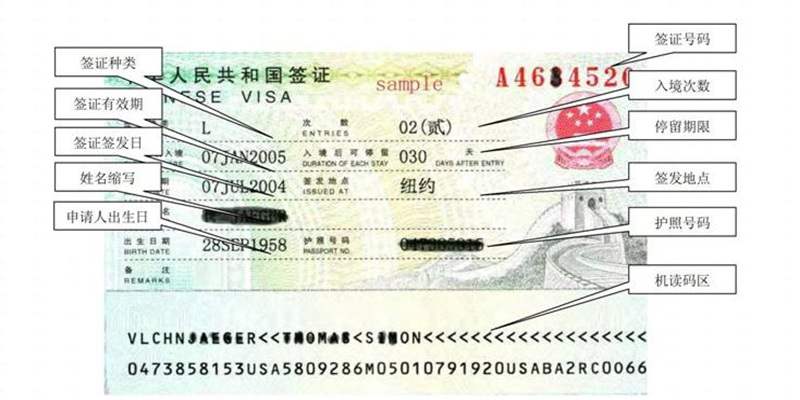
Visa Sample
Visa-Free Entry or Visa-on-Arrival in These Cases
Although most international visitors need to apply for a visa in advance, to promote the development of international tourism, China has signed visa exemption agreements with many countries and also introduced a number of visa-on-arrival and transit visa exemption policies. At this time, if you ask “Do I need a visa for China?” the answer may be no. Below are several common types of visa-free and visa-on-arrival scenarios for visitors with different needs.
1. Mutual Visa Exemption for Ordinary Passports: Direct Entry Without Advance Application
China has signed various types of mutual visa exemption agreements with more than 150 countries, among which some agreements cover the tourism entry needs of ordinary passport holders. For example, citizens of many countries such as the UAE, Qatar, Russia, France, and Germany can enter China visa-free within the specified period with a valid ordinary passport. The specific duration of visa-free stay varies by country, ranging from a minimum of 30 days to a maximum of 90 days.
It is particularly important to note that mutual visa exemption policies may be adjusted based on bilateral relations. Before traveling, visitors must check the latest policies through the official websites of Chinese embassies and consulates abroad or authoritative travel platforms to confirm that their country is on the visa-free list. They must also strictly abide by the stay duration regulations to avoid affecting their itinerary due to policy changes or misunderstandings.
2. Visa-on-Arrival Policy: Obtain a Visa at the Port of Entry Upon Arrival
For citizens of some countries that have not signed mutual visa exemption agreements with China, if they plan to travel to China for a short period, they can choose to apply for a visa-on-arrival. Visitors do not need to apply in advance in their home countries; they only need to hold a valid passport, return flight ticket, hotel reservation confirmation, and other materials to apply for an entry visa at ports in China that offer visa-on-arrival services. Currently, many major air and water ports in China support visa-on-arrival applications, greatly facilitating visitors with temporary travel plans.
3. Transit Visa Exemption: No Visa Required During Layover
If your itinerary involves transiting through a city in China to a third country and meets certain conditions, then do you need a visa for China? The answer is also no. China has launched 24-hour, 72-hour, and 144-hour transit visa exemption policies, as well as the 144-hour transit visa exemption policy for the Guangdong-Hong Kong-Macao Greater Bay Area. Different policies apply to different ports and have different stay durations. For example, the 144-hour transit visa exemption policy is applicable to multiple airports, seaports, and railway ports nationwide. Visitors can stay in the specified area for 144 hours, which is sufficient to experience the customs and traditions of the transit city.
To apply for transit visa exemption, visitors must hold a confirmed connecting flight or ship ticket to a third country or region, and the stay duration must not exceed the specified time limit. This policy not only saves visa application time and costs but also provides transit visitors with the opportunity to explore Chinese cities.
Full Visa Application Process: Detailed Steps from Preparation to Collection
For international visitors who need to apply for a visa in advance, understanding the complete application process is crucial. After clarifying whether a visa is required for China, preparing materials in a timely manner and following the application process are essential to ensuring that the itinerary is not affected. Below are the general application steps for tourism visas for your reference.
1. Determine the Visa Type and Prepare Application Documents
First, determine the visa type based on your travel purpose. For tourism, you usually choose an L-type or Q2-type visa. Then prepare the corresponding application documents. Core materials include: a passport valid for at least 6 months and a copy of the passport pages, a fully completed visa application form, recent passport-sized color photos with a white background (without a hat), a travel itinerary plan, hotel reservation confirmation, return flight ticket reservation confirmation, etc. If applying for a Q2-type visa, you also need to provide proof of relationship with relatives in China, such as a birth certificate or marriage certificate.
It is recommended that visitors organize their materials in advance to ensure that all materials are true, valid, complete, and clear. Incomplete materials or false information may result in the visa application being rejected, delaying the itinerary.
2. Submit the Application Online by Appointment or On-Site
Currently, most Chinese embassies and consulates abroad and authorized visa application centers support online appointment services. Visitors can log on to the corresponding platform, select a nearby application location and time, and submit the application in person with the materials after completing the appointment. Some regions also support submitting materials by mail; specific methods can be queried through official channels.
When submitting materials, staff will conduct a preliminary review. If there are missing or non-compliant materials, they will promptly inform the visitor to supplement them. During this process, visitors can proactively inquire about the method to check the visa application progress to track the application status in a timely manner.
3. Pay the Fee and Wait for Review
After submitting the materials, visitors need to pay the visa application fee in accordance with the relevant regulations. The fee standard varies by country and visa type and can be queried through the official website before application. After payment, the visa review process begins. The review period is usually 5-7 working days, but may be extended during peak seasons. It is recommended that visitors plan their time in advance and avoid applying for the visa just before their trip.
4. Collect the Visa and Verify the Information
After the visa is approved, visitors can collect their passport and visa from the application location with the collection certificate or choose mail delivery service. After collection, it is crucial to carefully verify the information on the visa, including name, passport number, duration of stay, number of entries, etc., to ensure that it is consistent with personal information. If any information errors are found, contact the visa application center promptly to make corrections.
Important Visa Application Notes: Tips to Help You Successfully Obtain a Visa
After resolving the core question of whether a visa is required for China, mastering some important visa application notes can effectively improve the visa approval rate and avoid unnecessary troubles. Below are several key tips:
1. Apply in Advance and Plan Your Time
Chinese visa applications require a certain review period and may be extended due to material supplementation or policy adjustments. It is recommended that international visitors start preparing visa materials and submit the application as soon as possible after confirming their itinerary. Especially during tourism peak seasons and holidays, sufficient time should be allowed to avoid delaying the trip due to visa issues.
2. Provide True Documents and Avoid Falsification
The authenticity of materials is the primary review criterion during the visa review process. Any false materials, such as forged hotel reservation confirmations or travel itineraries, will result in the visa application being rejected and may even lead to being placed on a blacklist, affecting future entry applications. Visitors should provide materials truthfully; if there are special circumstances, an explanatory letter can be attached to explain.
3. Respect Policies and Abide by Regulations
Different types of visas have clear scopes of use and duration of stay regulations. Visitors should strictly abide by these regulations after entering China. For example, a tourism visa shall not be used for business, work, or other purposes, and the stay duration shall not exceed the period indicated on the visa. If there is a genuine need to extend the stay duration due to special circumstances, an application should be submitted to the exit and entry administration department of the local public security organ before the expiration of the stay period, and the extension is only allowed after approval.
4. Choose Official Channels and Guard Against Fraud
Chinese visas should be applied for through Chinese embassies and consulates abroad, officially authorized visa application centers, or regular travel agencies. Do not trust unregulated online channels to avoid fraud, which may result in property losses or personal information leakage. If professional assistance is needed, you can consult China Dragon Travel to formulate travel services and obtain regular itinerary planning and visa consultation support.
Frequently Asked Questions (FAQs) About China’s Unilateral Visa-Free Policy
Q1: Which countries’ citizens are eligible for China’s unilateral visa-free policy?
A1: Citizens of 48 countries holding ordinary passports may enter China visa-free for purposes such as business, tourism, family visits, exchanges, or transit, with a maximum stay of 30 days. These countries include Brunei, France, Germany, Italy, Spain, the Netherlands, Switzerland, Ireland, Hungary, Austria, Belgium, Luxembourg, New Zealand, Australia, Poland, Portugal, Greece, Cyprus, Slovenia, Slovakia, Norway, Finland, Denmark, Iceland, Andorra, Monaco, Liechtenstein, South Korea, Bulgaria, Romania, Croatia, Montenegro, North Macedonia, Malta, Estonia, Latvia, Japan, Brazil, Argentina, Chile, Peru, Uruguay, Saudi Arabia, Oman, Kuwait, Bahrain, Russia, and Sweden.
Q2: Is there an expiration date for the unilateral visa-free policy?
A2: Currently, China’s visa-free policy for Brunei citizens holding ordinary passports has no expiration date. For Russian citizens holding ordinary passports, the policy is valid until September 14, 2026. For citizens of the other 46 countries, the policy is valid until December 31, 2026.
Q3: Are there any special requirements for minors applying for visa-free entry to China?
A3: Minors are subject to the same conditions as adults for visa-free entry to China.
Q4: Can foreigners entering China to participate in sports events, exhibitions, study tours (summer/winter camps), etc., apply for visa-free entry?
A4: Foreigners entering China to participate in sports events, exhibitions, study tours (summer/winter camps), etc., with a stay of no more than 30 days are eligible for the visa-free policy, provided they hold a valid ordinary passport.
Q5: Can tour groups apply for visa-free entry?
A5: Foreigners who meet the visa-free entry requirements may enter China either as part of a tour group or as individual travelers under the visa-free policy.
Q6: Will Chinese border inspection authorities verify the purpose of entry, and if so, how? Are there any additional documents required besides a passport for entry?
A6: Foreigners whose purpose of entry is consistent with the visa-free policy (business, tourism, family visits, exchanges, or transit) will be allowed to enter after inspection and approval by Chinese border inspection authorities in accordance with the law. Those whose purpose of entry does not match the policy or who have other statutory grounds for denial of entry will be refused entry in accordance with the law. It is recommended to carry supporting documents consistent with the purpose of entry, such as an invitation letter, flight tickets, and hotel reservations. Foreigners entering China for work, study, journalism, or other purposes not covered by the visa-free policy are not eligible.
Q7: Are there any requirements for the type and validity of entry documents?
A7: Foreigners must hold a valid ordinary passport to enter China, with a validity period sufficient for their travel in China. Those holding travel documents, temporary or emergency documents, or other documents other than ordinary passports are not eligible for the visa-free policy.
Q8: Can travelers depart from a country other than their country of citizenship?
A8: Foreigners eligible for visa-free entry to China may depart from any country or region outside China.
Q9: Does the policy apply to entry methods other than air travel?
A9: The unilateral visa-free policy applies to all land, sea, and air ports open to foreigners (except as otherwise specified by laws, regulations, or bilateral agreements). Those entering China by private means of transport must also complete relevant entry and exit procedures in accordance with Chinese laws and regulations.
Q10: How is the 30-day stay period calculated?
A10: The visa-free stay period starts from the day after entry and allows for a continuous stay of 30 consecutive calendar days.
Q11: Can the stay period be extended if it exceeds 30 days?
A11: Foreigners intending to stay or reside in China for more than 30 days must apply for a visa corresponding to their purpose of entry at a Chinese embassy or consulate abroad in advance. If, after entering China under the visa-free policy, a foreigner needs to extend their stay for legitimate reasons, they must apply for a stay permit from the exit-entry administration authority of the public security organ.
Q12: Is multiple entry allowed? Are there any requirements for the interval between entries, or restrictions on the number of visa-free entries or total stay days?
A12: Foreigners eligible for visa-free entry may use the policy for multiple entries. Currently, there are no restrictions on the number of visa-free entries or the total number of stay days, but they must not engage in activities inconsistent with the purpose of entry.
Q13: Do foreigners need to declare in advance to Chinese embassies or consulates abroad to apply for visa-free entry to China?
A13: Foreigners who meet the conditions are not required to declare in advance to Chinese embassies or consulates abroad to use the visa-free policy.
Q14: If a foreigner loses their passport with the Chinese border inspection stamp after visa-free entry, can they depart directly with an emergency travel document issued by the relevant embassy or consulate in China?
A14: If a foreigner loses or damages their passport after entering China visa-free and needs to depart with a replacement passport, emergency passport, travel document, or other entry-exit document, Chinese border inspection authorities will verify their identity information, entry records, loss report, or other supporting documents issued by the relevant embassy or consulate in China in accordance with the law. If the documents are in order and the person has no illegal acts such as overstaying the visa-free period, border inspection authorities will process their departure procedures in accordance with the law. If there are illegal acts under the jurisdiction of border inspection authorities, such as overstaying, the authorities will handle the matter in accordance with laws and regulations. For other illegal acts beyond the jurisdiction of border inspection authorities, the person must first accept handling by the exit-entry administration authority of the public security organ or other relevant competent departments, and then complete departure procedures at the border inspection authority with the relevant supporting documents.