
Dunhuang murals are one of the most important cultural heritages along the Silk Road and are recognized worldwide for their scale and preservation. Spread across sites such as the Mogao Caves, Yulin Grottoes, and Western Thousand Buddha Caves, they form a vast artistic system created over centuries. For first-time visitors, understanding which caves to visit, how to interpret the murals, and how to book tickets are essential steps. This guide provides a structured overview to help travelers better experience and understand the value of Dunhuang mural art.
Information to Know Before Visiting Dunhuang Murals
Dunhuang murals are distributed in multiple cave groups. Mogao Caves is the largest and most famous, while Yulin Caves and Western Thousand Buddha Caves also preserve a large number of exquisite murals. Master the following basic information before departure.
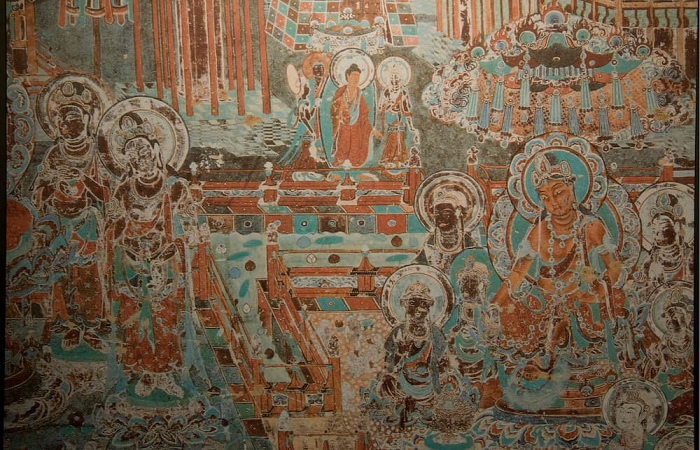
- Composition of Dunhuang Murals: Dunhuang murals include not only Buddha statues and flying apsaras but also Buddhist scripture story paintings, ancient social life scenes, architectural decorative patterns, donor portraits, etc. For example, the murals in Cave 257 depict the story of the Nine-Colored Deer, and the murals in Cave 45 show the scene of Tang Dynasty merchants encountering bandits. Understanding mural themes helps to deeply comprehend their value.
- Suitable Visiting Seasons: May to October is the peak tourist season with pleasant temperatures but large crowds. Early September to early October features mild climate and a good visiting experience. November to March of the following year is the off-season with low temperatures, half-price tickets, fewer tourists, sufficient explanation time, and more opportunities to visit special caves. In the off-season, Mogao Caves tickets cost 140 CNY for 10 caves, while in the peak season, 238 CNY for 8 caves.
- Ticket Booking Time: Mogao Caves tickets must be booked in advance through official channels. The official website is the Dunhuang Academy official website, and the mini-program is named “Mogao Caves Visiting Reservation Network”. Tickets need to be booked 15 to 30 days in advance in the peak season, and a few days in advance in the off-season. Tickets for Yulin Caves and Western Thousand Buddha Caves are relatively sufficient, but advance reservation is also recommended.
- Official Ticket Purchasing Channels: Dunhuang Academy has not authorized any third-party institutions or individuals to sell tickets on its behalf. Tourists should purchase tickets through official channels to avoid being unable to enter the site due to purchasing from third-party agents.
Dunhuang Murals
Mogao Caves Visiting Procedures and Cave Selection
Mogao Caves is the core site for viewing Dunhuang Murals, with a specific visiting process. Tickets are sold in limited quantities, the entry time is fixed, and visitors are led by guides in groups, requiring advance planning.
- Ticket Type Selection: Regular admission tickets allow access to 8 to 10 caves and include two themed movies, costing 238 CNY in peak season and 140 CNY in off-season, with a daily quota of 6,000 tickets. Emergency admission tickets only cover 4 caves with no movies, with a daily quota of 12,000 tickets, and are only launched when there are too many tourists in the peak season. Special cave tickets must be purchased on site after completing the regular visit. Currently open special caves include 009, 045, 057, 156, 158, 159, 217, 220, 254, 275, 320, 321, 322, 420, etc. Recommended caves: Cave 45 (Prosperous Tang Dynasty painted sculptures), Cave 57 (Bodhisattva statues), Cave 158 (Nirvana statue).
- Visiting Procedures on the Day: Step 1: Go to the Mogao Caves Digital Exhibition Center, located at 8899 Yangguan East Road, Dunhuang City. Direct entry to the Mogao Caves main body is not allowed. Exchange tickets with ID cards and watch two movies: Millennium Mogao introducing the historical background, and Dream Buddha Palace a dome movie showing unopened special caves. After the movies, take the scenic area shuttle bus to the Mogao Caves main body, about 15 minutes’ drive. After arrival, visitors are divided into groups, each equipped with a guide, and listen to explanations via headphones. The caves for regular ticket visitors are assigned randomly, usually including Cave 96 (Nine-Story Building Giant Buddha), Cave 17 (Library Cave), Cave 148 (Reclining Buddha).
- Special Cave Purchase Method: The open special caves vary daily, and the purchase time is 11:00 to 14:00. Visitors must hold the same-day Mogao Caves ticket and queue up on site to purchase after completing the regular visit. Special caves are open by route and cannot be purchased across routes. Each cave explanation takes about 15 minutes. It is recommended to learn about the features of each special cave in advance and choose according to interests. Cave 45 has intact Prosperous Tang Dynasty painted sculptures, Cave 57 has exquisitely painted Bodhisattva statues, and the Medicine Buddha Sutra Transformation in Cave 220 shows Tang Dynasty music and dance scenes.
- Precautions Inside Caves: There is no lighting equipment in the caves, and viewing relies on the guide’s flashlight. Photography and video recording, touching murals, leaning on screens, and loud talking are strictly prohibited. Backpacks should be carried on the chest, and avoid hitting the walls when turning around. The caves are stuffy in summer, but fans are not allowed, as air currents will accelerate mural peeling. The caves will be closed temporarily in extreme weather such as heavy rainfall and strong sandstorms.
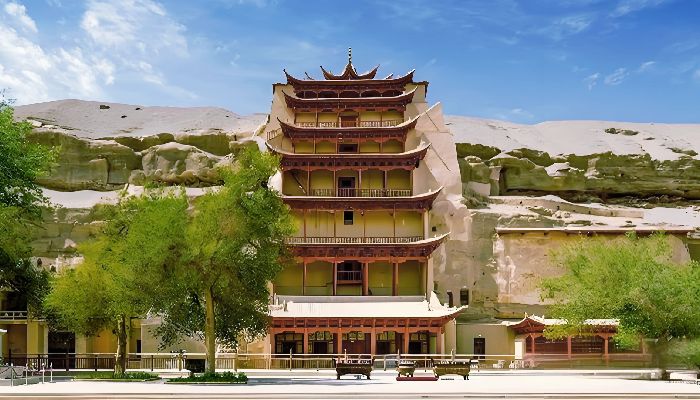
Exterior of the Nine-Story Building in Cave 96
Features and Visiting Methods of Yulin Caves Murals
Yulin Caves is located in Guazhou County, about one and a half hours’ drive from Dunhuang urban area. It preserves a large number of Western Xia and Yuan Dynasty murals, known as the sister cave of Mogao Caves.
- Features of Yulin Caves Murals: The Water-Moon Guanyin statue in Cave 2, the Transformation of Manjushri and Transformation of Samantabhadra in Cave 3 integrate ink landscape painting and meticulous heavy-color techniques. The Tang Dynasty murals in Cave 25 are called “the most perfect work among Chinese grotto murals”by Zhang Daqian. Yulin Caves is built on both banks of the Tashi River Canyon, with a quiet environment, forming a unique landscape of grottoes coexisting with clear streams.
- Transportation to Yulin Caves: Chartering a car is the most convenient, costing 500 to 600 CNY per day, with views of Gobi scenery and Suoyang City Ruins along the way. You can also join local one-day group tours. The 40 CNY ticket covers 5 regular caves, and special cave tickets cost 100 to 150 CNY each. Recommended caves: 2, 3, 4, 25. If time is limited, visit Cave 25 at least.
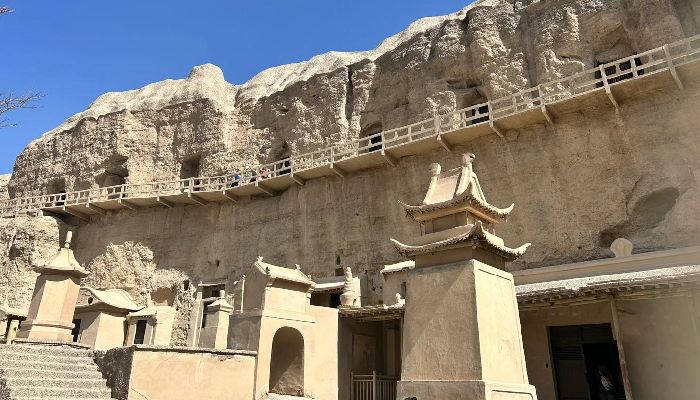
Exterior View of Yulin Caves
Western Thousand Buddha Caves Murals and Visiting Information
Western Thousand Buddha Caves is located southwest of Dunhuang urban area, about half an hour’s drive, on the way to Yangguan Pass. The caves are carved on the cliffs of the Danghe Canyon, and 16 caves are currently open to the public.
- Highlights of Western Thousand Buddha Caves Murals: Northern Zhou Dynasty murals are well preserved. The “Battle of Raudraksha”in Cave 5 is the earliest version in Dunhuang area, more than 100 years earlier than similar themes in Mogao Caves. The “Story of Shanci”in Cave 4 of Northern Zhou Dynasty has smooth lines. The flying apsaras in Cave 5 of Tang Dynasty have elegant and free-flowing ribbons.
- Practical Visiting Information: The 30 CNY ticket covers 4 caves, with a daily limit of 800 visitors. Advance reservation on the Dunhuang Academy official website is required in peak season. Morning visits are recommended for the best lighting conditions. It can be arranged on the same day with Yangguan Pass and Yumenguan Pass. If you fail to book a Mogao Caves ticket, Western Thousand Buddha Caves can be an alternative choice.
Dunhuang Murals Interpretation Methods and Viewing Key Points
First-time visitors are easily shocked by the murals covering the walls. Mastering the following key points helps understand the mural content.
- Evolution of Flying Apsaras Images: Flying apsaras are a common theme in Dunhuang murals, with obvious stylistic features in different dynasties. Flying apsaras in the Northern Liang and Northern Wei Dynasties have rough and simple shapes, become lighter in the Sui Dynasty, and have elegant and flexible postures with stretched ribbons in the Tang Dynasty. The evolution from Western Region style to Tang Dynasty style reflects the track of cultural exchanges.
- Representation of Buddhist Scripture Stories: A large number of Buddhist scripture stories are depicted in the murals, and guides will point out specific plots. The Nine-Colored Deer story in Cave 257 tells of karma between good and evil, the “Hu Merchants Robbed”painting in Cave 45 reflects the situation of Silk Road merchants in the Tang Dynasty, and the “Zhang Yichao’s Procession”in Cave 156 shows the ceremonial scene of Tang Dynasty nobles. These stories contain historical information.
- Social Life Scenes: The “Zhang Yichao’s Procession”in Cave 156 depicts scenes of drum music, ceremonies, dances and variety shows, showing the grandeur of Tang Dynasty nobles’ outings. Architectural images in the murals provide materials for the study of ancient architecture. Architect Liang Sicheng once referred to the Wutai Mountain Map in Cave 61 to find Foguang Temple, a Tang Dynasty building. Pay attention to details such as pavilions, temples, and courtyard walls in the murals.
- Reasons for Mural Color Changes: Some murals have bright colors, while others are dark brown, the latter caused by pigment oxidation. Most skin tones of figures turn dark brown due to the oxidation of lead powder pigment. Well-preserved Tang Dynasty murals still retain the original colors of mineral pigments such as cinnabar red, azurite blue, and malachite green, reflecting the stability of mineral pigments.
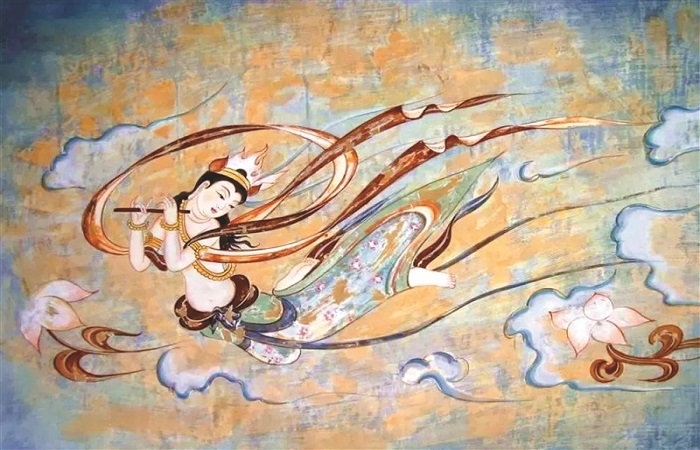
Dunhuang Murals
Items to Prepare for Visiting Dunhuang Murals
Dunhuang has a dry climate, strong ultraviolet rays, large temperature differences between day and night, and obvious environmental differences inside and outside the caves. Preparing appropriate items can improve the visiting experience.
- Sun Protection Supplies: Sunglasses, sun hats, and high-factor sunscreen are essential. The sun is intense in the Gobi area, and sun protection is still needed in winter. Ultraviolet rays are the strongest at noon, so adequate protection is required.
- Clothing Selection: There is a large temperature difference inside and outside the caves. The external temperature can reach over 30 degrees Celsius in summer, while only more than 10 degrees Celsius inside the caves, so a thin coat is needed. In winter, a thick down jacket is required as the temperature can drop to below minus 10 degrees Celsius, and hats, scarves, and gloves should be prepared. The temperature difference between day and night is large during the Mid-Autumn Festival and National Day, and a coat or thin sweater should be added in the morning and evening.
- Shoe Selection: Long periods of standing and walking are required during the visit, and walking is needed from the Digital Exhibition Center to the caves. Comfortable sports shoes or hiking shoes are recommended, avoiding new shoes.
- Lighting Tools: Some caves are dim, and the guide’s flashlight has a limited lighting range. A low-light flashlight can be carried for auxiliary viewing. Strong flashlights are strictly prohibited.
- Pre-Trip Knowledge Preparation: Learning about Dunhuang history, the discovery of the Library Cave, and the background of common Buddhist scripture stories before the visit helps understand the explanation content. It is recommended to watch documentaries such as Hexi Corridor, Dunhuang, and Nine-Colored Deer. A notebook can be carried to record key points for future reference.
When Murals Come Alive: Dunhuang as an Ongoing Dialogue Across Time
The beauty of Dunhuang murals lies not only in their artistic achievement but also in the historical memory and cultural exchange they preserve. From the evolution of flying apsaras to Buddhist narrative paintings and Silk Road life scenes, each mural represents a fragment of time preserved on stone walls.
For a deeper experience, it is recommended to combine visits to the Mogao Caves, Yulin Grottoes, and Western Thousand Buddha Caves within one itinerary. For transportation and travel planning support, China Dragon Travel can assist travelers in organizing a smoother and more comprehensive Dunhuang mural journey.