
Yunnan is one of the most culturally diverse regions in China, home to more than twenty ethnic minority groups whose traditions are deeply connected to their landscapes and seasonal rhythms. Ethnic festivals here are not simply celebrations, but living expressions of history, belief, and everyday life. From water-splashing rituals in the tropical south to torch-lit gatherings on the highlands and harvest feasts in the terraced fields, each festival offers a unique way to understand local cultures.
Southwest Yunnan · Rainforest Dai Charm: Water Splashing Carnival & Wa Harvest Joy
Surrounded by tropical rainforests, Xishuangbanna and Pu’er in southwest Yunnan are home to the Dai and Wa people, whose lives are integrated with nature. Their festivals are full of tropical warmth and simplicity, such as the exuberant Water-Splashing Festival and joyful New Rice Festival. A 3-4 day stay is recommended.
Core Ethnic & Festival Experiences
Dai Water-Splashing Festival (April 13-15, Gregorian calendar) : The most grand New Year of the Dai people, with Jinghong as the core experience spot, known as the “Oriental Carnival”. On the first day, the solemn Buddha Bathing Ceremony is held at Manting Park, where people bathe the Buddha with clear water for blessings. On the second day, the water-splashing carnival takes place along the Lancang River and in Gaozhuang Xishuangjing—people splash water on each other with basins and water guns to wash away bad luck and welcome a new start, with laughter filling the streets. At night, sky lanterns are released and Dai-style bonfire parties are held, creating an unforgettable festive atmosphere under the starry sky.
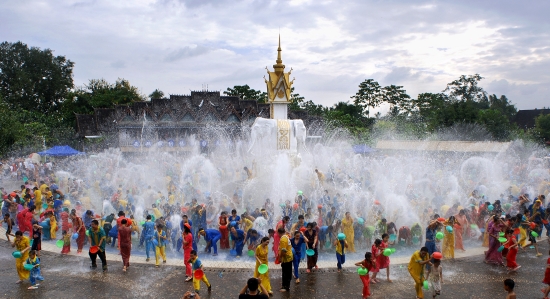
Dai Water-Splashing Festival
Wa New Rice Festival (Mid-August, Lunar calendar) : The Wa harvest celebration, with the most authentic experience in Ximeng Wa Autonomous County of Pu’er. During the festival, the Wa people dress in their iconic black clothes and red skirts, perform the passionate wooden drum dance and graceful hair-swaying dance to worship the grain god and ancestors, giving thanks for nature’s gifts. Visitors can join farming activities like rice harvesting and hand pounding rice, and taste local delicacies such as new rice cakes, Wa chicken congee and beef salad, feeling the joy of harvest in the simple rituals.
Practical Travel Tips
Transportation : Fly directly to Xishuangbanna Gasa International Airport (JHG) with direct flights to Bangkok, Chiang Mai, Vientiane, Siem Reap, etc., or transfer via Kunming Changshui International Airport (KMG) by high-speed rail (about 3.5 hours, 320 CNY per person) or flight (about 1.5 hours, 500-1500 CNY per person). The starting taxi fare in Jinghong is 8 CNY, with mainstream ride-hailing apps available. Take Bus No.5 (5 CNY per person) or a shared ride (20 CNY per person) to the Dai Village Park. The 300-kilometer drive from Jinghong to Ximeng Wa Autonomous County takes 5-6 hours; a regular chartered car costs about 600 CNY—book via hotel front desk and confirm the vehicle operation certificate and driver’s license.
Accommodation : Stay in Gaozhuang Xishuangjing in Xishuangbanna, where Dai-style boutique homestays cost 300-600 CNY per night (some with courtyard swimming pools), within walking distance to the Water-Splashing Festival venue for easy travel. In Ximeng County of Pu’er, budget hotels and Wa village homestays are available at 150-300 CNY per night; village homestays offer an in-depth experience of Wa traditional life with high cost performance.
Budget : 1800-2500 CNY per person (including transportation, accommodation, meals and tickets). Local cuisine features Dai and Wa flavors—try pineapple rice and lemongrass grilled fish in Xishuangbanna (60-80 CNY per meal), and Wa chicken congee and roast suckling pig in Ximeng (50-70 CNY per meal). Tickets: Dai Village Park 45 CNY per person, Manting Park 40 CNY per person. Sky lanterns for the Water-Splashing Festival cost 20 CNY each, with no mandatory extra charges.
Tips : Book accommodation 1-2 months in advance as the Water-Splashing Festival draws a large number of visitors. Bring a change of clothes and a waterproof phone case for water splashing; avoid expensive clothes and leather shoes. Take off shoes when entering Dai bamboo houses, respect Wa sacrificial rituals and do not take photos without permission.
Northwest Yunnan · Plateau Style: Torch Festival & Millennium Market Fun
Nestled between snow-capped mountains and grasslands, Dali, Lijiang and Chuxiong in northwest Yunnan are home to the Yi, Bai and Naxi people with a millennium of cultural heritage. The fiery Torch Festival, lively March Street and solemn Sanduo Festival fill the plateau with life and cultural charm. A 5-6 day stay is recommended.
Core Ethnic & Festival Experiences
Yi Torch Festival (June 24, Lunar calendar) : The most grand festival of the Yi people, with grand celebrations in Chuxiong Yi Ancient Town, Weishan County of Dali and Ninglang County of Lijiang. Night is the highlight: people hold torches and parade around villages and fields to exorcise evil spirits and pray for good weather and a bumper harvest. A huge bonfire is lit in the square, where Yi people in ethnic costumes dance the Left Foot Dance and Dati Dance—firelight illuminates smiling faces and songs echo in the valleys. Visitors can also join traditional sports like wrestling and horse racing, and taste Yi delicacies such as stone pot meat, buckwheat cakes and roasted milk fan, feeling the pure plateau enthusiasm.
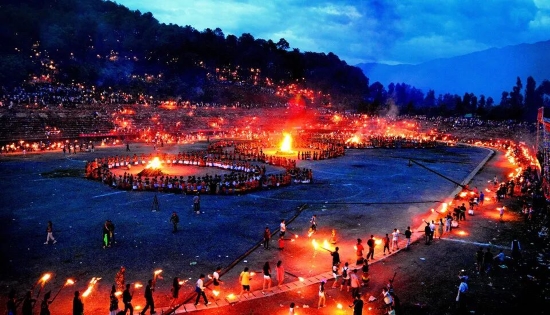
Yi Torch Festival
Bai March Street Festival (March 15-21, Lunar calendar) : A millennial trade and cultural event of the Bai people, held at the square outside the west gate of Dali Ancient City. During the festival, people of all ethnic groups from western Yunnan gather here for a bustling market of horses, medicinal herbs, handcrafts and local delicacies. Meanwhile, the Bai people hold the “Around the Three Sacred Sites” sacrifice, perform the overlord whip dance and octagonal drum dance, and play the cave scripture music and Bai folk songs. Visitors can experience intangible cultural heritage like Bai tie-dyeing and silver jewelry forging, feeling the folk charm of the Bai people in the millennial market.
Naxi Sanduo Festival (February 8, Lunar calendar) : The Naxi festival to worship Sanduo, the protective god, with Lijiang Ancient City and Shuhe Ancient Town as the core experience spots. Naxi people dress in their “star and moon” traditional costumes and go to Yufeng Temple and Sanduo Temple to pray for blessings. In the ancient towns, there are Dongba dance performances and Naxi ancient music concerts. Visitors can learn to write Dongba characters, join the Naxi group dance, and taste Lijiang cake, butter tea and Naxi cured pork rib hot pot, touching the cultural heritage of the Naxi people.
Practical Travel Tips
Transportation : Fly directly to Lijiang Sanyi International Airport (LJG) with direct flights to Bangkok, etc., or transfer via Kunming. Take the high-speed rail from Kunming to Dali (about 2 hours, 145 CNY per person) and from Dali to Lijiang (about 2 hours, 80 CNY per person). Buy high-speed rail tickets via the 12306 official website/APP (supporting international credit cards) or station ticket windows. The starting taxi fare in Dali is 10 CNY; take Bus No.2 or 4 (2 CNY per person) to the March Street Square. Motor vehicles are prohibited in Lijiang Ancient City—walk or take a scenic battery car (20 CNY per person). The 120-kilometer drive from Lijiang to Ninglang County takes 3 hours; a shared ride costs 50 CNY per person—choose a regular fleet.
Accommodation : Stay near Dali Ancient City or Xizhou Ancient Town, where Bai-style courtyard inns cost 250-500 CNY per night (some with Cangshan mountain views). In Lijiang, stay in Shuhe Ancient Town—Naxi-style homestays cost 300-600 CNY per night, quieter and more original than Dayan Ancient City. Chuxiong Yi Ancient Town has a variety of inns at 200-400 CNY per night, with a strong festive atmosphere during the Torch Festival.
Budget : 2500-3500 CNY per person (including transportation, accommodation, meals and tickets). Local cuisine features Bai, Yi and Naxi flavors—try Dali sour fish and Bai eight-course feast (70-100 CNY per meal), Lijiang cured pork rib hot pot and chickpea jelly (80-120 CNY per meal), and Chuxiong Yi stone pot meat and soup pot (60-90 CNY per meal). Dali Ancient City and Lijiang Ancient City are free to enter; Lijiang Ancient City maintenance fee is 50 CNY per person (required for some scenic spots). No extra tickets for festivals.
Tips : The temperature is high and ultraviolet radiation is strong in northwest Yunnan during the Torch Festival—take sun protection measures. Keep a safe distance from the bonfire to avoid burns. The Bai three-course tea is a hospitality ritual—experience it actively (30 CNY per person). Keep quiet during Naxi Dongba sacrificial rituals and do not interrupt at will.
Southeast Yunnan · Terraced Rice Waves: Long Street Banquet & Folk Song Duet Charm
Honghe Prefecture and Wenshan Prefecture in southeast Yunnan are where the Hani and Zhuang people have cultivated terraced fields for generations. Their festivals are closely linked to farming culture, such as the long street banquet of the October New Year and the folk song duet of the March Third Festival, full of simple life vibes. A 3-4 day stay is recommended.
Core Ethnic & Festival Experiences
Hani October New Year (First Dragon Day of October, Lunar calendar) : The grand New Year of the Hani people, with the most distinctive celebrations in villages around the Yuanyang Hani Terraced Fields. During the festival, the Hani people kill pigs and chickens, brew rice wine, make glutinous rice cakes, and visit relatives and friends to send blessings. The highlight is the thousand-person long street banquet—villagers set up a hundreds-of-meters-long feast on the village street, with delicacies like terraced field fish, salted duck eggs, Hani cured pork and pounded dried beef. Visitors can join the banquet (50-80 CNY per person), feeling the spectacular scene of “one village, one feast, thousands of people celebrating together”. They can also watch the Hani palm fan dance and bamboo pole dance, experience traditional crafts like spinning and weaving, and understanding the wisdom of the Hani people living in harmony with the terraced fields.
Zhuang March Third Festival (March 3, Lunar calendar) : The traditional festival of the Zhuang people, with rich celebrations in Guangnan County of Wenshan Prefecture and Mile City of Honghe Prefecture, known as the “Zhuang Valentine’s Day”. During the festival, Zhuang men and women dress in colorful traditional costumes, sing folk songs and throw silk balls by rivers and in squares to find their soulmates. There are also folk activities like top spinning, dragon boat racing and opera singing, with a lively atmosphere. Visitors can taste five-color glutinous rice, Zhuang sour fish hot pot and mugwort cake, experience handcrafts like Zhuang brocade weaving and batik making, feeling the romance and enthusiasm of the Zhuang people.
Practical Travel Tips
Transportation : Fly to Kunming Changshui International Airport first, then take the high-speed rail to Jianshui (about 2 hours, 100 CNY per person), and transfer to a tourist bus to Xinyue Town of Yuanyang (about 2 hours, 30 CNY per person). Charter a car in the Yuanyang Terraced Fields Scenic Area (about 300 CNY per day) to visit each viewing platform with good road conditions and convenient travel. Take the high-speed rail from Kunming to Guangnan County of Wenshan (about 3 hours, 180 CNY per person). The starting taxi fare in Guangnan County is 8 CNY; take a shared ride (30 CNY per person) to Zhuang villages—book via local regular travel agencies or hotels.
Accommodation : Stay in Xinyue Town or Duoyishu Village of Yuanyang, where Hani-style homestays cost 200-400 CNY per night (some with viewing terraces for shooting the sunrise over the terraced fields in the early morning). In Guangnan County of Wenshan, budget hotels and Zhuang village homestays are available at 150-300 CNY per night; village homestays offer an experience of Zhuang traditional life and authentic folk customs.
Budget : 1800-2800 CNY per person (including transportation, accommodation, meals and tickets). Local cuisine features Hani and Zhuang flavors—try terraced field fish and salted duck eggs in Yuanyang (60-80 CNY per meal), and five-color glutinous rice and Zhuang sour fish hot pot in Guangnan (50-70 CNY per meal). Ticket: Yuanyang Hani Terraced Fields 70 CNY per person. No extra tickets for other festival activities with high cost performance.
Tips : The temperature is low (5-15℃) in Yuanyang during the October New Year with a large day and night temperature difference—bring warm coats. Some viewing platforms in the terraced scenic area have steep roads—wear non-slip sports shoes. Join the Zhuang March Third Festival folk song duet actively to feel the ethnic enthusiasm. Ask for permission before taking photos of ethnic minorities to respect their privacy.
Yunnan Festival Travel Convenience Guide
Itinerary Planning : Yunnan’s ethnic festivals are mainly held in April-May (Water-Splashing Festival, March Street, March Third Festival), July-August (Torch Festival) and November-December (October New Year). Plan your trip according to your favorite festivals to avoid missing the core experiences. The three core areas (southwest, northwest and southeast Yunnan) are far apart—choose 1-2 areas for in-depth experience instead of rushing.
Transportation Booking Tips : Book international flights 1-2 months in advance for better prices. Book high-speed rail tickets via the 12306 official website/APP, supporting Visa, Mastercard and other international credit cards—register an account and complete real-name authentication in advance for convenience. Sign a regular contract when chartering a car, specifying the included expenses (fuel, tolls, driver’s accommodation and meals) to avoid price increases on the way.
Payment & Documents : Alipay and WeChat Pay are accepted in major cities and scenic spots in Yunnan; only cash is accepted in some remote villages—prepare 500-1000 CNY in cash. Carry a valid ID document, which may be checked at some scenic spots and transportation hubs. If renting a car to drive by yourself, carry an international driving license translation and a Chinese driving license (required by some car rental companies).
Packing List : Yunnan has a large day and night temperature difference—bring light and warm coats no matter the season. Ultraviolet radiation is strong in ethnic minority areas—prepare high-factor sunscreen, sunglasses and a sun hat. There are many mosquitoes in some villages—bring mosquito repellent and floral water. Prepare common medicines (cold medicine, gastrointestinal medicine, motion sickness medicine) as medical care is inconvenient in remote areas.
Folk Etiquette : Respect the traditional customs and religious beliefs of all ethnic groups; abide by local rules when entering temples and villages. Do not touch the headdress and clothing of ethnic minorities at will, and do not step on sacrificial supplies. Accept food and gifts from locals with both hands and express thanks. Keep quiet during sacrificial and prayer rituals; do not take photos or make noise at will.
Experience Yunnan Through Its Ethnic Festivals
Traveling during an ethnic festival transforms a journey through Yunnan into a deeper cultural encounter. Sharing food at a village feast, joining communal dances, or witnessing age-old rituals allows travelers to connect with local communities beyond sightseeing. These moments reveal the true spirit of Yunnan—diverse, vibrant, and deeply rooted in tradition. For those seeking a well-timed and culturally respectful festival journey, China Dragon Travel offers professional guidance and planning support, helping travelers experience Yunnan’s ethnic festivals with insight, comfort, and authenticity.