
One of the most common challenges when planning a trip to Mount Emei is not the lack of attractions, but choosing where to start when time is limited. Instead of trying to cover everything, focusing on four key areas – Golden Summit, Wannian Temple, Qingyin Pavilion, and Baoguo Temple – offers a much clearer and more efficient approach. Each of them represents a different side of the mountain: dramatic views at the summit, deep cultural history, peaceful natural scenery, and a practical entry point. Once these are understood, the entire trip becomes easier to structure.
Jinding (Golden Summit) at Mount Emei
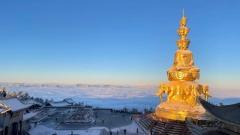
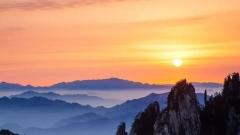
Jinding is at the summit of Mount Emei, 3,079 meters above sea level, the commanding height of the whole mountain. Not visiting Jinding basically means you have not finished your trip to Mount Emei. It is renowned for four natural spectacles: sea of clouds, sunrise, Buddha Light and Sacred Lanterns.
Core Highlights of Jinding: Ten-Direction Samantabhadra Statue, Golden Hall, Silver Hall and Bronze Hall
The Ten-Direction Samantabhadra Statue is the landmark of Jinding, 48 meters high and gilded all over. The statue has ten faces, representing the preaching of Samantabhadra Bodhisattva in ten directions. Most visitors walk clockwise around the statue three times after arriving at Jinding as a way to pray for blessings. Shenshen Cliff on the edge of Jinding is the best place to view the sea of clouds and sunrise. Please note that you must not climb over the guardrails when taking photos at the cliff edge.
Practical Information for Getting to Jinding
- To get to Jinding from the foot of the mountain, you need to take the scenic shuttle bus to Leidongping first, then walk for about half an hour to Jieyin Hall, and transfer to the Jinding Cableway.
- The Jinding Cableway charges 65 CNY for a one-way up trip and 55 CNY for a one-way down trip in peak season, with lower prices in off-season. To avoid the peak of visitor flow, you can take the first cableway in the early morning or late afternoon.
- Jinding has a high altitude, and the temperature is significantly lower than that at the foot of the mountain. You need to bring a thick coat even when going up the mountain in summer; in winter, you must wear down jackets, hats and gloves.
- To watch the sunrise, you need to stay at a hotel in Leidongping or on Jinding one day in advance. Leidongping has more hotel options, while hotels on Jinding are few and expensive, but you do not need to get up early to catch the cableway.
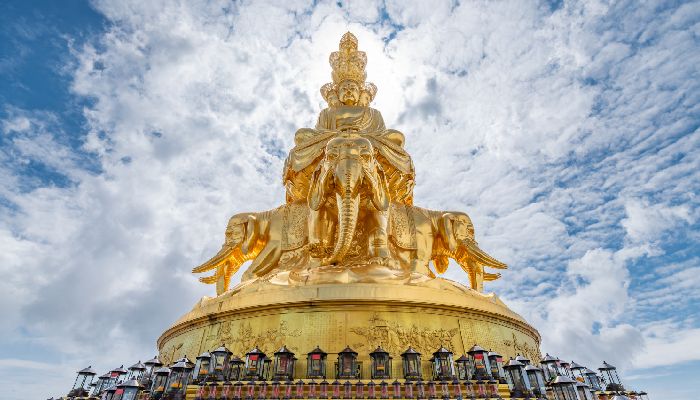
Ten-Direction Samantabhadra Bronze Statue at Jinding, Mount Emei
Wannian Temple at Mount Emei
Wannian Temple is located on the upper middle part of Mount Emei, about 1,000 meters above sea level. It is the oldest temple on the mountain, first built in the Eastern Jin Dynasty, with a history of more than 1,600 years. Wannian Temple is selected as one of the four scenic areas not only for its long history, but also for its unique architecture and national-level cultural relics.
Core Highlights of Wannian Temple: Beamless Brick Hall and Bronze Statue of Samantabhadra Riding an Elephant of the Song Dynasty
The Beamless Brick Hall was built during the Wanli Period of the Ming Dynasty. The whole hall has no wooden beams or tiles, and is entirely constructed with bricks and stones, with a circular dome roof. This brick structure has survived 18 earthquakes in more than 400 years, including a magnitude 7.9 earthquake, and still stands firmly, regarded as a miracle in the history of ancient Chinese architecture.
The hall enshrines a Bronze Statue of Samantabhadra Riding an Elephant cast in the Song Dynasty, 7.35 meters high and 62 tons heavy, the largest existing ancient bronze Buddha statue in China. In addition, Xingyuan Building in the temple collects three precious cultural relics: Buddha Tooth, Palm-Leaf Manuscript and Wanli Gold Seal.
Preparatory Notes for Visiting Wannian Temple
- Wannian Temple is permanently open for free, no extra ticket is required.
- You can take the cableway up the mountain from Wannian Temple Parking Lot, or hike up. The hike takes about forty minutes.
- It takes about one and a half hours to visit Wannian Temple alone. You can also visit nearby small attractions such as Bailong Cave (the legendary cultivation place of Bai Suzhen) along the way.
- You can walk downhill from Wannian Temple to Qingyin Pavilion, and many visitors visit these two scenic areas in half a day.
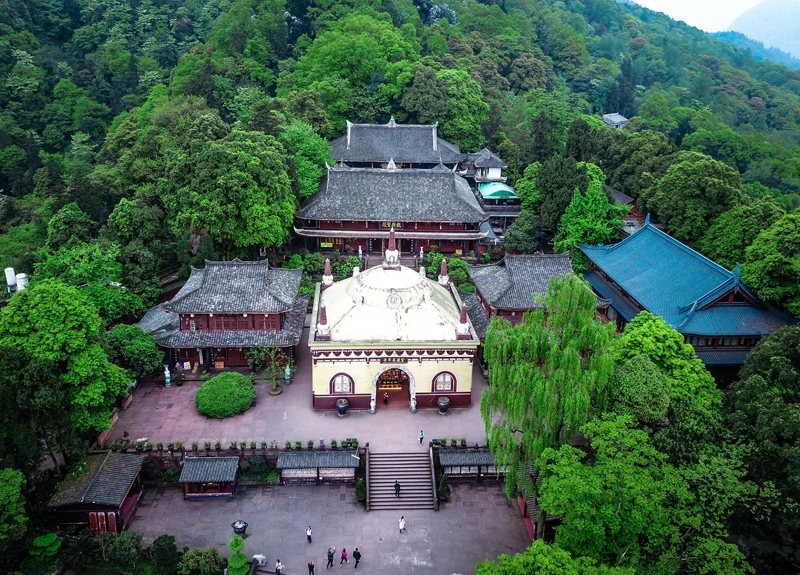
Wannian Temple
Qingyin Pavilion at Mount Emei
Qingyin Pavilion is not famous for summit scenery or ancient cultural relics, but the area with the most splendid landscape scenery in Mount Emei. It has a low altitude, about 550 to 1,000 meters, with no steep mountain roads to climb. The whole area is surrounded by streams, woods and stone bridges, with fresh air.
Core Highlights of Qingyin Pavilion: Shuangqiao Qingyin and Ecological Monkey Area
Shuangqiao Qingyin is the most famous scenery of Qingyin Pavilion. Two streams flow from different directions and converge at Niuxin Stone, with clear and crisp water sounds. Two small stone bridges span across the streams, ideal for taking photos. The ecological monkey area is another popular attraction of Qingyin Pavilion. Tibetan macaques in Mount Emei often gather by the road and approach visitors when they see food in their hands.
Safety Tips for Visiting the Ecological Monkey Area
- The monkey area is near First Line Sky, about ten minutes’ walk from Qingyin Pavilion.
- After entering the monkey area, do not rummage through your backpack in front of macaques, do not shake plastic bags, and do not walk around openly with food in hand.
- Small items such as hats and sunglasses should be properly stored, and backpack zippers should be fastened.
- If entangled by macaques, do not scream or run. The correct way is to squat down and pretend to pick up stones, or slowly put down your belongings and leave step by step.
- It takes about one to two hours to travel back and forth from Qingyin Pavilion to the ecological monkey area, including time for watching macaques.
In addition, Qingyin Pavilion has a low altitude and is cool in summer. After visiting, you can continue walking towards First Line Sky if you have enough physical strength and time.
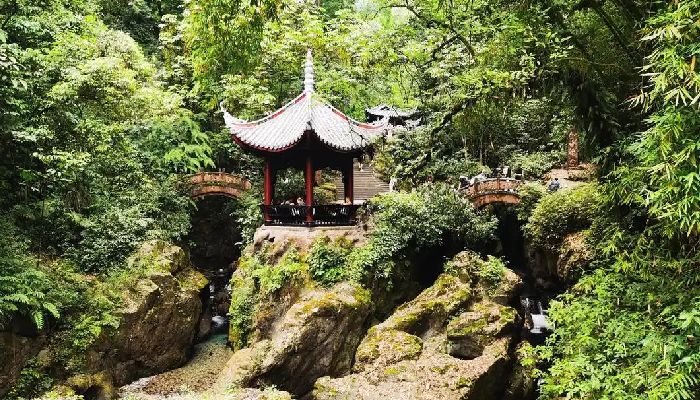
Shuangqiao Qingyin at Qingyin Pavilion, Mount Emei
Baoguo Temple at Mount Emei
Baoguo Temple is located at the foot of Mount Emei, about 550 meters above sea level, the first ancient temple you see when entering the mountain. Baoguo Temple covers an area of 40,000 square meters, built during the Wanli Period of the Ming Dynasty, and was historically a site where Confucianism, Buddhism and Taoism integrated.
Core Highlights of Baoguo Temple: Shanmen Plaque, Maitreya Hall, Mahavira Hall and Seven Buddhas Hall
The Shanmen Plaque of Baoguo Temple is inscribed with three Chinese characters “Baoguo Temple”, personally written by Emperor Kangxi. Entering the Shanmen, you will see Maitreya Hall, Mahavira Hall and Seven Buddhas Hall in sequence. Seven Buddhas are enshrined in Seven Buddhas Hall, with murals of Buddhist stories painted on the left and right walls. The temple has a spacious courtyard with many ancient trees planted.
Baoguo Temple is permanently open for free, no ticket is required. It takes less than one hour to visit the whole temple.
Practical Information of Baoguo Temple as a Transportation and Accommodation Hub
Next to Baoguo Temple is the Mount Emei Tourist Passenger Transport Center, the main departure station for scenic shuttle buses. You can take buses here to Leidongping, Wannian Temple or Qingyin Pavilion up the mountain. There are numerous restaurants and inns around Baoguo Temple, with convenient accommodation and dining. If you arrive at Mount Emei in the afternoon or evening, it is recommended to stay near Baoguo Temple first. If time permits, you can walk from Baoguo Temple to Fuhu Temple, which takes about twenty minutes.
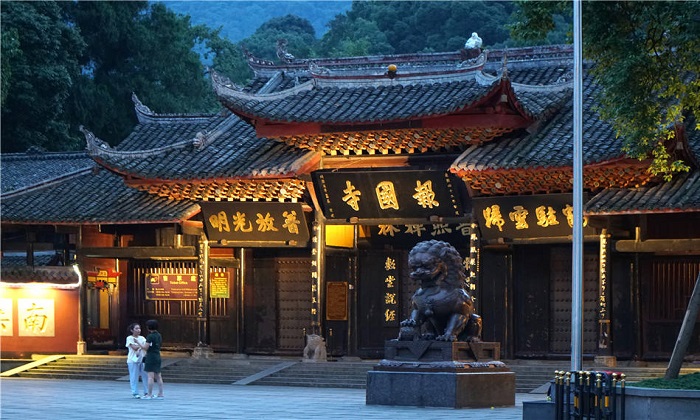
Baoguo Temple
Practical Experience for Visiting Mount Emei
Corresponding Scenic Areas of Each Shuttle Bus Stop
- Leidongping: Get off at this stop for Jinding, then walk for about half an hour to Jieyin Hall to transfer to the Jinding Cableway.
- Wuxiagang Parking Lot: The closest to Qingyin Pavilion, walk for twenty minutes after getting off to reach Shuangqiao Qingyin.
- Wannian Temple Parking Lot: Get off at this stop for Wannian Temple, you can transfer to the Wannian Cableway up the mountain or hike.
Methods to Avoid the Visitor Flow Peak
The number of visitors going up the mountain is the largest in the morning, and the Jinding Cableway is especially crowded. Queuing for 30 to 40 minutes at 7 or 8 o’clock in the morning is common. If you want to avoid the peak, you can go to Jinding after 2 o’clock in the afternoon. Allocate your morning time to Qingyin Pavilion or Wannian Temple, and go up to Jinding in the afternoon for a smoother route.
It is Recommended to Book Tickets and Cableway Tickets Online in Advance
Purchase entrance tickets and shuttle bus tickets in advance through official channels. On-site tickets are often sold out in peak season. Tickets for Jinding Cableway and Wannian Temple Cableway can also be booked online in advance.
Comparison of Different Accommodation Zones
- Around Baoguo Temple: Abundant hotels, convenient dining, moderate prices. Disadvantage: you need to set off early to go up the mountain the next day.
- Leidongping: Close to Jinding, suitable for visitors who want to watch sunrise but do not want to stay on Jinding. Few hotels, high prices.
- On Jinding: Very few and expensive hotels, but the viewing platform is right outside the door, and you do not need to crowd the shuttle bus to watch sunrise.
Recommended Routes to Save Energy for Visiting
Stay near Baoguo Temple, take the shuttle bus directly to Leidongping in the morning, and transfer to the cableway to Jinding. Return to Leidongping along the same route after visiting, take the bus downhill to Wannian Temple Parking Lot, visit Wannian Temple and take the cableway downhill, then take the bus back to Baoguo Temple. You can go to Qingyin Pavilion in the remaining time. This route involves no backtracking, suitable for visitors with elders or limited physical strength.
Frequently Asked Questions About Mount Emei
Q: Which season is the most suitable for visiting Mount Emei?
A: Spring (April to June) and autumn (September to November) are the most comfortable. Azaleas bloom in spring with a moderate temperature. Visibility is high in autumn, and the probability of sea of clouds appearing at Jinding is relatively high. Summer (July to August) is cool on the mountain, suitable for escaping summer heat, but it is easy to get foggy in the rainy season. Winter (December to February) has snow scenery, but the temperature is low and some roads may be icy.
Q: What is the ticket price? Are there any preferential policies?
A: Tickets are divided into peak and off seasons. Peak season (January 16 to December 14): 160 CNY; Off-season (December 15 to January 15 of the next year): 110 CNY. Round-trip shuttle bus ticket for the whole mountain: 90 CNY. Jinding Cableway: 65 CNY for one-way up, 55 CNY for one-way down; Wannian Temple Cableway: 65 CNY for one-way up, 45 CNY for one-way down. Students and the elderly can purchase preferential tickets. All temples in the scenic area are now permanently open for free.
Q: How large is the temperature difference between the mountain top and the foot? How should I dress?
A: Baoguo Temple at the foot is about 500 meters above sea level, while Jinding is nearly 3,100 meters, with a huge temperature difference. Wear short sleeves at the foot in summer and a coat on Jinding; the temperature at the foot is about 5 to 10 degrees Celsius in winter, and -5 to 5 degrees Celsius on Jinding. A three-layer dressing method is recommended: quick-drying underwear, fleece or thin down jacket, windproof and waterproof jacket. Choose non-slip hiking shoes, and add crampons in winter. Sunglasses and sunscreen are essential.
Q: What safety precautions should be taken when watching macaques in the ecological monkey area?
A: Do not hang plastic bags outside your backpack and shake them; do not take food out of your bag in front of macaques; do not stare at macaques, scream or run. If entangled, squat down and pretend to pick up stones, and macaques will usually back off. The scenic area has implemented human-monkey separation management, but the above precautions still need to be followed.
Q: How to use the scenic shuttle bus efficiently?
A: The round-trip ticket for the whole mountain is 90 CNY, valid for two days, and you can get on and off freely between Baoguo Temple, Wannian Temple Station, Wuxiagang Station and Leidongping. It takes about two hours from the foot of the mountain to Leidongping. When going downhill, if you plan to visit Wannian Temple or Qingyin Pavilion, be sure to tell the driver to get off at Wannian Temple or Wuxiagang Station. Leidongping tickets are limited daily, so it is recommended to buy the shuttle bus ticket together with the entrance ticket.
Q: Where is the most cost-effective place to stay?
A: Around Baoguo Temple: about 150 to 300 CNY per night, convenient accommodation and dining, but you need to get up early to go up the mountain the next day. Leidongping: about 400 to 800 CNY per night, close to Jinding, suitable for visitors watching sunrise, but few hotel options. On Jinding: about 800 to 1,500 CNY or more per night, viewing platform right outside the door, but high prices, average room conditions, and possible mild altitude sickness due to high altitude.
Q: How to arrange the trip for visitors with limited physical strength and time?
A: Take the shuttle bus from Baoguo Temple to Leidongping, then transfer to the cableway to Jinding, with basically no strenuous climbing required. If you only visit the essence, prioritize Jinding and Qingyin Pavilion.
Q: What money-saving methods are available for visitors on a limited budget?
A: Travel in off-season, tickets are reduced by about 50 CNY, and cableway prices are halved. Choose inns around Baoguo Temple. Bring your own dry food and drinking water. Buy tickets and cableway tickets online in advance to save time and avoid sold-out situations.
The Smart Way to Experience Mount Emei
What makes Mount Emei stand out is how its experiences unfold gradually rather than all at once. The journey begins quietly at Baoguo Temple, moves through the forested and scenic paths of Qingyin Pavilion, deepens with the history of Wannian Temple, and culminates at the expansive views of Golden Summit. Seen this way, Mount Emei is not just a collection of attractions, but a progression that feels more complete when approached in the right order.
For first-time visitors, a well-planned route can make a significant difference—not only in saving time and energy, but also in avoiding unnecessary backtracking and crowds. Coordinating transport, cable cars, and accommodation in advance helps create a smoother experience overall. This is also why many travelers choose China Dragon Travel when they want a Mount Emei trip that is better organized, more efficient, and easier to navigate from start to finish.