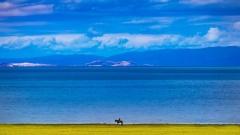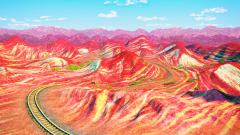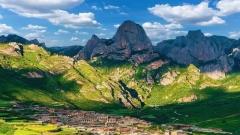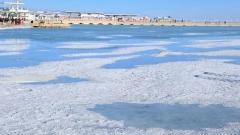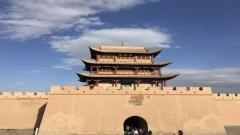

In the geographical tapestry of Northwest China, the Qaidam Basin is often referred to as the “Treasure Basin.” At its northern edge lies Da Chaidan (Mongolian for “Big Salt Lake”), a strategic and administrative hub that serves as a vital window into the Earth’s extreme geological evolution. For the seasoned traveler, Da Chaidan is no longer just a coordinate on a map; it is a complex synthesis of geology, spectroscopy, and high-stakes logistical coordination.
Mineral Spectrums and Liquid Legacies — Analyzing Emerald Lake
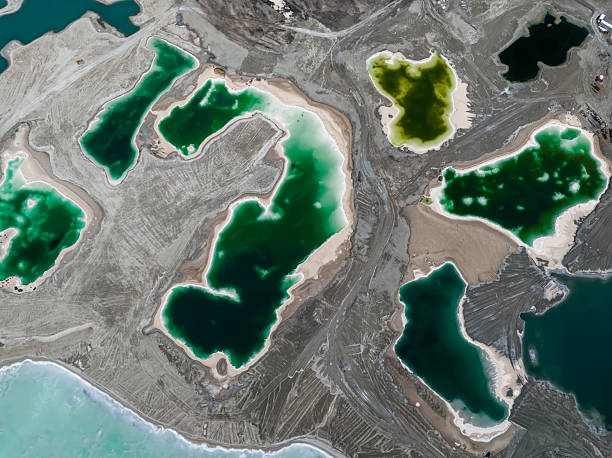
Unlike the well-known Caka Salt Lake, the Emerald Lake of Da Chaidan is not a purely natural phenomenon. It is a “color miracle” born from the intersection of industrial history and geological transformation.
Mineral Saturation and Dynamic Color Shifts
The striking colors of Emerald Lake stem from high concentrations of minerals, including potassium, magnesium, and lithium. These elements undergo physical and chemical reactions depending on seasonal and temperature variations, altering the lake’s refractive index. In May, as plateau temperatures rise and ice layers melt, the salts in the pits re-dissolve to reach saturation. It is during this time that the water exhibits its most vivid layers of emerald green and milky blue.
Salt Crystallization and Marginal Geomorphology
Observers will notice thick layers of white salt crystals encrusting the lake’s edges. This is a result of the extreme evaporation-to-precipitation ratio in the Qaidam Basin. From a geological perspective, this is an active chemical precipitation field. For professional photographers, these crystalline textures provide natural macro subjects, showcasing the primitive geometric arrangements found in the natural world.
The Duel of Wind and Water — The Evolution of Wusute Water Yadan
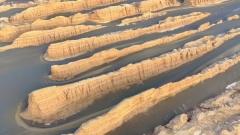
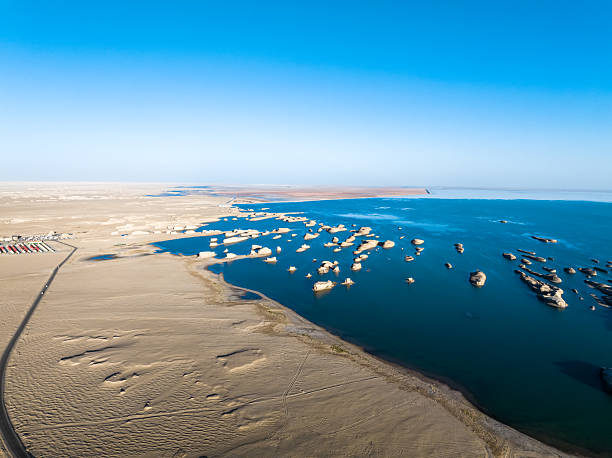
Approximately 200 kilometers southwest of Da Chaidan lies one of the rarest geological sights on Earth: the Wusute Water Yadan.
Defining the Yadan Landform
The term “Yadan” (or Yardang) originates from the Uyghur word meaning “steep mound.” It is a classic aeolian (wind-eroded) landform typically found in hyper-arid regions. However, Wusute’s uniqueness lies in its coexistence with water.
The Transition from Land to Water
Geological surveys indicate that this area was once a standard terrestrial Yadan field. As water levels in West and East Taijinar Lakes rose significantly due to climate fluctuations, the lake water flooded the Yadan clusters, submerging the bases of the mounds. This “Water Yadan” landscape is extremely rare globally, representing a transient state of ecological equilibrium.
-
Scientific Value: Studying the hydrological changes here is crucial for understanding the climate shifts of the northern Qinghai-Tibet Plateau.
-
Environmental Fragility: Because the Yadan soil is porous and loose, constant immersion and wave erosion accelerate the collapse of these structures. Thus, it is a “time-limited” wonder of the world.
The Climatic Logic of the Qaidam Basin
Da Chaidan is characterized by a typical high-altitude continental arid climate. Its complexity for travelers lies in its extreme and unpredictable meteorological shifts.
Radiation, Thermal Fluctuations, and “Onion” Layering
At altitudes above 3,100 meters, the atmosphere’s ability to filter solar radiation is significantly weakened. In May, UV intensity is at extreme levels, yet the lack of atmospheric heat regulation means temperatures plummet as soon as clouds cover the sun or night falls.
-
Technical Clothing Strategy: Professional travelers should employ the “Onion Layering” system (Wicking base layer, fleece insulating mid-layer, and windproof/waterproof outer shell). One must be prepared for 0°C temperatures during sunrise shoots at the lake, yet be able to adjust quickly for 20°C+ conditions by noon.
Physiological Adaptation in Arid Zones
With extremely low annual precipitation, humidity levels in Da Chaidan often fall below 20%. During long-distance cross-border travel, visitors frequently face respiratory dryness and nosebleeds. In professional itinerary planning, humidity management and electrolyte replenishment are as vital as altitude adaptation.
Strategic Rhythm and Logistics of Long-Distance Expeditions
On the 3,000-kilometer journey of the Silk Road’s Great Loop, Da Chaidan is the “lifeline” that determines the success of the expedition.
Strategic Location: The Link Between Qinghai and the Western Regions
Geographically, Da Chaidan is the confluence of the G315 (the famous desert highway) and the G3011 (Liuge Expressway). It sits at the center of a crossroad between Delingha to the east, Mangya to the west, Dunhuang to the north, and Golmud to the south.
Technical Preparation for Wilderness Crossing
Traveling from Da Chaidan toward Dunhuang or Huatugou involves hundreds of kilometers of desert highways with zero signal. This demands high standards from the travel team:
-
Communication Backup: Since mobile signals are unstable in the desert interior, professional teams must be equipped with satellite navigation and emergency communication devices.
-
Vehicle Engineering: High altitude, low pressure, and sustained high temperatures are extreme tests for vehicle cooling systems and tire pressure.
-
Supply Hub: Da Chaidan is the last major resupply point before entering Gansu. Ensuring adequate reserves of fuel, water, and emergency medicine here is the key to safety for the remainder of the trip.
Cultural Fusion and Historical Sediments
While often viewed solely as a scenic area, Da Chaidan’s historical depth is profound. It is a core component of the “Silk Road via Qinghai.”
Memories of Pastures and Industry
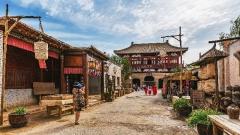
The name “Da Chaidan” originates from Mongolian, reflecting its past as a lush summer pasture. In the 1950s, it became a famous chemical base during the Qaidam development boom. This transition from “primitive pasture” to “industrial town” and finally to “tourism sanctuary” offers a unique lens through which to understand the modern development of Qinghai.
The Wisdom of Coexistence
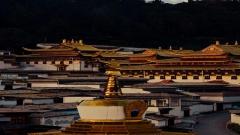
Here, Mongolian, Tibetan, and Han cultures intertwine. Travelers can witness vibrant prayer flags alongside Mongolian yurts and taste cuisine that fuses multi-ethnic flavors. This cultural symbiosis adds a profound human layer to the stark desert journey.
The beauty of Da Chaidan is magnificent, but it is also unforgiving. Its charm lies in its primitivity and isolation, while its challenge lies in the extreme demands it places on a traveler’s physical and organizational capabilities.
A successful journey through the Qaidam Basin should not be a mere “check-list” tour; it should be an act of reverence and exploration of natural laws. Through an understanding of geological backgrounds, precise mastery of climatic patterns, and rigorous organization of long-distance logistics, travelers can touch the deepest soul of this wilderness while remaining safe.
In Da Chaidan, every salt crystal and every Yadan mound tells a story of planetary evolution. Our responsibility is to provide you with the professional key to unlock that story.