
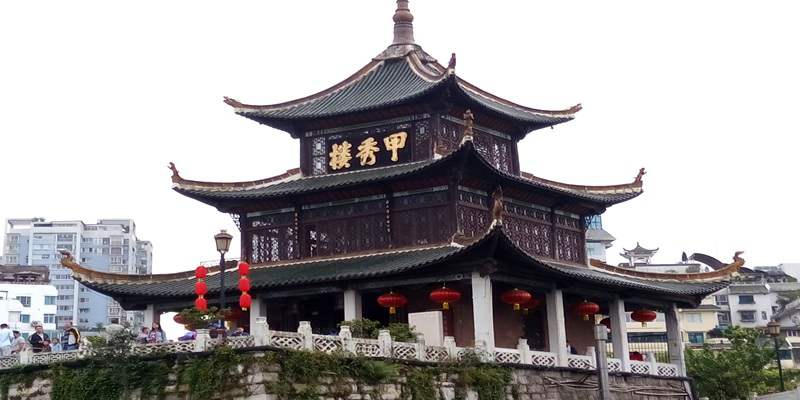
Perched on Aoji Rock in Guiyang’s Nanming River, Jiaxiu Tower, built in 1598, is Guizhou’s cultural icon. Named Jiaxiu (“Outstanding Scholars”), it was commissioned by Governor Jiang Dongzhi to foster talent in the region. After six renovations, the tower merges Jiangnan-style elegance with Guizhou’s rugged mountain architecture, forming a stunning vista alongside Fuyu Bridge and Cuiwei Garden. Designated a Major National Historical Site and AAA-Level Scenic Area, it offers visitors Ming-Qing architectural craftsmanship, riverside views, and a tangible link to Guiyang’s 400-year history.
The History of Jiaxiu Tower in Guizhou
The birth of Jiaxiu Tower is closely tied to the cultural development of Guizhou. During the Wanli era of the Ming Dynasty, the southern bank of the Nanming River in Guiyang gradually became a gathering place for literati. Ma Tingxi, a successor of Wang Yangming’s Heart-Mind Theory, built the Qiyun Pavilion here, where he studied the theory and gave lectures. Subsequently, cultural venues such as the Yuji Academy and Yuantiao Hall emerged, laying a solid cultural foundation for the construction of Jiaxiu Tower.
In 1598 (the 26th year of the Wanli era), Governor Jiang Dongzhi and Inspector Ying Chaoqing, witnessing Guizhou’s lagging performance in the imperial examinations, proposed building a pavilion on the Ao Ji Stone in the Nanming River for scholars to study, embodying their hopes for academic excellence. Initially, a platform resembling a striving turtle was built on the sand, named Ao Tou Ji (Turtle Head Rock), and then a pavilion was constructed on top, initially named Jiaxiu Tower (Exemplary Tower).
Over the following centuries, Jiaxiu Tower endured numerous vicissitudes, being destroyed and rebuilt multiple times.
- In 1621 (the first year of the Tianqi era), the pavilion was destroyed during unrest and rebuilt by Governor Zhu Xieyuan, who renamed it Laifeng Pavilion (Phoenix Arrival Pavilion), only to be damaged again later.
- In 1689 (the 28th year of the Kangxi era), Governor Tian Wen oversaw its reconstruction, reverting to the original name Jiaxiu Tower and adding the Floating Jade Bridge to connect both sides.
- In 1776 (the 41st year of the Qianlong era), Governor Pei Zongxi renovated the pavilion, inscribed the plaque, and added the Hanbi Pavilion on the bridge.
- In 1909 (the first year of the Xuantong era), Jiaxiu Tower was destroyed by war and rebuilt again by Governor Pang Shuhong. During the turbulent decade, the pavilion fell into disrepair.
- In 1981, the Guiyang Municipal Government restored it according to the original design and added a moon terrace to the east.
- In 1982, Jiaxiu Tower was listed as one of the first batch of cultural relic protection units in Guizhou Province.
- In 2006, it was designated as a National Key Cultural Relic Protection Unit by the State Council, alongside Guiyang’s Wenchang Pavilion, establishing its significant status among ancient Chinese architecture.
Notably, the completion of Jiaxiu Tower fulfilled the aspirations of its founders and greatly inspired the academic fervor of scholars in central Guizhou. Since its establishment during the Ming Dynasty, Guizhou has produced a remarkable array of talents during the Ming and Qing dynasties, achieving the remarkable feat of nurturing one military scholar, two literary scholars, three top scholars (zhuangyuan), seven hundred successful candidates in the highest imperial examinations (jinshi), and six thousand recommended scholars (ju ren). Among them, Xia Tonghe stood out as China’s sole top scholar who also studied abroad, receiving special permission from Empress Dowager Cixi to ride a horse within the Forbidden City—an extraordinary honor. Thus, Jiaxiu Tower transformed from its initial function as a scholarly retreat into a symbol of Guizhou’s cultural flourishing, becoming an important landmark that embodies the humanistic spirit of central Guizhou.
Guizhou Jiaxiu Tower
Jiaxiu Tower’s Scenic Area Layout
Starting from the square archway, Guizhou Jiaxiu Tower Scenic Area is divided into three closely connected parts from north to south, each with its own characteristics, forming a travel experience where scenery changes with each step. Touring from north to south, visitors can successively see the stone archway, Fuyu Bridge and Hanbi Pavilion, then the core attraction Jiaxiu Tower, and finally Cuiwei Garden with Suzhou garden style. The three parts unfold along the Nanming River, with mountains, rivers, ancient buildings and gardens complementing each other, perfectly interpreting the unique artistic conception of “Aojiao Floating Jade”.
Stone Archway and Floating Jade Bridge: The Enchanting First Glimpse upon Entry
The stone archway and the Floating Jade Bridge form the first scenic vista as one enters the scenic area. The stone archway, located at the northern end of the Floating Jade Bridge, was originally a fully wooden structure from the Qing Dynasty. The existing building bears the four bold and vigorous characters “Cheng Nan Sheng Ji” (A Remarkable Relic in the South of the City), serving as an iconic landmark of “Cheng Nan Yiji” (Relics in the South of the City), one of the eight renowned scenic spots in Qing-era Guiyang.
The Floating Jade Bridge, which connects both banks of the river, is truly a masterpiece of ancient bridge architecture. Constructed from white cotton stone, a specialty of Guizhou, the bridge appears from afar like a jade belt floating on the water, hence its name. The craftsmanship of this bridge is exceptionally unique: the bridge arches gradually increase in size from north to south, with the largest circular arch near the high southern bank resembling the elegant charm of single-arch stone bridges found in the water towns of Jiangnan. The central line of the bridge deck forms a subtle S-shape, clearly visible from an aerial view. Spanning over 90 meters in length, it passes beneath the pavilion to connect both shores. Initially, the Floating Jade Bridge featured nine arches. The sandbar to the west of the bridge, known as Fangdu Zhou, was adorned with a profusion of flowers and trees. On clear nights with a bright moon and sparse stars, the bridge’s reflection interplayed charmingly with the sandbar, creating the famous scene of “Nine Arches Reflecting on the Sandbar.” Later, due to urban development, two arches were filled in, leaving only seven visible today, and Fangdu Zhou has submerged beneath the water. Nevertheless, the scenic view of the bridge reflecting on the river remains captivating.
Hanbi Pavilion: A Leisurely Spot for Enjoying Scenery by the Flowing Water
The Hanbi Pavilion on the Floating Jade Bridge is an excellent place for tourists to rest and take in the scenery. Built in the forty-first year of the Qianlong era, this small pavilion derives its name from the deep pool beneath the bridge, known as Hanbi Pool (Pool of Implicit Emerald). The pillars of the pavilion are inscribed with two couplets composed by Wang Bing’ao, the magistrate of Guiyang during the Xianfeng era of the Qing Dynasty. The first couplet reads, “Water emerges from a jade ring, while people walk amidst lotus petals,” and the second, “The Milky Way floats across the sky with stars gliding over the water; a jade rainbow drags raindrops as wild geese streak across autumn.” These verses vividly depict the shimmering waters and radiant skies surrounding Hanbi Pavilion, imbued with literary charm. Seated within the pavilion, one can feel the refreshing breeze, admire the rippling blue waves of the Nanming River, and gaze upon the majestic silhouette of Jiaxiu Tower in the distance, experiencing the leisurely and poetic sentiment of ancient scholars as they watched fishing boats drift and rinsed their cups by the flowing waters.
Jiaxiu Tower: The Soul of Guiyang on Crayfish Rock
Nestled on Crayfish Rock in the middle of Nanming River, Jiaxiu Tower stands as a timeless symbol of Guiyang, its three-tiered, four-cornered spire rising 22.9 meters into the sky. Crafted from timber and stone, the tower features red-lattice windows, white marble pillars, and carved stone railings, its layered design tapering gracefully toward the heavens. From its peak, visitors gaze out at the river winding below, where the structure’s reflection merges with the water, creating a dreamlike scene that embodies the harmony of nature and architecture.
Ascending the tower, one finds eight Qing Dynasty steles inscribed with poems and essays, silent witnesses to centuries of change. The tower’s most iconic feature is its plaque—”Jiaxiu Tower” —written by Xie Shiqin during the Xuantong era. Lost during the Cultural Revolution, only the characters “xiù” (elegance) and “lóu” ( tower) were recovered; the missing “jiǎ” (first) was recreated from old photos, making the plaque a poignant blend of history and memory.
But Jiaxiu Tower’s true heart lies in its 174-character long couplet, penned by Qing scholar Liu Yunliang. The upper scroll paints a vivid picture of Guiyang’s geography: “Five hundred years have I stood on Crayfish Rock, propping up the sky; let me climb one more floor to feast my eyes on the boundless view. Eastward, I lean on Hengyang and Xiang; westward, I embrace Yunnan and Guizhou; southward, I screen Guangdong and Guangxi; northward, I border Sichuan and Chongqing—vast rivers and mountains stretch before me.” The lower scroll delves into history: “Thousands of feet high, I tower over the river, guarding the border; who else could have carved these twin pillars to hold back the raging tides? I think of Qin’s ancient roads, Han’s Zangke Commandery, Tang’s Jialan, and Song’s Luodian—through wind and rain, these places have withstood the test of time.” The couplet, longer than Kunming’s Daguanyuan (Grand View Garden) couplet, weaves together landscape, history, and emotion, capturing the essence of Guizhou’s resilience and charm.
Today, Jiaxiu Tower remains a beloved landmark, its red walls and green tiles reflecting the river’s currents. For visitors, climbing its stairs is not just a journey upward but a step back in time—where the past meets the present, and the soul of Guiyang reveals itself.
Cuiwei Garden: A Serene Retreat in the Depths of the Landscape
Nestled at the southernmost end of the Jiaxiu Tower scenic area, Cuiwei Garden is a complex of Ming and Qing-style Suzhou-inspired courtyards, facing the iconic Jiaxiu Tower across the Nanming River. Approved for integration into the Jiaxiu Tower site in 1999 by the Guizhou Provincial Government, this garden—once known as Nan’an(South Cottage)—dates back to the Ming Dynasty. Its layout includes classical structures like Gongnan Pavilion, Cuiwei Pavilion, meditation halls, and the Longmen Academy, all connected by winding paths that meander through lush foliage and tranquil corners. The garden embodies the refined elegance of Jiangnan-style landscapes, where every turn reveals a harmonious blend of architecture and nature.
Originally established as a retreat for scholars, Cuiwei Garden served as a cultural hub during the Ming era. Its design emphasizes serenity and contemplation, with pavilions positioned to frame picturesque views of the river and surrounding greenery. The use of delicate woodcarvings, stone pathways, and layered vegetation reflects the Suzhou garden principle of “borrowing scenery” to create an illusion of expansiveness within a compact space.
Literary Legacy: Wang Yangming‘s Poetic Tributes
In 1509, during the Zhengde era, the renowned philosopher Wang Yangming visited Cuiwei Garden (then called Nan’an) while lecturing at Guiyang’s Wenming Academy. He penned several poems, including Two Verses Composed at Nan’anand Rhyming with Xu Duxian on a Joint Visit to Nan’an, capturing the garden’s ethereal beauty. Lines such as “A few woodcutters and fishermen dwell beyond the water; a stone path skirts the ridge, slanting into the stream”and “Pine woods bask in evening rain over a thousand peaks; maple leaves in autumn merge with clouds of sunset glow”evoke the garden’s timeless tranquility. These verses remain celebrated for their vivid imagery and lyrical grace, offering a window into the garden’s historical ambiance.
The Longmen Academy: Echoing Guizhou‘s Scholarly Spirit
At the heart of Cuiwei Garden lies the Longmen Academy, once a pivotal institution for Confucian learning in Guizhou. Its emphasis on education resonated with Jiaxiu Tower’s symbolic role in promoting academic excellence. Together, they underscored Guizhou’s cultural resurgence, fostering generations of scholars. Today, the academy stands as a testament to the province’s intellectual heritage, where visitors can trace the legacy of ancient lectures and scholarly debates.
Cuiwei Garden invites modern travelers to step into a space where history, poetry, and nature intertwine—a quiet counterpoint to the grandeur of Jiaxiu Tower, yet equally vital to Guiyang’s cultural tapestry.
Travel Guide: An Immersive Experience of Jiaxiu Tower’s Beauty
Transportation Routes
Jiaxiu Tower is located at No. 8 Cuiwei Lane, Nanming District, Guiyang, at the intersection of the Nanming River, Xihu Road and Binhe Road, with extremely convenient transportation:
- Public Transport: Take Metro Line 1 to Hebin Park Station, Exit A, then walk 1.5 kilometers or transfer to a bus to reach; you can also directly take buses such as No. 15, 34, 46, 48, 52 to Jiaxiu Tower Station, and walk a few steps to the scenic area entrance.
- Self-Driving: There are few parking lots near the scenic area. It is recommended to park your car at Lixing Famous Store or Wenhua Road Parking Lot, then walk about 10 minutes to the scenic area.
Opening Hours and Tickets
- Ticket Policy: The main building of Jiaxiu Tower is open to the public for free; Cuiwei Garden requires a ticket during the day, with a ticket price of 8 yuan, and is open for free after 18:00.
- Opening Hours: The scenic area is divided into two travel periods: day and night view—daytime opening hours are 08:30-18:00 (last entry to Cuiwei Garden is 17:30); night view opening hours are 19:00-22:00. At this time, the lights are on, and the reflections of Jiaxiu Tower and Fuyu Bridge are reflected in the Nanming River, like a poem and a painting, which is the best time for sightseeing and photography.
- Notes: Some areas of the scenic area require ID card verification to enter. It is recommended that tourists carry their ID cards with them.
Photography and Travel Suggestions
The beauty of Jiaxiu Tower lies in the deep integration of mountains, rivers and ancient buildings. There are unique scenes at different times and angles:
- Best Photography Locations:
- The head of Fuyu Bridge—can take a panoramic view of Jiaxiu Tower, wide-angle lens is recommended;
- The side of Xihu Road on the opposite bank of the Nanming River—suitable for taking photos of the pavilion and its reflection in the water, especially for night view photography;
- Inside Cuiwei Garden—composing with the garden’s archways and flower windows as the foreground can take photos full of ancient charm.
- Recommended Travel Time: Prefer early morning or evening—there are few people in the early morning with soft light, allowing you to feel the quietness of the scenic area; the blue hour in the evening (19:00-19:30), when the lights are just on and the sky is not dark, the night view taken at this time is the most atmospheric.
- Recommended Travel Route: Enter from the “Cheng Nan Sheng Ji” stone archway, walk along Fuyu Bridge, and rest and enjoy the scenery at Hanbi Pavilion on the way; then climb Jiaxiu Tower, visit the stone carvings and long couplet, and feel the humanistic heritage of the ancient tower; after climbing the tower to overlook the scenery of the Nanming River, cross the bridge to Cuiwei Garden, visit ancient buildings such as Gongnan Pavilion and Longmen Academy, and experience the tranquility of Jiangnan gardens; finally, walk along the Nanming River bank to enjoy the night view of Jiaxiu Tower and end the trip. If time permits, you can also visit Wenchang Pavilion (known as the “sister tower” with Jiaxiu Tower, both are ancient buildings of the Ming Dynasty) which is only 500 meters away, to further feel the charm of ancient architecture in Guiyang.
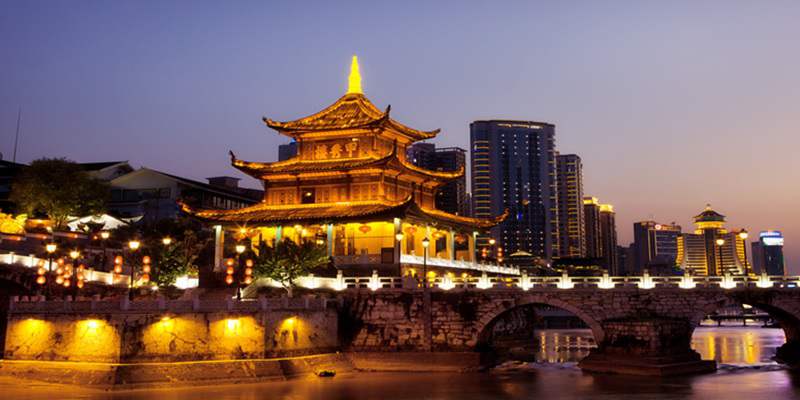
Jiaxiu Tower at Night
Recommended Food
After the tour, you can taste authentic Guizhou cuisine around Jiaxiu Tower:
- Bao Zheng (Jiaxiu Tower Store): A popular restaurant with a terrace offering a direct view of Jiaxiu Tower. It is recommended to try special dishes such as silk doll (thin flour wrappers with various shredded vegetables) and sour soup fish.
- Nanmenkou Changwang Noodle: A time-honored brand in Guiyang, a 10-minute walk away. The changwang noodle (noodle soup with pig intestines, blood curd and preserved vegetables) is rich and flavorful, with distinct local characteristics.
- Lei’s Tofu Balls (Xihu Road Store): A classic Guizhou snack. The crispy outer and tender inner tofu balls are served with a unique Houttuynia cordata dipping sauce, full of flavor.
- Drink Recommendation: Qucha Shan by the Nanming River. Choose a window seat, order a local specialty tea, quietly enjoy the river view, and experience the slow life of Guiyang.
Combined Tour Attractions
- Qianling Mountain Park: 3 kilometers away from Jiaxiu Tower, known as the “urban lung of Guiyang”. You can climb mountains, watch monkeys, and visit Hongfu Temple, feeling the integration of nature and humanity.
- Qingyan Ancient Town: 30 kilometers away from Jiaxiu Tower, it is a stone city from the Ming and Qing dynasties. The ancient streets, lanes, stone walls and stone houses are quite charming. You can also taste special foods such as braised pork knuckles and rose candy, which is suitable for a half-day to one-day trip.
Notes
- Most of the roads around Jiaxiu Tower are slate roads, which are easy to slip when wet. Visitors are advised to wear non-slip shoes.
- There are numerous cultural relics in Cuiwei Garden. Please do not touch them and keep quiet to avoid affecting other visitors’ tours.
- There are many tourists during holidays. It is recommended to travel during off-peak hours, with early morning or weekday afternoons being the best times.
- When visiting at night, the light along the Nanming River is relatively dark. Please pay attention to your steps to ensure safety.
- Smoking and littering are prohibited in the scenic area. Please jointly protect the scenic environment.
Centuries of Character Etched in Jiaxiu, Savor Guizhou’s Spirit as your Journey Unfolds
From the reading voices of scholars in the Ming and Qing dynasties to the sincere admiration of today’s tourists, Jiaxiu Tower in Guizhou has stood tall by the Nanming River for hundreds of years through wind and frost. Here, there are not only the ingenuity of ancient architecture, the natural beauty of mountains and rivers, but also the spiritual pursuit of “outstanding imperial examination candidates” and cultural confidence of Guizhou people. Traveling to Jiaxiu Tower, you don’t need to rush. You might as well slow down your pace: feel the breeze on Fuyu Bridge, read the long couplet in Jiaxiu Tower, admire the garden scenery in Cuiwei Garden, and wait for the night by the Nanming River, so that you can truly experience the unique charm of this ancient tower.
If you want to enjoy the charm of Jiaxiu Tower more easily and travel deeply to the scenic spots and historical sites in Guiyang and even Guizhou, you can choose China Dragon Travel—professional team will plan a reasonable itinerary, take you to immerse yourself in the natural beauty and humanistic heritage of Guizhou, making every trip fulfilling and unforgettable. Whether traveling alone, on a couple’s date, or with family, Jiaxiu Tower in Guizhou will bring you a unique travel experience, becoming an unforgettable memory of your trip to Guizhou.