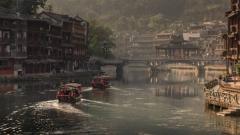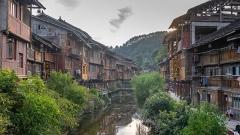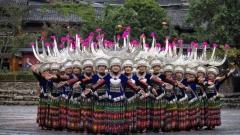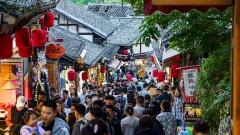

Nestled in southwest China, Guizhou boasts stunning mountains, rivers, a pleasant climate, and karst landforms that nurture countless breathtaking natural wonders. As one of China’s most ethnically diverse provinces, it is home to numerous ethnic minorities, where rich and varied cultures blend harmoniously, creating unique natural and humanistic scenery. It has the magnificent Huangguoshu Waterfall, the ancient Zhenyuan Old Town, Xijiang Qianhu Miao Village, and Zhaoxing Dong Village, which never fails visitors. This guide organizes Guizhou’s tourist attractions from a map perspective, helping you explore this hidden gem of cultural and natural marvels.
Regional Division of Guizhou Tourism Map
Based on geographical features, transportation routes, and cultural distribution, Guizhou can be divided into the following major tourist regions for easy itinerary planning:
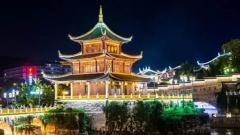
- Central Guizhou: The province’s tourism hub and main gateway for entry and exit, often serving as the start or end of a trip. Nearby attractions include Qingyan Ancient Town and Tianhetan Scenic Area.
- Southwest Guizhou: Features typical karst peak forest landforms, with the majestic Wanfenglin Scenic Area. It is home to water landscapes such as Maling River Gorge and Wanfeng Lake, and is renowned for its strong Buyi and Miao cultural heritage.
- Southern Guizhou: Represented by Libo Zhangjiang Scenic Area, it boasts karst forests, underwater forests, waterfalls, and lakes.
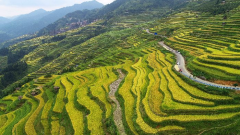
- Southeastern Guizhou: Centered on Leigong Mountain in the Miaoling Mountains, it is crisscrossed by streams and terraced fields. As the core area of China’s Miao and Dong cultures, it houses numerous iconic ethnic villages and historical towns, including Xijiang Qianhu Miao Village, Zhaoxing Dong Village, Zhenyuan Old Town, and Basha Miao Village.
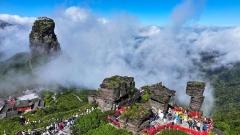
- Northeastern Guizhou: Dominated by Fanjing Mountain, the main peak of the Wuling Mountains. A famous Buddhist sacred mountain and World Natural Heritage, it is celebrated for its unique mountain shapes, spectacular sea of clouds, Buddhist culture, and ancient town history.
- Northern Guizhou: Traversed by the Dalou Mountains and Wujiang River system. It is home to Chishui Danxia World Natural Heritage, renowned for its danxia landforms, bamboo seas, and waterfall groups. As a red tourism destination, it also features ethnic customs of the Gelao and Miao peoples.
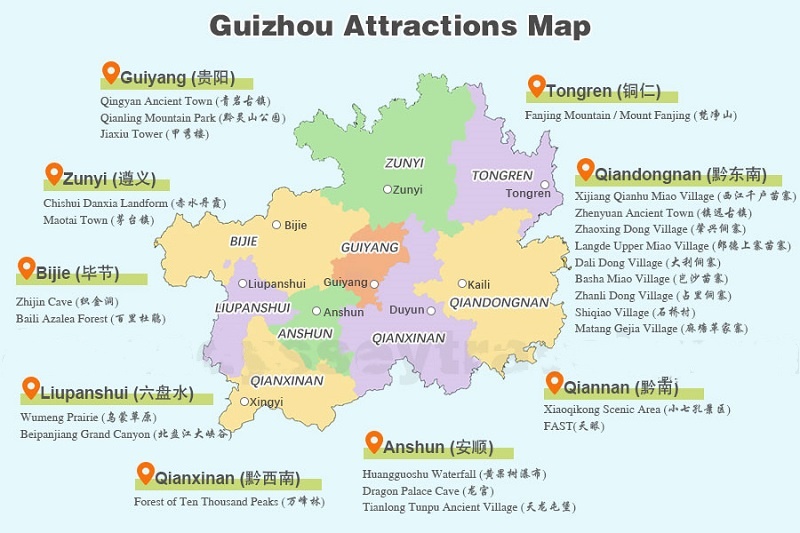
Guizhou Tour Map
Detailed Guide to Guizhou Tourism Map
Natural Wonders
- Huangguoshu Waterfall Group: Located southwest of central Guizhou, about 128 km from Guiyang. It is Asia’s largest waterfall and one of the world’s most famous waterfalls. The scenic area also includes Doupotang Waterfall and Tianxingqiao Scenic Area (Silver Chain Waterfall), forming a magnificent waterfall cluster.
- Libo Zhangjiang Scenic Area: Situated in southern Guizhou, approximately 200 km from Duyun. A World Natural Heritage, it consists of two major scenic spots: Xiaoqikong and Daqikong.
- Fanjing Mountain: Located in northeastern Guizhou, about 70 km from Tongren urban area. A World Natural Heritage and one of China’s five great Buddhist mountains, its iconic landscape is Hongyun Golden Summit.
- Chishui Danxia Tourism Area: In northwestern Guizhou, bordering Sichuan. It integrates danxia landforms, bamboo seas, and “the city of a thousand waterfalls,” making it a masterpiece of natural scenery.
- Maolan National Nature Reserve: Located in Libo County, southern Guizhou. It preserves the world’s largest area of primeval karst forest.
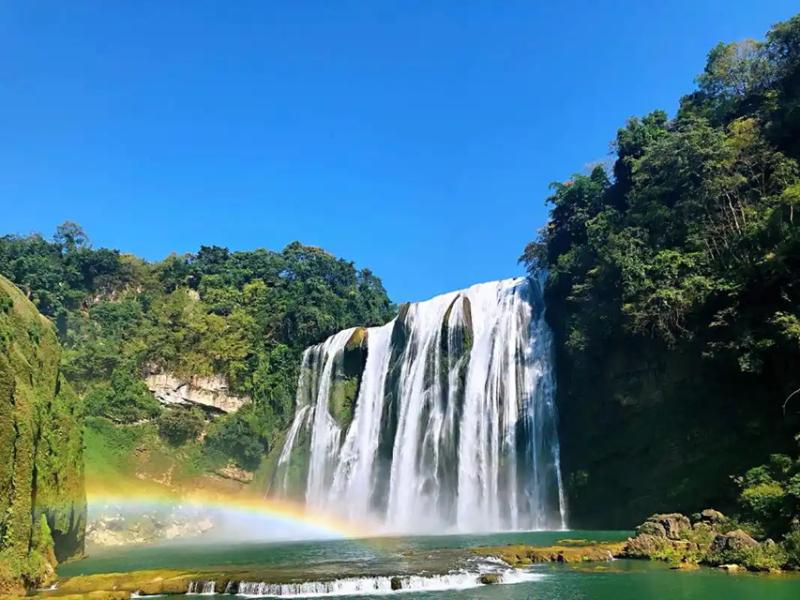
Huangguoshu Waterfall: A Must-Visit Check-in Spot for Guizhou Travel
Cultural Landscapes
- Xijiang Qianhu Miao Village: In northeastern Leishan County, southeastern Guizhou, about 35 km from Kaili. More than a dozen villages built along the mountains are connected, with thousands of stilted buildings stretching across the undulating terrain.
- Zhenyuan Old Town: In western southeastern Guizhou, a renowned historical and cultural city in China. Built along the Wuyang River, the buildings on both banks feature upturned eaves.
- Zhaoxing Dong Village: Located in Liping County, southeastern Guizhou. One of China’s largest Dong villages, it is famous for its cluster of drum towers.
- Longli Ancient Town: In Jinping County, southeastern Guizhou. A well-preserved military garrison from the Ming Dynasty, it features a rigorous layout and unique structure.
- Bing’an Ancient Town: In south-central Chishui City. An important station for the Red Army during the “Four Crossings of the Chishui River,” it is simple and full of red memories.
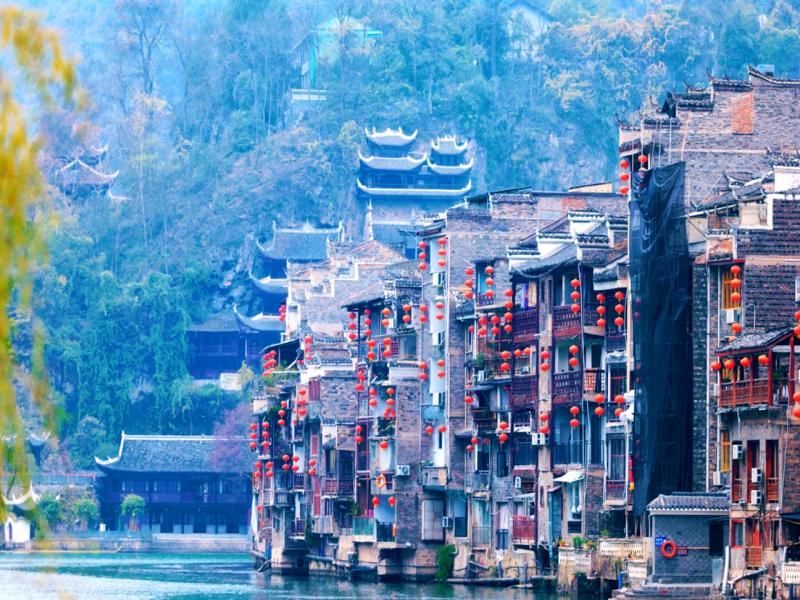
Zhenyuan Old Town: One of Guizhou’s Must-Visit Cultural Landscapes
Core Transportation Network in Guizhou
These core transportation hubs provide convenient travel options for your trip to Guizhou. It is recommended that you choose the suitable mode of transportation according to your personal circumstances.
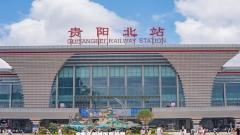
- High-Speed Railway: Guizhou’s high-speed rail network (e.g., Shanghai-Kunming High-Speed Railway, Guiyang-Guangzhou High-Speed Railway) forms a “cross-shaped” main skeleton, running north-south and east-west. It is the core artery connecting Fanjing Mountain, Xijiang Miao Village, and Huangguoshu Waterfall. Most high-speed rail stations are located on the outskirts of cities or counties; after arrival, transfer to buses to reach specific scenic areas.
- Expressways: National trunk lines such as Lanzhou-Haikou Expressway (G75), Shanghai-Kunming Expressway (G60), and Xiamen-Chengdu Expressway (G76) form the main transportation network, connecting remote attractions like Wanfenglin, Maling River Gorge, Chishui Danxia, and Maolan Nature Reserve with fast access. Self-driving or chartered cars rely primarily on this network.
- Airports: Guiyang Longdongbao International Airport is the main hub for international/domestic arrivals and transfers. Other local airports include Tongren Fenghuang Airport, Xingyi Wanfenglin Airport, and Libo Airport, providing convenient travel options for visitors to different regions.
Practical Information
To ensure a smooth and worry-free trip, please familiarize yourself with the distribution of key public services and mark the following on your mobile map in advance:
- Medical Services: Guizhou Provincial People’s Hospital (Zhongshan West Road), Affiliated Hospital of Guizhou Medical University (Beijing Road), Kaili No.1 People’s Hospital (Jinjing Road), Affiliated Hospital of Zunyi Medical University, etc.
- Financial Services: Branches and 24-hour ATMs of Industrial and Commercial Bank of China (ICBC), Agricultural Bank of China (ABC), Bank of China (BOC), and China Construction Bank (CCB) are widely distributed in major commercial districts across Guizhou, such as Zhonghua Road, Zunyi Road, and Penchi in Guiyang.
- Network Services: 4G/5G signals cover all cities, counties, and major scenic areas in Guizhou. However, signals may be unstable or interrupted in some remote mountainous areas or deep within nature reserves.
If you feel unwell in a remote scenic area, contact the management or guides immediately and transfer to a county or urban hospital as soon as possible. Before visiting remote ethnic villages, withdraw sufficient cash in advance, as electronic payments or ATMs may not be available in some villages. Official tourism information centers are usually located at airport/high-speed rail station entrances and major scenic areas (e.g., Huangguoshu Waterfall, Xijiang Qianhu Miao Village, Libo Xiaoqikong), where you can obtain free maps or consult routes.
Q&As for Guizhou Travel
Q1: What is the best transportation method for traveling in Guizhou?
We highly recommend the combination of high-speed rail + chartered car/shared car. Use high-speed rail to efficiently connect major cities, then book chartered or shared car services through local reputable travel agencies or online platforms to reach nearby attractions. This option balances efficiency and flexibility, with local drivers familiar with mountainous roads to navigate complex terrain. Self-driving is also an option but requires extensive mountain driving experience; Guizhou has a high ratio of bridges and tunnels, resulting in significant toll fees, so route planning is essential.
Q2: As Guizhou is rainy, will it affect travel significantly?
Guizhou receives abundant rainfall, especially in spring and summer. However, this rarely means all-day rain; most precipitation is showers or night rain, with sunny periods often available during the day. Post-rain landscapes are even fresher and more beautiful, shrouded in mist like a fairyland. With proper rain gear and non-slip shoes, rainy weather will not overly impact your travel experience.
Q3: What are the best family-friendly attractions in Guizhou?
We recommend Huangguoshu Waterfall, Libo Xiaoqikong, and Xingyi Wanfenglin. These attractions offer a mix of fun and scenery, serving as excellent outdoor classrooms to connect with nature, and feature relaxed itineraries for a pleasant trip.
Guizhou is not only a three-dimensional landscape painting to be savored slowly, but also an ongoing epic of ethnic culture. Its beauty lies not only in the karst wonders that greet your eyes, but also in the resounding Grand Song of the Dong that fills your ears, the rich and fresh flavors that dance on your tongue, and the warmth and resilience of the local people. This map guide will point the way for your journey and open a window to experiencing Guizhou. When you step into Guizhou’s mountains, everything you see and hear will be the most sincere gifts from this land. May your journey be meaningful and rewarding.