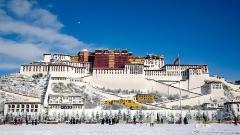

Trekkers planning Tibet trekking often ask: Are there porters and yaks available? Yes. Hiring porters and yaks is common on all routes, including Mount Kailash Kora, Everest East Gamagou Valley, Kulagangri and Motuo. Most services are clearly priced by local village collective companies. For example, Kangsha Village at the foot of Mount Kailash set up a yak transport team in 1981, providing standardized tourism services. Porters and yaks help trekkers lighten their load, focus on snow-capped mountains and holy lakes, and get support at high altitudes. This article introduces hiring methods, costs and precautions to help trekkers prepare.
Porter Services for Trekking in Tibet: Arrangements, Costs and Precautions
Porters are important human support for trekking in Tibet. Most of them are local Tibetan residents who have lived in high-altitude areas since childhood, with good physical fitness and familiarity with mountain roads and weather changes. The following key information can help trekkers quickly understand porter services:
- Hiring channels: In Tarchen Town of Mount Kailash, many innkeepers can recommend porters. Tarchen has official porter and guide services provided by Kangsha Village Company with transparent prices. In Qudang Township of Everest East, you need to register and arrange porters and yaks at the township government’s tourism office. Trekkers can also make arrangements in advance through agencies such as China Dragon Travel to avoid the trouble of looking for them temporarily upon arrival.
- Porter work content: The main task is to carry personal equipment, food and camping supplies. Each porter can carry 15 to 25 kilograms. They can also lead the way, find water sources and help set up tents along the way. Porters usually do not speak Mandarin or English fluently, but basic gestures and simple words are enough for communication, and both parties have clear goals with little communication barrier.
- Cost reference: Porter fees are calculated daily, about 200 to 350 CNY per day. The total cost depends on the length of the trip, usually ranging from hundreds to thousands of CNY. Prices are higher in peak season (May to October) than in off-season. The accommodation and meals of porters are usually borne by the employer, which should be clearly agreed before departure.
Agreeing on the price, scope of work and division of labor with the porter before departure can effectively avoid misunderstandings during the trip. Specific details to be clarified include: whether the start and end dates of work include the entry and exit days; the weight limit and whether extra charges apply for overweight; the daily remuneration (you can compare multiple people and take the median); the arrangement of meals and accommodation for the porter during the trek (unified preparation or daily subsidy). It is recommended to buy short-term accident insurance for the porter, which is responsible for both parties. Tips are not mandatory, but it is a common practice to give a proper tip at the end if the service is good.
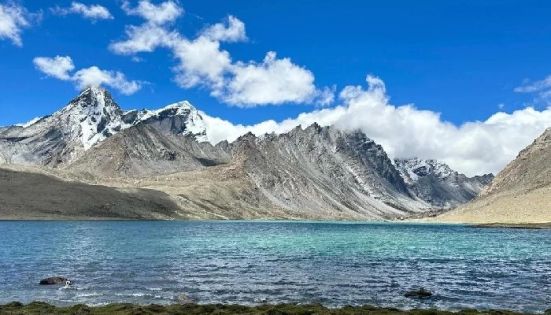
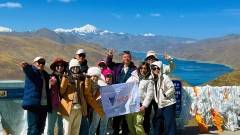
Scenery of Snow-Capped Mountains and Lakes on the Tibetan Plateau
Usage and Costs of Yak Transport Teams for Trekking in Tibet
Yaks are traditional means of transport for trekking on the plateau. An adult yak can carry 40 to 60 kilograms of supplies, and can walk steadily in complex terrains such as high altitudes, oxygen deficiency and gravel slopes. Many long-distance trekking routes, such as Everest East Gamagou Valley and Kulagangri, use yak teams. Yaks are usually led by yak herders, who are responsible for driving the yaks, loading and unloading goods, and grazing near the camp. The following key information can help trekkers quickly understand yak services:
- Cost calculation: Yak rental is calculated per head per day, and yak herders’ wages are separate. On the Everest East Gamagou Valley trekking route, yaks cost about 230 CNY per head per day, and yak herders about 250 CNY per person per day. One yak herder can manage up to 3 yaks at most. On the Mount Kailash Kora route, yaks cost about 150 to 200 CNY per day. Prices are higher in peak season than in off-season, and the accommodation and meals of yak herders also need to be arranged by the employer.
- Benefits of using yaks: Trekkers can travel light, only carrying a small bag with water, camera and snacks, and leaving large items such as tents, sleeping bags, cooking utensils and food to yaks. This can significantly reduce daily fatigue and extend the walkable distance. Many trekkers feedback that after traveling light with yaks on Everest East, they only need to carry food and drinks for the day, and the difficulty is greatly reduced.
- Precautions for getting along with yaks: Yaks need to be treated with caution; do not approach or pat them, especially female yaks with calves. Yak herders control the herd in front or behind the team. Trekkers should keep a distance of more than two to three meters from yaks. Yak teams move slowly on steep mountain roads. Trekkers can discuss the daily departure time and rest rhythm with herders in advance. Yaks may not be able to move forward in sections with deep snow, so you need to wait patiently or adjust the itinerary at this time.
Common Mistakes in Hiring Porters and Yaks for Trekking in Tibet
Many trekkers encounter avoidable problems when actually hiring porters or yaks. The following are common mistakes and their avoidance methods:
- No written proof for oral agreements: Some trekkers only agree on services through oral promises, resulting in porters not showing up the next day, or the person arriving being different from the agreement and price changes. It is recommended to go directly to the village committee or tourism service company to register upon arrival, ask for receipts or simple contracts; even handwritten records are more reliable than oral agreements.
- Unclear responsibility for meals and accommodation: Only the daily fee is mentioned when negotiating the price, without clarifying how to arrange meals and accommodation for porters and yak herders. Trekkers only find out that they need extra expenses when the other party asks for meals and accommodation during the trip. It should be clearly agreed before departure whether the team provides unified meals or daily subsidies.
- Temporary price increase due to overweight: Luggage weight is not weighed before departure, and porters claim overweight and ask for price increases after walking for a distance. Trekkers often have no choice at this time. Weigh your backpack and luggage to be transported before departure to ensure it is within the agreed limit.
- Ignoring language barriers: Porters may not understand the route names spoken by trekkers. It is recommended to write down place names and camp names along the way in simple Chinese on paper, and identify them with a map, which is more effective than oral instructions.
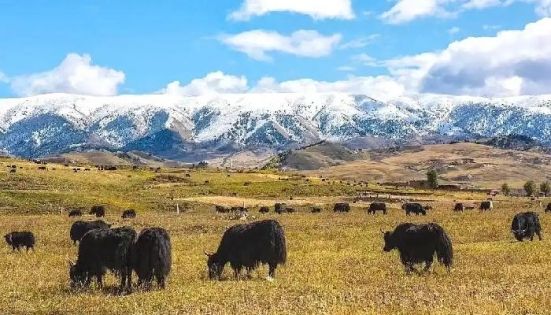
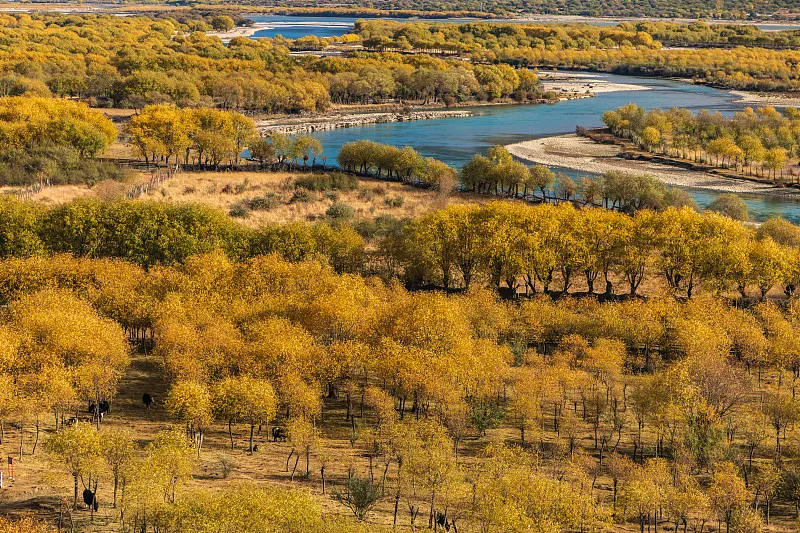
Scenery of Yak Herds in Valleys and Grasslands of Tibet
Practical Tips for Trekking with Porters and Yak Herders in Tibet
Trekking with porters and yak herders for several days will go more smoothly if you get along well. The following tips are proven and practical:
- Confirm the route before departure daily: Take out the map and point to the target camp and estimated walking time of the day, so that the porter clearly understands the route and avoids getting lost.
- Respect the local walking pace: Porters and yak herders have their own step frequency; do not urge them to speed up. Following their pace is more labor-saving instead.
- Share snacks: When resting along the way, give the porter a piece of chocolate or a few biscuits, which can improve the team atmosphere without costing much.
- Learn simple local greetings: Say “Zhaxidele” (auspiciousness and good fortune), and the porter will feel friendly. This one phrase is enough.
In addition, if you find that porters or yak herders are unwell, such as coughing or looking pale, take the initiative to ask and give proper medicine or rest time. In a high-altitude environment, anyone may have physical problems, and mutual care is necessary.
Differences in Using Porters and Yaks on Various Trekking Routes in Tibet
The demand and usage of porters and yaks vary on different trekking routes. The following key information can help trekkers make arrangements according to specific routes:
- Mount Kailash Kora: The route is about 52 kilometers long, crossing the Drolma La Pass at an altitude of nearly 5,700 meters. Porter and yak services are very mature. There is a special tourism service company in Kangsha Village at the foot of the mountain, providing yak cargo transport, horse riding, porter and guide services with unified and clear prices. During the peak tourist season, nearly 100 horses and 20 yaks are needed to provide transport services for tourists in just one day. You can contact and arrange directly in Tarchen Town.
- Everest East Gamagou Valley: This route has magnificent scenery but complex road conditions with no supply points along the way. Porters and yaks can also be hired here. Experienced trekkers recommend traveling light and leaving large luggage to yaks. Note that yaks may stop moving on steep slopes; for example, when they cannot walk on rocky slopes, yak herders need to unload part of the load to continue. Yaks also cannot move in deep snow, and manual path clearing is required. These situations should be fully considered before departure.
- Motuo Trekking: Yaks cannot pass through some rainforest sections in Motuo, so only porters can be used. Hiring porters is recommended if conditions permit. They are very familiar with the situation along the way and usually have rich experience in risk avoidance and field survival. Porter prices change every year, so it is recommended to ask locals before negotiating the price.
Choosing Porters and Yaks for Light or Heavy Trekking in Tibet
Trekkers often face the decision of whether to hire porters or yaks. This choice mainly depends on personal physical strength, trip length and desired experience type. The following suggestions can help trekkers make a suitable choice:
- Short-distance light trekking: If the trip is short and personal load can be controlled within 10 kilograms, you can carry it by yourself completely and enjoy a completely independent pace.
- Long-distance light trekking: For longer routes, food and fuel alone may exceed 10 kilograms, plus tents, sleeping bags and moisture-proof mats, the total weight can easily exceed 20 kilograms. Carrying such weight every day at high altitudes is unbearable for most people and can easily induce altitude sickness. Hiring a porter or renting several yaks is a reasonable choice at this time. The extra cost brings better physical condition and higher trip safety.
- Compromise plan: Only hire yaks to transport large items, and carry a small daily bag by yourself. This reduces the load while retaining the independence of trekking. Yaks transport supplies to the next camp every day, and trekkers arrive lightly to pick them up. Many trekkers on Everest East adopt this method.
No matter which way you choose, you should not think that hiring porters or yaks is a sign of weakness. Trekking routes in Tibet generally have high altitudes, few supply points and complex road conditions. It is really difficult to complete the trip with personal load alone. Local porters and yak herders also rely on this job to make a living. Trekkers pay for services, and they earn income, which is a fair and beneficial mutual assistance relationship.
If you decide not to hire help and carry the load by yourself throughout the trip, you should do load training in advance to adapt your body. Personal physical strength will decline at high altitudes. The load should be based on the weight you can easily carry at ordinary times, and the daily walking time should be shorter than when hiring help, leaving sufficient time for rest and cooking.
Pre-Trekking Checklists for Trekking in Tibet
Before entering the mountains, the following items are easy to ignore but very important. Trekkers are recommended to check them one by one:
- Agree on the specific service days and start and end locations with porters or yak herders. It is better to record them by mobile phone or in writing to avoid inconsistent memories between both parties.
- Weigh the luggage to be carried by porters or yaks in advance, and do not exceed the agreed limit. Valuables such as cameras, documents and cash must be carried with you.
- Provide porters and yak herders with a simple route map or camp name list to ensure that everyone has a consistent understanding of the daily destination.
- Prepare enough cash. ATMs are usually unavailable at the end of the trek, so it is recommended to carry 20% more than the budget as a backup.
In addition, there are several details worth noting: carry commonly used medicines, such as painkillers, band-aids, and Gao Yuan An. Porters and yak herders may not have the habit of carrying medicines with them, and trekkers can provide help at critical moments. You must pay attention to warmth and sun protection during high-altitude trekking. Jackets, down jackets, fleece jackets, quick-drying clothes, sun protection masks, sunscreen, sun hats and sunglasses are essential items. The ultraviolet rays on the plateau are strong, and you are easy to get sunburned without proper protection. Trekking poles and knee pads are also practical equipment. Trekking poles can assist in exerting force and reducing the burden on knees, and knee pads can reduce knee damage when going downhill.
Final Notes on Using Porters and Yaks for Trekking in Tibet
The answer to whether porters and yaks are available for trekking in Tibet is clear: porter and yak services exist on all mature trekking routes in Tibet, and a relatively standardized operation system has been formed. Trekkers should make plans in advance and arrange through formal channels (such as local village committees, tourism service companies or reputable travel agencies). At the same time, respect the labor habits and cultural traditions of local practitioners. For example, China Dragon Travel has a long-term cooperative local team in arranging porters and yaks, and will sign service agreements in advance to clarify the rights and responsibilities of both parties, so as to effectively avoid possible disputes during the trip. When trekkers actually walk on mountain roads above 4,000 meters above sea level, looking at the distant snow-capped mountains showing a golden color in the sunset, and only carrying a light bag on their body, they will deeply realize that making reasonable use of porter and yak services is an important way to make trekking in Tibet safer, more comfortable and memorable. Wish every trekker going to Tibet can find a suitable helper and leave solid and free footsteps on this plateau land.