
When travelers arrive in Lhasa, one of their first questions is: “Which temples should I visit?” Others often ask about entrance fees, opening hours, dress codes, and photography rules. As the spiritual heart of Tibetan Buddhism, Lhasa is home to some of the most revered monasteries in the world. Among them, Jokhang Temple, Sera Monastery, and Drepung Monastery stand out as must-see landmarks.
Jokhang Temple: The Holiest Temple in Lhasa
Jokhang Temple holds an extremely high position in the hearts of Tibetans, and the lifelong wish of many local people is to come here to worship. In front of the main gate of the temple, people prostrate themselves in kowtows from morning till night, and the pious scene is unforgettable at a glance. The temple enshrines the 12-year-old statue of Sakyamuni that Princess Wencheng brought from Chang’an back then. It is said that there are only three such statues in the world, and this is the most well-preserved one. As an old saying goes, “Jokhang Temple came first, then the city of Lhasa”, and the city was built slowly around it.
Tickets and Opening Hours
- Tickets: Peak season (May-October): CNY 85 per person, Off-season (November-April): CNY 35 per person. Half-price tickets are available for students and the elderly.
- Opening hours: 9:00 to 18:00, stop admission at 16:30.
- Reservation method: Real-name reservation is required one day in advance on the WeChat mini-program “Jokhang Temple Official Reservation”in peak season, and admission is granted by swiping the ID card. You can buy tickets directly at the gate in off-season.
- Recommended visiting time: 2 to 3 hours.
How to Get There
- Bus: Take Bus No.1, No.3, No.11 or No.12 to “Jokhang Temple Station”and walk for 5 minutes after getting off.
- Taxi: It costs CNY 10 to 15 to take a taxi from the urban area to the entrance of Barkhor Street, as motor vehicles are not allowed to enter the old town.
- On foot: It is the most convenient to walk there if you live near Barkhor Street.
Recommended Visiting Order
It will be smoother to arrange your visit in three steps: reservation – visit – experience. After entering Jokhang Temple, it is recommended to walk in the following order:
- Look at the Tang-Tubo Alliance Stele and the Princess Willow before entering the gate, which are historical relics.
- The core area is the Jokhang Hall, which enshrines the 12-year-old statue of Sakyamuni. The statue is inlaid with countless treasures around it and is said to have been personally blessed by Sakyamuni, thus becoming the holiest statue in Tibet.
- The Thousand Buddha Corridor connects all the halls, with thousands of small Buddha statues on both sides, most of which were cast in the Ming and Qing dynasties.
- Finally, climb to the golden roof platform on the third floor to overlook the scripture-turning crowd in Barkhor Street and the Potala Palace in the distance.
Important Notes for Visiting
- Take off your hat and remove your sunglasses when entering any Buddha hall, and do not wear short shorts, mini skirts, strapless tops or slippers.
- Photography is strictly prohibited inside the Buddha halls, neither for Buddha statues nor murals. Photography is allowed in outdoor areas, but do not take photos of believers from the front.
- Walk clockwise when moving in the temple, do not walk counterclockwise.
- Prepare some small-denomination banknotes of CNY 1 and CNY 0.5 to place in front of Buddha statues for worship, as coins are not accepted in Tibet. You can spend CNY 10 to offer a butter lamp.
- Do not speak loudly or point at Buddha statues with your fingers in the temple, and keep quiet and respectful.
- The best visiting time is from 8:30 to 10:00 in the morning, when there are few tourists and the light is soft.
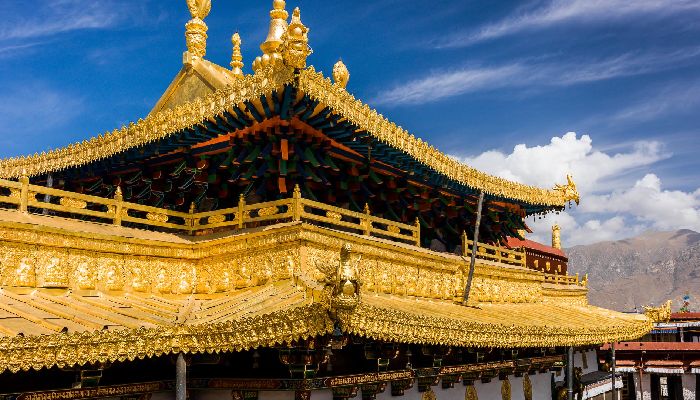
Jokhang Temple
Sera Monastery: The Best Temple in Lhasa for Watching Scripture Debates
Sera Monastery is located at the foot of Sera Utse Mountain in the northern suburbs of Lhasa. Built in 1419, it has a history of more than 600 years. “Sera”means wild rose in Tibetan, and it is said that the mountain foot was full of wild roses when the monastery was built. It is one of the six major monasteries of the Gelug Sect, and there were more than 9,000 monks in its prime.
The most special thing about Sera Monastery is the scripture debate activity every afternoon. Monks form pairs, one standing and one sitting. The standing one claps hands loudly to ask questions, and the sitting one answers. The clear clapping sounds fill the whole venue. Although you cannot understand Tibetan, the earnest and vivid atmosphere is well worth seeing.
Scripture Debate Time and Tickets
- Scripture debate time: 15:00 to 17:00 from Monday to Saturday, not held on Sundays and special festivals.
- Tickets: CNY 50 per person, only CNY 10 after 17:00 in the afternoon.
- Opening hours: 8:30 to 17:00, but scripture debates can only be watched after 15:00.
- Recommended visiting time: 3 to 4 hours.
- Scripture debate venue: Walk straight in after ticket checking to the open-air scripture debate venue on the north side, which is paved with gravel and surrounded by ancient trees, with a unique charm.
How to Get There
- Bus: Take Bus No.16, No.22, No.23 or No.24 to “Sera Monastery Station”.
- Taxi: It takes about 20 minutes to take a taxi from the urban area, costing CNY 15 to 20.
- Cycling: If you are in good physical condition, you can ride a bike from the urban area for about 30 minutes.
Rules at the Scripture Debate Venue
- You can take photos with your mobile phone, but do not turn on the flash. Professional cameras are generally not allowed.
- Do not walk into the middle of the monks, and do not sit on their red cushions.
- Keep quiet and do not speak loudly to disturb others.
- There is a second scripture debate venue next to the main one, with fewer people and a better experience.
Other Attractions Worth Seeing Besides Scripture Debates
- Hayagriva Statue: Enshrined in Jabba Zhacang (Buddhist College), it is said to be the wrathful incarnation of Avalokitesvara. Photography is prohibited, but it is extremely shocking.
- Tsokchen Hall: The largest hall of Sera Monastery, which can accommodate thousands of monks for gatherings, with a 6-meter-high gilded bronze statue of Maitreya Buddha enshrined inside.
- The back mountain: You can climb up to overlook the whole view of Lhasa and the snow-capped mountains together, but it takes about 1 hour to climb up, so it is recommended to prepare an oxygen tank.
Recommended Tour Route
Arrive at about 14:30 in the afternoon, visit the main hall first, watch the scripture debate on time at 15:00, take photos of the buildings after the debate, and climb the back mountain if you are in good physical condition.
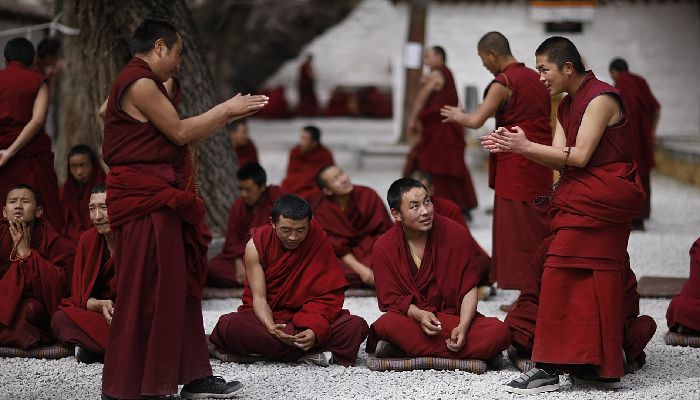
Monks Debating at Sera Monastery
Drepung Monastery: The Largest Temple in Lhasa
Drepung Monastery is located at the foot of Gephel Utse Mountain in the western suburbs of Lhasa. Built in 1416, it was founded by Jamchen Chojé Shakya Yeshe, a disciple of Master Tsongkhapa. The white-walled and red-roofed buildings stretch from the foot to the hillside of the mountain, looking like a pile of white rice from a distance. “Drepung”means “gathering of rice”in Tibetan. Historically, more than 10,000 monks lived here at most, making it the largest Tibetan Buddhism monastery in the world. It is a long walk to go around the monastery, but precisely because it is large, people are relatively scattered, and it is not crowded to walk around.
Tickets and Opening Hours
- Tickets: CNY 50 per person.
- Opening hours: 8:30 to 17:30. Most Buddha halls close early in the afternoon, so it is better to go in the morning.
- Recommended visiting time: 2 to 3 hours.
How to Get There
- Bus: Take Bus No.17, No.25 or No.34 to “Drepung Monastery Station”, then climb a slope or take a minibus (CNY 5) to the monastery gate.
- Taxi: It costs about CNY 30 to 40 to take a taxi from the urban area.
- Note: There is a mountain road from the alighting point to the main gate of the monastery, so it is important to wear a pair of comfortable shoes.
Must-See Spots
- Tsokchen Hall: The largest hall of the whole monastery, which can accommodate thousands of monks to recite scriptures together.
- Ganden Phodrang: Once one of the residences of the Dalai Lama in Lhasa, with a special architectural style.
- The entire monastery complex is built against the mountain in a scattered and orderly manner, and it is very spectacular to look down from a high place.
Practical Reminders
- The monastery covers a large area, and it takes at least 2 to 3 hours to visit it all, so bring water and snacks.
- There are many steps to climb, walk slowly and take a rest when you are tired.
- The Buddha Unveiling Ceremony is held at Drepung Monastery during the Shoton Festival every year, when there will be a huge crowd of people, and the ticket prices and transportation will change.
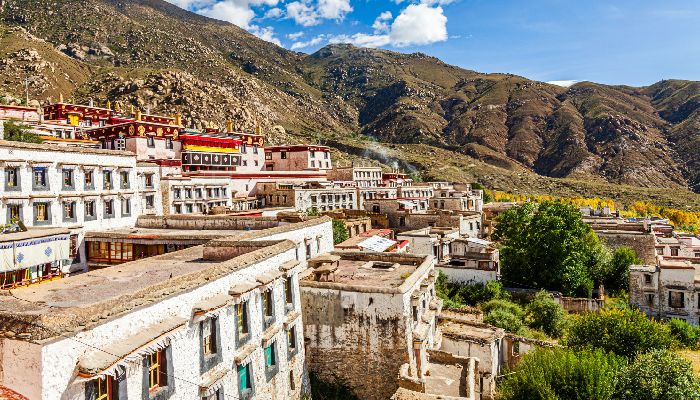
Drepung Monastery
Other Notable Temples in Lhasa Area
In addition to the three core temples above, there are several unique and less crowded temples in and around Lhasa that are worth visiting.
Ramoche Temple
- Enshrines the 8-year-old equal-height statue of Sakyamuni.
- Ticket: 30 RMB, opening hours: 9:00 to 17:00.
- Located about 500 meters north of Barkhor Street, accessible on foot.
Ramoche Temple and the famous Jokhang Temple are collectively known as the “Two Temples of Lhasa”. Founded in the 7th century during the Tubo Dynasty, it was laid by Princess Wencheng herself. The architectural style of the temple integrates the characteristics of Han and Tibetan regions, and the initial temple management was presided over by Han monks, which is a physical witness of cultural exchanges between the Han and Tibetan peoples. The 12-year-old equal-height statue enshrined in Jokhang Temple was originally enshrined in Ramoche Temple. The two equal-height statues were later exchanged for historical reasons, and this past is still a widely circulated story in Lhasa’s temple culture.
Zhajsi Temple
- The only God of Wealth Temple in Tibet, the main deity “Zhaji Lham” is the God of Wealth.
- Free admission.
- Located in the northern part of Lhasa.
Zhajsi Temple was originally a branch temple of Sera Monastery. Historically, it was a place dedicated to praying for safety for outsiders. Most of the outsiders were businessmen, and their businesses went smoothly after worshiping at Zhajsi Temple, so it gradually evolved into a well-known God of Wealth Temple. You can buy Zhaji Lham Thangka and wormwood pine needles for Sang offering in front of the temple. Zhaji Lham is particularly fond of wine, and tourists can buy a bottle of white wine at the temple gate as an offering. The largest number of believers come to worship the God of Wealth at Zhajsi Temple every Wednesday, when they need to queue for one-way passage. Take off your hat and sunglasses before entering the inner hall when visiting.
Ganden Monastery
- The ancestral temple of the Gelug Sect, founded by Master Tsongkhapa in 1409.
- Altitude: 3,800 meters, ticket: 45 RMB.
- Located on the mountain in the eastern suburbs of Lhasa, accessible by shuttle bus.
Ganden Monastery, together with Drepung Monastery and Sera Monastery, is known as the Three Great Monasteries of Lhasa, and enjoys a high status in the Gelug Sect. Built in the col between Wangur Mountain and Luobuer Mountain, the temple complex is built layer by layer along the mountain, which is spectacular. The temple houses the throne and relics of Master Tsongkhapa, as well as a large number of precious cultural relics. The Thangka platform on the back mountain has an excellent view, and you can overlook the panoramic view of the Lhasa River Valley from a high place.
Drak Yerpa Monastery
- A cave temple built on cliffs, with an altitude of about 4,000 meters.
- Master Padmasambhava and Songtsen Gampo once practiced here.
- A round trip from downtown Lhasa is available in one day.
The whole temple is built by chiseling the cliffs, integrating caves and temples. Some Buddha halls are directly embedded in the mountain, and the buildings are integrated with the rocks, making the landscape very unique. Many famous practitioners of Tibetan Buddhism once practiced in seclusion here. Drak Yerpa Monastery is suitable for tourists who prefer off-the-beaten-path routes and are not satisfied with conventional tourist attractions.
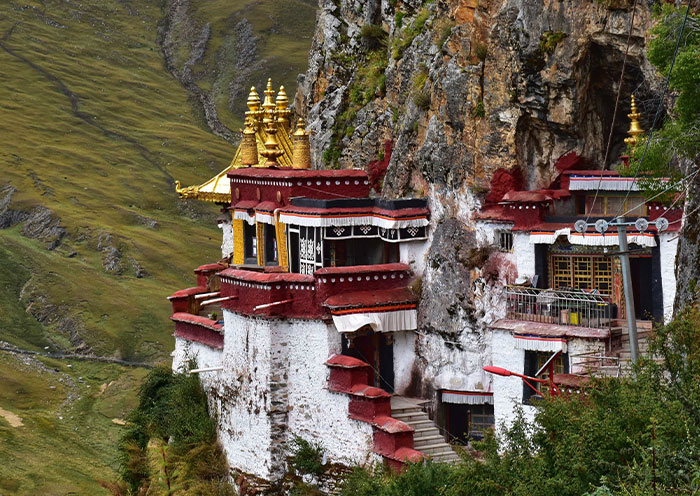
Drak Yerpa Monastery
Practical Notes for Visiting Lhasa Temples
- The best time to visit Jokhang Temple: 8:30 to 10:00 in the morning, when the believers’ worship has just ended, there are few tourists, the light is soft, and the experience is the best. The light on the golden roof is the best from 14:00 to 16:00 in the afternoon, suitable for taking photos of the distant view of the Potala Palace. Try to avoid weekends and Tibetan calendar festivals, when there will be a large crowd of people.
- The best time to watch the scripture debate at Sera Monastery: The scripture debate starts on time at 15:00, it is recommended to arrive at about 14:30, visit the main hall first, then go to the scripture debate venue so as not to miss anything.
- Notes for visiting Drepung Monastery: There is an uphill road from the bus station to the monastery gate, so reserve enough physical strength and time. Most Buddha halls close one after another in the afternoon, so it is recommended to go in the morning.
- Equipment suggestions: The sunshine in Lhasa is extremely strong, so sun protection must be done in all seasons, and a hat, sunglasses and sunscreen should be carried. The temperature difference between day and night is large, so it is recommended to bring a thick coat even in summer. Wear comfortable flat shoes and avoid wearing high heels in the temple.
Basic Rules to Know Before Entering Lhasa Temples
The following rules are basically universal no matter which Lhasa temple you visit.
Appropriate Dressing
Do not wear short shorts, mini skirts or slippers. Women should not wear strapless or too thin clothes. Take off your hat and sunglasses before entering any Buddha hall. The sunshine in Lhasa is strong during the day and the temperature difference between morning and evening is large, so it is recommended to bring a coat even in summer.
Whether Photography Is Allowed
Photography is basically allowed in the outdoor areas of the temple, but it is strictly forbidden to take photos inside the Buddha halls, of Buddha statues, scripture halls and stupas. Put away your mobile phone when you see the no-photography sign and do not take photos in violation of the rules. If found by monks, you will be required to delete the photos on the spot.
Walking Direction
When following believers, be sure to walk clockwise, that is, from left to right. Prayer wheels should also be turned clockwise with the right hand. Walking counterclockwise is both impolite and will hinder others.
Whether to Prepare Small Change
It is recommended to prepare some small-denomination banknotes of CNY 1 and CNY 0.5 for worship. Coins are not used in Tibet, only banknotes are accepted. The amount of worship does not need to be too much, it’s the thought that counts. You can put your palms together to express your respect, and there is no need to imitate complex religious rituals such as prostrating in kowtows.
How to Deal With Altitude Sickness
Lhasa is at an altitude of 3,650 meters, and there are often stairs or uphill sections in the temples, which consume more energy than in plain areas. It is not advisable to arrange too many itineraries in the first two days after arriving in Lhasa, and it is more appropriate to visit one temple a day. Carry a thermos cup to drink hot water, sit down and rest when you feel out of breath, and do not force yourself.
Other Notes
- Do not touch the heads of Tibetans, especially children, as this is regarded as a very sacred part.
- Do not point directly at Buddha statues, murals or monks with your fingers; it is more polite to gesture with your whole palm.
- Do not speak loudly or laugh and frolic in the temple.
Exploring Lhasa’s Temples: A Journey into the Heart of Tibetan Buddhism
Visiting Lhasa’s iconic monasteries offers more than sightseeing—it is an immersive journey into Tibet’s spiritual and cultural heritage. From the sacred Jokhang Temple to the lively philosophical debates at Sera Monastery and the grandeur of Drepung Monastery, each site reveals a unique facet of Tibetan Buddhism. With proper planning and cultural awareness, your exploration of these sacred landmarks will be both meaningful and unforgettable.
For a smoother and more insightful experience, China Dragon Travel provides professional Tibet tour services, including Tibet Travel Permit applications, guided monastery tours, and customized itineraries. With expert local knowledge and reliable arrangements, your journey to Lhasa can be seamless, enriching, and truly memorable.