
In Tibet, time is not measured only by calendars or clocks.
It is measured by seasons, by the movement of the sun and moon, by ritual, and by intention.
Losar — the Tibetan New Year — is not simply a celebration marking the start of another year. It is the most important moment in the Tibetan cultural and spiritual calendar, a time when families, communities, and individuals realign themselves with nature, faith, and the deeper rhythms of life on the plateau.
To understand Losar is to understand how Tibetans perceive time itself — not as something to chase, but as something to enter consciously.
The Origins of Losar:
Losar predates Tibetan Buddhism, emerging from early agrarian and pastoral traditions on the plateau. Long before monasteries dominated the skyline, ancient Tibetans observed the cycles of the moon, the return of sunlight, and the subtle shifts in weather that determined survival.
Over centuries, these observations merged with Buddhist cosmology, astrology, and ritual practice, forming the Tibetan lunar calendar. Losar, marking the first month of this calendar, became a moment of both cosmic and personal renewal.
Unlike fixed Western New Year dates, Losar usually falls between late January and late February, depending on lunar calculations and astrological alignments. This variability reflects a worldview where time adapts to nature — not the other way around.
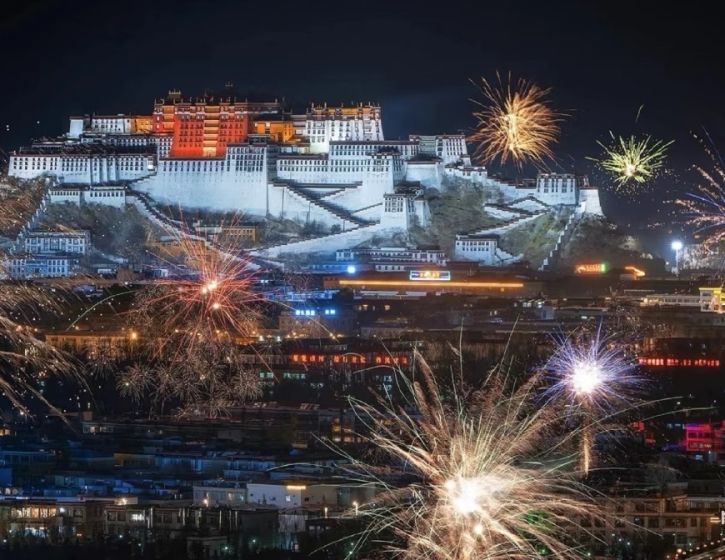
Preparing for the New Year:
Cleansing Space, Cleansing the Mind
Losar does not begin on the first day alone. Its arrival is preceded by days, sometimes weeks, of preparation that extend far beyond logistics.
Physical Cleansing as Spiritual Practice
Homes are thoroughly cleaned, repaired, and reorganized. Dust, clutter, and broken items are removed, symbolizing the release of misfortune, negativity, and unresolved burdens from the past year.
This act is deeply symbolic. In Tibetan culture, external order is believed to influence internal clarity.
Ritual Foods and Offerings
Families prepare traditional foods such as:
-
Kapse (fried pastries in symbolic shapes)
-
Tsampa (roasted barley flour)
-
Chang (barley beer)
These foods are not simply consumed; they are offered first — to household altars, local deities, and ancestral spirits — reinforcing the belief that sustenance is a shared exchange between humans and the unseen world.
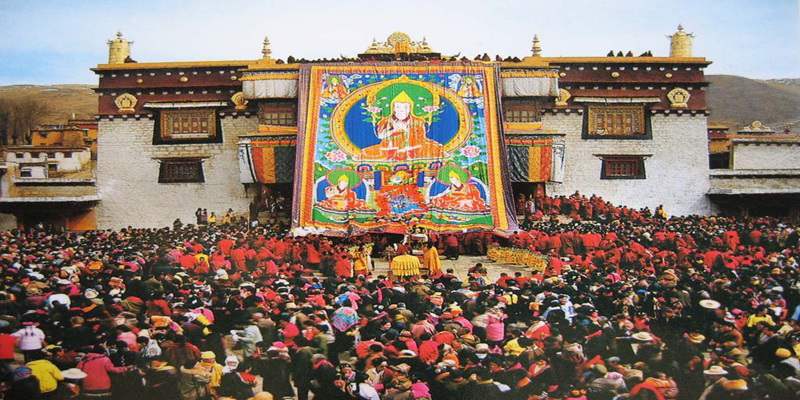
Gutor Night:
The night before Losar is known as Gutor, one of the most symbolically charged moments of the year.
Families gather to eat Guthuk, a special noodle soup containing small symbolic items hidden inside the dumplings. These items — stones, wool, charcoal, or grains — are not predictions, but gentle reflections, prompting laughter, self-awareness, and release.
Later that night, ritual objects representing misfortune and negativity are carried outside and discarded. In some regions, this is accompanied by chanting, torches, or symbolic noise meant to drive away lingering obstacles.
Gutor is not about fear or superstition. It is about acknowledging imperfection — and choosing not to carry it forward.
Losar Day One:
On the first morning of Losar, Tibetans rise early, often before sunrise.
The day begins with sangsol, the burning of juniper branches or incense, sending fragrant smoke into the sky as an offering to the land, the spirits, and the Buddhas. It is an act of gratitude rather than request.
Families dress in their finest traditional clothing, visit temples, offer khatas (ceremonial scarves), and exchange blessings. Speech and behavior are consciously moderated — kindness, patience, and auspicious words are emphasized, as it is believed that the tone of the first day influences the entire year.
Beyond Celebration:
Unlike many modern festivals focused on entertainment or consumption, Losar emphasizes inner alignment.
Its core values include:
-
Gratitude for life and livelihood
-
Responsibility for one’s actions and intentions
-
Awareness of impermanence
-
Renewal through mindfulness
Rather than escaping daily life, Losar invites people to return to it with greater clarity.
Regional Expressions of Losar
Tibet’s vast geography means Losar is celebrated differently across regions:
-
Central Tibet (Lhasa region): Strong monastic presence, temple ceremonies, formal rituals
-
Amdo: Community gatherings, songs, and public celebrations
-
Kham: Emphasis on dance, horse culture, and extended family events
These variations reflect the diversity within Tibetan culture — unified in spirit, diverse in expression.
Experiencing Losar as a Traveler:
For travelers, Losar offers a rare window into Tibetan life — but it demands sensitivity.
Losar is not a performance. It is an intimate, family-centered, and spiritually significant time. Travelers who approach with respect, patience, and humility often gain far more than those seeking spectacle.
Understanding when to observe quietly, when to accept invitations, and when to step back is essential.
Losar in Contemporary Tibet
Despite modernization, Losar remains deeply embedded in Tibetan life. While urban environments have changed, the essence of the festival persists — not as nostalgia, but as continuity.
In a rapidly accelerating world, Losar serves as a reminder that time can still be sacred.
Losar and the Philosophy of Time
Perhaps the most profound lesson of Losar lies in its understanding of time.
Time is not a resource to be optimized, but a cycle to be honored.
Beginnings are not rushed; they are prepared for.
Endings are not feared; they are acknowledged.
This philosophy resonates deeply with travelers drawn to slow travel, spiritual journeys, and meaningful cultural encounters.
Losar Is Not Just a New Year — It Is a Way of Living
Losar teaches that renewal does not require distance or reinvention. It requires attention.
Attention to how we live.
Attention to how we speak.
Attention to how we relate — to each other, to nature, and to ourselves.
For those seeking more than destinations, Losar offers insight into a culture where spirituality is not separate from life, and where the passage of time is met with intention rather than urgency.
To understand Losar is to glimpse the deeper rhythm of Tibet itself.