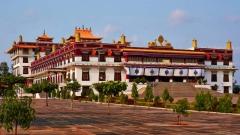

On the shores of Namtso Lake, 4,718 meters above sea level, Tashi Peninsula stretches quietly like a hidden pearl, and Tashi Dor Monastery lies within this secret land, serving as a spiritual link between nature and faith. As the only monastery on the peninsula, it is not only a vital venue for the Nyingma sect of Tibetan Buddhism but also carries thousands of years of religious culture and folk legends. In the morning, sunlight shines on the monastery’s golden roof, prayer flags flutter in the wind, and the scents of incense and lake water interweave—every corner holds stories worth exploring for visitors. Whether you are a religious culture enthusiast or a traveler pursuing natural beauty, Tashi Dor Monastery brings a unique spiritual touch exclusive to Tibet.
The Origin of Tashi Dor Monastery: A Millennium-Old Venue Surrounded by the Holy Lake
Historical Context and Founding Origin of Tashi Dor Monastery
The development of Tashi Dor Monastery bears witness to the changes of Tibetan religious culture, with a clear historical context.
- Founding Era and Founder: Established in 1337 AD by Gongtuoba Tuoxie, the monastery has a history of nearly 700 years and is one of the earliest religious venues around Namtso Lake.
- Sect Affiliation and Religious Status: Belonging to the Nyingma sect of Tibetan Buddhism, it serves as an important inheritance site for the sect in the Namtso region and has long been a core pilgrimage destination for local believers.
- Historical Changes and Restoration: Damaged by wars and the Cultural Revolution, the monastery launched gradual restoration in the 1980s, preserving its primitive simplicity while restoring religious functions.
Site Selection Wisdom and Legendary Connotation of Tashi Dor Monastery
The monastery’s location aligns with Tibetan geomantic concepts and contains profound folk legends, adding a strong sense of mystery to it:
Unique Natural Environment: Backed by the Nyenchen Tanglha Mountains and facing Namtso Lake, the landscape of interdependent mountains and water forms a natural meditation sanctuary, demonstrating the unique wisdom of Tibetan monastery site selection.
Padmasambhava’s Meditation Mark: Legend has it that this was an important place where Guru Padmasambhava propagated Buddhism and practiced meditation in seclusion, laying a solid religious foundation and legendary color for the monastery.
Significance of Landmark: The tall flagpole at the monastery gate is not only a prominent landmark of Tashi Peninsulabut also an important symbol for believers to identify pilgrimage directions and unite their faith.
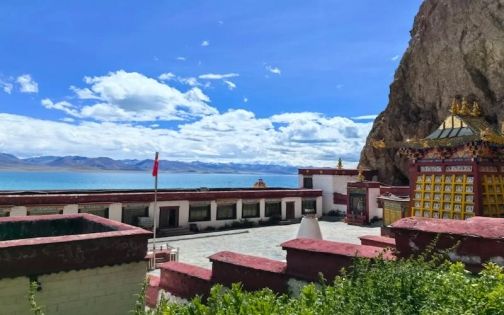
Tashi Dor Monastery
Core Landscapes of Tashi Dor Monastery: Faith Symbols Hidden in the Peninsula
Padmasambhava Cave: A Naturally Formed Meditation Sanctuary
As the most legendary landscape of Tashi Dor Monastery, Padmasambhava Cave combines natural wonders with religious connotations, with core highlights as follows:
- Natural Landform Features: The naturally formed cave is narrow enough for only one person to sit cross-legged. Crystal-clear water drips from the rock walls all year round, regarded by believers as blessed holy water.
- Religious and Cultural Value: The rock walls bear naturally formed religious marks. It is said that Padmasambhava practiced meditation here for many years, filling the cave with a strong spiritual energy.
- Visiting Experience Tips: Warm butter lamp light flickers in the cave, and a statue of Padmasambhava is enshrined on a stone platform deep inside. Visitors can sit quietly to reflect and experience peace away from the hustle and bustle.
Monastery Halls and Sacred Relics: Faith Carriers Tempered by Time
Though not grand, the halls and sacred relics of Tashi Dor Monastery carry thousands of years of cultural accumulation, with key highlights divided into two categories:
- Hall Style and Mural Art: The main hall is simple and solemn, enshrining statues of Padmasambhava, Sakyamuni, and other Buddhas, inlaid with treasures donated by believers, shining brightly under the light. The murals in the hall cover Buddhist stories and Dharma protector statues, with smooth lines and profound connotations.
- Precious Sacred Relics: It houses Ming and Qing Dynasty thangkas and ritual artifacts. The thangkas feature rich colors and distinct expressions, embodying the painters’ piety and craftsmanship; the ritual artifacts have unique designs and exquisite craftsmanship, serving as important relics of Tibetan culture. Visitors can visit these relics under the guidance of monks.
Mani Stones and Prayer Path: A Flowing Inheritance of Faith
The prayer path and Mani stones surrounding the monastery reflect the integration of Tibetan faith into daily life, carrying believers’ pious wishes with core features including:
Cultural Connotation of Mani Stones: Countless Mani stones line the prayer path, each carved with the Six-Syllable Mantra. The inscriptions remain clear despite wind and rain, known as “stone scriptures.”
Ritual Sense of Prayer Circumambulation: Every morning and evening, believers walk clockwise along the prayer path, holding prayer wheels and chanting scriptures, with firm and calm steps, inheriting the millennium-old faith.
Landmark Clasped Hands Stone: The naturally formed Clasped Hands Stone midway along the prayer path resembles hands folded in prayer, regarded as an incarnation of Guanyin Bodhisattva and an important pilgrimage spot. Visitors can follow believers to experience the ritual of prayer circumambulation.
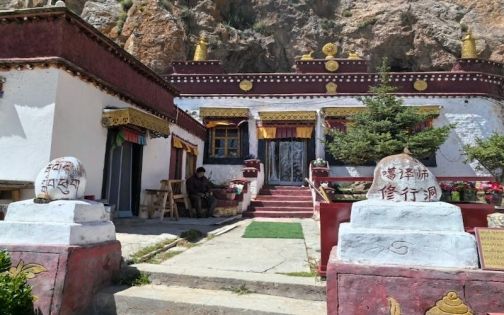
Tashi Dor Monastery
Folk Activities at Tashi Dor Monastery: Faith Celebrations in the Tibetan Calendar
Core Religious Ceremony: Guru Padmasambhava Commemoration Festival
Held in the fifth month of the Tibetan calendar, the Guru Padmasambhava Commemoration Festival is the grandest event at Tashi Dor Monastery, filled with a strong religious atmosphere. Details are as follows:
- Event Purpose and Time: Held to commemorate Padmasambhava’s contributions to propagating Buddhism, the festival lasts for several days and is one of the most important religious celebrations in the region on the Tibetan calendar.
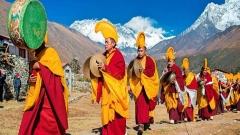
- On-Site Grand Occasion: During the festival, the monastery is filled with incense. Monks wear grand robes to chant scriptures and pray, with ritual music echoing across Tashi Peninsula, creating a solemn yet lively atmosphere.
- Believers’ Participation: Believers bring offerings such as butter and hada to pay homage, presenting hada and prostrating to pray, immersing themselves in the power of faith.
Featured Festival Celebration: The Brilliant Festival of Lights
Celebrated on the 25th day of the tenth month of the Tibetan calendar, the Festival of Lights is another important event at Tashi Dor Monastery, perfectly integrating religious piety with natural beauty. Highlights are as follows:
- Origin and Meaning: The festival honors religious ancestors, with butter lamps lit to pray for blessings, symbolizing the inheritance of light and faith.
- Visual Feast: Thousands of butter lamps are lit inside and outside the monastery at night, their light reflecting on Namtso Lake like falling stars, creating a magnificent scene.
- Visitor Suggestions: Visitors can join believers to experience the festival atmosphere, respect local customs, and quietly admire the unique brilliant night view of Tibet.
Tashi Dor Monastery Travel Guide: Unlock the Faith Journey by the Holy Lake
Transportation Guide: Practical Routes to the Secret Land
Tashi Dor Monastery is located on Tashi Peninsula of Namtso Lake, approximately 220 kilometers from Lhasa. Visitors can choose suitable transportation methods based on their needs, with specific options as follows:
- Self-Driving: Drive from Lhasa along National Highway 109, taking about 4 hours. Enjoy the scenery of the Nyenchen Tanglha Mountains along the way, and pay attention to speed limits and vehicle inspections on plateau sections.
- Chartered Car or Group Tour: There are many group tours from Lhasa to Namtso, priced between 600 and 1,000 yuan per day. Chartering a car allows flexible itinerary control, suitable for group travel.
- On-Site Transportation: After arriving at Namtso Scenic Area, take the scenic shuttle bus to Tashi Peninsula, then walk to the monastery. The road is in good condition with low walking difficulty.
Visiting Guidelines: Travel Norms Respecting Faith
As a religious site, visitors to Tashi Dor Monastery must abide by local customs and regulations, and take precautions against altitude sickness. Specific precautions are as follows:
- Faith Respect Norms: Remove hats before entering halls; do not wear shorts, skirts, or other revealing clothing. No photography or noise in halls; do not touch Buddha statues, thangkas, or other sacred relics. Seek permission from monks before taking photos.
- Incense and Donations: The monastery is open for free. It is recommended to prepare some change as incense money to show respect for local faith; donations are voluntary.
- Altitude Sickness Prevention: The scenic area is 4,718 meters above sea level. Prepare oxygen tanks and anti-altitude sickness medicine in advance, and avoid strenuous exercise. UV radiation is strong, so bring sun protection products and windproof/waterproof jackets to cope with changing plateau weather.
Best Visiting Time: Encounter the Most Beautiful Ancient Monastery Scenery
Tashi Dor Monastery boasts unique charm in different seasons and times. Combining scenery and experience, the recommended visiting times are as follows:
- Best Season: May to October each year. Namtso Lake thaws, grasslands turn green, and the lake and ancient monastery set off each other beautifully, with relatively comfortable weather for visitors.
- Best Time of Day: Morning sunlight is soft, casting excellent light and shadow on the golden roof and lake; the monastery appears more serene in the evening sunset, perfect for photography and reflection.
- Special Period: The Year of the Sheep on the Tibetan calendar is a grand pilgrimage year for Namtso. Visitors can encounter numerous believers and experience a strong religious atmosphere, but need to plan ahead to avoid crowds.
- Off-the-Beaten-Path Option: Although temperatures are low in winter, visitors can admire the frozen Namtso Lake and the monastery surrounded by snow-capped mountains, offering a quiet and unique experience for niche travelers.
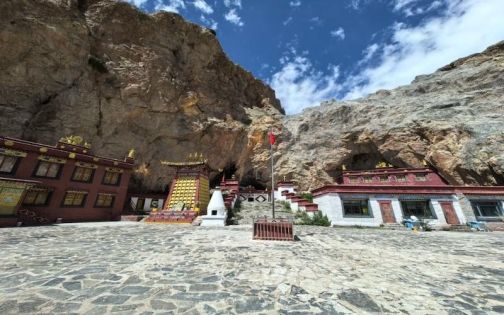
Tashi Dor Monastery
Tashi Dor Monastery: A Spiritual Pure Land by the Holy Lake
The Quiet Uniqueness of Tashi Dor Monastery
Compared with other popular monasteries in Tibet, Tashi Dor Monastery touches people with its unique attributes, with core characteristics reflected in:
- Pure and Quiet Atmosphere: Without grand buildings or crowds, it retains a simple and mellow temperament, allowing visitors to calm down and feel the essence of faith.
- Integration of Landscape and Faith: Relying on the grandeur of Namtso Lake and the Nyenchen Tanglha Mountains, it perfectly combines natural beauty with religious faith, offering a strong sense of healing.
- Profound Cultural Heritage: With nearly 700 years of historical accumulation and the legend of Padmasambhava, every landscape carries rich cultural connotations.
Travelers’ Spiritual Gains
Visiting Tashi Dor Monastery, travelers can not only admire the beautiful scenery of the lake, mountains, and ancient monastery, and deeply understand Tibetan Buddhist culture and artistic relics but also gain profound spiritual touches. Standing in front of the monastery, looking out at the holy lake and snow-capped mountains, and listening to the interweaving of prayer flags and scriptures, travel fatigue and life worries fade away. This tranquility and piety away from the hustle and bustle will become the most precious and unique memory of the Tibetan journey.
The story of Tashi Dor Monastery lies in every ray of sunlight, every flutter of prayer flags, and every butter lamp. It is not only a faith landmark by Namtso Lake but also a spiritual pure land, waiting for every distant traveler to explore and cherish.