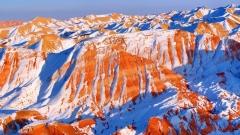

Hidden deep in China’s Hexi Corridor, Zhangye Danxia Landform looks as if the earth itself spilled a box of paints across the mountains. Waves of red, orange, yellow, white, gray, and even green stretch across the landscape, creating one of the most visually striking geological wonders in the world. But where do these colors come from? This article explores the geological, chemical, climatic, and visual factors behind Zhangye Danxia’s extraordinary palette.
Geographic Location and Overall Characteristics of Zhangye Danxia
Zhangye Danxia is located in northern Gansu Province, primarily within Linze County and Sunan Yugur Autonomous County, at the northern foothills of the Qilian Mountains. This region sits in the heart of the Hexi Corridor, a historic passage connecting central China with Central Asia along the ancient Silk Road.
What makes Zhangye Danxia distinctive is its scale and clarity. Rather than isolated rock towers, the landform consists of expansive layered hills and ridges, exposing broad geological cross-sections. These formations stretch for kilometers, creating a continuous visual narrative of Earth’s sedimentary history. The openness of the terrain allows visitors to clearly observe color transitions, layer thickness, and erosion patterns—features rarely so well preserved elsewhere.
What Is Danxia Landform?
The term “Danxia landform” refers to a specific type of landscape shaped primarily from continental red sedimentary rocks, especially sandstone and conglomerate. These rocks were deposited in inland basins and later sculpted by weathering and erosion.
Key defining features of Danxia landforms include:
-
Dominance of red or reddish-brown sedimentary rock
-
Formation in arid or semi-arid continental environments
-
Horizontal or gently tilted strata
-
Landforms shaped by long-term wind and water erosion
Zhangye Danxia represents a special subtype often referred to as “colorful Danxia,” where mineral diversity and depositional rhythms produce unusually rich and sharply defined color layers.
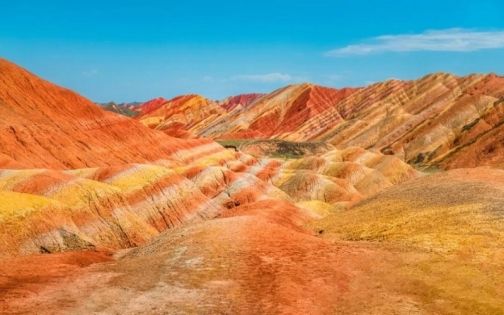
Zhangye Danxia
The Fundamental Source of Color: Iron Oxidation
At the most basic level, the dominant reds, oranges, and yellows of Zhangye Danxia originate from iron-rich minerals. During sediment deposition millions of years ago, iron-bearing particles were transported by rivers and wind into the basin.
Over time, exposure to oxygen and moisture caused iron to oxidize, forming different iron oxides:
-
Hematite (Fe₂O₃): produces bright red and brick-red tones
-
Goethite and limonite: responsible for yellow, ochre, and orange hues
-
Magnetite: contributes darker grayish or purplish shades
Variations in oxygen availability, moisture levels, and sediment composition resulted in different oxidation states, which directly influenced color intensity and distribution.
Beyond Red: Mineral Diversity and Color Layering
If iron were the only factor, Zhangye Danxia would appear largely uniform in color. The spectacular multi-colored appearance arises from the coexistence of multiple minerals deposited during different geological periods.
Common contributing minerals include:
-
Quartz: white or milky tones
-
Feldspar: pale pink or light gray
-
Calcite: light yellow or off-white
-
Clay minerals and mica: gray, bluish-gray, or greenish shades
Each layer represents a distinct sedimentary episode, reflecting changes in climate, water chemistry, and sediment source. The result is a naturally layered “geological rainbow,” with remarkably sharp boundaries between colors.
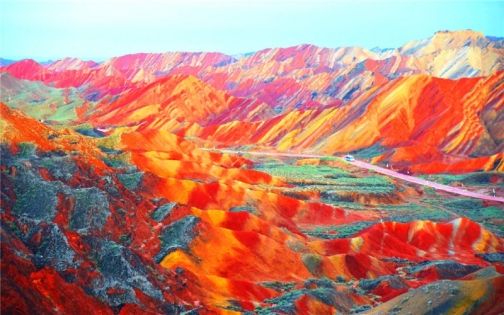
Zhangye Danxia
Sedimentary Rhythm and Geological Time
The striped appearance of Zhangye Danxia is a direct record of sedimentary rhythm over immense timescales. From roughly 200 million to 70 million years ago, the region experienced repeated environmental changes.
These included:
-
Expansion and retreat of ancient lakes
-
Shifts in river systems
-
Alternating wet and dry climatic phases
Each shift produced a new layer with unique mineral content and coloration. Over millions of years, these layers stacked one upon another, preserving a timeline of environmental evolution visible to the naked eye.
The Role of an Arid Climate
Zhangye’s present-day arid to semi-arid climate plays a crucial role in preserving its vivid colors. Low precipitation limits vegetation growth, preventing soil and plants from obscuring exposed rock layers.
Additionally, reduced chemical weathering means colors fade much more slowly than in humid regions. As a result, the landform remains visually sharp, with clearly defined layers that might otherwise blur or disappear under heavier rainfall and biological activity.
Wind, Water, and the Sculpting of Form
While mineral composition determines color, erosion determines shape. Wind abrasion, seasonal rainfall, and freeze-thaw cycles gradually carve the landscape.
Water preferentially erodes softer layers, creating grooves and valleys, while harder layers resist erosion and form ridges. Wind further sharpens edges and enhances contrast between layers. Together, these forces expose the internal structure of the landform, revealing color bands like pages of an open book.
Light and Visual Perception
Many visitors notice that Zhangye Danxia looks dramatically different throughout the day. This is not an illusion but a function of light physics.
-
Morning and sunset: low-angle sunlight enhances shadows and color saturation
-
Midday: overhead light flattens contrast, making colors appear softer
-
After rain: wet surfaces deepen tones and increase reflectivity
These changes explain why sunrise and sunset are considered the best times for photography.
Why Zhangye Danxia Is Globally Unique
Danxia landforms exist in other parts of China and the world, but few match Zhangye in scale, color diversity, and preservation. Its uniqueness lies in the rare convergence of factors: mineral richness, long-term sediment stability, minimal tectonic disruption, and a dry climate.
Because of these qualities, Zhangye Danxia has been recognized as part of the UNESCO World Natural Heritage, not only for its beauty but also for its scientific value in understanding Earth’s sedimentary history.
A Chronicle Written in Color
The colors of Zhangye Danxia are not random strokes of nature but the result of geological processes unfolding over hundreds of millions of years. Each band records a chapter of Earth’s past—changes in climate, chemistry, and landscape frozen in stone.
For travelers seeking to explore Zhangye Danxia alongside Silk Road history, northwestern China, or even Tibetan Plateau routes, working with experienced regional specialists can greatly enhance understanding of the landscape. China Dragon Travel, specializes in western China and high-altitude journeys, offering informed perspectives that connect natural scenery with its deeper geological and cultural context.