
When is the best time to visit Tibet for its traditional festivals? Beyond its majestic landscapes and sacred monasteries, Tibet’s vibrant celebrations provide a unique window into Tibetan culture and spirituality. From the Tibetan New Year in winter to the Shoton Festival and thrilling horse racing events in summer, and the sacred Saga Dawa Festival in late spring, Tibet offers extraordinary cultural experiences throughout the year.
Best Time to Visit Tibet for the Tibetan New Year (Losar)
Losar is the most grand traditional festival in Tibet, known as “Losar” in Tibetan, equivalent to the New Year. The date of Losar varies every year, usually between late January and early March in the Gregorian calendar. The Tibetan calendar is a lunisolar calendar, and its corresponding relationship with the Gregorian calendar changes every year. Travelers need to check the specific date of the year before departure.
Key information about this festival:
- Main rituals: On New Year’s Eve, the whole family eats “Gutu”, a kind of dough ball soup with different fillings. Finding wool symbolizes a gentle personality, chili symbolizes eloquence, salt symbolizes laziness, and black charcoal symbolizes a bad heart. Family members sit together to taste and joke with each other. On the first day of the new year, people wear new Tibetan robes and take “Qiema” (an auspicious box filled with highland barley and butter) to temples to pray for blessings. Horse races and Guozhuang Dance are held on the streets. Traditional activities are held in Lhasa and surrounding areas throughout the first month of the Tibetan calendar, and the streets are bustling.
- Suitable for: Travelers who love cultural experiences and are not afraid of cold weather. The temperature in Tibet is very low at this time, reaching minus ten degrees Celsius in the morning and evening, but there are few tourists, and accommodation and flight prices are lower than in peak season. Please note that some temples may restrict tourist entry and many restaurants are closed during Losar. It is recommended to confirm with China Dragon Travel in advance.
- Special tips for overseas travelers: Tibet is usually closed to foreign travelers from late February to mid-March every year. Losar falls during this period, so foreign travelers are generally unable to enter Tibet to participate in the festival.
Losar is a great choice if you want to experience an authentic Tibetan New Year atmosphere, but overseas travelers need to pay attention to policy restrictions.
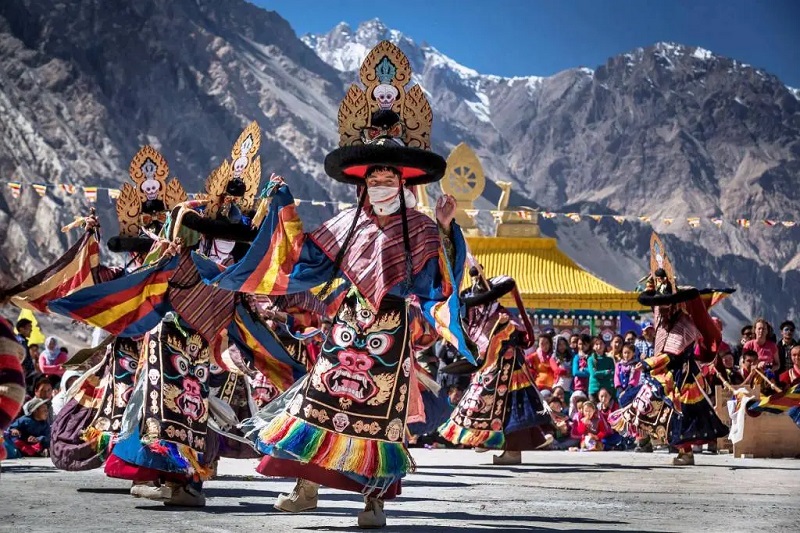
Losar (Tibetan New Year)
Best Time to Visit Tibet for the Saga Dawa Festival
Saga Dawa Festival is a religious festival commemorating the birth, enlightenment and nirvana of Sakyamuni Buddha, and is recognized as one of the most sacred festivals in Tibet. The entire fourth month of the Tibetan calendar is regarded as the “Month of Merit”, and the 15th day of the fourth month is the core day of the festival. The festival is usually held from late May to early June in the Gregorian calendar, and the specific date needs to be checked against the Tibetan calendar of the year.
Key information about this festival:
- Main activities: Throughout the fourth month of the Tibetan calendar, believers circumambulate, kowtow, release lives and chant Buddha’s names, and it is believed that merit is doubled. In Lhasa, devout believers can be seen from morning till night on the pilgrimage routes around Jokhang Temple and Ramoche Temple. Circumambulating Mount Kailash during Saga Dawa Festival is believed to double merit, and numerous believers walk around the sacred mountain.
- Suitable for: Travelers interested in Tibetan Buddhist culture and religious atmosphere. Tibet has entered late spring and early summer at this time, with comfortable temperature and high oxygen content, so the risk of altitude sickness is relatively low. Compared with the peak season from July to August, the number of tourists is small and the cost is reasonable.
- Small tip: During Saga Dawa Festival, the areas around Jokhang Temple, Ramoche Temple and Potala Palace in Lhasa are very crowded. If you want to experience circumambulation, it is recommended to go early in the morning to avoid the midday heat and peak crowds. Please respect religious rituals and do not take photos of pilgrims at will.
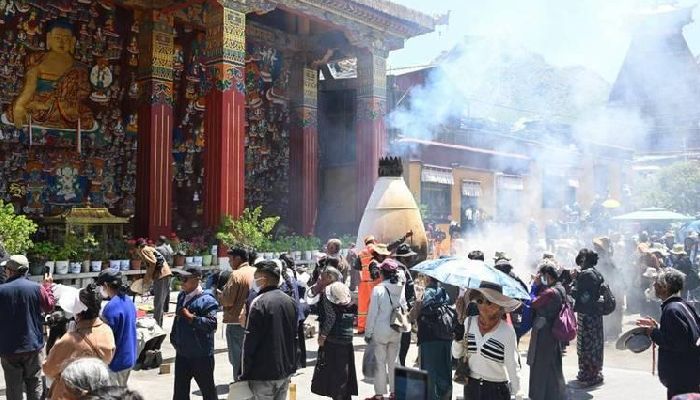
Saga Dawa Festival in Tibet
Best Time to Visit Tibet for the Shoton Festival
Shoton Festival is one of the largest and most famous festivals in Tibet. “Shoton” means “Yogurt Feast” in Tibetan, so it is also known as the Yogurt Festival. Shoton Festival opens on the 30th day of the sixth month of the Tibetan calendar, and the corresponding Gregorian date varies every year. The festival is usually held from late July to early August, with core activities concentrated on the first two days: the Buddha Display at Drepung Monastery on the first morning, and Tibetan opera performances at Norbulingka on the second day.
Key information about this festival:
- Buddha Display Ceremony: On the first day of Shoton Festival, a large crowd gathers on the hillside behind Drepung Monastery before dawn. At sunrise, a huge Thangka is slowly unfolded from the top of the mountain, with Buddhist horns sounding and thousands of people joining their palms and kowtowing. The scene is spectacular, and many travelers come specially for this.
- Tibetan Opera Performances: Starting from the second day of the festival, Tibetan operas are performed at Norbulingka and Longwangtan Park. Actors wear masks and sing ancient legends, and a single opera can last from morning till dark.
- Yogurt Tasting: Yogurt made from yak milk is available everywhere during the festival, with a rich taste. It can be eaten with sugar or honey, a special food in Tibet.
Peak season reminder: Shoton Festival is the super peak season for tourism in Tibet. Hotel prices more than double the usual, and flights are rarely discounted. If you plan to visit at this time, it is recommended to book 2 to 3 months in advance.
Get up early for the Buddha Display: To go to Drepung Monastery on the first day of the festival, you need to set off at 3 or 4 o’clock in the morning. Due to traffic control, vehicles can only park at the foot of the mountain, and you need to walk up the mountain by yourself. The flow of people is huge, so please prepare mentally in advance.
Shoton Festival is worth a special trip if you want to watch the most spectacular and lively scenes.
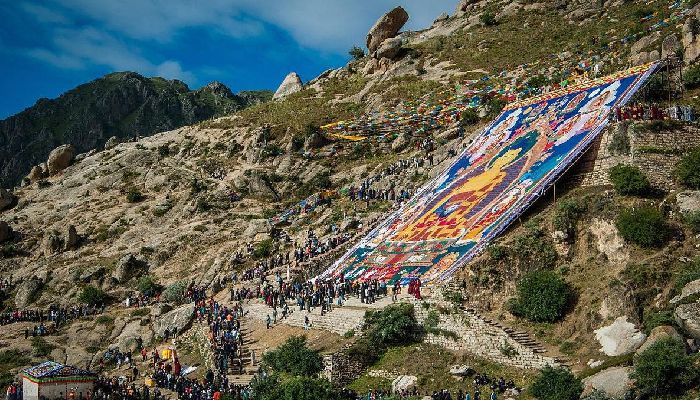
The Buddha Display at Drepung Monastery During Shoton Festival
Best Time to Visit Tibet for the Horse Racing Festivals
Tibet’s Horse Racing Festivals are mainly held on the northern Tibetan grasslands. The most famous one is Nagqu Horse Racing Festival, usually held in early August of the Gregorian calendar, lasting 5 to 7 days. In addition, Gyantse Horse Racing Festival (Dama Festival) is held from late May to mid-June of the Gregorian calendar, and Damxung Horse Racing Festival (near Namtso) is around August 10th.
Key information about this festival:
- Wonderful events: In addition to speed horse racing, there are equestrian shows where riders bend down to pick up khata, stand upside down and ride sideways; as well as traditional strength competitions such as “stone holding” and “tug of war”, retaining an original ecological style. Locals dress in their most beautiful Tibetan robes, set up tents, and cook tea and meat. The whole grassland is like a large carnival.
- Golden period for photography: Blue sky, white clouds, grasslands, fine horses and colorful Tibetan robes form bright colors, perfect for photography.
- High altitude threshold: The altitude of Nagqu is over 4,500 meters, more than 1,000 meters higher than Lhasa. It is recommended to stay in Lhasa for a few days to acclimatize before going. Accommodation conditions are simple (tents or guest houses), and the temperature difference between day and night is large—hot in the daytime and cold at night.
- Cost reference: During Nagqu Horse Racing Festival, accommodation is limited. The bed fee in tents or guest houses is about 50 to 150 CNY per person. Meals need to be prepared by yourself or bought at stalls, and the price is slightly higher than that in Lhasa. Chartering a car from Lhasa to Nagqu and back costs about 1,500 to 2,500 CNY (calculated per car, more cost-effective for 4 to 6 people to share).
If you do not want to travel a long distance, you can also pay attention to small-scale horse racing activities around Lhasa, such as Damxung Horse Racing Festival, which is near Namtso, and you can visit the lake at the same time.
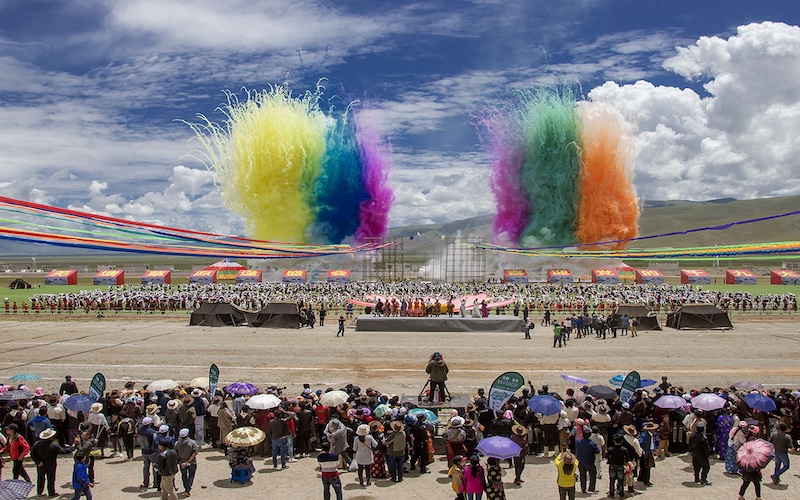
The Opening of the Horse Racing Festival
Best Time to Visit Tibet for Other Festivals
In addition to the above three major festivals, there are some smaller but equally interesting festivals in Tibet.
- Butter Lamp Festival (Jian’a Quba): The 15th day of the first month of the Tibetan calendar, from late February to early March in the Gregorian calendar. As the climax and closing of the Great Prayer Festival, Lhasa is lit up with thousands of lamps at night, and temples display flowers, figures and Buddha statues carved with butter, which are stunning with interwoven light and shadow.
- Ongor Festival: A festival for farmers to celebrate harvest, mainly held in Shannan and Xigaze. It is held around the ripening of highland barley (August to September in the Gregorian calendar). People dress in grand costumes, circle the fields, sing and race horses. The date varies in each village. If you see tents and crowds by the road during a self-driving trip, it is likely to be Ongor Festival.
- Bathing Festival (Gama Riji): The seventh month of the Tibetan calendar, from late August to early September in the Gregorian calendar, lasting about 7 days. Legend has it that river water has medicinal effects during this period, and the whole family goes to the river to bathe and wash clothes. The banks of the Lhasa River are very lively with a relaxed atmosphere and no special rituals required.
- Lamp Burning Festival: The 25th day of the tenth month of the Tibetan calendar, from late November to early December in the Gregorian calendar. At night, temples and residents in Lhasa light up butter lamps on roofs and windowsills to commemorate the parinirvana of Master Tsongkhapa. The whole city is illuminated by little lights, with a quiet and solemn atmosphere.
Best Time and Preparations for Overseas Travelers to Visit Tibet Festivals
The most crucial thing for overseas travelers to visit Tibet is to obtain the Tibet Travel Permit in accordance with the law. Here are some core pieces of information:
- Tibet Travel Permit is mandatory: All travelers with foreign passports and Taiwan compatriots (with Taiwan Compatriot Permit) must apply for a Tibet Travel Permit in advance before entering Tibet. Hong Kong and Macao residents with Home Return Permits generally do not need to apply for it.
- Must be processed through qualified travel agencies: Individuals cannot directly apply for the Tibet Travel Permit to the Tibet Tourism Bureau. It must be processed by a local travel agency in Tibet with foreign-related qualifications. The Tibet Travel Permit is part of the travel agency’s group tours package and cannot be processed separately.
- Required materials for application: Color scanned copy of the passport home page (validity period longer than 6 months), scanned copy of valid Chinese visa page. Travelers from visa-exempt countries are exempt from submitting visa materials. The travel plan (including dates, destinations, hotel information) also needs to be confirmed in advance.
- Processing time: It usually takes 8 to 20 working days, and may take longer during peak seasons. It is recommended to submit materials 30 to 45 days in advance. If you plan to visit border areas such as Everest Base Camp and Ngari, you also need to apply for an additional Border Permit or Alien’s Travel Permit, which will be processed by the travel agency together.
- Transportation options for entering Tibet: There are no direct flights from overseas to Lhasa at present. Overseas travelers generally fly to a gateway city in China first, then transfer to a flight or train to enter Tibet. Recommended transfer cities are Chengdu, Chongqing, Xi’an, Beijing and Shanghai, among which Chengdu has the most and most frequent flights. The Qinghai-Tibet Railway departs from Xining to Lhasa, passing through Hoh Xil and Tanggula Mountain with beautiful scenery along the way, which is also a way to enter Tibet.
- Boarding and riding requirements: When taking a flight to Tibet, you must present the original paper copy of the Tibet Travel Permit to check in; you also need to present the Tibet Travel Permit when taking a train to Tibet. Please carry the original paper copy with you after obtaining the Tibet Travel Permit, as electronic or copied versions may not be accepted.
In addition, please make the following preparations before departure: confirm that your passport and visa are valid for a sufficient period; book flights or trains in advance (2 to 3 months in advance during peak seasons); book hotels with foreign-related reception qualifications; purchase travel insurance including altitude sickness rescue and emergency medical treatment; prepare layered clothing (down jackets, windbreak jackets and sun protection equipment are all required); prepare commonly used medicines such as Rhodiola rosea and cold medicine. Most merchants in Lhasa and big cities support mobile payment, but it is recommended to carry some cash in remote areas.
How to Choose the Right Time for a Tibet Festival Trip?
Before determining the best time to visit Tibet for festivals, it is recommended to evaluate from the following perspectives:
- Climate tolerance: Winter (November to March) is cold but with few and exquisite festivals, few tourists and low prices; summer (June to August) is warm with sufficient oxygen but crowded with tourists and high costs; spring and autumn (April to May, September to October) have pleasant weather but few festival activities.
- Holiday matching: The Gregorian date of Losar varies every year, while Shoton Festival and Horse Racing Festival are basically fixed from late July to early August. If you only have holidays in summer, Shoton Festival and Horse Racing Festival are the best choices; if you have flexible holidays, you can choose to experience Losar or Lamp Burning Festival in the off-season.
- Altitude acclimatization ability: There are large crowds, many activities and high physical consumption during festivals. Especially Nagqu Horse Racing Festival is at a high altitude. Travelers who are prone to altitude sickness are recommended to start with festivals in Lhasa (Shoton Festival, Losar) and go to higher altitude areas after acclimatization.
- Special tips for overseas travelers: Tibet is usually closed to foreign travelers from late February to mid-March every year, so foreign travelers are generally unable to participate in Losar and Butter Lamp Festival, the two winter festivals. The best travel time for festivals is concentrated from June to September, including Saga Dawa Festival in June, Shoton Festival and Horse Racing Festival in July to August.
Choose Losar (January to March, not applicable for overseas travelers) if you want to experience a family-style New Year atmosphere; choose Shoton Festival (July to August) if you want to watch the Buddha Display and join the Yogurt Festival; choose Nagqu Horse Racing Festival (August) if you want to photograph grassland horse racing; choose Saga Dawa Festival (May to June) if you want to feel the religious atmosphere; choose Lamp Burning Festival (November to December) if you want to watch the sea of butter lamps. There is no absolute “best time”; the key lies in personal preference.
Plan Your Tibet Festival Journey at the Perfect Time
Tibet’s festivals are far more than colorful celebrations—they are living expressions of faith, heritage, and tradition. Whether witnessing the grand Thangka unveiling at Drepung Monastery during the Shoton Festival, joining pilgrims during the sacred Saga Dawa Festival, or experiencing the excitement of horse racing on the vast northern grasslands, each event reveals the profound spiritual and cultural essence of the Tibetan Plateau. Ultimately, the best time to visit Tibet for festivals depends on your interests, travel schedule, and desired level of cultural immersion.
To ensure a smooth and enriching experience, international travelers are encouraged to plan their journey through a professional Tibet travel agency. From securing the Tibet Travel Permit to arranging transportation, accommodations, and festival experiences, expert guidance allows you to explore Tibet with confidence and ease—turning your dream of experiencing Tibet’s extraordinary festivals into reality.