
For tourists dreaming of Tibet’s beauty, the Tibet Travel Permit is essential. A rejected permit often turns expectations into anxiety. As an official certificate for Tibet’s non-open areas, it has strict review standards. Many fail due to insufficient understanding, but rejection isn’t the end. Identify causes and master remedies, and you can still make the trip. This article offers guidance on this issue.
Tibet Travel Permit Not Approved? First Clarify the Common Reasons for Failure
To resolve the issue of a rejected Tibet Travel Permit, the first step is to clarify the specific reasons for the failed review. The review of Tibet Travel Permits is conducted by relevant local departments in Tibet, covering multiple dimensions such as personal identity, completeness of materials, and rationality of the itinerary. Omissions in any link may lead to the rejection of the application. Based on the application experience of numerous tourists, the following reasons are the most typical. Tourists can first conduct a self-check against them to lay the foundation for subsequent remedies.
- Personal identity and eligibility issues are the primary thresholds for review. Due to safety management needs in some areas of Tibet, there are special requirements for tourists’ identities. For example, individuals with illegal or disciplinary records or those on the list of persons subject to enforcement for breach of trust will usually have difficulty passing the review. Special groups such as military personnel, civil servants, and staff of public institutions will also have their Tibet Travel Permit applications directly rejected if they fail to provide the required certification documents for travel approval from their units. In such cases, tourists should first verify whether their identity meets the application requirements and supplement relevant certificates in a timely manner if necessary.
- Incomplete application materials or filling errors are common problems. Applying for a Tibet Travel Permit requires submitting a copy of both sides of the ID card, a recent bare-headed white background photo, a detailed itinerary confirmation, and other materials. Foreign tourists also need to provide additional documents such as a passport and visa-related papers. Some tourists miss materials due to hasty preparation, or make mistakes such as typos in names, missing ID card numbers, or incorrect contact information when filling in personal information, which directly affect the review result. There was once a tourist who mistakenly wrote the number 0 in the ID card number as the letter O, resulting in the system being unable to match the personal information and ultimately the rejection of the Tibet Travel Permit. Such detailed errors can actually be avoided by careful verification.
- Unreasonable itinerary planning can also become an obstacle to the review. A detailed travel plan must be attached to the Tibet Travel Permit application, including the date of arrival in Tibet, date of departure, daily places of stay, attractions to visit, and means of transportation. If the itinerary has vague parts or involves unopened military-administered areas or border regions, the review department will reject the application because it cannot judge the safety of the itinerary. In addition, an overly tight itinerary, such as planning to visit multiple attractions hundreds of kilometers apart in one day, which is inconsistent with the conventional rhythm of plateau travel, may also arouse the suspicion of reviewers and lead to the rejection of the Tibet Travel Permit.
- An irregular application channel is an easily overlooked hidden danger. Currently, individuals cannot directly apply for a Tibet Travel Permit from relevant departments; it must be handled by a formally qualified travel agency in Tibet. If tourists choose an intermediary organization or an unlicensed travel agency without the qualification to handle the permit, not only will the application process be irregular, but the submitted materials will also lack strict checks, making it extremely likely that the Tibet Travel Permit will not be approved. What’s worse, some unscrupulous intermediaries charge high fees under the guise of “fast processing” or “guaranteed approval” but ultimately fail to complete the application, bringing tourists double troubles of economic losses and delayed itineraries.
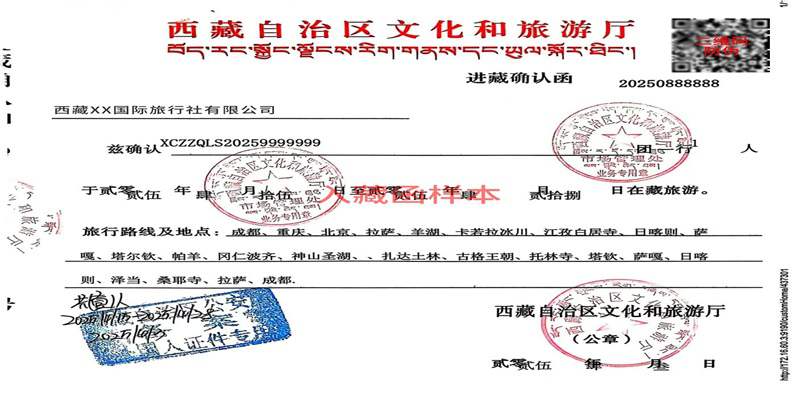
Sample of Tibet Travel Permit
What to Do If Your Tibet Travel Permit Is Not Approved? A Three-Step Efficient Remedial Method
After confirming that the Tibet Travel Permit has not been approved, hastily reapplying will only waste time. The correct approach is to operate in an orderly manner according to the steps of “inquiring about the reasons — adjusting materials — choosing the best application channel”, minimizing the remediation cycle and ensuring that the itinerary is not affected. This proven remedial method by many tourists can effectively solve the problem of a rejected Tibet Travel Permit.
- Step 1: Timely inquire about the specific reasons for the failure. Tourists should contact the travel agency handling the application immediately and request a detailed explanation of the failed review. Regular travel agencies, with good communication channels with the review department, can quickly feedback the specific reasons, such as missing materials, incorrect information, or itinerary issues. If the travel agency cannot clearly explain the reasons or shirks responsibility with excuses such as “system problems”, tourists should resolutely change the application channel to avoid wasting valuable itinerary time. After learning the reasons, record them one by one and mark the priority of solving them to prepare for subsequent adjustments.
- Step 2: Optimize and adjust targeted solutions for each problem. This is the core link to solve the issue of a rejected Tibet Travel Permit. Corresponding measures should be taken according to different failure reasons. If materials are incomplete, supplement the missing documents in a timely manner, such as special groups submitting unit approval certificates, and foreign tourists completing passport and visa copies as well as the Tibet Travel Application Form. If there are errors in filling in information, re-verify all application information to ensure that core content such as name, ID card number, and contact information is accurate and error-free, and print the corrected application form with the travel agency’s official seal. If the itinerary is unreasonable, re-plan the itinerary to ensure that the itinerary details are clear, all attractions are open to the public, and the route planning is in line with the rhythm of plateau travel. If necessary, consult professional planners from local Tibet travel agencies to adjust the itinerary according to the season and the opening status of attractions, eliminating forbidden areas or vague zones.
- Step 3: Choose a regular channel for reapplication. After adjusting the materials, the choice of channel for reapplication is crucial, as it directly affects whether the Tibet Travel Permit can be successfully approved. It is recommended to prioritize well-established regular travel agencies in Tibet with rich experience in handling permits. Such institutions are not only familiar with the review standards and can conduct a second check on the materials but also can communicate with the review department in a timely manner during the application process to coordinate and solve minor problems. After submitting the reapplication, maintain close contact with the travel agency to track the review progress. If new problems arise, respond promptly to ensure that the issue of the rejected Tibet Travel Permit does not recur.
Prevention First: Practical Tips to Avoid Rejection of Tibet Travel Permit
Compared with post-remediation, taking preventive measures in advance can avoid the trouble of a rejected Tibet Travel Permit from the source. This is especially important for tourists with fixed itineraries that cannot be adjusted arbitrarily. The following practical tips can effectively improve the approval rate of Tibet Travel Permit applications.
- First, understand the application requirements and prepare materials in advance. It is recommended that tourists inquire about the latest Tibet Travel Permit application requirements through regular channels 1-2 months before planning the itinerary, and clarify the list of materials to be prepared for their own group. When preparing materials, note that the photo should be a recent bare-headed color photo with a white background taken within the past six months, and the size should meet the travel agency’s requirements. The copy of the ID card should be clear and complete, with both front and back sides on the same page. The travel plan should be specific to the arrangements for the morning and afternoon of each day, avoiding vague expressions such as “to be determined”. After preparing the materials, verify them at least 2-3 times to ensure there are no omissions or errors.
- Second, plan the itinerary reasonably and avoid forbidden areas. When formulating a Tibet itinerary, confirm in advance whether the attractions are open to the public and avoid including unopened areas in the itinerary. Priority can be given to mature and open attractions such as Lhasa, Nam Co, and Nyingchi, where the itinerary review approval rate is higher. At the same time, consider the impact of altitude sickness on the itinerary, avoid arranging overly intensive schedules, and the daily driving distance should not be too long. Ensure that the itinerary conforms to the conventional travel logic, reduce the suspicion of reviewers, and thus avoid the rejection of the Tibet Travel Permit.
- Finally, carefully choose the travel agency handling the application. When selecting an application channel, verify the travel agency’s qualification documents such as the business license and travel agency business operation license, and avoid choosing unqualified intermediaries or online application platforms. You can check the list of regular travel agencies on the official website of the Tibet Tourism Bureau, or select institutions recommended by acquaintances with a good reputation. When communicating with the travel agency, clearly inquire about the application process, review cycle, and failure remediation measures, and sign a formal service contract to protect your own rights and interests.
A rejected Tibet Travel Permit will indeed bring a small detour to your Tibet trip, but as long as you stay calm and take scientific remedial measures according to the steps of “finding the reasons, adjusting materials, and choosing a regular channel”, most tourists can successfully resolve the issue. From a preventive perspective, understanding the requirements in advance, carefully preparing materials, reasonably planning the itinerary, and selecting a reliable agency are the core points to avoid the failure of Tibet Travel Permit applications. Among many regular travel agencies, China Dragon Travel, with years of experience in handling Tibet Travel Permits, is familiar with the review standards and processes. It can provide tourists with services such as material checks, itinerary planning suggestions, and full-process progress tracking, effectively reducing the risk of permit rejection and helping tourists smoothly embark on a wonderful journey to the snow-capped plateau. Whether it is the initial application or reapplication for remediation, choosing a professional team can make the handling of the Tibet Travel Permit more worry-free and efficient.