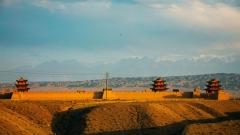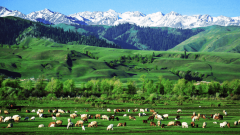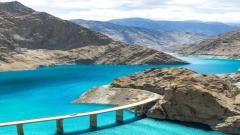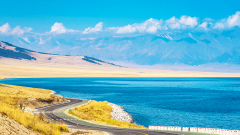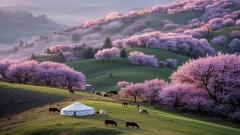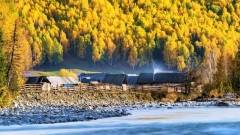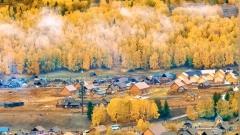

Northern Xinjiang, in northern China’s Xinjiang, spans the Altai Mountains and Junggar Basin. Its diverse landforms and distinct climate create layered, breathtaking autumn scenery. Unlike short-lived autumns elsewhere, it starts in early September. As latitude and altitude shift, autumn colors spread gradually, fading slowly in mid-October. For foreign tourists, knowing autumn’s exact timing is key to planning seamless trips and capturing this land’s most gorgeous scenery. Chasing Kanas’ crystal-clear lake and mountain views, exploring Tuva villages or wandering Wucai Beach—autumn Northern Xinjiang never disappoints.
Kanas in Early September: Northern Xinjiang’s First Brush of Golden Autumn
The answer to “when is autumn in Northern Xinjiang” is vividly illustrated in Kanas in early September. At this time, Kanas seems to be splashed with rich colors from nature’s palette. Poplars and birches are the first to shed their green attire, taking on shades of light yellow, golden yellow, and even orange-red, forming a striking contrast with the dark green spruces. These colors spread layer by layer across the hillsides. Kanas Lake also enters its clearest season of the year; the lake water changes into various hues such as dark blue, light green, and black jade as the light shifts. The surface of the lake reflects the colorful forests on the shore and the snow-capped mountains in the distance, composing a magnificent landscape painting.
Foreign tourists visiting here can stroll slowly along the wooden boardwalk by the lake, feeling the cool autumn breeze brushing their cheeks and listening to the soft sound of falling leaves. In the early morning, a faint mist rises over the lake, wrapping the entire Kanas in a hazy veil, like a fairyland on earth. If time permits, you may take a cruise on the lake to appreciate the autumn scenery from different angles. Additionally, the three bays of Kanas—Moon Bay, Immortal Bay, and Wolong Bay—are unmissable attractions. The early September sun shines on these bays, adding a touch of vitality and mystery through the interlacing light and shadow. The temperature in Kanas at this time ranges from 5°C to 15°C. It is recommended that foreign tourists bring a thin down jacket or a thick coat to cope with the coolness in the morning and evening.
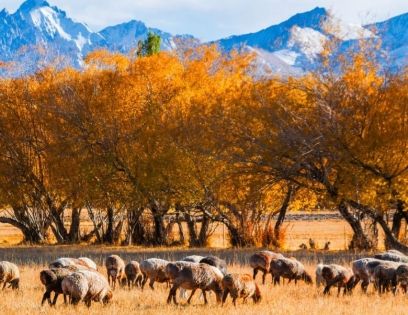
Autumn scenery of Tahe man Township, Taxian County, Kashgar
Baihaba in Mid-September: Border Charm in Northern Xinjiang’s Autumn
When asked “when is autumn in Northern Xinjiang,” Baihaba in mid-September offers another beautiful answer. Located in Habahe County, Altay Prefecture, Northern Xinjiang, Baihaba sits on the border between China and Kazakhstan and is known as “the first village in the northwest.” By mid-September, the autumn colors in Baihaba are in full bloom. The entire village is surrounded by golden poplars and birches. The roofs of the wooden houses are occasionally dusted with a light layer of snow, forming a delightful contrast with the blue sky and white clouds, creating a tranquil pastoral scene.
This place not only boasts breathtaking autumn scenery but also unique border charm. Foreign tourists can see the solemn border sentry posts here and gaze at the mountains and rivers in Kazakhstan in the distance. The village is inhabited by Tuva and Kazakh people; their traditional wooden houses are neatly arranged, and dried forage is placed in front of and behind the houses, filling the air with a strong sense of life. As the sun rises slowly in the morning, its rays fall on the village and the surrounding mountains, dyeing everything in a warm golden hue. At this moment, picking up a camera and taking a random shot will result in a stunning landscape photo. When traveling in Baihaba, it is advisable for foreign tourists to respect the living habits of the local residents. You can try local specialty foods such as hand-grasped mutton and baked nang to experience the rich ethnic customs. The temperature in Baihaba is slightly lower in mid-September, and it may drop below 0°C at night, so be sure to bring sufficient warm clothing.
Wucai Beach in Late September: A Fantasy of Colors in Northern Xinjiang’s Autumn
In the discussion of “when is autumn in Northern Xinjiang,” Wucai Beach in late September is another highlight not to be missed. Located in Burqin County, along the banks of the Irtysh River, Wucai Beach’s unique yardang landforms display extremely gorgeous colors in autumn. Shades of red, green, yellow, and brown interweave, like a colorful carpet spread along the riverbank, creating an incredible sight. During this time, the Irtysh River is full of water; its clear blue current forms a strong contrast with the colorful yardang landforms on the bank, composing a wonderful picture.
The best time for foreign tourists to visit Wucai Beach is in the evening. As the sun sets, its slanting rays shine on the yardang landforms, making the colors more vivid and intense—red like fire, yellow like gold, and green like jade. Standing on the viewing platform of the scenic area, you can see colorful yardang landforms on one side, lush poplar forests on the other, and the rolling Irtysh River in between. This unique combination of landscapes is extremely rare in the world. When traveling, it should be noted that Wucai Beach is located in a Gobi area with strong winds. It is recommended to bring a windproof headscarf and sunglasses. The daytime temperature in Wucai Beach in late September ranges from 10°C to 20°C, but the temperature drops significantly at night, so warm measures are necessary. In addition, the tourist routes in the scenic area are clear; foreign tourists can follow the boardwalks, and there are clear signboards along the way introducing the scenic spots.
Hemu in Early October: Warmth of Human Life in Northern Xinjiang’s Autumn
The answer to “when is autumn in Northern Xinjiang” continues warmly in Hemu in early October. Located east of Kanas, Hemu is a village inhabited by the Tuva people and is known as one of the most beautiful villages in China. By early October, the autumn colors in Hemu have reached their peak. The entire village is surrounded by golden birches; the wooden houses are neatly arranged, and their roofs are covered with a thin layer of hoarfrost. In the morning, curling smoke rises from the chimneys, combining with the surrounding colorful forests and snow-capped mountains to form a pastoral picture full of human warmth.
Foreign tourists can experience various unique activities in Hemu. You can ride a horse through the golden birch forests, feeling the autumn wind whispering in your ears and enjoying the breathtaking scenery along the way. You can also walk into the homes of local Tuva people, have a cup of hot milk tea, and listen to them tell the history and traditional culture of the village. In the evening, go to the viewing platform of Hemu to overlook the panoramic view of the entire village. Under the setting sun, Hemu is dyed in a warm orange-yellow color, and the curling smoke blends with the mist (mostly cooking smoke in the evening), like a paradise. The temperature in Hemu is relatively low in early October; the daytime temperature ranges from 3°C to 12°C, and it often drops below 0°C at night, with occasional snowfall. Foreign tourists must bring thick down jackets, snow boots, and other warm equipment. In addition, the accommodation in Hemu is mainly wooden houses, which are full of local characteristics. It is recommended to book in advance to avoid itinerary delays.
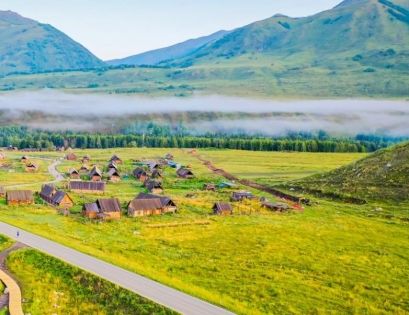
Hemu Village, Kanas
Autumn Climate and Clothing in Northern Xinjiang
After figuring out “when is autumn in Northern Xinjiang,” climate and clothing are among the top concerns for foreign tourists. Autumn in Northern Xinjiang starts in early September and ends in mid-October. The overall climate is cool and pleasant, but the temperature gradually drops as the season progresses, with a large temperature difference between day and night, which can reach 10°C to 15°C. In early September, the daytime temperature in Northern Xinjiang is mostly between 15°C and 25°C, dropping to 5°C to 10°C at night. By early October, the daytime temperature may only be between 5°C and 15°C, and it will drop below 0°C at night, with occasional snowfall in some high-altitude areas.
Based on these climate characteristics, foreign tourists should follow the principle of “layered dressing that is easy to put on and take off.” For the inner layer, you can wear a soft and comfortable long-sleeved T-shirt or a thin sweater. For the middle layer, a fleece jacket or a thin down jacket is suitable. For the outer layer, a windproof and waterproof thick coat is necessary to cope with sudden weather changes and strong winds in the mountains. It is recommended to choose thick jeans or casual pants for bottoms, paired with long socks and comfortable sports shoes or snow boots. In addition, hats, scarves, and gloves are essential items—they not only keep you warm but also protect your head and neck from the wind while traveling. Carry a portable down jacket or a foldable coat with you, which can be taken off at any time when indoors or when the temperature rises, making it very convenient. At the same time, the autumn sun in Northern Xinjiang is bright, and the ultraviolet rays are strong, so sunglasses and sunscreen are also indispensable.
Recommended Specialty Foods and Souvenirs in Northern Xinjiang
After clarifying “when is autumn in Northern Xinjiang” and planning the itinerary, tasting local specialty foods and selecting souvenirs are also important experiences for foreign tourists. Northern Xinjiang is a multi-ethnic area, and its cuisine combines the characteristics of the Han, Kazakh, Uyghur, and other ethnic groups, with unique flavors. When visiting Northern Xinjiang in autumn, you must not miss hand-grasped mutton—fresh mutton is simply boiled, resulting in tender and juicy meat. It tastes excellent when paired with local onions. In addition, roasted foods such as whole roasted lamb, roasted buns, and nang pit meat are also very distinctive, with crispy outer layers and rich fillings that leave a lasting aftertaste.
In addition to meat dishes, the noodles in Northern Xinjiang are also worth trying. There are various styles such as pulled noodles, hand-pinched noodles, and fried noodles, all paired with unique seasonings for a rich flavor. For drinks, brick tea and milk tea are daily beverages for locals—warm and mellow, they can dispel the cold and warm the body. Fresh fruits such as grapes and Hami melons are also abundant in autumn, with high sweetness and sufficient moisture, making them an excellent choice for replenishing moisture and vitamins. As for souvenirs, Northern Xinjiang has a wide variety of specialties. Camel milk and camel meat products are nutritious and easy to carry, making them a good choice. Local specialty dried fruits such as wolfberries, jujubes, and walnuts are of high quality, suitable for personal consumption or as gifts for relatives and friends. In addition, Uyghur hand-woven carpets, ethnic musical instruments, jewelry, and other handicrafts are very distinctive, full of exotic charm, and can serve as precious souvenirs of your trip to Northern Xinjiang. When purchasing souvenirs, it is recommended to go to regular markets or stores to avoid buying counterfeit and shoddy products.
Itinerary Planning for a Smooth Trip to Northern Xinjiang
After confirming “when is autumn in Northern Xinjiang,” a reasonable itinerary plan can make the trip to Northern Xinjiang more smooth for foreign tourists. The scenic spots in Northern Xinjiang are scattered and far apart. It is recommended that foreign tourists arrange a 7 to 10-day itinerary, focusing on Kanas and radiating to surrounding scenic spots such as Hemu, Baihaba, and Wucai Beach. If time permits, you can also visit Urumqi, Tianchi, and other areas to experience different styles of Northern Xinjiang. It is recommended to choose Urumqi as the starting point of the itinerary, as it has convenient transportation with direct flights and trains to many domestic and foreign cities.
Starting from Urumqi, you can choose to drive by yourself, hire a car, or join a tour group to travel to various places in Northern Xinjiang. Self-driving and car-hiring offer high flexibility, allowing you to stop and enjoy the scenery along the way at any time. However, it should be noted that some roads in Northern Xinjiang have complex terrain, requiring rich driving experience. Joining a tour group is more worry-free and labor-saving; the travel agency will be responsible for transportation, accommodation, tickets, and other matters, making it suitable for tourists who do not like trouble. For accommodation, there are various hotels and homestays available in and around the scenic spots in Northern Xinjiang, ranging from economical to high-end and comfortable. It is recommended to book in advance, especially during the peak tourist season from September to October. In addition, foreign tourists traveling to Northern Xinjiang need to carry valid passports and visas. For some border areas, a border pass is required, which can be applied for in advance at the local public security department or travel agency.
Embark on a Date with Northern Xinjiang’s Golden Autumn
When is autumn in Northern Xinjiang? The answer is already hidden in the scenery from September to October. From the first golden touch in Kanas in early September to the border charm of Baihaba in mid-September; from the magical colors of Wucai Beach in late September to the warm human touch of Hemu in early October, Northern Xinjiang’s autumn waits for every tourist with countless beautiful sceneries. The autumn scenery here not only features the magnificent grandeur of nature but also rich ethnic customs and warm human warmth. Whether you are a tourist who loves landscape photography or an adventurer who enjoys experiencing exotic cultures, you can find your own joy in Northern Xinjiang’s autumn.
Pack your luggage, bring your camera and curiosity, and embark on this gorgeous golden autumn date with Northern Xinjiang from September to October. Here, you will witness the beautiful combination of lake water and colorful forests, feel the harmonious coexistence of snow-capped mountains and villages, taste unique ethnic foods, and gain unforgettable travel memories. The autumn of Northern Xinjiang will live up to every expectation, waiting for you to start your own golden autumn adventure.