
When planning a trip to Lhasa, one of the primary considerations is your mode of transportation: by train, plane, or road. This decision profoundly shapes your journey—affecting your experience, how you acclimatize to the altitude, and the overall pace of your travel. For travelers seeking speed, flying is the most time-efficient option. If you wish to enjoy breathtaking views while gradually acclimatizing to higher elevations, the train offers an ideal balance. Road trips appeal to those who embrace spontaneity and enjoy the thrill of adventure. We will delve into the advantages and drawbacks of each option to help you make an informed choice.
Before Making a Decision, Think About These Things First
Before comparing planes, trains and roads, it’s best to ask yourself the following questions – the answers will help you narrow down your options.
– How many days of vacation do you have? This is the most realistic question. If you only have seven or eight days in total, road travel to Tibet is basically out of the question; if you want to spend more time traveling in Lhasa and other parts of Tibet, flying can save you the most time on the road.
– How much money have you prepared? The approximate costs are: flying one-way is usually the most expensive, train tickets are moderately priced, and sharing the cost with several people by chartered car or long-distance bus may be the cheapest. But you need to calculate the total cost of the whole trip.
– Are you worried about altitude sickness? This is very important. Different ways to enter Tibet mean completely different rhythms of physical adaptation to the plateau – choosing the right one can make you much more comfortable.
– What kind of travel experience do you want? Do you want convenience and comfort, enjoy the slow train journey with changing scenery along the way, or desire a road adventure full of uncertainty by driving yourself?
– Can your itinerary be flexibly changed? Plane tickets and train sleeper tickets are in high demand during the peak tourist season, and road travel is greatly affected by weather and road conditions. You need to plan in advance and preferably have a backup plan.
Once you figure these out, let’s take a look at the specifics of each mode.
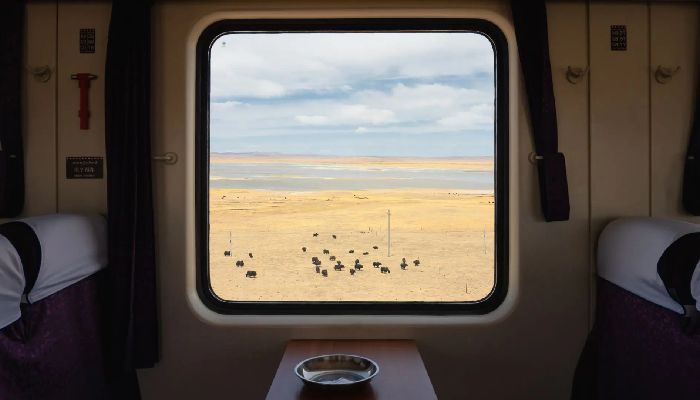
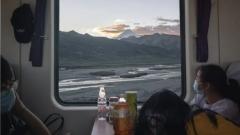
Scenery Outside the Window of a Qinghai-Tibet Railway Train
Option 1: Fly to Lhasa – Fastest and Time-Saving
If your vacation is short, or you don’t want to spend time on the road, flying is undoubtedly the fastest way.
Advantages of flying:
– Fastest speed: Flying from cities like Chengdu, Chongqing and Xining to Lhasa only takes 2 to 3 hours, and you can rest in downtown Lhasa in the afternoon – it’s very suitable for people with limited time.
– Relatively comfortable and worry-free: Free from long-distance jolting, take-off and arrival times are clear, and the entire trip is highly certain.
– Stunning scenery from the sky: If the weather is good, when the plane flies over the Qinghai-Tibet Plateau, you can see continuous snow-capped mountain ranges from the window – the grandeur is unseen on the ground.
Things to consider when flying:
– Altitude sickness may come faster: Your body suddenly flies from flat land to Lhasa, which is 3,650 meters above sea level, without an adaptation period. Some people may feel headaches and shortness of breath immediately after getting off the plane. So on the first day in Lhasa, be sure to walk slowly, drink plenty of water, rest well, and don’t rush out to play.
– Relatively high cost: Especially during the peak tourist season from May to October, air ticket prices are very high and rarely discounted.
– Missing the change of scenery on the way: Although flying is fast, it skips the wonderful experience of the landscape changing little by little from the plains to the plateau.
If you decide to fly, you can pay attention to these points:
- Choose a flight: Try to choose a flight that arrives in the morning or noon, so you have time to adapt and rest in the afternoon. You can also consider flying to Xining first (with a lower altitude), staying for one night, and then flying to Lhasa – your body will be more comfortable.
- Deal with altitude sickness: Don’t be too tired or catch a cold before boarding the plane. On the day you arrive in Lhasa, never run or take a bath – let your body calm down.
- Timing for buying tickets: Be sure to buy air tickets in advance for peak season travel, and keep an eye on whether airlines have special offers.
Option 2: Take the Train to Lhasa – Balance of Scenery and Altitude Sickness Adaptation
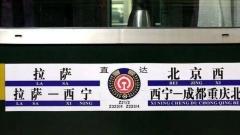
Taking the train to Lhasa via the Qinghai-Tibet Railway is itself a famous travel experience. If you are not in a hurry, want to see the scenery and let your body adapt slowly, the train is a great choice.
Advantages of taking the train:
– Allow the body to adapt to the plateau slowly: This is the biggest advantage of the train. The carriages are equipped with oxygen, and the train climbs slowly, with the altitude rising gradually – giving your body enough time to adjust, making it less likely to suffer from severe altitude sickness.
– Scenery flows past the window like a movie: You will pass Qinghai Lake, cross Hoh Xil to see Tibetan antelopes, and pass Tanggula Pass. The scenery outside the window changes constantly from farmland to grassland to snow-capped mountains – it’s very enjoyable.
– Stable price, less affected: Train ticket prices do not fluctuate as much as air tickets, and are generally not affected by bad weather, with accurate timing.
– Easy to make friends: The train is full of tourists going to Lhasa, so it’s easy to strike up a conversation, share travel experiences, and time passes quickly.
Things to consider when taking the train:
– Long travel time: It takes nearly a whole day (21-22 hours) just to travel from Xining to Lhasa. If you start from Beijing or Shanghai, you will have to stay on the train for two days and two nights – patience is required.
– Crowded carriage life: Staying on the bunk for a long time, sleeping, eating and washing are not as convenient as at home – it may be a bit tiring for people who are afraid of trouble.
– Train tickets are hard to buy during peak season: Especially sleeper tickets, which are in high demand in summer. Be sure to book in advance or ask a reliable travel agency for help.
If you decide to take the train, you can prepare these:
- Which section of the train to choose: The most scenic section is from Xining to Lhasa. You can fly or take a train to Xining first, travel for a day or two, and then board the train from Xining.
- Which seat to choose: Hard sleeper is the most cost-effective, and soft sleeper is more comfortable and quiet. The journey is long, so it’s best not to buy hard seat. Try to choose the lower bunk for more activity space.
- Bring these things: In addition to daily necessities, it is strongly recommended to bring a pair of slippers, a U-shaped pillow, eye mask, earplugs, a large-capacity power bank, wet wipes and some snacks to satisfy hunger.
- Don’t forget to watch the scenery: Check the approximate time when the train passes several major attractions (such as Golmud, Hoh Xil, Tanggula Pass) in advance, set an alarm, and don’t oversleep and miss them.
Option 3: Travel to Lhasa by Road – Give Yourself a Real Adventure
Traveling to Tibet by road mainly refers to driving by yourself, chartering a car or taking a long-distance bus, and entering Tibet via routes such as the Sichuan-Tibet Line (National Highway 318) and Qinghai-Tibet Line. This is the most challenging way, but also the one that can bring the most surprises.
Advantages of traveling by road:
– Freedom to stop whenever you want: The scenery is all on the road. When you see a good viewing platform, you can stop to take photos at any time; when you encounter an interesting small village, you can turn in to have a look. The itinerary is completely up to you.
– The most diverse scenery: Along the way, you will experience forests, canyons, grasslands and snow-capped mountains – seeing all kinds of landforms within a few days, with a sense of freshness every day.
– The most natural adaptation to altitude sickness: When driving or taking a car, the altitude rises slowly, and often you climb over a very high mountain pass today and stay in a river valley with a lower altitude at night. This “up and down” allows your body to adapt unconsciously.
– Great sense of accomplishment after completion: Driving all the way to Lhasa by yourself is a goal for many travel lovers – this sense of accomplishment is incomparable to flying or taking the train.
Things to consider when traveling by road:
– Most time-consuming: Driving from Chengdu to Lhasa takes 7 to 8 days even if you don’t travel much. It’s suitable for people with a long vacation.
– Complex road conditions, high requirements: Some mountain roads are narrow, with cliffs on the side, and you may encounter landslides and road repairs. It requires drivers to have good skills and courage, and the car must be reliable. Novice drivers should not drive by themselves.
– Both people and cars are prone to fatigue: Driving in the mountains for a long time requires high concentration, which is very exhausting. The accommodation conditions in some places along the way are relatively average.
– Plans can’t keep up with changes: Rainy season landslides and traffic control may force you to change routes – you need to be able to handle various situations flexibly.
If you decide to travel by road, remember these things:
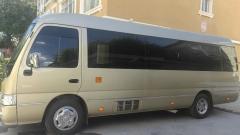
- How to go: If you drive by yourself, be sure to travel with experienced people; the most worry-free way is to charter a car and hire a local driver who is familiar with the roads; the cheapest (but also the hardest) way is to take a long-distance bus.
- Prepare the car well: It’s best to use an off-road vehicle or SUV with a high chassis and strong power. Be sure to thoroughly inspect and maintain the car before departure.
- Don’t drive too fast: Drive no more than 300 kilometers per day, leaving enough time to see the scenery and rest. Book accommodation in counties along the way in advance.
- Safety first: Always pay attention to weather forecasts and road condition information. Be extra careful during the rainy season (July and August). Be sure to buy a travel insurance that covers plateau travel.
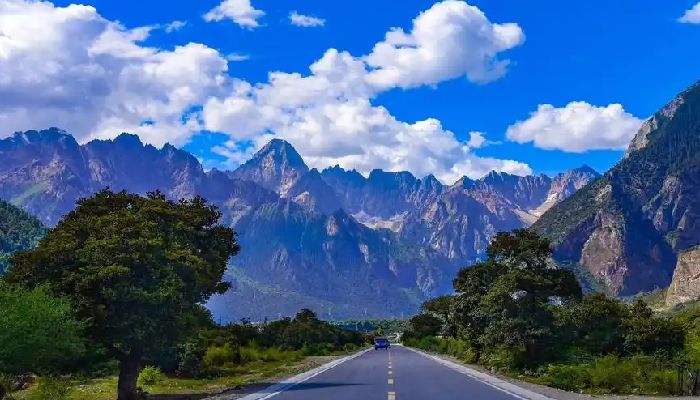
Scenery of Sichuan-Tibet Line on National Highway 318
A Brief Summary of the Three Modes to Help You Decide
Let’s make a brief summary to make it clearer for you:
- In terms of time: Flying is the fastest, taking a few hours; the train takes a day and a night; and the road takes about a week, which is a long-distance trip.
- In terms of cost: Flying directly is usually the most expensive; train tickets are moderately priced and relatively stable; the cost of road travel depends on how you go – chartering a car is more expensive than driving by yourself, but may be cheaper than flying.
- In terms of physical adaptation: Road travel allows the body to adapt most naturally; the train helps you transition smoothly through slow altitude increase and on-board oxygen supply; flying requires you to pay special attention to rest after getting off the plane.
- In terms of travel experience: Flying is just a means of transportation; the train is a slow travel to see the scenery; road travel is a complete adventure that requires you to take care of everything yourself.
So, should you choose train, plane or road to Lhasa? It depends on what you value:
– If you have little time, are afraid of trouble, and want comfort, choose flying.
– If you are not in a hurry, want to see the scenery of the Qinghai-Tibet Railway, and are afraid of altitude sickness, choosing the train is definitely correct – especially recommended to start from Xining.
– If you have a long vacation, like to explore by yourself, and are not afraid of challenges, choosing the road will definitely make your trip unforgettable.
There’s also a smart way: the “plane + train” combination. For example, fly to Xining first, travel for a while, then take the train to Lhasa – this way you can experience the train and save some time; or vice versa, take the train to Tibet first, and then fly back after traveling.
Choose the Right Route and Start Your Lhasa Journey with Confidence
There is no single best way to reach Lhasa, only the option that fits your time, budget, and travel expectations. Flights offer speed and convenience, trains provide gradual altitude adaptation with scenic views, while overland routes deliver freedom and adventure. Understanding these differences before departure can greatly improve your overall Tibet experience. For travelers seeking a smooth and well-planned journey, China Dragon Travel can assist with transportation planning and entry arrangements, ensuring your trip to Lhasa begins comfortably and safely.