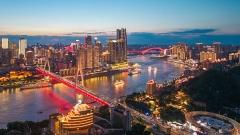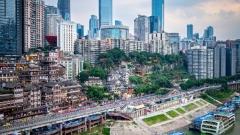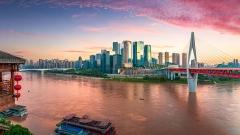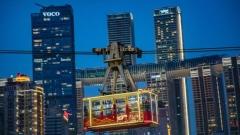

For many first-time visitors, Chongqing feels unlike any other city in China. Buildings appear stacked on steep hillsides, streets exist on multiple levels, and what looks like a rooftop from one direction may actually be the middle floor of a residential building. Walking through the city often means climbing stairs, passing through bridges, and suddenly emerging onto streets far above the previous level. This striking visual landscape is the result of Chongqing’s mountainous geography, long urban history, and creative architectural adaptation. Understanding why the houses appear layered helps reveal how the city developed into one of China’s most fascinating mountain metropolises.
A Mountainous Landscape That Shapes the City
The most fundamental reason Chongqing’s houses appear stacked is its geography. The city sits at the meeting point of the Yangtze River and the Jialing River, in a region dominated by steep hills and valleys. Unlike cities built on flat plains, Chongqing has very little level land.
Because of this terrain, buildings must adapt to slopes instead of replacing them. Residential structures are often constructed along the natural contours of hillsides. Instead of flattening the land entirely, architects work with the elevation changes.
A single building may therefore have multiple entrances at different heights. What serves as the first floor from one street might appear as the tenth floor from the riverside below. This vertical complexity creates the layered cityscape that Chongqing is famous for.
When viewed from across the river, the city resembles a giant staircase rising from the water to the hilltops. Buildings appear to grow out of the mountains themselves, forming a dramatic urban silhouette that changes depending on where you stand.
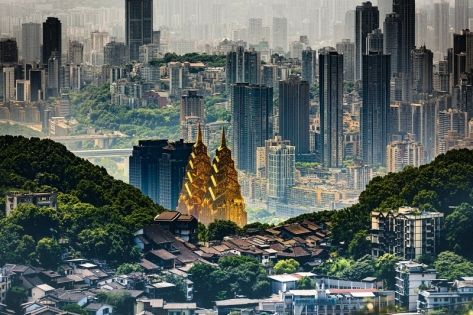
Chongqing
Historical Expansion Along the Riverbanks
Chongqing’s layered architecture is not only shaped by geography but also by history. For centuries, Chongqing served as one of the most important trading ports along the upper Yangtze River. Boats carrying goods from inland regions gathered at its docks, bringing merchants, workers, and migrants.
Early settlements naturally formed near the riverbanks because the river served as the main transportation route. However, flat land along the rivers was extremely limited. As the population increased, residents had little choice but to expand upward along the hillsides.
New homes were gradually built above existing neighborhoods, and streets climbed higher and higher into the hills. Over time, this created neighborhoods that were vertically layered rather than horizontally spread.
Unlike cities that were planned all at once, Chongqing developed gradually over centuries. Each generation added new buildings, stairs, and streets that connected different elevations. This organic growth produced the complex three-dimensional urban layout that defines the city today.
The Influence of Traditional Stilt Houses
Traditional architecture in southwest China often reflects the challenges of mountainous terrain. One of the most famous examples is the stilt house, a structure supported by wooden or stone pillars that allow part of the building to extend over slopes or rivers.
Stilt houses were particularly common in steep areas because they allowed builders to create level living spaces without needing to reshape the landscape dramatically. By elevating part of the structure on pillars, residents could use uneven ground efficiently.
Although modern Chongqing is filled with concrete apartment buildings, the design philosophy behind stilt houses continues to influence construction. Many buildings still incorporate elevated sections, terraces, and multiple levels that adapt to steep terrain.
In some historic districts, traditional wooden stilt houses can still be seen clinging to cliffs or rising above narrow alleys. These structures demonstrate how people have long adapted architecture to the natural landscape of the region.
Even modern developments reflect this heritage. Multi-level structures, suspended platforms, and hillside foundations are all modern interpretations of traditional mountain architecture.
A Multi-Level Transportation System
Another important factor contributing to Chongqing’s layered appearance is its complex transportation network. Because of the city’s mountainous terrain, roads cannot simply run straight across the landscape. Instead, they wind along slopes, pass through tunnels, and cross rivers via bridges.
Many streets exist at completely different heights. Elevated highways pass above residential districts, while tunnels cut directly through mountains. Pedestrian stairways and hillside paths connect neighborhoods separated by steep slopes.
Chongqing’s rail transit system adds another dimension to this layered environment. One of the city’s most famous landmarks is the Liziba metro station, where a train line passes directly through the middle of a residential building.
This unusual design is not simply a novelty; it is a practical solution to the challenge of building transportation infrastructure in a mountainous city with limited space.
Because of these multi-level roads and railways, buildings appear to change height depending on where you view them. What seems like a mid-rise building from above may reveal dozens of floors when seen from the river below.
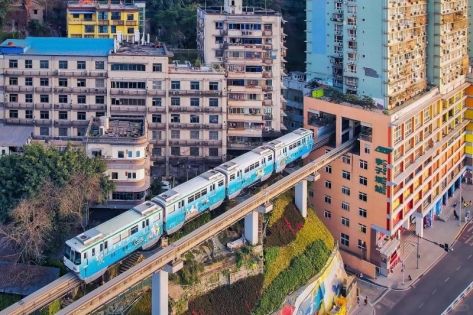
Chongqing Liziba Light Rail
High Density Urban Growth
In recent decades, Chongqing has experienced rapid urban expansion. With a metropolitan population exceeding 30 million, land resources have become increasingly valuable. In mountainous terrain, the scarcity of flat land makes efficient use of space even more important.
Architects have responded by designing buildings that maximize vertical space. Hillsides are often developed with terraced apartment complexes that follow the slope of the mountain.
These developments may include multiple entry points connected to different roads. Lower floors may open onto a street at the base of the hill, while higher floors connect to another road further up the slope.
This approach not only saves land but also provides many apartments with panoramic views of the city and surrounding rivers.
The result is a carefully organized vertical city where buildings, streets, and public spaces occupy different elevations yet remain interconnected.
Everyday Life in a Vertical City
Living in Chongqing means adapting to a city that moves vertically as much as horizontally. Walking uphill, climbing staircases, and navigating narrow hillside paths are part of daily life.
In older neighborhoods, long staircases connect residential blocks, markets, and small restaurants. Local residents are accustomed to this environment and often move through these vertical spaces with ease.
These stairways also shape the social atmosphere of the city. Small shops, tea houses, and street vendors frequently line the steps and alleyways, creating lively community spaces.
For visitors, exploring these stair streets provides a deeper understanding of Chongqing’s character. The city reveals itself not just through famous landmarks but also through these everyday pathways that link different levels of urban life.
A Unique Urban Landscape That Attracts Travelers
Chongqing’s layered architecture has become one of its most distinctive attractions. Many of the city’s most popular landmarks showcase the interaction between buildings and mountainous terrain.
Hongyadong is perhaps the best-known example. Built along a steep riverbank, the complex resembles traditional stilt houses stacked against the cliff. At night, thousands of lights illuminate the structure, creating a scene that looks almost like a fantasy city.
Another famous location is the Liziba metro station, where trains appear to pass through a residential building. This unusual sight has made the station a global social media sensation.
The Mountain City Walkways and hillside viewpoints also allow travelers to experience Chongqing’s vertical urban landscape firsthand.
These attractions highlight how geography, architecture, and daily life combine to create a city unlike any other.
Understanding the Wisdom Behind Mountain City Architecture
To truly understand why Chongqing’s houses appear layered, the best approach is simply to explore the city slowly. Walking along hillside paths, crossing bridges, and observing how buildings connect to different streets reveals the logic behind the design.
Every slope, staircase, and terrace reflects generations of adaptation to the natural landscape. Instead of forcing the terrain to change, Chongqing has evolved by working with the mountains.
This approach has produced a city that feels dynamic, complex, and visually unforgettable.
For travelers interested in exploring Chongqing and other destinations across western China, planning the journey carefully can make the experience even more rewarding. Travel agencies such as China Dragon Travel offer guided itineraries throughout the region, helping visitors discover not only Chongqing but also the diverse landscapes and cultures of Tibet and Northwest China.