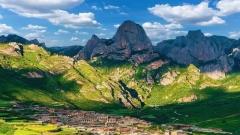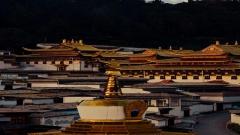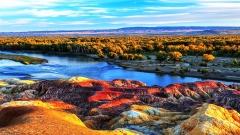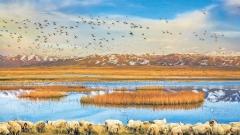

Jiuquan is located in northwestern Gansu, the west of the Hexi Corridor, and was one of the four commanderies of the Hexi region during the Han Dynasty. As a strategic transportation hub, its name derives from a legend passed down for a thousand years about General Huo Qubing pouring wine into the spring to share with his soldiers. Today’s Jiuquan is home to Mogao Grottoes, the desert wonders of Mingsha Mountain and Crescent Lake, and the aerospace miracles of the Satellite Launch Center. Its vast area and scattered attractions require first time visitors to plan itinerary carefully. This guide details in Jiuquan travel, including documents, travel advice, attractions, laying out everything you need to know.
Essential Documents for Visiting Jiuquan
Passport
When traveling to Jiuquan, ensure your passport is valid for at least six months beyond your intended stay and carry the original document with you at all times. You will need to present your passport for hotel check in, train ticket purchases, scenic area ticket purchases, and border inspections. It is recommended that you take a photo of your passport information page and save it on your phone, and carry one or two photocopies stored separately from the original in case of emergency.
Visa
Foreign travelers holding ordinary passports must ensure they have a valid Chinese tourist visa (L visa), with validity and duration of stay covering your entire trip to Jiuquan. If you are from a visa exempt country, you may enter visa free for 15 to 30 days, but you should confirm that the visa free policy applies to Gansu Province. Some visa free policies are limited to specific ports of entry or specific regions. Before traveling, check the official website of the Chinese embassy or consulate in your country to confirm the latest policies.
Visit Permit for Satellite Launch Center
The Jiuquan Satellite Launch Center (Dongfeng Aerospace City) is located within a military controlled area, and access for foreign travelers is strictly restricted. As of 2026, the core areas of the launch center are not open to foreign travelers holding ordinary passports. If you wish to visit the surrounding areas or the museum at the launch center, you must apply for a special permit in advance through a qualified travel agency. It is recommended that you contact multiple travel agencies to confirm the latest policies before planning your trip. Do not go there on your own, as there are multiple checkpoints around the launch center, and you will be turned back without a valid permit.
Travel Advice for Jiuquan
Time
Jiuquan has a vast area. Dunhuang and downtown Jiuquan are about 400 kilometers apart. The high speed train takes about 1.5 hours, and driving takes about 4.5 hours. It is recommended that you allocate at least 5 to 6 days to cover the core attractions of both the Dunhuang and Jiuquan areas. If you have limited time, Dunhuang alone requires at least 3 days, while downtown Jiuquan and its surrounding areas need 2 days.
Accommodation
Accommodations in downtown Dunhuang are concentrated around the Shazhou Night Market, within walking distance of the night market and the main dining areas of the city. There are also guesthouses near the Mingsha Mountain scenic area, suitable for those who wish to view the desert sunrise from close range. Accommodations in downtown Jiuquan are more dispersed. It is recommended that you choose areas near the Drum Tower or the City Government Square, which offer convenient transportation and many dining options. Jiayuguan City, as a transit hub, offers good value accommodations and is only 25 kilometers from downtown Jiuquan.
Transportation
Both Dunhuang and Jiayuguan have airports, with direct flights from cities such as Beijing, Lanzhou, Xi’an, and Chengdu. Dunhuang Airport is about 13 kilometers from the city center, and Jiayuguan Airport is about 25 kilometers from downtown Jiuquan. High speed trains connect Lanzhou, Dunhuang, Jiayuguan, and Urumqi. The train ride from Dunhuang to Jiayuguan takes about 1.5 hours. For attractions within the city, you can take a taxi or bus. For the Western Route attractions like Yadan National Geological Park and Yumen Pass, you will need to hire a private car (about 400 to 600 RMB per day). Travel to the Jiuquan Satellite Launch Center also requires a private car or a tour group, with a drive of about 2.5 hours from downtown Jiuquan.
Transit Cities
Lanzhou is the most convenient transit city for traveling to Jiuquan. From Lanzhou Zhongchuan Airport, take an intercity train to Lanzhou West Station (about 40 minutes), then transfer to a high speed train to Dunhuang or Jiayuguan. High speed trains are frequent, with about 8 daily services to Dunhuang taking about 4.5 to 5 hours, and services to Jiayuguan taking about 3.5 to 4 hours. Xi’an is also an important transit hub. From Xi’an Xianyang Airport, take the metro to Xi’an North Station (about 50 minutes), then transfer to a high speed train to Dunhuang (about 8 hours) or Jiayuguan (about 7 hours). If you are short on time, you can choose to fly directly from Lanzhou or Xi’an to Dunhuang Airport or Jiayuguan Airport, with flight times of about 1.5 hours and 2.5 hours respectively. Foreign travelers are advised to prioritize Lanzhou as a transit city.
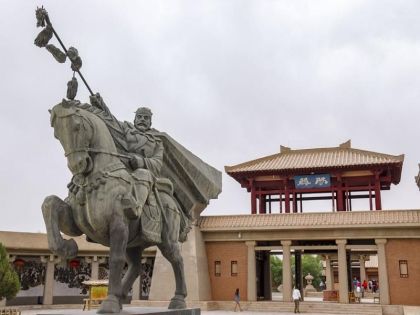
Jiuquan Historic Site of Western Han Dynasty
Core Attractions in Jiuquan
Mogao Grottoes
The Mogao Grottoes are a UNESCO World Heritage Site, featuring 735 caves, 45,000 square meters of murals, and over 2,400 painted sculptures. Spanning more than ten dynasties, they represent the greatest achievements of Silk Road civilization. Entering the caves, with their ethereal flying apsaras and solemn Buddha figures, feels like stepping into a thousand year art gallery. To visit the Mogao Grottoes, you must book tickets in advance under your real name through the official WeChat public account. During peak season, it is recommended that you book two weeks ahead. The regular ticket allows you to visit 8 caves with a professional guide and costs 238 RMB.
Mingsha Mountain and Crescent Lake
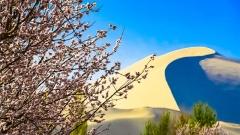
Mingsha Mountain and Crescent Lake form a desert wonder where sand and water coexist. Nestled among the sand dunes, a crescent shaped spring has lain still for a thousand years, never covered by windblown sand nor dried up. It is known as the “Number One Spring in the Desert.” The entrance fee is 110 RMB, and the ticket allows multiple entries over three days. The best time to visit is early morning or evening. You can watch the desert sunrise in the morning or overlook the night view of Crescent Lake from the sand dunes in the evening. Recommended activities include a camel ride across the sand sea (about 100 RMB) and sand sliding (about 40 RMB). The hour before sunset is the prime time for photography, as the light dyes the sand dunes golden red.
Yadan National Geological Park
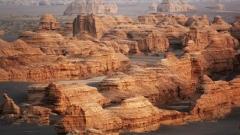
The Yadan landform is located about 180 kilometers west of downtown Dunhuang. Wind eroded mounds form bizarre shapes. When strong winds blow, the sounds echoing through the formations are said to resemble ghosts howling, earning it the name “Devil City.” The entrance fee is 120 RMB (including the sightseeing bus). It is recommended that you depart in the afternoon and return after watching the sunset at Devil City.
Yangguan Pass and Yumen Pass
Yangguan Pass and Yumen Pass were important passes on the ancient Silk Road. Although only ruins remain today, standing here you can almost hear the ancient sounds of camel bells. The entrance fee for Yangguan Pass is 50 RMB, and for Yumen Pass it is 40 RMB. Both passes are located along the same Western Route and can be visited together.
Jiuquan Satellite Launch Center
The Jiuquan Satellite Launch Center is China’s earliest and largest comprehensive missile and satellite launch center, and the birthplace of the Shenzhou spacecraft. Tour highlights include the History Exhibition Hall, Wentian Pavilion, the Dongfeng missile launch tower, and the manned space launch tower. Please note that visiting the Satellite Launch Center requires advance procedures. Foreign travelers must apply for a permit through a travel agency. It is recommended that you contact a local travel agency 4 to 6 weeks in advance to confirm the visiting qualifications and procedures.
Jiuquan Historic Site of Western Han Dynasty
The Western Han Dynasty Jiuquan Historic Site is located in downtown Jiuquan and is the birthplace of the city’s name. Legend has it that in 121 BC, General Huo Qubing defeated the Xiongnu. Emperor Wu of Han sent a jar of fine wine as a reward. To share it with his soldiers, Huo poured the wine into a spring, giving Jiuquan (Wine Spring) its name, a story told for a thousand years. The park features the legendary ancient spring, a statue of Huo Qubing sharing wine with his soldiers, and the over 130 year old “Zuo Gong Willow.” Entry is free, and the site is suitable for a half day stroll around the city.
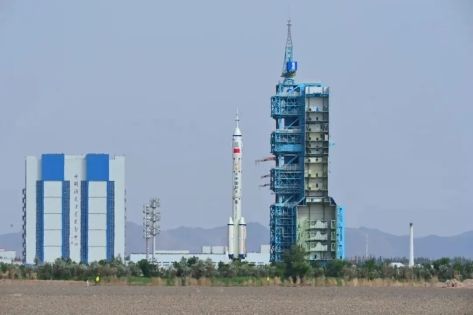
Jiuquan Satellite Launch Center
Tips for Visiting Jiuquan
Ticket Booking of Mogao Grottoes
Regular tickets for the Mogao Grottoes must be booked 14 days in advance through the official WeChat public account. Tickets for mid October usually sell out within one hour of release. Foreign travelers holding passports can book through the same channel or purchase tickets at the manual window at the Digital Exhibition Center. Special cave tickets must be purchased after completing the regular tour, at the Special Cave Office in the cave area. Photography is strictly prohibited inside the Mogao Grottoes caves. Do not touch the murals.
Satellite Launch Center Visit
The Jiuquan Satellite Launch Center is a military controlled area with strict access restrictions. Foreign travelers must apply in advance through a travel agency and cannot go independently. Chinese citizens must bring their original ID card. The visit date may be adjusted due to launch missions, so be sure to confirm with your travel agency before departure.
Best Time to Visit Mingsha Mountain
The best times to visit Mingsha Mountain are from 6:00 am to 8:00 am and from 5:00 pm to 7:30 pm. At midday, the sand surface temperature can exceed 50°C, so outdoor activities are not recommended. The camel riding and sand sliding experiences have long queues in the evening, so it is recommended that you try these activities first after entering the park, and then climb the sand dunes for photos before sunset.
Language
Most staff at hotel front desks, upscale restaurants, airports, and train stations in downtown Jiuquan and Dunhuang have basic English communication skills. When traveling to suburban attractions like Yadan Devil City, Jinta Populus Euphratica Forest, or the Satellite Launch Center, local drivers and vendors have limited English. It is recommended that foreign travelers download a translation app in advance and save common Chinese phrases. When hiring a private car for the Western Route, it is advisable to book an English speaking driver through your hotel or a travel agency, which will cost about 100 to 200 RMB more than a regular private car.
Jiuquan Travel Guide: Journey to the Ancient Silk Road and the Sea of Stars
Jiuquan is a very special city. To the south, the murals of the Mogao Grottoes depict ancient people’s imaginations of flying. To the north, under the towers of the Satellite Launch Center rest the spacecraft that actually fly into space. Two kinds of flight, separated by over a thousand years, have both been realized on this Gobi Desert. In Jiuquan, you can ride a camel to watch the sunset at Mingsha Mountain, gaze upon thousand year old murals at the Mogao Grottoes, feel the desolation of “spring wind never reaching Yumen Pass,” and look up at the pride of China’s aerospace achievements at the Launch Center. We hope this guide helps you plan a fulfilling trip to Jiuquan.