
Yearning to scale the towering, mist-wreathed summit of Fanjing Mountain—a bright pearl nestled on the Yunnan-Guizhou Plateau and truly a shining treasure of nature. As a World Natural Heritage site, it blends ecological charm, Buddhist philosophy, and unique landforms into one breathtaking package. Whether you’re an adventurer eager to push your limits or a traveler seeking spiritual solace, this “Sky City” is sure to leave an indelible mark on your heart. Below is a carefully curated 2026 adventure guide to Fanjing Mountain, packed with detailed transportation information, hiking trails, and thoughtful travel tips to make your journey seamless.
Why Is Fanjing Mountain Hailed as the “Sky City”?
Standing alone on the eastern Guizhou land, Guizhou Fanjing Mountain shrouds in lingering mist all year round, like a fairyland floating above the mortal world — hence the title “Sky City”. It is not composed of a single peak, but a collection of ancient geological relics. Its main peak, Fenghuang Mountain, rises 2572 meters above sea level, but the most visually stunning is undoubtedly the “Hongyun Golden Peak”, which rises abruptly with a vertical drop of hundreds of meters. Geographically, it is the backbone of the Wuling Mountains. Having endured hundreds of millions of years of wind and rain erosion, it has formed the unique landforms we see today. The name “Fanjing” carries profound Buddhist meaning, derived from the Buddhist term “Brahmic Pure Land”, referring to an unpolluted paradise. This perfectly aligns with its trait of being far from hustle and bustle, pure and natural. When you traverse the dense forests at the foot of the mountain, ascend by cable car, or hike to the summit, the transition from the mortal world to the clouds is extremely strong — this is the most intuitive experience of why it is hailed as the “Sky City”.
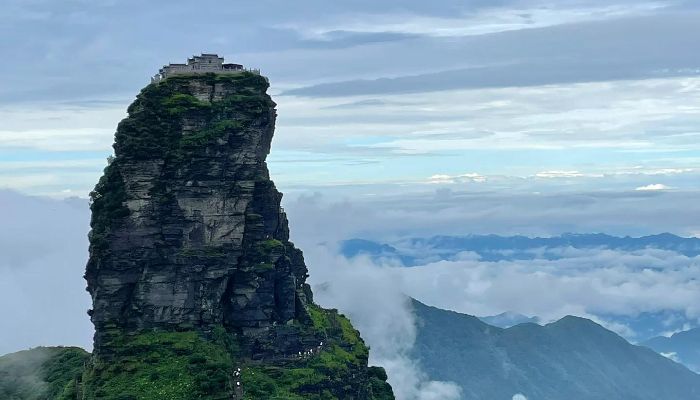
Sea of Clouds over Guizhou Fanjing Mountain
Fanjing Mountain’s Best Travel Seasons & Weather Preparation
Choosing the right season to visit Fanjing Mountain is crucial, as it directly affects your travel experience and safety.
- Spring (March-May): Blooming flowers and mild climate make it a great time to admire azaleas. However, rainfall increases during this period, and the mountainous area is often foggy — be sure to bring rain gear.
- Summer (June-August): A summer resort, but also the peak rainy season. Heavy rains may cause slippery trails or even temporary closures. Nevertheless, the sea of clouds after rain is particularly magnificent.
- Autumn (September-November): Regarded as the golden season to visit Fanjing Mountain. Stable weather, clear skies and high visibility make it the best time to photograph the Golden Peak and exotic rocks.
- Winter (December-February): The mountainous area receives snow, presenting a unique silver-clad scenery. However, some trails and cable cars may be closed due to icing — confirm in advance.
No matter when you visit, the mountainous climate is changeable. Always adopt “onion-style dressing”, bring a windproof and waterproof jacket, comfortable non-slip hiking shoes, a hat, gloves, and sufficient drinking water and high-energy snacks.
Natural & Cultural Essence of Fanjing Mountain
When people talk about Guizhou Fanjing Mountain, they are often first shocked by its sky-piercing visual spectacle. However, the true soul of this “Sky City” lies in the magnificent epic written by hundreds of millions of years of geological movements, and the quiet poem precipitated by thousands of years of human beliefs. It is not only a check-in spot, but also an open-air natural museum and a living history of Buddhist culture. Shrouded in clouds and mist, the ancient granite mountains tell the story of the Earth’s changes; atop Hongyun Golden Peak, curling incense continues the spiritual pursuit. Exploring in depth, you will find that every exotic rock, every forest and every ancient temple in Fanjing Mountain contains codes waiting to be deciphered.
Unmissable Geological Wonders
Fanjing Mountain is an open geological encyclopedia, and the most striking chapter is undoubtedly the Mushroom Stone. Not man-made, it is a masterpiece crafted by nature with wind and frost as blades and time as anvil, over tens of millions of years. A huge slab of rock rests on a thinner stone pillar, resembling a mushroom. It seems precarious, yet has stood firm for countless years, becoming a symbol of tenacity. Complementing it, the Hongyun Golden Peak is a masterpiece of nature’s craftsmanship — a huge mountain splits into two from the top, with a crack tens of meters deep. The summits on both sides are respectively home to Sakyamuni Hall and Maitreya Hall, connected by a sky bridge. Climbing the Golden Peak is like a pilgrimage — you need to climb with hands and feet, clinging to iron chains and traversing the narrow “Golden Knife Gorge”. When you reach the summit, surrounded by nothing but surging clouds below, you can truly appreciate the ultimate realm of “seeing all mountains small”. In addition, the layered Wan Juan Shu Rock (Ten Thousand Volumes of Books Rock) and the lifelike Laoying Rock (Eagle Rock) all make people marvel at the magic of the creator.
Rich Ecological & Buddhist Cultural Heritage
Beyond the silent stones, Fanjing Mountain is a vibrant green treasure trove. It preserves a complete subtropical primeval forest ecosystem, serving as a sanctuary for many rare animals and plants. The most famous resident is the Guizhou Golden Monkey, a primate unique to the Fanjing Mountain area, hailed as the “only child of the Earth”. With blue faces and golden fur, they shuttle through the dense forests — encountering them is undoubtedly a lucky surprise of the journey. Meanwhile, Fanjing Mountain’s cultural pulse has been beating for hundreds of years. Since the prosperity of Buddhism in the Ming Dynasty, it has become a Taoist site of Maitreya Bodhisattva. Ancient temples such as Chengen Temple and Zhenguo Temple in the mountains, though not large in scale, are full of ancient charm and incense. Many hikers will sit quietly in front of the temples after reaching the summit, letting the howling mountain wind interweave with the afterglow of scriptures, experiencing the wonderful resonance between the grandeur of nature and inner peace. This deep integration of ecology and culture is the unique charm that sets Fanjing Mountain apart from ordinary mountain scenic areas.
How to Get to Fanjing Mountain? Detailed Transportation Guide
Nestled in the hinterland of the Wuling Mountains, reaching Fanjing Mountain requires some effort. Reasonably planning long-distance transportation and the final transfer is the key to a smooth journey. The main transportation hubs are Guiyang, the capital of Guizhou Province, or the neighboring Tongren City — choose flexibly based on your departure location.
- Fly to Major Transfer Cities
Most long-distance travelers choose to fly to Guiyang Longdongbao International Airport, the largest aviation hub in Guizhou Province with the most flight options. From Guiyang, you can take the convenient high-speed rail to Tongren (about 1.5 hours) — currently the most popular way; or take a long-distance bus (about 3 hours). Another more direct way is to fly to Tongren Fenghuang Airport, which has routes connecting some major domestic cities. Direct flights here will significantly shorten the subsequent ground transportation time, bringing you closer to your destination faster.
- Ground Transfer to Scenic Area Entrance
After arriving in Tongren City (whether at the airport or high-speed rail station), the real “mountain entry” begins. You need to transfer to transportation to the tourist service center at the foot of Fanjing Mountain. The main entrances are located in Jiangkou County (East Gate) and Yinjiang County (West Gate, commonly used for hiking routes). Tongren Tourism Bus Station operates special shuttle buses to Jiangkou, with a journey of about 1-1.5 hours. If traveling with a group or having inconvenient luggage, booking a local taxi or ride-hailing service to the scenic area entrance is a more flexible and comfortable choice, especially during peak tourist seasons, allowing you to better control your time.
- Internal Scenic Area Transfer
After arriving at the tourist service center and purchasing tickets, all private vehicles are not allowed to enter the core area of the reserve. You must transfer to the scenic area’s unified sightseeing bus to reach the starting point of the hiking trail (such as Yu’ao) or the cable car lower station. This winding mountain road offers beautiful scenery and is also the start of acclimatizing to the altitude. Be sure to reserve time for waiting for the sightseeing bus, especially during peak holiday periods.
Fanjing Mountain’s Summit Experience & Core Area Guide
Successfully reaching the Fanjing Mountain summit platform is just the beginning of a wonderful journey. This area lifted by clouds and mist gathers the most essential scenery — reasonably planning the visiting order can greatly enhance your experience.
Primary Target: Hongyun Golden Peak
This is the visual and spiritual focus of the entire area. Please note that the summit trail is steep and narrow, often requiring queuing and implementing one-way traffic. It is recommended to take on the challenge when you have the most energy, preferably in the early morning or afternoon when there are relatively fewer people. When climbing, be sure to hold onto the iron chains and do what you can. The summit space is limited — be patient when taking photos.
Classic Loop: Mushroom Stone & Old Golden Peak
After descending from Hongyun Golden Peak, head to the Mushroom Stone Observation Deck, the best angle to take iconic photos. Afterwards, those with sufficient energy can continue to challenge the Old Golden Peak, which is higher in altitude and offers a broader view, overlooking the magnificent rolling mountains. The Mushroom Stone and Old Golden Peak are connected by a relatively gentle plank road — walking along it, you can admire the rugged texture of the mountain from different angles.
Cultural Stop: Chengen Temple Area
After visiting the natural wonders, take a break in the Chengen Temple area. The atmosphere here is quiet, allowing you to learn about Fanjing Mountain’s history as a famous Buddhist mountain. Even if you are not a believer, looking at the mountains from here can bring a sense of unique peace.
Important Reminder: The weather on the summit changes rapidly — a gust of wind can bring heavy fog, obscuring all scenery. Maintain a calm attitude — the gathering and dispersing of clouds and mist are themselves a rare sight. It takes about 3 to 5 hours to visit the entire summit area.
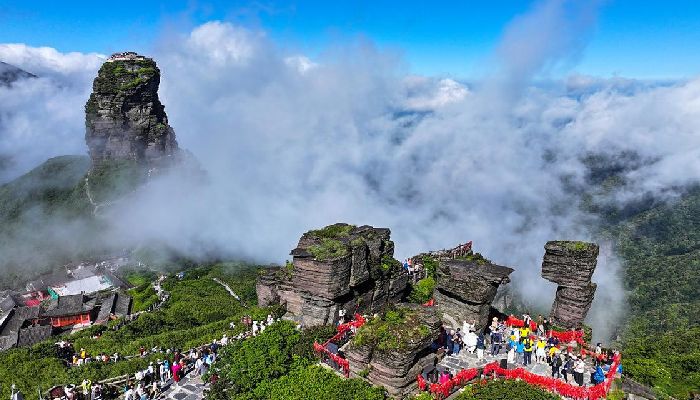
Fanjing Mountain
Safety Notes & Practical Tips for Fanjing Mountain Tour
- High-Altitude Adaptation: The summit area of Fanjing Mountain exceeds 2300 meters above sea level. Though not as high as the Qinghai-Tibet Plateau, rapid ascent may still cause mild altitude sickness such as headaches and shortness of breath. When hiking, be sure to slow down and avoid strenuous exercise, especially on the steep sections of Hongyun Golden Peak — rest immediately if you feel unwell. Maintain steady breathing and drink plenty of warm water to help your body adapt.
- Trail Safety: Most trails in the core summit area are built along cliffs. Especially the “Golden Knife Gorge” section connecting the Golden Peak, which is only wide enough for one person to pass — firmly hold the iron chains on both sides. When it rains or ices in winter, the stone steps become extremely slippery — be sure to wear professional non-slip hiking shoes. Do not stop to take photos on dangerous edges or narrow passages, and always follow the scenic area’s one-way traffic signs.
- Supply Preparation: Transporting supplies up the mountain is difficult. The limited supply points have few options and relatively high prices. It is recommended to bring sufficient high-calorie snacks (such as chocolate, nuts), at least 1-1.5 liters of drinking water, and a small amount of electrolyte powder. The mountainous area has strong ultraviolet radiation — sunscreen, sunglasses and a sun hat are indispensable. Regardless of the weather forecast, a lightweight windproof and waterproof jacket should always be in your backpack.
- Environmental Protection & Etiquette: Please take all garbage, including fruit peels and wrapping paper, down the mountain. Respect local Buddhist culture — keep quiet and dress appropriately when entering temple areas. Do not take photos of monks or specific religious items without permission. In crowded places such as observation decks, be polite to each other and jointly maintain a quiet and peaceful visiting environment.
For tourists unfamiliar with local transportation, hiking planning or hoping to save time on itinerary arrangements, consulting an experienced travel service agency can be helpful. They can usually assist with ticket booking, transportation connections and provide professional itinerary suggestions, making your journey more relaxed.
Plan Your Pilgrimage to the Sky City
The quintessential Fanjing Mountain of Guizhou, ethereal and elusive, silently awaits at the veil of clouds, a beacon of tranquility. It’s not merely a point on the map, but a sacred retreat that beckons to be tread upon, breathed into life, and felt in the core of one’s being. The act of charting this expedition is a ritual steeped in yearning. As your fingers graze the faint indent on the parchment, your mind soars — through verdant subtropical forests, up cold, metallic ladders, until you stand atop the world, beholding the capricious dance of wind and clouds, and cradling the expanse within your gaze. The ineffable sensation of soaring above oneself and the piercing clarity of conversing with nature defy the confines of imagery or language. Hence, let not mundane details impede your quest. View the essential preparations as the keys to an enigmatic realm, and every stride on the trail as an homage to your essence. Whether you embark on this odyssey solo, in quest of answers from within, or share the ecstasy of the peak with cherished companions, Fanjing Mountain will echo your deepest impulses with its pristine soul. The moment is ripe to transform aspirations into actionable blueprints, and blueprints into the mettle for a daring escapade. That celestial city adrift in the clouds stands in quiet anticipation, ready for your footfalls to inscribe a singular saga of mountains and streams.