
Lake Manasarovar is one of the most fascinating destinations in Tibet, attracting pilgrims, explorers, spiritual seekers, and adventure travelers from around the world. Located at an elevation of 4,588 meters in western Tibet and only a short distance from the sacred Mount Kailash, this extraordinary lake has been revered for thousands of years. Beyond its breathtaking scenery, Lake Manasarovar is surrounded by countless legends, religious stories, mysterious natural phenomena, and unsolved mysteries that continue to intrigue both believers and scientists. Whether you are interested in spirituality, Tibetan culture, ancient civilizations, or the natural beauty of the Tibetan Plateau, Lake Manasarovar offers an unforgettable journey into one of the world’s most sacred and mysterious places.
Why Lake Manasarovar Is Considered the Holiest Lake in Tibet
Among all the sacred lakes found across the Tibetan Plateau, Lake Manasarovar enjoys a unique status. It is one of the very few places on Earth that is revered by four major religions: Tibetan Buddhism, Hinduism, Bon, and Jainism.
For centuries, pilgrims have crossed mountains, deserts, and remote plateaus to reach its shores. Many believe that simply seeing the lake can bring spiritual merit, while touching or bathing in its waters can cleanse negative karma and bring blessings for the future.
The lake’s location also contributes to its significance. Situated near Mount Kailash, one of the world’s most sacred mountains, Lake Manasarovar forms part of a spiritual landscape that has inspired devotion for thousands of years.
| Religion | Importance of Lake Manasarovar |
|---|---|
| Tibetan Buddhism | Source of sacred blessings and spiritual purification |
| Hinduism | Sacred lake created by Brahma and connected to Shiva |
| Bon | Origin of life and cosmic energy |
| Jainism | Place associated with enlightenment |
This extraordinary combination of religious importance has made Lake Manasarovar a symbol of spiritual unity across cultures and traditions.
Tibetan Buddhist Mysteries of Lake Manasarovar
For Tibetan Buddhists, Lake Manasarovar is not simply a body of water. It is a sacred place where the physical world and the spiritual world are believed to meet.
The Hidden Palace of Wisdom
One of the most fascinating Tibetan legends tells of a mysterious Palace of Wisdom hidden beneath the center of the lake. According to traditional beliefs, this sacred palace contains profound teachings and spiritual knowledge inaccessible to ordinary people.
Only individuals with pure hearts, sincere intentions, and accumulated spiritual merit are said to be capable of perceiving its presence. While no physical evidence exists, the story continues to inspire countless pilgrims who meditate beside the lake seeking wisdom and enlightenment.
The Rainbow Light Above the Lake
During important religious periods, especially the Saga Dawa Festival, some pilgrims report seeing unusual rainbow-colored lights above the lake.
Many Tibetan Buddhists believe these lights represent blessings from enlightened beings or manifestations of sacred teachings. Visitors often describe experiencing a deep sense of peace and clarity while spending time near the lake during these special occasions.
Walking the Sacred Kora
Pilgrims frequently perform a kora around Lake Manasarovar by walking around its shoreline while reciting prayers and mantras.
This spiritual journey is believed to help practitioners overcome negative emotions such as attachment, anger, ignorance, pride, and jealousy. Completing the kora is considered a powerful act of purification and devotion.
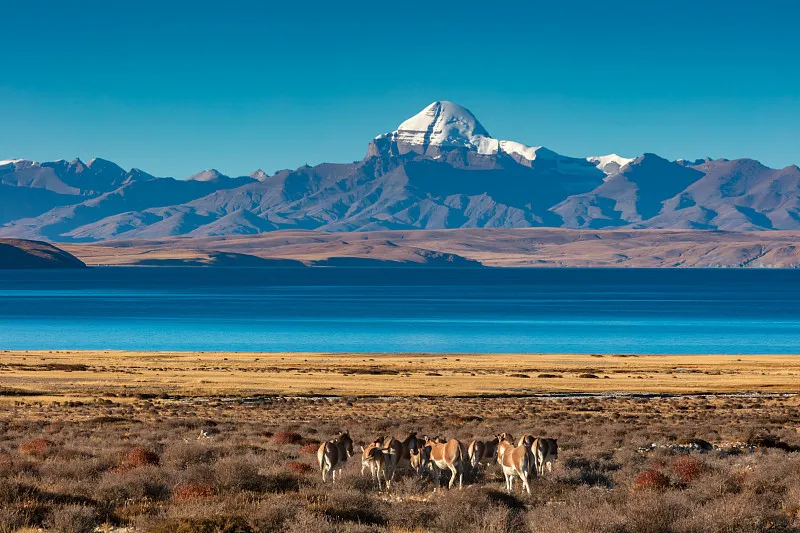
Manasarovar
Hindu Legends and Spiritual Significance of Lake Manasarovar
Lake Manasarovar also occupies an important place in Hindu mythology and religious practice. For millions of Hindus, visiting the lake is a lifelong spiritual goal.
A Lake Born from Brahma’s Mind
According to Hindu tradition, the creator god Brahma formed Lake Manasarovar from his own mind. The name “Manasarovar” itself is often interpreted as “Lake of the Mind.”
Because of this divine origin, the lake is regarded as a manifestation of purity, wisdom, and spiritual perfection.
The Sacred Home of Shiva and Parvati
Mount Kailash, which rises majestically near the lake, is believed to be the home of Lord Shiva. Lake Manasarovar is closely associated with Parvati, Shiva’s divine consort.
Together, Mount Kailash and Lake Manasarovar represent one of the most sacred spiritual landscapes in Hinduism. Many devotees visit both sites during the same pilgrimage.
The Purifying Waters of the Lake
Hindu pilgrims often collect water from Lake Manasarovar and bring it back to their homes and temples.
Many also perform ritual bathing ceremonies, believing that the holy water can cleanse sins, purify the soul, and help individuals progress on their spiritual journey.
Meditation, prayer, and religious offerings along the shoreline remain common practices among Hindu visitors.
Bon Traditions and Ancient Cosmology
Long before Buddhism arrived in Tibet, the indigenous Bon religion already regarded Lake Manasarovar as one of the most sacred places in the region.
The Cosmic Womb of Creation
Ancient Bon teachings describe the lake as the womb of the primordial goddess Droma, the mother of all existence.
According to these traditions, the lake served as the source from which life, energy, and the universe itself emerged. This belief gives Lake Manasarovar a role that extends far beyond human spirituality.
The Twelve Sacred Springs
Bon mythology speaks of twelve sacred springs surrounding the lake. Each spring is associated with a different goddess who protects a specific stage of life.
Together, these springs symbolize the complete cycle of existence, from birth to death and spiritual transformation.
Ancient Ritual Practices
Bon practitioners continue to perform rituals near the lake today. One of the most unique ceremonies involves making symbolic offerings to water deities in exchange for blessings, healing, good harvests, and favorable weather.
These traditions preserve spiritual practices that have survived for thousands of years on the Tibetan Plateau.
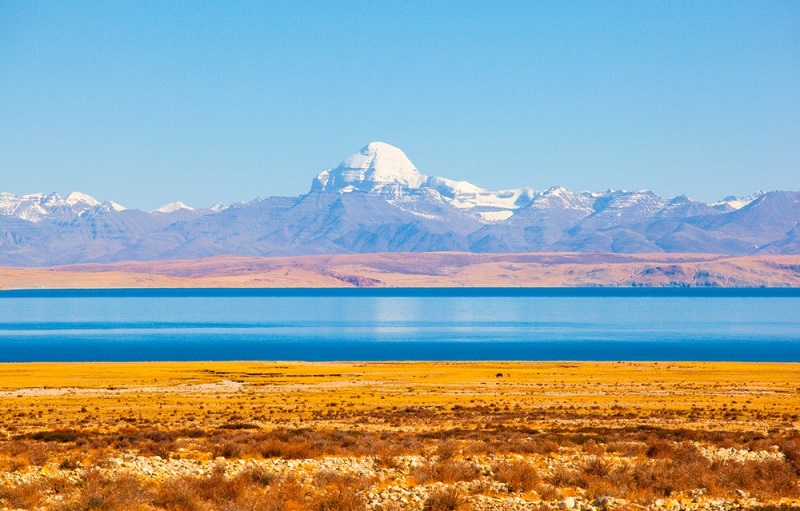
Lake Manasarovar
Jainism and the Path to Enlightenment
Although less widely known, Lake Manasarovar also holds great significance in Jainism.
The Enlightenment of Lord Rishabhanatha
Jain tradition teaches that Lord Rishabhanatha, the first Tirthankara, achieved enlightenment in the vicinity of Lake Manasarovar.
After years of meditation and spiritual practice, he attained ultimate wisdom and understanding, making this region a sacred destination for Jain pilgrims.
The Enlightenment Rock
According to local beliefs, the footprints of Lord Rishabhanatha remain preserved on a rock along the northern shore of the lake.
Pilgrims visit this site to honor his teachings and seek inspiration for their own spiritual development.

The Extraordinary Purity of Lake Manasarovar Water
Aside from religious significance, one of the greatest mysteries of Lake Manasarovar involves the remarkable quality of its water.
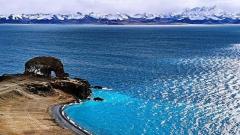
Visitors are often astonished by its crystal-clear appearance. On calm days, visibility can extend deep beneath the surface, revealing stunning shades of blue and turquoise.
The water contains various natural minerals and has traditionally been regarded as one of Tibet’s sacred healing waters. Ancient Tibetan medical texts even classified it among the most valuable natural waters in the region.
Scientists have studied the lake’s composition, yet questions remain about how it maintains such exceptional clarity throughout the year despite its harsh environment.
Why Doesn’t Lake Manasarovar Completely Freeze?
One of the most frequently discussed mysteries surrounding Lake Manasarovar involves its behavior during winter.
Western Tibet experiences extremely cold temperatures, sometimes dropping below -30°C. Under such conditions, most high-altitude lakes freeze completely.
However, local residents have long observed that while parts of Lake Manasarovar freeze near the shore, sections of the central lake often remain surprisingly active.
Local Explanations
Many Tibetans believe hidden geothermal energy exists beneath the lake. According to local legends, underground heat sources prevent the entire lake from freezing.
Others view this phenomenon as evidence of the lake’s sacred nature and spiritual power.
Scientific Perspectives
Researchers have suggested several possible explanations, including water circulation patterns, underground springs, and unique geological conditions.
Despite these theories, no single explanation has fully solved the mystery.
For travelers visiting Tibet in winter, witnessing the partially frozen lake surrounded by snow-covered mountains creates an unforgettable scene unlike anywhere else on the Tibetan Plateau.
Lake Manasarovar and Rakshastal: The Twin Lake Mystery
One of the most intriguing geographical features in western Tibet is the existence of two neighboring lakes with dramatically different characteristics.
Only a few kilometers away from Lake Manasarovar lies Rakshastal, often referred to as the “Demon Lake.”
A Remarkable Contrast
Lake Manasarovar is a freshwater lake known for its beauty, spiritual significance, and abundant life.
Rakshastal, by contrast, is a saltwater lake associated with darker legends and mysterious symbolism.
The contrast between the two lakes has fascinated visitors for centuries.
The Underground Connection Legend
According to local Tibetan beliefs, an underground passage connects the two lakes.
Symbolically, this hidden connection represents the balance between life and death, purity and temptation, light and darkness.
Whether interpreted literally or spiritually, the relationship between the two lakes remains one of Tibet’s most enduring mysteries.
Mysteries of Lost Treasures Beneath Lake Manasarovar
Beyond religion and natural wonders, stories of hidden treasures have added another layer of intrigue to Lake Manasarovar.
For generations, local legends have spoken of priceless artifacts, sacred scriptures, and ancient riches concealed beneath the lake’s waters.
These stories have inspired explorers, treasure hunters, and historians alike.
The Guge Kingdom Treasure Legend
One popular legend claims that monks from the ancient Guge Kingdom hid valuable treasures beneath the lake before the kingdom collapsed.
According to these stories, gold, religious relics, and sacred manuscripts were submerged to protect them from invading forces.
Even today, occasional reports of unusual objects found near the shoreline continue to fuel speculation about what may remain hidden beneath the water.
The Lost Civilization Beneath the Lake
Another fascinating tradition originates from ancient Bon texts, which suggest that a forgotten city from the legendary Zhang Zhung civilization may lie beneath Lake Manasarovar.
The story describes a sacred settlement used for religious ceremonies and spiritual practices thousands of years ago.
Because the lake is considered holy, extensive underwater exploration has never taken place. As a result, the legend of the submerged city continues to capture the imagination of visitors and researchers alike.
The Mystical Legends And Lost Treasures Of Lake Manasarovar
Beyond its religious importance and breathtaking scenery, Lake Manasarovar has long been associated with stories of hidden kingdoms, lost treasures, and unexplained mysteries. These legends have fascinated pilgrims, explorers, historians, and adventurers for centuries, adding another layer of intrigue to one of Tibet’s most sacred destinations.
The Legend Of The Lost Treasures Beneath The Lake
One of the most enduring stories surrounding Lake Manasarovar involves the disappearance of treasures from the ancient Guge Kingdom.
According to local traditions, when the once-powerful Guge Kingdom faced invasion and collapse, monks and nobles sought to protect sacred scriptures, religious artifacts, gold, and precious jewels from falling into enemy hands. Rather than allowing these treasures to be seized, they are said to have secretly hidden them beneath the waters of Lake Manasarovar.
Even today, local herders occasionally share stories of discovering unusual objects along the lakeshore after storms or seasonal water fluctuations. Some claim to have found ancient ritual items, fragments of religious artifacts, or objects decorated with precious stones.
Although no definitive archaeological evidence has confirmed these stories, the legends continue to spark curiosity among travelers exploring western Tibet.
The Mysterious Sunken City Of Zhang Zhung
Another fascinating legend comes from the ancient Bon religion.
According to certain Bon traditions, a sacred city from the ancient Zhang Zhung civilization once existed beneath the waters of Lake Manasarovar. Zhang Zhung was a powerful kingdom that flourished in western Tibet long before Tibetan Buddhism became dominant in the region.
The legend suggests that this hidden city served as a spiritual center where sacred ceremonies and rituals were performed. Some stories describe magnificent temples, palaces, and underground chambers lying deep beneath the lake.
Because Lake Manasarovar is considered holy, extensive underwater exploration has never been widely pursued. Religious beliefs and local customs encourage respect for the lake’s sacred nature, leaving many of these stories unresolved and adding to the lake’s enduring mystery.
Famous Explorers And Their Fascination With Lake Manasarovar
Throughout history, Lake Manasarovar has attracted explorers, monks, scholars, and travelers seeking to understand its significance.
One of the earliest documented accounts comes from the famous Chinese monk Xuanzang during the 7th century. During his journey across Asia, he recorded descriptions of the sacred lake and its surrounding region.
In his writings, Lake Manasarovar was portrayed as a mystical body of water associated with sacred creatures, spiritual powers, and heavenly blessings. Local stories collected during his travels spoke of hidden treasures and divine protection surrounding the lake.
Centuries later, Swedish explorer Sven Hedin traveled extensively throughout Tibet and Central Asia. During his explorations in the early twentieth century, he became fascinated by the untouched beauty and spiritual atmosphere surrounding Lake Manasarovar and Mount Kailash.
Some scholars have even suggested that the region may have influenced later concepts of Shangri-La—a mythical hidden paradise characterized by peace, purity, and spiritual enlightenment.
Whether historically accurate or not, these associations have further strengthened the lake’s reputation as one of the world’s most mysterious destinations.
Mysterious Customs And Sacred Traditions Around Lake Manasarovar
For local Tibetans, Lake Manasarovar is not simply a scenic attraction or pilgrimage destination. It remains deeply woven into everyday spiritual life, influencing traditions that have been passed down for generations.
Sacred Blessings For Newborn Children
One beautiful local tradition involves blessing newborn babies with water from Lake Manasarovar.
When an infant reaches approximately one month of age, some families perform a symbolic ceremony using holy water collected from the lake. The water is mixed with fresh yak milk, representing purity, strength, and life.
During the ritual, elders gently touch the baby’s forehead, hands, and lips while offering blessings for health, wisdom, and spiritual protection.
The ceremony reflects the belief that the sacred energy of Lake Manasarovar can accompany a child throughout life.
Traditional Funeral Rituals Connected To The Lake
Lake Manasarovar also plays a symbolic role in certain funeral customs.
In some local traditions, families create a small ceremonial boat using roasted barley flour and personal items connected to the deceased. This symbolic vessel is then placed on the lake.
The direction and movement of the boat are believed to provide signs regarding the soul’s spiritual journey.
While these practices vary among communities, they demonstrate the profound spiritual relationship many Tibetans maintain with the sacred lake.
Meditation Retreats Along The Lakeshore
For centuries, monks, yogis, and spiritual practitioners have chosen Lake Manasarovar as a place for meditation and retreat.
The combination of silence, vast open skies, crystal-clear water, and the presence of nearby Mount Kailash creates an atmosphere that many describe as deeply transformative.
Ancient caves and monasteries scattered around the lake have served as meditation centers for generations.
Many Tibetan spiritual masters are believed to have practiced in this region, further enhancing its reputation as a center for contemplation and inner discovery.
The Spiritual Energy Of Chiu Monastery
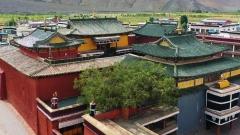
Among the most famous religious sites near the lake is Chiu Monastery.
Perched dramatically on a rocky hillside overlooking Lake Manasarovar, this ancient monastery offers some of the most spectacular panoramic views in Tibet.
The monastery is closely associated with Guru Rinpoche, also known as Padmasambhava, who is credited with introducing Buddhism to Tibet.
Visitors can explore meditation caves, prayer halls, and ancient shrines while enjoying sweeping views across the lake toward Mount Kailash.
For many travelers, Chiu Monastery becomes one of the most memorable highlights of their Lake Manasarovar journey.
Three Unsolved Mysteries Of Lake Manasarovar Today
Despite advances in modern science, several mysteries surrounding Lake Manasarovar remain unexplained.
The Strange Magnetic Phenomena
Many visitors have reported unusual behavior from electronic devices near the lake.
Compasses occasionally appear inaccurate, GPS signals may fluctuate, and some travelers describe intermittent disruptions to mobile devices.
Scientists have detected localized magnetic anomalies in the region, though no universally accepted explanation has emerged.
Local Tibetans often interpret these phenomena through spiritual beliefs, viewing the area as a powerful energy center connected to Mount Kailash.
The Curious “Compassionate Fish”
Lake Manasarovar is home to a unique species of high-altitude fish.
According to local observations, these fish behave differently from many freshwater species. They often appear unusually calm and do not aggressively feed near the surface.
This has inspired the local nickname “Compassionate Fish,” reflecting the peaceful character associated with the sacred lake.
Researchers continue to study the ecosystem, but certain aspects of the fishes’ behavior remain poorly understood.
The Mystery Of The Stable Water Level
Western Tibet receives relatively little annual rainfall, yet Lake Manasarovar has maintained a remarkably stable water level for centuries.
Under normal environmental conditions, lakes in such arid regions often shrink significantly due to evaporation.
Geologists suspect that underground water systems may continuously replenish the lake, but the full hydrological mechanism remains uncertain.
This balance between water loss and replenishment remains one of the lake’s most intriguing scientific mysteries.
How Travelers Can Experience The Mysteries Of Lake Manasarovar
While many of the lake’s legends remain unproven, visitors can still experience its extraordinary atmosphere firsthand.
Walk Along The Sacred Shoreline
A leisurely walk around parts of Lake Manasarovar allows travelers to appreciate its incredible tranquility.
The sapphire-blue water, distant snow-covered mountains, and endless Tibetan sky create a landscape unlike anywhere else on Earth.
Many visitors describe a profound sense of calm while simply sitting beside the lake and observing its changing colors throughout the day.
Meditate Beside The Holy Waters
Meditation has become one of the most meaningful activities for travelers visiting Lake Manasarovar.
The combination of high-altitude silence and breathtaking natural beauty creates an environment ideal for reflection and mindfulness.
Whether religious or not, many visitors find themselves deeply moved by the peaceful atmosphere.
Experience A Sacred Dip
Some pilgrims choose to enter the lake’s waters as part of a spiritual purification ritual.
The water is considered sacred by multiple religions and is believed to cleanse negative karma and bring blessings.
Because temperatures remain cold even during summer, many travelers prefer to touch the water, wash their hands, or collect a small amount to take home rather than fully immerse themselves.
Relax In Natural Hot Springs
Several natural hot springs can be found near Lake Manasarovar.
After completing the demanding Mount Kailash trek, soaking in these warm waters provides welcome relaxation for tired muscles while allowing travelers to enjoy the spectacular scenery.
Visit Chiu Monastery
For those interested in both culture and spirituality, Chiu Monastery offers one of the most rewarding experiences around the lake.
Its elevated position provides stunning photographic opportunities and a unique perspective on both Lake Manasarovar and Mount Kailash.
The monastery’s ancient atmosphere and spiritual heritage add depth to any visit.
More FAQs About Visiting Lake Manasarovar
Q1: What Is The Best Time To Visit Lake Manasarovar?
The most favorable period is generally from May to October when temperatures are milder, roads are more accessible, and weather conditions are relatively stable.
Many pilgrims also consider the Saga Dawa Festival period to be especially auspicious.
Q2: How Far Is Lake Manasarovar From Lhasa?
Lake Manasarovar is located approximately 1,200 kilometers west of Lhasa.
Because of the distance and high altitude, most international travelers visit as part of an organized Mount Kailash tour.
Q3: Do International Travelers Need Special Permits?
Yes.
International visitors require a Tibet Travel Permit and additional travel documents for western Tibet.
When booking through China Dragon Travel, the necessary permit arrangements can be handled as part of the tour process, making travel much smoother and more convenient.
Q4: Is Lake Manasarovar Safe To Visit?
Yes.
The lake is considered safe for travelers, provided that proper altitude acclimatization is observed.
A carefully planned itinerary that gradually ascends from Lhasa significantly improves comfort and safety.
Q5: Can I Visit Lake Manasarovar Without Trekking Mount Kailash?
Absolutely.
Although many travelers combine Lake Manasarovar with the famous Mount Kailash pilgrimage trek, it is entirely possible to visit the lake itself without completing the full kora.
Q6: Is The Water Really Drinkable?
Many pilgrims traditionally drink small amounts of Lake Manasarovar water because of its sacred significance.
However, international travelers should always follow guide recommendations and use appropriate precautions when consuming natural water sources.
Discover The Mysteries Of Lake Manasarovar With China Dragon Travel
Lake Manasarovar is far more than a beautiful alpine lake in western Tibet. It is a place where religion, mythology, history, nature, and mystery converge in extraordinary ways. Revered by Tibetan Buddhists, Hindus, Bon followers, and Jains alike, the lake has inspired countless stories of hidden wisdom, sacred blessings, lost treasures, and unexplained phenomena.
Whether you come to admire its crystal-clear waters, explore its ancient legends, meditate beside its peaceful shores, or combine your journey with the legendary Mount Kailash pilgrimage, Lake Manasarovar offers an experience unlike any other destination in Tibet.
With professionally organized Mount Kailash and Lake Manasarovar tours, experienced local guides, reliable transportation, and carefully planned acclimatization schedules, China Dragon Travel helps international travelers explore this sacred region safely, comfortably, and deeply. For those seeking one of Tibet’s most spiritual and mysterious destinations, Lake Manasarovar remains a journey that will stay with you long after you leave its shores.