
In Beijing, the Temple of Heaven ranks with the Forbidden City and the Great Wall as top landmarks. Many visitors know little about it, so this article covers its tickets, entrances and visiting time. Built in 1420, it was originally “Temple of Heaven and Earth” for imperial worship. Later renamed the Temple of Heaven, it hosted 654 heaven-worshipping ceremonies by 22 emperors. Covering 2.73 million square meters, it is four times larger than the Forbidden City. Listed as a World Cultural Heritage in 1998, it is hailed by UNESCO as the world’s largest and best-preserved heaven-worshipping ancient complex.
Ticket Types and Purchase Methods of the Temple of Heaven in Beijing
There are two types of tickets for the Temple of Heaven: general admission ticket and combined ticket. The general admission ticket only allows entry to the park for walking and viewing ancient trees, but not to the core attractions. The combined ticket includes the general admission ticket and tickets to the Hall of Prayer for Good Harvests, the Echo Wall and the Circular Mound Altar. These are the real highlights of the Temple of Heaven. First-time visitors are advised to buy the combined ticket directly.
Specific prices are as follows:
- Peak season (April 1 to October 31): General admission ticket 15 CNY, combined ticket 34 CNY.
- Off-season (November 1 to March 31 of the next year): General admission ticket 10 CNY, combined ticket 28 CNY.
- Discount: Seniors aged 60 and above and minors under 18 can enter for free with valid certificates.
- Purchase methods: Buy at on-site windows; queues may be long when there are many visitors, so it is recommended to arrive early.
Important reminder: Core attractions are closed on Mondays (except legal holidays). Avoid visiting on Mondays, otherwise you cannot enter the Hall of Prayer for Good Harvests, the Echo Wall and the Circular Mound Altar.
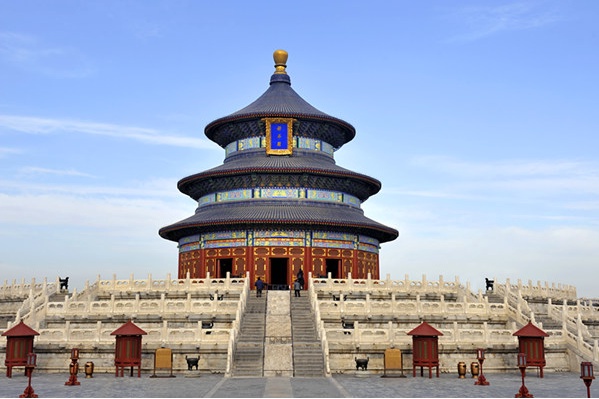
Temple of Heaven in Beijing
Opening Hours and Visiting Duration of the Temple of Heaven in Beijing
The opening hours of the Temple of Heaven are divided into two parts: the park gate and the internal core attractions. The park gate opens early and closes late:
- Peak season (April 1 – October 31): Park gate opens at 6:00, stops entry at 21:00, closes at 22:00.
- Off-season (November 1 – March 31 of the next year): Park gate opens at 6:30, stops entry at 21:00, closes at 22:00.
The opening hours of internal core attractions (Hall of Prayer for Good Harvests, Echo Wall, Circular Mound Altar) are calculated separately:
- Peak season: 8:00 – 18:00 (last entry at 17:30).
- Off-season: 8:00 – 17:00 (last entry at 16:30).
Night view: The Hall of Prayer for Good Harvests is lit up from 19:00 to 21:00 on Fridays, Saturdays and legal holidays. It can be viewed from a distance in the park, but the interior is not open.
Visiting duration: 1.5 hours for a casual visit. If you want to visit the three core attractions carefully, walk slowly along the central axis and take photos in the ancient cypress forest, it is recommended to set aside 3 to 4 hours.
Temple of Heaven in Beijing
Three Core Buildings to See in the Temple of Heaven in Beijing
The three most worthwhile buildings are all located on the north-south central axis. It is recommended to start from the Circular Mound Altar at the southern end, go north past the Imperial Vault of Heaven and the Echo Wall, and finally reach the Hall of Prayer for Good Harvests at the northern end.
Circular Mound Altar
The place where emperors worshipped heaven. The Circular Mound Altar is located at the southernmost end of the Temple of Heaven, a three-tiered white marble altar. Emperors held the grand heaven-worshipping ceremony here on the winter solstice every year. All design numbers of the Circular Mound Altar are related to the number “nine”– there are nine steps, and the number of stone slabs on each tier is a multiple of nine, because nine is the largest yang number, representing “heaven”. There is a round stone slab in the center of the Circular Mound Altar called the Heavenly Center Stone. Standing on it and speaking makes the voice particularly loud. This acoustic effect still exists today.
Special note: Admission to the Circular Mound Altar is included in the combined ticket. It is the most crowded near the closing time in the afternoon; it is recommended to visit in the morning.
Imperial Vault of Heaven and Echo Wall
Acoustic phenomena to experience. Walking north from the Circular Mound Altar leads to the Imperial Vault of Heaven, a round hall that enshrines the memorial tablet of the “Supreme Lord of Heaven”. The curved enclosure wall around it is the Echo Wall. Two people stand on the east and west sides of the wall respectively; one speaks softly with his back to the wall, and the sound can travel along the wall, which can be clearly heard by the person leaning against the wall on the other side. At present, guardrails have been installed along the wall for cultural relic protection, so direct contact is not allowed, but you can still feel the sound transmission effect standing nearby.
Special reminder: The actual size of the Echo Wall is smaller than most tourists imagine. The experience effect will be reduced when there are many visitors during peak season; it is recommended to go directly after opening at 8:00 in the morning.
Hall of Prayer for Good Harvests
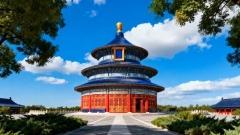
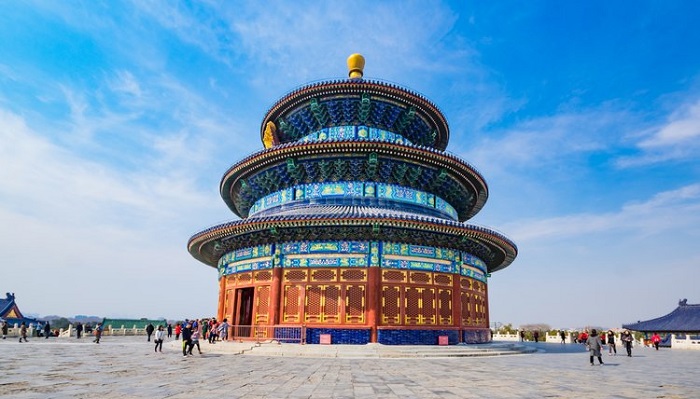
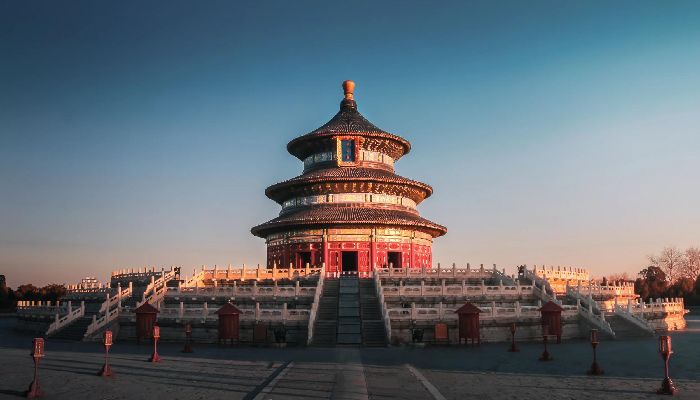
The landmark building of the Temple of Heaven. Walking across the Danbi Bridge leads to the Hall of Prayer for Good Harvests. This blue three-tiered domed hall is the most frequently seen image in various photos of the Temple of Heaven. The Hall of Prayer for Good Harvests is a pure wooden structure with no iron nails inside, supported by 28 huge wooden pillars that interlock with each other. The arrangement of these pillars is symbolic: the four central pillars represent the four seasons of a year, the 12 pillars in the second circle represent the 12 months, and the 12 pillars in the outermost circle represent the 12 two-hour periods of a day. The blue glazed tiles, red hall body and white marble railings of the Hall of Prayer for Good Harvests are in harmonious colors, suitable for shooting from all angles.
Photography tip: The light is strong from 10:00 a.m. to 2:00 p.m. It is recommended to visit right after opening in the morning or after 3:00 p.m., when the light is soft and the shooting effect is better.
Hall of Prayer for Good Harvests
Visiting Information and Highlights of the Divine Music Administration in the Temple of Heaven
Located on the southwest side of the outer altar of the Temple of Heaven, the Divine Music Administration is one of the five core architectural complexes of the Temple of Heaven. Built in the 18th year of Yongle in the Ming Dynasty (1420), it was the highest institution of ritual music and the core venue for practicing sacrificial ritual music in the Ming and Qing dynasties. The “Zhonghe Shao Music”it inherits is praised as the “Orthodox Sound of China”, and was selected into the fifth batch of the National Intangible Cultural Heritage List in 2021. On February 10, 2026, after systematic renovation and upgrading during the 14th Five-Year Plan period, the Divine Music Administration reopened to the public. The key visiting points are summarized as follows:
Exhibition Scale and Content
The exhibition includes a 1,500-square-meter immersive space and a 540-meter exhibition line, divided into four sections: “Orthodox Sound of China”, “Harmony of Eight Musical Sounds”, “Eight Yi Dances”and “Rhythmic Ensemble”. The “Orthodox Sound of China”section traces the historical context of Zhonghe Shao Music from the elegant music of the Zhou Dynasty to its naming in the early Ming Dynasty. The “Harmony of Eight Musical Sounds”section displays 16 kinds of musical instruments of eight categories: metal, stone, silk, bamboo, gourd, clay, leather and wood, with audio trial walls allowing visitors to experience the timbre of ancient music up close. The “Eight Yi Dances”section uses somatosensory interactive all-in-one machines and AI costume changing systems to let visitors simulate ancient ritual music dances and sacrificial costumes. The “Rhythmic Ensemble”section is equipped with a string pitch experimental device of the three-part division method and touchscreen music composition function, allowing visitors to touch the principles of ancient musical scales and create their own Shao Music.
Ticket Price
The ticket for the Divine Music Administration is 10 CNY, students can enjoy a half-price discount with valid certificates, not included in the general admission ticket or combined ticket of the Temple of Heaven.
Opening Hours
Implement peak and off-season opening hours. Off-season (November to March next year): 8:00 to 17:00, peak season (April to October): 8:00 to 18:00, closed every Monday.
Visiting Suggestion
It is recommended to set aside 1 to 1.5 hours. It is most convenient to enter from the west gate of the park to the Divine Music Administration. Avoid visiting on Mondays when it is closed. Please keep quiet during the visit, visit in a civilized manner, and protect the ancient buildings and cultural relics in the exhibition hall.
Practical Tips for Visiting the Temple of Heaven in Beijing
- Wear comfortable shoes. The Temple of Heaven covers a large area, and most areas require walking.
- Bring your own drinking water and a small amount of food. Shopping spots in the park may require queuing during peak season.
- Pay attention to sun protection. There are many open-air areas, and the sun is strong in summer.
- Carry your passport. You need to show it when purchasing and checking tickets.
- Arrive as early as possible. There are the fewest visitors right after opening at 8:00 in the morning, and the visiting experience is the best.
- Best photography time: 8:00 to 9:00 in the morning, or 4:00 to 5:00 in the afternoon.
Frequently Asked Questions About the Temple of Heaven in Beijing
Q: Can I store luggage at the Temple of Heaven?
A: Tourist service centers at each entrance provide paid luggage storage services, and the one near the east gate is the most convenient.
Q: Can I visit the Temple of Heaven and the Forbidden City in one day?
A: Yes, but the time is tight. It is recommended to visit the Forbidden City in the morning and go to the Temple of Heaven in the afternoon. It takes about 30 minutes by taxi or subway between the two places. Set aside at least 3 hours for the Temple of Heaven. If you have enough time, it is recommended to visit on separate days for a better experience.
Q: What catering options are there near the Temple of Heaven?
A: There are several Beijing-style restaurants outside the south gate of the Temple of Heaven, serving copper pot shabu-shabu, fried sauce noodles and other dishes. There are more choices outside the east gate and in Qianmen Street.
Q: Is photography allowed inside the Temple of Heaven?
A: Yes. Photography is allowed in all public areas, but please turn off the flash when visiting inside the halls.
Q: Is the Temple of Heaven suitable for the elderly and children?
A: Yes. The main roads are flat, and wheelchairs and strollers can be pushed. Accessible passages are set up in internal attractions.
A Few Details That Are Easy to Miss
The Temple of Heaven is straightforward once you’re inside, but the gap between a good visit and a frustrating one usually comes down to timing and ticket type. The three main structures – the Circular Mound Altar, Echo Wall, and Hall of Prayer for Good Harvests — run along a north-south axis, and walking them south to north makes the most sense historically and logistically. Get there when the gates open at 8am, avoid Mondays, and buy the through ticket rather than the park-only admission. That’s most of what you need to know.
If the Temple of Heaven is one stop on a longer Beijing itinerary that also includes the Forbidden City, Great Wall, or other sites, China Dragon Travel can help sequence your days and arrange transport between locations — particularly useful if you’re navigating the city without Mandarin and want the logistics handled in advance.