
Travel Guide for Chengdu Qingyang Palace: Visiting Sichuan’s First Taoist Temple
Keywords: Travel Guide for Chengdu Qingyang Palace, Must-know Information, Transportation, Attractions, Experiences, Tips
SEO Title: Travel Guide for Chengdu Qingyang Palace – A Guide to the First Taoist Temple in Sichuan
SEO Description: Planning to visit Qingyang Palace? This guide details in the travel guide to the Palace, including must-know information, transportation, attractions, and unique experiences, helping you experience Chengdu’s Taoist culture.
Chengdu Qingyang Palace was built in the Zhou Dynasty over 2,000 years ago. During the Tang Dynasty, Emperor Xizong used the palace as a temporary imperial residence and later renamed it Qingyang Palace. Mostly rebuilt during the Kangxi period of the Qing Dynasty, it covers 120,000 square meters. Qingyang Palace is renowned as the “First Taoist Temple in Western Sichuan” and is a key cultural site. The palace embodies Taoism, with ancient cypress trees reaching skyward, while outside gathers delicious food, making it an ideal place to experience Chengdu’s slow life. This guide details in the travel guide for Qingyang Palace, including must-know information, transportation, attractions, and unique experiences, ensuring you a smooth journey to this millennium Taoist Palace.
Must-Know Information for Chengdu Qingyang Palace
Visa Policy
China has implemented a unilateral visa-free policy for citizens of certain countries holding ordinary passports. Eligible visitors can enter China without a visa for stays of 15 to 30 days for tourism, business, family visits, or transit. Before departure, please confirm the latest visa policy with the Chinese embassy or consulate in your home country and ensure your passport meets the validity requirements.
Opening Hours
Qingyang Palace is open year-round. Summer opening hours are from 8:00 AM to 6:00 PM; winter hours are from 8:00 AM to 5:30 PM, with ticket sales stopping 10 minutes before closing. It is recommended to enter before 9:00 AM or after 3:00 PM, when there are fewer visitors and the light is better for photography. Please check the day’s announcements for last entry time; it is advisable to allow at least 1.5 to 2 hours for your visit.
Ticket Policy
Tickets for Qingyang Palace are only available for purchase at the offline ticket window, not online. International visitors must purchase tickets at the ticket window using their original passport. It is recommended to have 10 RMB in cash ready or ensure your mobile payment (WeChat Pay, Alipay) is activated. Most ticket window staff can communicate in Mandarin. It is advisable to have your passport and small change ready to speed up the purchase. Note that the ticket price does not include guide services; if you wish to learn more about Taoist culture in depth, you can inquire about guide services at the entrance.
Duration
A simple tour of the main halls within Qingyang Palace takes about 1.5 to 2 hours. If you plan to pray, burn incense, sit and drink tea, and take photos, allow about 3 hours. In spring, magnolias and plum blossoms bloom within the palace; in autumn, the ginkgo trees turn golden, offering beautiful scenery. Weekdays (Tuesday to Thursday) are generally less crowded than weekends and holidays. Early morning offers a peaceful atmosphere for Taoist morning lessons; rainy days provide a unique charm listening to the rain under the eaves.
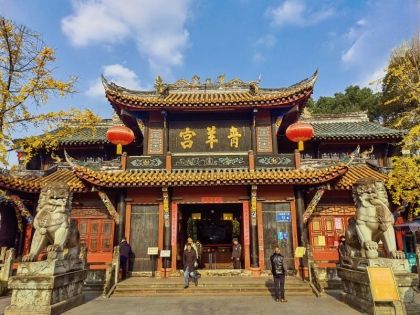
The Antique Qingyang Palace
Transportation to Chengdu Qingyang Palace
Metro
You can take Metro Line 4 or Line 5 to Qingyang Palace Station, exit from Gate C or Gate B, and walk about 3 minutes to arrive. The Metro is the most convenient way to reach Qingyang Palace, avoiding traffic jams, with signs guiding the way after exiting.
Bus
You can take buses 58, 109, 27, 5, 13, 43, 47, 64, 78, 163, etc., and get off at Qingyang Palace Station. The bus fare is 2 RMB, which is economical, and all routes support QR code payment via Alipay or WeChat.
Taxi and Ride-hailing
Traveling from Chengdu Shuangliu International Airport to Qingyang Palace takes about 40 minutes and costs about 50-60 RMB; from Tianfu International Airport, it takes about 70 minutes and costs about 100-120 RMB. Starting from the city center, the trip takes about 15 minutes and costs about 15-25 RMB. Traffic on the First Ring Road around Qingyang Palace is heavy on weekends and holidays; taking the subway is recommended as a priority.
Self-Driving
If you choose to drive to Qingyang Palace, you can navigate directly to the Qingyang Palace Parking Lot, whose entrance is on the west section of the First Ring Road. Qingyang Palace’s own parking spaces are very limited, with only a few internal spots open to the public, almost certainly full after 9:30 AM on holidays. If the parking lot is full, you can use nearby commercial parking lots. The First Ring Road is a major ring road in Chengdu, with slow traffic during morning (8:00-9:30 AM) and evening (5:00-7:00 PM) peak hours; try to avoid these times if driving. The reference parking fee is 5 RMB for the first hour, 2 RMB for each subsequent hour, with a daily maximum of about 20 RMB.
Attractions of Chengdu Qingyang Palace
Main Gate
The main gate of Qingyang Palace is a newly built structure, adorned with carved auspicious animals like dragons and tigers on the eaves and walls. The golden horizontal plaque reading “Qingyang Palace” hangs above the gate; this calligraphy dates back to the Qianlong period of the Qing Dynasty and is one of the palace’s precious cultural relics. Before entering the main gate, you can take photos here as a starting point for your visit.
Hunyuan Hall
Hunyuan Hall is the second major hall of Qingyang Palace, rebuilt during the Guangxu period of the Qing Dynasty, covering an area of 616 square meters, with 26 stone pillars and 2 wooden pillars. The pillars feature hollow carvings of deer, phoenixes gazing at the moon, and two lions playing with a ball. The hall enshrines Taishang Laojun (Laozi) in the center; the rear hall enshrines Guanyin Bodhisattva, making it the first stop to understand Taoist culture.
Bagua Pavilion
The Bagua Pavilion is located between Sanqing Hall and Hunyuan Hall. It is a landmark structure of Qingyang Palace, covering nearly 300 square meters. The pavilion’s base platform is square, while its body is circular, symbolizing the ancient concept of “a round heaven and a square earth.” It has double eaves with protruding corners and is surrounded by turtle-patterned doors and cloud-flower lattice windows. Take 15-20 minutes to appreciate it carefully.
Sanqing Hall
Sanqing Hall is the main hall of Qingyang Palace, first built in the Tang Dynasty, with a total area of 1,600 square meters and 36 large pillars. Eight wooden pillars represent the Eight Heavenly Kings of Taoism, while twenty-eight stone pillars represent the Twenty-Eight Mansions in the sky. The hall enshrines the highest Taoist deities: Yuanshi Tianzun, Lingbao Tianzun, and Daode Tianzun (Taishang Laojun). In front of Sanqing Hall are two bronze-cast goats, which are treasures of Qingyang Palace. The left one is a single-horned goat, and the right one is a double-horned goat; they are must-visit photo spots for tourists.
Doumu Hall
Doumu Hall was built in the Ming Dynasty and is the only surviving original Ming Dynasty structure in Qingyang Palace. The hall enshrines Doumu, a revered goddess in Taoism. Doumu has three eyes, four heads on her shoulders, and four arms on each side, making her a deity with three eyes, four heads, and eight arms. To Doumu’s right is the Queen Mother of the West (Xiwangmu), and to her left is Houtu (Goddess of the Earth).
Yuhuang Hall
Yuhuang Hall is located behind Doumu Hall; the new hall was built in 1995. The upper floor enshrines the Jade Emperor, a deity whose status in Taoism is second only to the Three Pure Ones. The front of the lower floor enshrines the Three Great Emperor-Officials, and the back enshrines the Great Emperor Ziwei of the North Star and the Great Emperor Zhenwu.
Tangwang Hall
Tangwang Hall is located in the rear garden of the Qingyang Palace complex and is the last significant structure in the palace. The hall features statues of Emperor Gaozu of Tang (Li Yuan) and his consort, and Emperor Taizong of Tang (Li Shimin). Emperor Xizong of Tang used Qingyang Palace as a temporary palace; after returning to the capital, he allocated funds for its expansion and issued an edict to change its name. Tangwang Hall was built to commemorate this history.
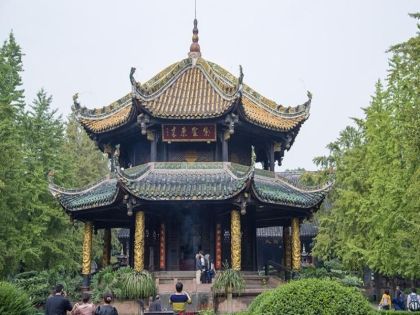
Qingyang Palace: A Holy Land for Blessing
Unique Experiences at Chengdu Qingyang Palace
Touching the Bronze Goats
The pair of bronze goats in front of Sanqing Hall are treasures of Qingyang Palace. The single-horned goat on the left embodies the characteristics of all twelve Chinese zodiac animals. It is said that touching the corresponding part of the bronze goat can cure ailments. Touching the goat for blessings is one of the most representative rituals at Qingyang Palace. There are often queues in front of the bronze goats; it is recommended to go before 9:00 AM or after 4:00 PM to avoid peak times.
Drawing Lots and Fortune Interpretation
Qingyang Palace is famous for its efficacious fortune-telling lots. After sincerely paying respects, silently contemplate your question in your heart, then draw a lot. Remember the number on the lot, return it to the container, and pay 20 RMB per lot. After receiving your fortune slip, go to the interpretation area on either side for free fortune telling. The fortune tellers will provide guidance based on your slip, offering a unique way to experience Taoist culture.
Tea Garden Inside the Palace
If you get tired from walking, you can sit in the tea garden inside the palace and order a bowl of covered tea. The minimum cost is about 15 RMB, and you can bring your own tea leaves. Sitting under the ancient cypress trees, watching the light smoke of incense, you can immerse yourself in the slow, quiet Taoist life within the bustling city of Chengdu. The tea garden also serves vegetarian meals daily from 11:30 AM to 2:00 PM, costing about 15 RMB per portion.
Viewing Plum Blossom
Qingyang Palace has several plum trees planted on its grounds. January to February is the best time to view the plum blossoms. In spring, magnolias and plum blossoms bloom; in autumn, the ginkgo trees turn golden, offering different beautiful scenes each season.
Tips for Visiting Chengdu Qingyang Palace
Etiquette
Please do not step on the threshold when entering halls, which is a traditional Taoist custom. Photography of the deities inside the halls is strictly prohibited, especially using flash. Maintain silence during your visit, avoid loud noise and horseplay, and set your phone to silent or vibrate mode. When prostrating, use the Taoist fist-and-palm salute (left hand over right fist), not the Buddhist palms-together gesture. Circumambulate pagodas or prayer wheels in a clockwise direction.
Photography
The Bagua Pavilion and the bronze goats in front of Sanqing Hall are the most popular spots for photos. The light is best and crowds are smallest before 10:00 AM. Photography of deities inside halls is strictly prohibited. The red walls of the Bagua Pavilion are suitable for portraits; wearing light-colored clothing is recommended for contrast with the red wall. To capture a panoramic shot of the Bagua Pavilion without people, arrive 10 minutes before opening and go there quickly as one of the first visitors.
Dressings
Qingyang Palace is a Taoist temple. When visiting, it is recommended to wear long pants or skirts that cover the knees, and avoid wearing sleeveless shirts, hot pants, or overly tight clothing. Chengdu summers are humid and hot; choose breathable materials like cotton or linen for long skirts or wide-leg pants, which are both cool and appropriate. Winters in the city are damp and cold, and most areas of the palace are outdoors; it is recommended to wear a down jacket or heavy coat, along with a scarf for warmth. The stone paths within the palace are worn from age, some sections are smooth, and they can be especially slippery when wet. It is recommended to wear sports shoes or flat shoes with good traction, avoiding leather shoes or high heels.
Seeking Taoist and the Slow Life of Chengdu
Qingyang Palace does not have the bustle of Wenshu Monastery or the solemn grandeur of Wuhou Shrine. It is more like a back garden hidden in the city center by the people of Chengdu. If you are traveling in Chengdu and have had your fill of Kuanzhai Alley and Jinli, consider spending half a day visiting Qingyang Palace. Here, you can experience the perfect blend of Taoist tranquility and the slow pace of Chengdu life, appreciating the depth of Taoist culture and the ingenuity of ancient artisans. It is not just a simple tour but a gentle encounter with a thousand years of Taoist tradition. Whether you seek peace and quiet, wish to pray for blessings, or want to deeply experience Chengdu’s vibrant yet leisurely atmosphere, Qingyang Palace will welcome every traveler from afar with its most composed demeanor.