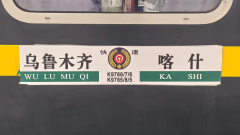

Traveling the Silk Road by train offers an immersive way to explore the historic route across China and Central Asia. From Xi’an and Dunhuang to Kashgar, Samarkand and beyond, travelers can experience ancient cities, desert landscapes, mountain scenery and diverse cultures along the way. This guide explains the main train options, popular routes, travel seasons and practical tips to help international visitors plan a comfortable Silk Road train journey.
Key Points
- Train travel offers a more immersive Silk Road experience by connecting major historical cities while allowing travelers to see deserts, mountains, grasslands and oasis landscapes along the way.
- Different train services suit different travel styles, from high-speed trains and overnight sleepers to premium tourist trains and selected international cross-border services.
- China provides the most extensive railway section of a Silk Road journey, with popular stops including Xi’an, Lanzhou, Zhangye, Jiayuguan, Dunhuang and Kashgar.
- Central Asia adds a different cultural dimension, with routes connecting travelers toward Kazakhstan, Kyrgyzstan, Uzbekistan, Turkmenistan and Tajikistan.
- The best train journey depends on your itinerary, comfort level and available time, so international travelers should plan routes, train bookings, accommodation and English-speaking support together.
Why Travel The Silk Road By Train?
The Silk Road is often imagined as a historic network of camel caravans crossing deserts between distant civilizations. Today, travelers can experience many of the same landscapes by railway, moving between ancient cities while watching the scenery change outside the window.
For international visitors, a Silk Road train journey offers something that flights cannot provide: a sense of geographical connection. Instead of simply arriving at Xi’an, Dunhuang, Kashgar or Samarkand, travelers can see how the landscape gradually changes from fertile plains to dry Gobi terrain, mountain ranges and Central Asian oases.
Train travel is also particularly practical for a long-distance Silk Road itinerary. Some journeys can be completed on daytime high-speed trains, while overnight sleeper trains allow travelers to cover longer distances without losing an entire day to transportation. For travelers who prefer a slower and more comfortable experience, premium tourist train concepts can turn transportation itself into part of the journey.
A well-designed Silk Road railway itinerary therefore does more than connect destinations. It becomes part of the travel experience.
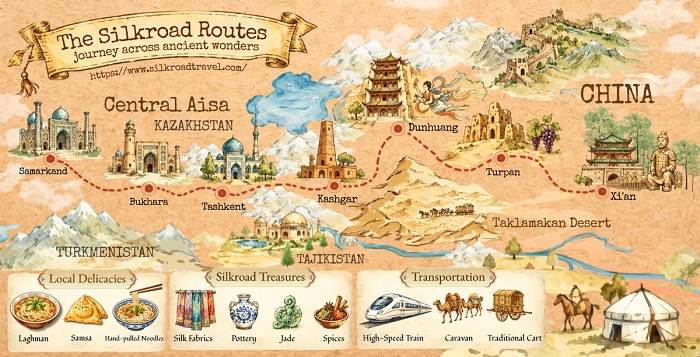
Routes for Silk Road Travel By Train
Where Can You Travel On The Silk Road By Train?
A modern Silk Road journey can combine destinations across China and Central Asia, although the exact railway connections and border procedures depend on the itinerary and current train schedules.
The Chinese section is particularly well suited to rail travel. A classic westbound route can begin in Xi’an, one of China’s most important ancient capitals, before continuing through destinations such as Lanzhou, Zhangye, Jiayuguan, Dunhuang and Kashgar.
Each destination represents a different chapter of Silk Road history. Xi’an is associated with the ancient eastern gateway of the Silk Road, while Zhangye is known for its colorful Danxia landscapes. Jiayuguan preserves one of the most famous western sections of the Ming Great Wall, and Dunhuang is home to the renowned Mogao Grottoes and the desert scenery around Crescent Spring. Farther west, Kashgar provides a gateway to the cultures and landscapes of China’s far-western region.
Beyond China, Silk Road travel can continue into Central Asia. The region traditionally associated with the modern Silk Road includes Kazakhstan, Kyrgyzstan, Uzbekistan, Turkmenistan and Tajikistan, each offering its own combination of history, architecture, landscapes and cultural traditions.
For many international travelers, cities such as Tashkent, Samarkand and Bukhara are particularly important stops. Samarkand’s Registan Square, the Gur-e-Amir Mausoleum and other historic monuments reveal the architectural legacy of the medieval Silk Road, while places such as ancient Merv in Turkmenistan offer a very different perspective on the civilizations that once flourished along these trade routes.
A multi-country Silk Road trip does not necessarily mean taking one continuous train from Xi’an to every destination. In practice, a successful itinerary usually combines different railway services with private transportation, domestic flights or border transfers where necessary.

Main Train Types For Silk Road Travel
There is no single “Silk Road train” that works for every traveler. Different railway services provide different levels of speed, comfort, privacy and flexibility.
High-Speed Express Trains
China’s high-speed railway is particularly useful for travelers who want to cover long distances efficiently while keeping more time for sightseeing.
High-speed trains are generally most suitable for daytime journeys between major cities. They offer comfortable seating, relatively short travel times and a convenient way to connect different sections of a China Silk Road itinerary.
For example, instead of spending an entire day on the road between major Chinese destinations, travelers can use high-speed rail where available and reserve more time for historical sites, local markets and cultural experiences.
For international visitors with limited vacation time, this can make it easier to include several destinations without turning the journey into a transportation-heavy trip.
Regular Overnight Sleeper Trains
Overnight sleeper trains provide a very different experience. Rather than focusing purely on speed, they allow travelers to travel while sleeping and wake up in another part of the country.
They are particularly useful for long-distance journeys where a daytime train would take many hours. Depending on the service, travelers may choose different sleeper arrangements, with private or more comfortable options generally costing more than standard berths.
For backpackers and travelers who enjoy a more traditional railway experience, overnight trains can also add an element of adventure to the Silk Road journey.
The main advantage is efficiency: a night on the train can replace both a long daytime transfer and one hotel night.
Premium Luxury Silk Road Tourist Trains
Luxury train travel approaches the Silk Road from a completely different perspective. Instead of treating the train simply as transportation, premium tourist trains can make the railway journey itself part of the holiday.
These services may offer more comfortable cabins, dining facilities, organized excursions and additional onboard services. They are particularly suitable for travelers who prefer a slower pace, families looking for convenience, private groups and travelers who want a more comfortable overland experience.
Availability, routes and operating schedules can vary considerably, so luxury train travel should be planned around the specific service available for the desired travel dates rather than assumed to operate on every Silk Road route.
Cross-Border International Trains
International railway services can add another dimension to a Silk Road journey by connecting parts of China and Central Asia.
For travelers interested in a genuine multi-country overland adventure, crossing borders by train can feel very different from flying between countries. However, international train services are more dependent on current schedules, border procedures and operational conditions than domestic rail travel.
This means travelers should check the latest service information before building an itinerary around a particular international train.
In many cases, the most practical Silk Road journey uses trains as the backbone of the route while combining them with road transfers and other transportation when required.
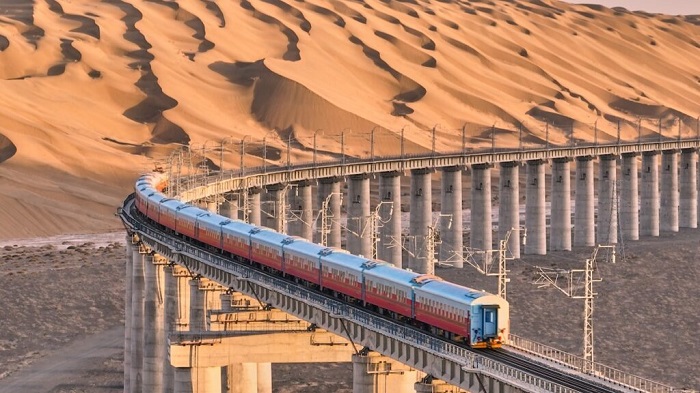
Silk Road New Luxury Train
Train Vs Flight: Which Is Better For The Silk Road?
Flights are often the fastest way to move between distant destinations, but speed comes with a trade-off. Much of the geographical experience disappears when travelers fly over the landscape.
A train journey allows you to watch the environment change gradually. Green agricultural areas can give way to dry desert landscapes, mountain ranges and vast open terrain. For a journey built around the idea of the Silk Road, that transition is part of the attraction.
Flights remain useful when the distance is extremely long or when railway connections are inconvenient. The two transportation methods do not have to compete with each other; a well-planned itinerary can use trains for scenic and culturally important sections while using flights where they save significant time.
Train Vs Private Car For The Silk Road
Private cars offer flexibility, particularly in remote areas where railway stations are far from attractions. Travelers can stop for photographs, visit smaller villages and adjust the route according to weather and local conditions.
The disadvantage is the amount of time spent on the road. Long-distance driving through desert and remote regions can be tiring, and international visitors may also face additional challenges related to navigation, language, road conditions and driving regulations.
For long intercity journeys, trains provide a more relaxed way to travel. A private vehicle can then be used for sightseeing around destinations where railways cannot reach.
This combination is often more practical than choosing only one form of transportation.
Train Vs Bus For The Silk Road
Buses can be useful for shorter regional transfers, but long-distance bus journeys may be less comfortable, particularly for older travelers, families with children or visitors who are not accustomed to extended road travel.
Trains generally provide more space to move around and a more stable environment for long journeys. Overnight sleeper trains can also eliminate the need to spend an entire day sitting on a bus.
For a multi-week Silk Road trip, combining trains for major intercity travel with private vehicles or buses for local sightseeing can provide a better balance between comfort and flexibility.
Best Time For A Silk Road Train Journey
Spring and autumn are generally the most comfortable seasons for exploring the Silk Road, particularly if the itinerary includes both China and Central Asia.
Spring brings pleasant temperatures and fresh landscapes to many regions, although conditions can vary significantly from east to west. Autumn is also attractive, with cooler temperatures and changing colors in some areas.
Summer can be extremely hot in parts of the Silk Road, especially in desert and low-altitude areas. Winter, meanwhile, can bring severe cold and challenging weather in northern China and parts of Central Asia.
Because the Silk Road covers such a large geographical area, there is no single perfect month for every destination. Your route should determine the travel season rather than choosing a date based on one city alone.

What To Pack For A Silk Road Train Journey
Temperature differences are one of the most important things to consider when packing for a Silk Road trip.
Layered clothing is more practical than relying on one heavy jacket. A comfortable base layer, light outer layer and warmer jacket allow travelers to adapt to changing conditions between cities and during early-morning or nighttime transfers.
Sunscreen, sunglasses and a hat are useful for desert and high-exposure areas. Travelers should also carry enough drinking water during long journeys and remote excursions.
For overnight trains, comfortable clothing and a light jacket can make the journey more pleasant, particularly if temperatures change during the night.
Comfortable walking shoes are also essential. A Silk Road itinerary often involves ancient city centers, archaeological sites, desert landscapes and historical monuments where travelers may spend several hours walking.

Silk Road Group Tour: Camel Riding
How To Choose Your Train Accommodation
The right cabin or seat depends mainly on the length of the journey.
For short daytime journeys, standard seats on high-speed trains are usually sufficient. The priority is convenience and getting to the next destination quickly.
For overnight journeys, a sleeper is more practical because it allows travelers to rest while covering a long distance. Travelers who value privacy and comfort should consider higher-level sleeper arrangements when available.
Luxury tourist trains are a separate category, where the accommodation is part of the overall travel experience rather than simply a place to sleep.
International travelers should also consider luggage. A large suitcase may be manageable on some services but less convenient on crowded trains or during multiple transfers. Packing efficiently can make a noticeable difference on a multi-stop Silk Road journey.
Silk Road Train Photography Tips
One of the great advantages of train travel is the constantly changing landscape outside the window. However, photography from a moving train requires some planning.
For desert and mountain scenery, try to choose a window seat with a clear view and avoid traveling only during the darkest hours when the most scenic sections of the route may pass unnoticed.
Gobi landscapes, snow-covered mountains, grasslands and oasis areas can all appear along different parts of a journey. Morning and late-afternoon light can create more depth in the landscape, although the best side of the train depends on the specific route and direction of travel.
Rather than relying on a fixed rule such as always choosing the right-hand side, check the actual route, direction and major landscape sections before departure.
A smartphone can capture excellent images through a clean train window, but a camera with a fast shutter speed can help reduce motion blur when photographing from a moving train.
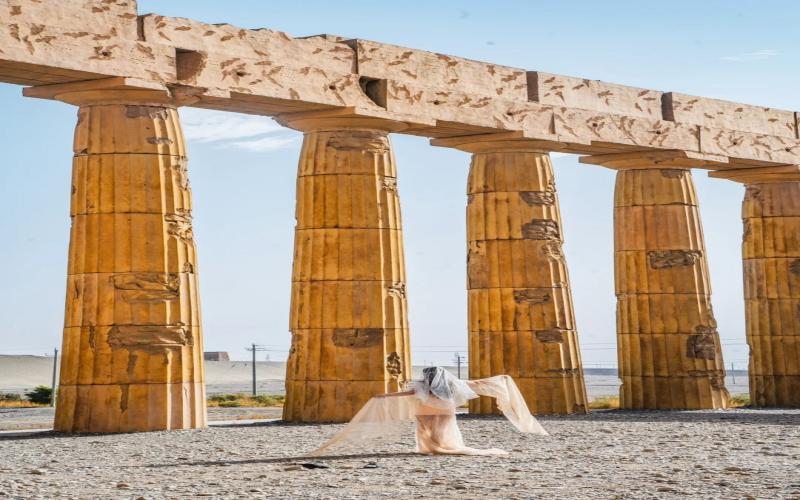
Silk Road Heritage City
Practical Advice For International Travelers
A Silk Road railway journey requires more planning than a simple city-to-city vacation because it may involve multiple languages, railway booking systems, border crossings and different transportation networks.
International travelers should confirm passport and visa requirements for every country included in the itinerary. Entry requirements are separate from railway arrangements, and requirements can change according to nationality and travel dates.
Train tickets should also be booked according to the actual route rather than assuming that seats or sleeper berths will always be available. Popular periods can have stronger demand, particularly when a journey includes several consecutive train segments.
English-speaking travel support can be particularly useful for first-time visitors. Assistance with train bookings, station transfers, hotel arrangements, local transportation and itinerary coordination can make a complicated multi-country journey considerably easier.
For remote destinations, it is also important to remember that the railway station may not be located close to the attraction itself. A train journey is only one part of the route; the final connection by car, private transfer or local transportation may need to be arranged in advance.
How To Plan A Silk Road Train Itinerary?
The best approach is to design the journey around destinations first and transportation second.
Start by deciding which historical cities and landscapes are most important to you. A traveler interested in Chinese history may focus more heavily on Xi’an, Zhangye, Jiayuguan and Dunhuang. Someone interested in Central Asian architecture may prioritize Samarkand, Bukhara and Tashkent.
Next, identify which sections are most suitable for high-speed rail, overnight trains or private transportation. There is no need to force every part of the trip onto a train simply because the journey is called a Silk Road train tour.
Finally, allow enough time for sightseeing. One of the biggest mistakes on a long overland itinerary is spending too much time moving between destinations and too little time actually experiencing them.
A well-designed Silk Road journey should balance transportation, historical sites, local culture, scenery and rest.

Why Travel The Silk Road With China Dragon Travel?
Planning a multi-country Silk Road journey can involve far more than purchasing train tickets. Routes may combine rail travel, private transfers, hotels, sightseeing, border arrangements and English-speaking guides, making local coordination especially valuable for international travelers.
China Dragon Travel provides customized travel arrangements for international visitors who want to explore the Silk Road with a combination of rail travel and local transportation. With more than 25 years of travel experience, the company focuses on carefully designed itineraries, local travel support and flexible arrangements rather than forcing travelers into a fixed route.
The service can be tailored around different travel styles, including private journeys and carefully selected tours. There are no forced shopping stops, allowing travelers to use their time for sightseeing and cultural experiences. English-speaking support and 24/7 assistance are also available for travelers who need help before or during their journey.
If you are planning a Silk Road adventure by train, the most suitable itinerary will depend on your travel dates, preferred destinations, budget and desired level of comfort. Contact China Dragon Travel to create a customized Silk Road train journey combining China’s historic cities, Central Asian heritage and the landscapes between them.
Frequently Asked Questions About Silk Road Train Travel
Can You Travel The Silk Road Entirely By Train?
Not necessarily. Train travel can form the backbone of a Silk Road itinerary, but a practical route may also require private vehicles, buses, flights or border transfers. Railway networks and international services do not connect every historical destination directly.
Is Train Travel Suitable For International Tourists?
Yes. Trains can be particularly convenient for international visitors traveling between major cities, especially where high-speed rail or overnight sleeper services are available. However, first-time visitors may benefit from assistance with ticket booking, station transfers and route planning.
Which Countries Can Be Included In A Silk Road Train Journey?
A modern Silk Road itinerary can include China and Central Asian countries such as Kazakhstan, Kyrgyzstan, Uzbekistan, Turkmenistan and Tajikistan. The exact combination depends on current transportation connections, border requirements and the traveler’s interests.
Are Overnight Trains Comfortable?
Comfort depends on the specific train and accommodation category. Sleeper trains are designed for long-distance travel and allow travelers to rest while moving between destinations, while higher-level cabins generally provide greater privacy and comfort.
What Is The Best Season For A Silk Road Train Tour?
Spring and autumn are generally comfortable periods for many Silk Road destinations. However, because the route crosses a very large geographical area, the ideal travel period depends on the specific countries and cities included in your itinerary.
Should I Choose A Train Or A Flight?
Use trains when the journey itself is part of your travel experience and you want to see the landscape between destinations. Flights can be more practical when distances are very long or when railway connections are limited. A combination of both can often create a more efficient Silk Road itinerary.
Experience The Silk Road As A Journey, Not Just A Destination
A Silk Road train journey allows modern travelers to experience the enormous geographical and cultural diversity behind one of the world’s most famous historical trade routes. From Xi’an and Dunhuang to Kashgar and onward toward Central Asia, the journey can combine ancient cities, desert landscapes, mountain scenery, Islamic architecture, archaeological sites and living local cultures.
The key is not to search for one “perfect” Silk Road train. Instead, build an itinerary around the places you want to experience and use different forms of transportation where they make the most sense. High-speed trains can save time, sleeper trains can turn long transfers into part of the adventure, and private transportation can connect railway stations with destinations that trains cannot reach.
For international travelers, thoughtful planning makes the difference between simply moving across the Silk Road and actually experiencing it. With the right route, train services, local guides and transportation support, the railway can become one of the most memorable parts of the journey itself.