
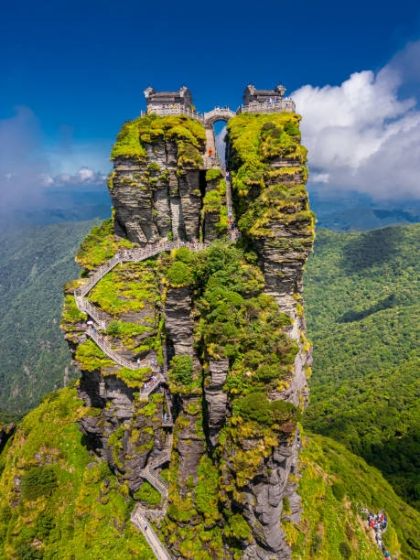
Deep within the Wuling Mountains of Tongren, in northeastern Guizhou Province, a solitary stone pillar rises abruptly into the heavens, appearing almost detached from the earthly realm below. This is Mount Fanjingshan, a UNESCO World Heritage site and one of China’s five sacred Buddhist mountains. Geologically, Fanjingshan is a fascinating “ecological island.” While the surrounding region is dominated by classic Karst formations, Fanjingshan stands apart as an ancient metamorphic rock mass. After hundreds of millions of years of wind and water erosion, nature has sculpted this isolated, ethereal “Castle in the Sky.” Piercing through the rolling sea of clouds to gaze upon the golden spires perched precariously on sheer, thousand-meter cliffs, you will immediately see why ancient pilgrims revered this sanctuary as the sacred bodhimanda of the Maitreya Buddha.
The absolute pinnacle of any journey to Fanjingshan is the Red Clouds Golden Summit (New Golden Summit). This vertical lonely finger of rock shoots up nearly one hundred meters from the ridge line. Most unbelievably, the summit is split cleanly in two by a deep glacial fracture known as the Golden Sword Gorge, with the two sides reconnected only by a narrow stone flyover bridge. Perched atop these twin spires are the Sakyamuni Temple and the Maitreya Temple. The two shrines face each other across the abyss, appearing and disappearing as the mountain mists drift by. To reach the top, adventurers must hold fast to iron chains and scramble up a nearly vertical rock face using both hands and feet. At sunrise and sunset, the peak is frequently enveloped in a radiant, scarlet mist—the phenomenon that gave the summit its poetic name. Standing on this bridge suspended 500 meters above the valley, watching the endless waves of clouds crash below, offers a mystical, martial-arts-epic experience unmatched by any other mountain range on Earth.
Beyond the jaw-dropping thrills of the Golden Summit, the Mushroom Stone serves as the iconic geological emblem of the mountain. Standing roughly ten meters tall, this bizarre rock formation is wide at the top and narrow at the bottom, perfectly resembling a giant mushroom that has stood defiantly against the elements for over a billion years. It is a masterpiece of differential weathering—the upper and lower rock strata possess varying degrees of resistance to erosion, leaving a monument that looks perpetually on the verge of tumbling over yet remains utterly unshakable. Surrounding this landmark is the Ten Thousand Books (Wanjuanjiu) formation, where layered strata of shale are piled neatly like an ancient, wordless library left by nature to record the primeval shifts of oceans and continents.
The allure of Fanjingshan extends far beyond its jagged peaks; it is also a massive genetic reservoir of wild flora and fauna. The mountain is the sole habitat of the Guizhou snub-nosed monkey, an endangered species affectionately called the “only child of the Earth,” with only a few hundred individuals remaining in the wild. As you traverse the mountain boardwalks or ride the Fanjingshan Cableway, you fly over a perfectly preserved subtropical primitive forest filled with ancient plant species like the Chinese dove tree. This dense, vibrant greenery blends with the high-altitude monoliths, mystical optical illusions like the “Buddha’s Light,” and the historic Chengen Temple nestled quietly in the saddle between the ridges. The temple’s red walls and gray tiles add a profound layer of human serenity to this wild, natural wonder.
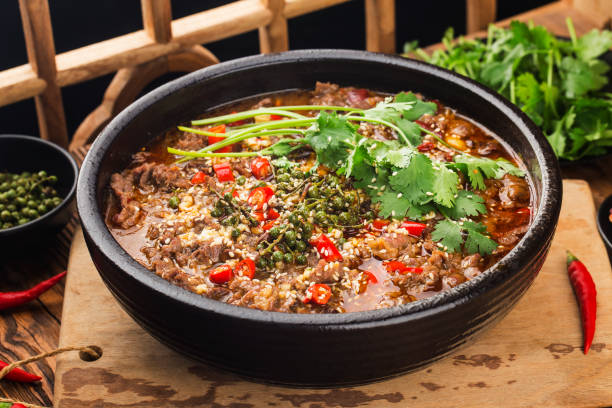
No expedition is complete without savoring the local culinary flavors. The dining culture of the Tongren region is a rich fusion of Miao, Dong, and Tujia minority traditions. At the foot of the mountain in Jiangkou County, the absolute must-try delicacy is Jiangkou Dried Tofu. Made with pure mountain spring water and premium soybeans, it is baked using traditional methods to create a dense, chewy texture. Whether torn by hand as a quick snack or stir-fried with local cured bacon, it bursts with smoky, savory goodness. Another favorite is Mi Doufu (Rice Tofu), a smooth rice-jelly cut into strips and tossed with local chili oil, pickled radish, roasted peanuts, and a secret savory sauce—offering a refreshing, spicy kick to rejuvenate hikers after a long climb. For dinner, a steaming pot of Qianjiang Sour Soup Beef features tender highland beef simmered in a red broth naturally fermented from wild tomatoes, perfectly driving away the high-altitude chill.
For travelers mapping out their journey, Fanjingshan offers two primary routes: the Jiangkou (East Route) and the Yinjiang (West Route). The vast majority of international travelers choose the East Route, which features convenient sightseeing shuttle buses and a world-class cableway system. This option allows you to soar effortlessly over the forest canopy, saving your stamina for the demanding vertical climb up the Golden Summit. The West Route, by contrast, is an all-walking trail suited for seasoned hikers wishing to see the untouched wilderness. Given the mountain’s volatile alpine climate, conditions can shift from clear skies at the base to a torrential downpour at the summit in minutes; packing windproof, warm layers and wet-weather gear is highly recommended.
Mount Fanjingshan is a destination that profoundly stirs both the body and the spirit. Through a billion years of solitary geological patience, it has carved an unparalleled sanctuary in the clouds. Standing atop its highest peak, watching the sky transform over a turbulent sea of white fog while the distant bells of Chengen Temple echo through the wind, you realize that this journey through the clouds is more than an eco-adventure—it is a pilgrimage to find an enduring inner peace.