
Flying into Tibet isn’t quite like flying anywhere else, and that’s largely thanks to the airline that built its entire identity around making it possible: Tibet Airlines, now officially known as Xizang Airlines. For travelers researching how to reach Lhasa or get around the Tibetan Plateau by air, understanding what makes this airline different, and how to book with it as a foreign visitor, can make trip planning considerably smoother. Here’s a complete look at the airline, from its specially engineered aircraft to its route network, baggage rules, and booking process.
What Is Tibet Airlines and Why Is It Unique
Tibet Airlines holds a distinction no other airline in the world can claim: it is China’s first, and the only, airline in the world based entirely at high-altitude airports across the Qinghai-Tibet Plateau. The carrier was founded in 2010, and its very first flight took off in 2011, connecting Lhasa with Ngari, one of the most remote regions on the plateau. The airline is headquartered in Lhasa itself, with a major operational hub in Chengdu and a newer base recently established in Xi’an.
What sets Tibet Airlines apart isn’t just its location, it’s the fact that operating safely and reliably at these altitudes requires fundamentally different engineering than standard commercial aviation. Building an airline around this challenge from day one is precisely what has made Tibet Airlines such a specialized player in China’s aviation industry.
Ownership and corporate structure. Tibet Airlines operates as a mixed-ownership enterprise, reflecting both regional government interests and major aviation industry backing. The largest shareholder is Tibet Autonomous Region Investment Co., Ltd., holding a 51% stake, while Air China holds 31%, with the remainder split between two additional shareholders. This partnership with Air China runs deeper than ownership alone. Since 2013, Tibet Airlines has been part of Air China’s PhoenixMiles frequent flyer program, allowing passengers to earn and redeem miles across both carriers.
Tibet Airlines
The Fleet and Technology Behind High-Altitude Flying
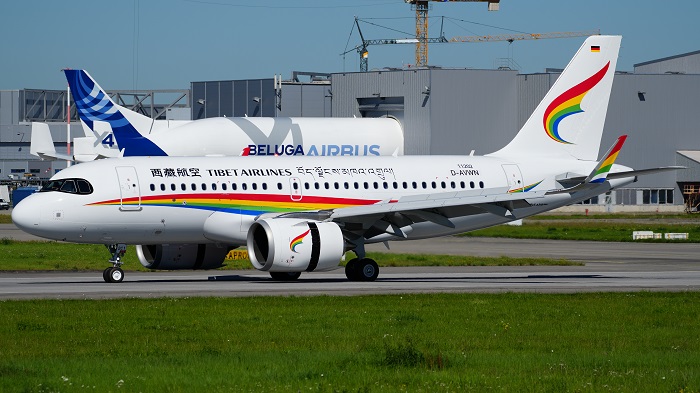
As of June 2025, Tibet Airlines operates a fleet of approximately 47 aircraft, including 27 Airbus A319 aircraft, 9 Airbus A319neo aircraft, 6 Airbus A320 aircraft, and 5 Airbus A330 aircraft. Every single A319 in the fleet has been specially modified to handle the demands of high-altitude flight safely, a level of customization that sets Tibet Airlines apart from carriers operating at standard elevations.
Looking ahead, the airline has signed agreements to add 40 high-altitude versions of the COMAC C919 along with 10 high-altitude ARJ21 aircraft, a significant expansion that should increase capacity on existing routes and potentially open up new ones in the years ahead.
Engineering Designed for Thin Air
Flying in and out of airports situated thousands of meters above sea level isn’t something a standard commercial aircraft can simply be repurposed for. Tibet Airlines’ modified Airbus A319 and A319neo fleet includes several features specifically engineered for these conditions.
Modified engine thrust and brake cooling systems help aircraft take off and land safely despite the thinner air and the unique demands of high-altitude runways. Enhanced supplemental oxygen systems, including upgraded cabin pressurization and additional emergency oxygen supplies, are built in to support passenger comfort and safety throughout plateau flights. The aircraft also rely on RNP AR satellite navigation technology, a precision system that allows pilots to navigate accurately through the mountainous terrain and narrow valleys surrounding many Tibetan airports, where traditional navigation approaches would be far less reliable.
Brand Identity and Milestones
Tibet Airlines’ visual identity reflects the culture it serves. Its logo weaves together elements of the traditional Tibetan hada, the ceremonial white scarf offered as a gesture of respect and goodwill, alongside prayer flags and wing imagery, blending Tibetan tradition with the language of aviation. The airline’s slogan, “Travel with Peace of Mind, Enjoy a Comfortable Journey,” captures the reassurance it aims to offer travelers navigating an unfamiliar and demanding flying environment.
Since launching, the airline has notched several firsts within China’s aviation industry: the first airline based at high-altitude plateau airports, the first to operate a high-altitude plateau route as its inaugural flight, the first to use RNP technology from its very first flight, and the first to establish regular night flights into Lhasa, a particularly notable achievement given how challenging nighttime mountain flying can be.
Routes and Destinations Across the Network
Tibet Airlines now operates 106 routes in total, including 59 high-altitude plateau routes, connecting passengers to 63 destinations. Its network breaks down into three broad categories: flights within the Tibet Autonomous Region, flights connecting major Chinese gateway cities to Lhasa, and additional domestic routes that don’t directly touch Tibet.
Routes Within the Tibet Autonomous Region
For travelers exploring multiple regions of Tibet, two domestic routes stand out as the most heavily used. The Lhasa–Ngari route operates roughly three flights per day, with a flight time of around one hour and fifty minutes, and one-way fares typically landing near US$450. The Lhasa–Chamdo route runs about two flights daily, taking approximately one hour and fifteen minutes, with fares generally around US$300.
Gateway City Routes to Lhasa
This is the route category most relevant to international travelers, since it covers the connections used to actually reach Lhasa from major Chinese hubs. Tibet Airlines offers daily direct service from numerous gateway cities, and frequency varies considerably depending on the route.
The busiest connection by far is Chengdu to Lhasa, with around ten flights per day and a flight time of roughly two hours, typically priced near US$150. Xi’an to Lhasa runs two to three flights daily at about two hours and twenty minutes, with similar pricing around US$150. Xining to Lhasa offers three daily flights at roughly two hours for about US$200, while Chongqing to Lhasa runs twice daily at around three hours for approximately US$250.
Beijing to Lhasa, the longest of the major gateway routes at around four hours, operates once daily with fares closer to US$400. Kunming to Lhasa runs once daily at about three hours for roughly US$150, and Shanghai to Lhasa, one of the longer routes at around six hours, also operates once daily near US$300. Rounding out the network, Guiyang to Lhasa offers one daily flight at around three hours for about US$160, while Guangzhou to Lhasa, the longest connection at roughly seven hours, runs once daily for approximately US$300.
Domestic Routes Beyond Tibet
Tibet Airlines also maintains a broader domestic network connecting major Chinese cities that aren’t directly tied to Tibet itself, including popular leisure and business routes such as Xi’an to Dali, Xi’an to Lijiang, Xi’an to Hangzhou, Mianyang to Nanjing, Chongqing to Dali, and several Chengdu connections to destinations like Sanya, Shanghai, Dali, Shenzhen, Xiamen, and Kunming. These routes range from roughly ninety minutes to three hours in duration, with fares generally falling between US$100 and US$180, and frequencies ranging from a single daily flight up to nine flights per day on the busiest Chengdu–Shenzhen corridor.
Tibet Airlines
Cabin Classes and Baggage Allowance
Tibet Airlines runs a two-cabin setup across its Airbus A319-115(WL), A319-153N, A320-214(WL), and A330-243 aircraft, offering Business Class and Economy Class. Business Class is arranged in a roomy 2-2 layout on the A319 and A319neo fleet, and passengers in this cabin enjoy priority check-in, lounge access at major hubs including Chengdu and Lhasa, upgraded meal service, and a more personalized experience overall.
Economy Class follows a standard 3-3 configuration, with complimentary meals or snacks and beverage service included. The newer A319neo cabins benefit from improved noise-reduction technology, making the experience noticeably quieter during flights across the plateau’s often turbulent mountain air.
Seat counts vary by aircraft type. The A319 offers 8 Business Class seats alongside 120 Economy seats, while the A320 carries 8 Business seats and 150 Economy seats. The larger A330 provides 12 Business Class seats and 267 Economy seats, split between 32 Premium Economy and 235 standard Economy seats.
Understanding Baggage Limits
Because high-altitude takeoffs are especially sensitive to aircraft weight, Tibet Airlines enforces baggage allowances more strictly than many carriers operating at lower elevations, and check-in counters apply these limits consistently.
Business Class passengers receive a free checked baggage allowance of 30 kg total, along with two carry-on pieces weighing up to 7 kg each. Carry-on bags must not exceed 55 by 40 by 20 centimeters, while checked baggage is capped at 100 by 60 by 40 centimeters. Economy Class passengers are allotted 20 kg of free checked baggage in total, plus a single carry-on piece up to 7 kg, with the same size restrictions applying to both carry-on and checked items.
One detail worth noting: infant tickets, covering passengers under two years old traveling without a designated seat, do not come with a free checked baggage allowance. Any weight exceeding the limit for your ticket class will incur an excess baggage fee, calculated per kilogram based on local civil aviation regulations and a percentage of the ticket price.
How to Book Tibet Airlines Flights
International travelers generally have three paths available when booking Tibet Airlines flights.
Booking through the official website. The airline’s official site, found at www.airxizang.com, along with its 24-hour service line, offers direct booking access. However, this option isn’t particularly practical for most international travelers, since the website operates only in Chinese, which can make the process confusing without language support.
Booking through consumer travel platforms. Third-party platforms such as Trip.com offer an English-language alternative, allowing travelers to search by departure city and destination and select Tibet Airlines directly from available results. Since pricing and discounts can vary noticeably between platforms, it’s generally worth comparing a few options before finalizing a booking.
Booking through a licensed travel agency. For most international visitors, working with a specialized Tibet travel agency turns out to be the simplest and most reliable route. A knowledgeable local agency can secure Tibet Airlines tickets at competitive local pricing while also handling the broader logistics of a Tibet trip.
This matters because of a critical requirement: anyone flying from a Chinese gateway city into Lhasa needs a valid Tibet Travel Permit to board the flight, and this permit cannot simply be obtained independently online. TibetYulong, with extensive experience arranging travel across the region, regularly assists international travelers in securing both their Tibet Travel Permits and their Tibet Airlines tickets as part of a complete tour package, removing much of the administrative complexity that can otherwise complicate a Tibet trip.
Practical Tips for Flying Tibet Airlines
Double-check your baggage allowance. Given how strictly weight limits are enforced on high-altitude routes, it’s worth reviewing your ticket class allowance carefully before heading to the airport. Packing light, or weighing bags in advance, can save both time and unexpected fees at check-in.
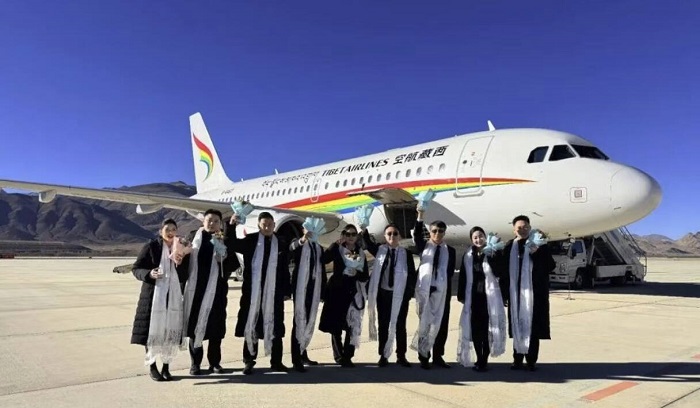
Take in the cultural experience onboard. Tibet Airlines leans into showcasing Tibetan culture throughout the flight experience itself. In-flight announcements are typically delivered in Mandarin, Tibetan, and English, and on major routes into Lhasa, some cabin crew are local Tibetans able to assist English-speaking travelers directly. Meal service can also include regional specialties such as highland barley snacks, Tibetan sweet tea, or yak milk yogurt, offering a small taste of Tibetan culture before passengers even land.
Consider booking morning flights. Lhasa Gonggar International Airport sits in mountainous terrain where weather conditions can shift quickly, particularly in the afternoon when winds tend to pick up. Choosing an earlier departure can reduce the likelihood of weather-related delays affecting your travel schedule.
Keep your documents ready. Travelers flying into Lhasa from a gateway city need their passport, Tibet Travel Permit, and flight ticket ready for inspection before boarding. For flights between cities outside Tibet, only a passport and ticket are required.
Frequently Asked Questions About Tibet Airlines
Is Tibet Airlines the same as Xizang Airlines?
Yes. Tibet Airlines officially adopted the English name Xizang Airlines on February 16, 2026. Operations, routes, and services have remained unchanged, and many travelers and travel sites continue referring to the carrier by its original name simply out of familiarity.
Is Tibet Airlines safe?
Yes. The airline specializes specifically in high-altitude aviation and operates one of the most experienced fleets serving the Tibetan Plateau, relying on specially modified aircraft and strict safety protocols designed for mountain flying conditions.
What is the baggage allowance on Tibet Airlines?
Business Class passengers receive 30 kg of free checked baggage along with two carry-on bags up to 7 kg each. Economy Class passengers are allotted 20 kg of free checked baggage and one carry-on bag up to 7 kg. Carry-on size is limited to 55 by 40 by 20 cm, while checked baggage cannot exceed 100 by 60 by 40 cm.
Which cities offer direct flights to Lhasa?
Direct Tibet Airlines flights to Lhasa operate from several major Chinese gateway cities, including Chengdu, Xi’an, Xining, Chongqing, Beijing, Shanghai, Kunming, Guiyang, and Guangzhou, though schedules can shift seasonally.
Can international travelers fly with Tibet Airlines?
Yes, international travelers can book and fly with Tibet Airlines just as they would with any other commercial carrier. The key requirement to keep in mind is that anyone flying to Lhasa or other destinations within Tibet must hold a valid Tibet Travel Permit before boarding.
Ready for Takeoff: Flying Tibet’s Skies With Confidence
Navigating flight bookings, permit requirements, and baggage rules can feel like a lot to manage on top of planning an actual Tibet itinerary. This is where working with an experienced local partner makes a real difference. TibetYulong specializes in helping international travelers put together complete Tibet journeys, handling Tibet Airlines bookings, Tibet Travel Permit applications, and broader trip logistics as part of one seamless process.
Whether the plan involves a direct flight into Lhasa to begin a cultural tour of the city, or a more ambitious overland journey toward Everest Base Camp or the Mount Kailash kora, TibetYulong’s familiarity with Tibet Airlines’ routes, schedules, and booking requirements means travelers can focus on the experience ahead rather than the administrative details required to get there.