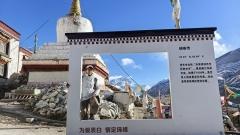

Every spring, parts of Tibet turn unexpectedly soft and colorful as wild peach trees begin to bloom along river valleys, villages, and mountain roads. The most famous spring landscape can be found around Nyingchi in southeastern Tibet, where pink and pale peach blossoms appear against snow-covered mountains, green valleys, and traditional Tibetan villages.
But there is no single date when all the peach blossoms in Tibet are at their best. The flowering season changes from one place to another depending on altitude, local temperatures, and the year’s weather. Some areas may begin blooming in early March, while higher or colder locations can peak later. For travelers planning a Tibet spring trip, understanding these regional differences is one of the most important parts of choosing the right dates.
Key Takeaways
- Tibet’s peach blossom season generally runs from March to April, with timing varying by location and yearly weather.
- Nyingchi is the main region for peach blossom viewing, but different valleys can peak at different times.
- Bomi is often associated with some of the most impressive peach blossom and snow mountain combinations.
- Lower and warmer valleys generally bloom earlier, while colder and higher areas tend to bloom later.
- Weather conditions can shift the flowering period from year to year, so blossom forecasts should be checked shortly before departure.
When Do Peach Blossoms Bloom in Tibet?
The main peach blossom season in Tibet is usually concentrated in March and April.
The exact timing is not fixed. Early spring temperatures, winter conditions, altitude, and local microclimates can all affect when the first flowers appear and how long they remain in bloom.
A simple way to think about the season is:
Early March: Some of the warmer and lower valleys may begin showing the first blossoms.
Mid-March: More areas around Nyingchi can start entering the flowering season.
Late March to early April: This is often an important period for travelers hoping to see widespread blossoms across the Nyingchi region.
Mid-April: Some later-blooming and higher areas may still have flowers, while earlier areas may already be past their peak.
These are only broad seasonal references rather than guaranteed dates. A warm spring can bring blossoms forward, while colder weather can delay them.
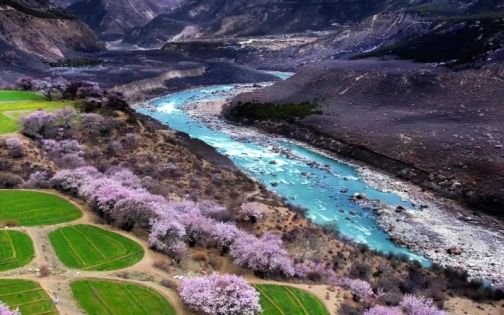
Nyingchi Peach Blossoms
Why Nyingchi Is the Main Peach Blossom Destination
When people talk about peach blossoms in Tibet, they are usually referring to the Nyingchi area.
Nyingchi sits in southeastern Tibet, where the Yarlung Tsangpo River system and mountain valleys create a very different environment from the dry plateau landscapes many travelers associate with Tibet.
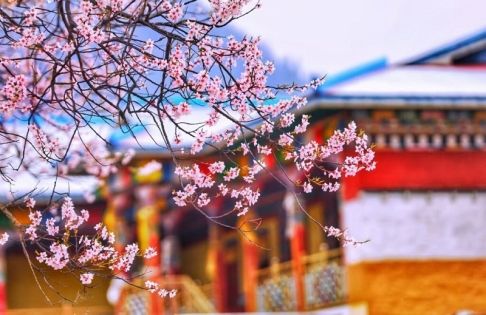
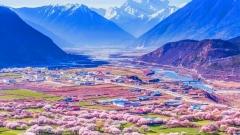
In spring, wild peach trees begin blooming across the valleys. Their pink flowers stand out against green grass, forests, villages, rivers, and distant snow peaks.
The result is a landscape that looks very different from the Tibet many people imagine.
Instead of endless high-altitude wilderness, you may find fields surrounded by flowering trees, traditional houses and dramatic Himalayan mountains in the distance.
This contrast is one of the main reasons the Nyingchi region has become so popular for spring photography.
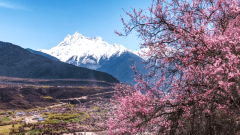
Different Areas Have Different Flowering Times
One of the biggest mistakes travelers can make is assuming that the entire Nyingchi region blooms at exactly the same time.
It does not.
Nyingchi covers a large area with substantial differences in altitude and local climate, so flowering can progress gradually from warmer valleys to colder areas.
Nyingchi and Surrounding Valleys
Areas closer to Nyingchi and lower river valleys can begin flowering relatively early.
The combination of blossoming trees, green fields, rivers, and mountain scenery makes these areas especially attractive for travelers who want a variety of landscapes rather than only close-up flower photography.
This part of the region can also be easier to combine with other Nyingchi attractions.
Bomi
Bomi is one of the most important destinations for peach blossom photography in southeastern Tibet.
The scenery here is particularly dramatic because flowering peach trees can appear in front of snow-covered mountains and forested slopes.
The landscape is not simply a field of pink flowers. It is the contrast between warm-colored blossoms and massive Himalayan scenery that makes Bomi so memorable.
Bomi can also have a somewhat different flowering schedule from lower areas around Nyingchi, so travelers planning a multi-stop peach blossom trip should avoid assuming that one area’s peak automatically means every other area is at peak bloom.
Yarlung Tsangpo Valley Areas
Some valleys along the Yarlung Tsangpo and surrounding river systems also offer spring blossoms.
Because valleys differ in altitude, exposure, and local temperatures, flowering can develop in stages.
This is one reason multi-day routes are useful during the peach blossom season: even if one location is just past its peak, another area farther along the route may be entering its best period.
What Causes the Differences in Flowering Dates?
Several natural factors determine when peach trees begin to bloom.
Temperature
Warmer conditions generally encourage earlier flowering, while prolonged cold weather can delay it.
Altitude
Higher locations are usually colder, so they may bloom later than lower valleys.
Sun Exposure
Slopes and valleys that receive more sunlight can warm up faster during spring.
Local Microclimates
Mountains, rivers, forests, and valley structures can create very different conditions even between locations that are not extremely far apart.
Year-to-Year Weather
This is particularly important. A date that produced peak blossoms one year may not produce exactly the same result the following year.
That means peach blossom travel should always be planned around an approximate flowering window rather than one fixed date.
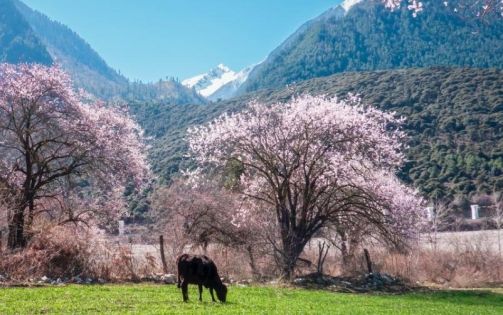
Nyingchi Tibet
Why Bomi Is Popular With Photographers
If your main goal is photography, Bomi deserves special attention.
The appeal comes from the combination of several elements rather than the flowers alone.
You can potentially frame:
- Peach blossoms + snow mountains
- Peach blossoms + Tibetan villages
- Peach blossoms + rivers
- Peach blossoms + forests and farmland
This creates much more depth than photographing a single flowering tree.
Early morning can be particularly rewarding because the light is softer and mountain visibility may be better before clouds build up later in the day.
A telephoto lens can help isolate snow peaks behind the flowers, while a wide-angle lens is useful for showing the full valley landscape.
What Does a Typical Peach Blossom Landscape Look Like?
The most memorable spring scenes in Tibet often come from contrast.
- Pink flowers look delicate against rugged mountains.
- Green fields appear beside brown winter landscape.
- Traditional Tibetan houses sit among flowering trees.
- Snow remains on distant peaks while the valley below begins turning green.
This mix of seasons is part of what makes Tibet’s peach blossom season different from an ordinary spring flower trip.
You are not visiting Tibet simply to see flowers. You are seeing spring arrive in a high-altitude mountain environment.
How Long Does the Peach Blossom Season Last?
The overall season can last several weeks across the broader region, but the peak period at one specific location can be much shorter.
That distinction is important.
You may have a good chance of seeing blossoms during a two- or three-week travel window, but you cannot assume that every tree will remain at peak bloom throughout that period.
Weather can also cause petals to fall quickly after flowering reaches its peak.
For this reason, travelers who have very specific photography goals should avoid planning the entire trip around one exact date unless they are prepared for some uncertainty.
When Should You Visit Tibet for Peach Blossoms?
For many travelers, late March to early April is a useful starting point when considering a Nyingchi peach blossom trip.
However, the ideal timing depends on which areas you want to visit.
If you want to focus on lower and warmer valleys, an earlier trip may work better.
If you want to include places such as Bomi and other areas where flowering can occur later, extending the travel period into early or mid-April may provide more flexibility.
The best approach is to select a travel window rather than a single “perfect” day.
What Is the Weather Like During Peach Blossom Season?
Spring in Tibet can bring large temperature differences between day and night.
During the daytime, lower valleys can feel surprisingly comfortable under the sun. Early mornings and evenings can still be cold, particularly in mountain areas.
Weather can also change quickly.
Clouds may appear around the mountains, wind can affect how flowers look, and a sudden temperature change can alter flowering conditions.
This is why travelers should pack in layers rather than assuming that a spring trip means warm weather everywhere.
A warm jacket, sun protection, comfortable walking shoes, and sunglasses are all useful.
Can You See Snow Mountains and Peach Blossoms at the Same Time?
This is one of the main attractions of the season.
Yes, spring is one of the periods when travelers can potentially see peach blossoms in the valleys while snow remains on the surrounding mountain peaks.
The effect is particularly striking around Bomi and other mountain valleys.
The exact visibility of the snow mountains depends heavily on weather. A location can be in full bloom but still have poor mountain visibility because of cloud cover.
For photographers, this is another reason not to schedule every stop too tightly. Having some flexibility makes it easier to wait for changing light and clearer views.
How Many Days Do You Need for a Tibet Peach Blossom Trip?
A very short trip can cover one or two blossom areas, but a longer itinerary gives you more opportunities to experience different flowering stages and landscapes.
About 5–7 days can work for a compact Nyingchi-focused journey.
Around 9–11 days gives you more room to combine Nyingchi with other destinations and travel through several scenic areas.
12 days or more can be suitable for travelers who want to add major Tibet highlights rather than focusing entirely on spring flowers.
For photographers, extra days can be especially useful because weather is never completely predictable.
A route that allows you to spend additional time in a scenic area can be much more rewarding than one that moves every day according to a strict schedule.
What Can You Combine With a Peach Blossom Trip?
Peach blossom season is a particularly good time to explore more than flowers.
A Nyingchi itinerary can potentially combine spring scenery with places such as Basum Tso, Lulang, Namcha Barwa, and the surrounding Tibetan villages and valleys.
You can also extend the journey to Lhasa for a very different cultural experience.
This combination works well because Nyingchi and Lhasa offer very different landscapes.
Lhasa brings monasteries, historic architecture, Tibetan culture, and high-altitude urban scenery.
Nyingchi brings forests, rivers, lower valleys, snow mountains, and spring blossoms.
Putting the two together creates a much more varied Tibet trip.
Is the Tibet Peach Blossom Season Suitable for Families and Older Travelers?
It can be, especially when the itinerary is designed around comfortable road travel and moderate walking.
Nyingchi is often considered a more relaxed option for travelers who are concerned about the physical demands of a Tibet trip, partly because some areas in the region are lower than central Tibet’s major tourist sites.
That said, altitude is still a factor, and individual travelers should consider their own health and ability before traveling at high elevation.
Families can also enjoy the visual variety of the region. Children may find the combination of flowers, rivers, villages, forests, and mountains more engaging than a trip focused entirely on religious monuments.
Tips for Planning Around the Flowering Season
Avoid treating one date as guaranteed peak bloom.
Flowering can change with the weather.
Allow some flexibility.
An extra day in a scenic area can be valuable when cloud cover or changing bloom conditions affect photography.
Check local conditions before departure.
Flowering updates closer to your travel date are more useful than relying entirely on historical dates.
Prepare for changing temperatures.
Spring does not mean consistently warm weather in Tibet.
Plan around light as well as flowers.
Early morning and late afternoon can provide more attractive photography conditions.
Don’t focus only on famous viewpoints.
Some of the best photographs may come from ordinary villages, roadsides, and fields along the route.
Is Tibet Peach Blossom Season Worth Planning a Trip Around?
For travelers who enjoy photography and seasonal landscapes, spring offers a side of Tibet that can feel completely different from the dry, rugged plateau image often associated with the region.
The key is understanding that Tibet’s peach blossom season is regional rather than uniform.
Nyingchi is the main area to consider, while Bomi and surrounding valleys can provide different combinations of flowering trees, snow mountains, forests, rivers, and Tibetan villages. The flowering period generally falls between March and April, but the exact timing shifts from year to year.
Instead of searching for one guaranteed date, it is better to choose a reasonable travel window and build some flexibility into the itinerary.
When the timing works, the result is one of Tibet’s most distinctive spring landscapes: delicate peach blossoms in the foreground, traditional villages in the valley, and snow-covered Himalayan peaks in the distance.