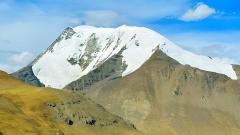

For many travelers, seeing snow-covered mountains is one of the main reasons to visit Tibet. But do you need to travel in winter to see them? Not at all. Many of Tibet’s highest peaks remain snow-covered throughout the year, including Mount Everest, Mount Kailash, and Namcha Barwa. The bigger question is whether the weather will give you a clear view. Cloud cover, visibility, and the time of day can make a much bigger difference than the amount of snow on the mountain. If your trip is planned around mountain scenery, choosing the right season and viewpoint can greatly improve your chances of seeing Tibet’s most spectacular peaks.
Key Takeaways
- Many of Tibet’s highest mountains are snow-covered year-round, so you do not need to visit in winter to see snow.
- September and October are generally among the best months for clear mountain views.
- Summer can still offer spectacular snow mountain scenery, but clouds and rainfall may make visibility less predictable.
- Early morning is often the best time to see and photograph snow-covered peaks.
- Mount Everest, Mount Kailash, Namcha Barwa, and the Nyenchen Tanglha Mountains offer some of Tibet’s most impressive mountain views.
- Weather matters as much as the season, so allowing some flexibility in your itinerary can make a big difference.
Are Tibet’s Snow-Covered Mountains Visible All Year Round?
Yes. Many of the highest mountains in Tibet are permanently snow-covered because of their extreme altitude.
Mount Everest rises to 8,848.86 meters, while Namcha Barwa reaches 7,782 meters and Mount Kailash stands at around 6,638 meters. At these elevations, snow and ice remain on the peaks throughout much of the year.
However, there is an important difference between a mountain having snow and being able to see the mountain clearly.
A peak can be covered in fresh snow but completely hidden behind clouds. This is particularly common in the warmer and wetter months.
For travelers, clear visibility is therefore usually more important than the season itself.
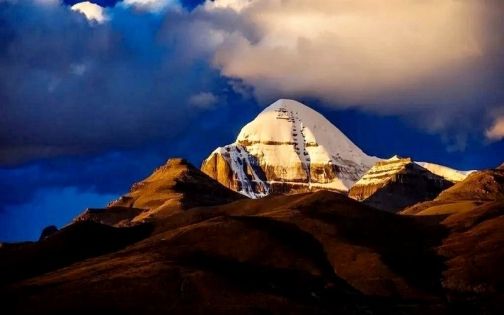
When Is the Best Time to See Snow-Covered Mountains in Tibet?
Spring: April to June
Spring can be an excellent time for mountain scenery.
As the weather becomes more stable, the landscape around Tibet begins to come alive. In Nyingchi, snow-covered peaks can appear above forests and peach blossoms, creating a particularly beautiful contrast in March and April.
By May and June, many roads and scenic areas become easier to access, while the major peaks remain covered in snow.
Spring is especially attractive for:
- Namcha Barwa
- Nyingchi
- Shigatse
- Himalayan mountain views
Summer: July to August
You can absolutely see snow-covered mountains in Tibet during summer.
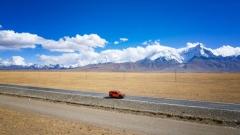
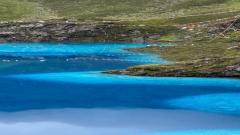
In fact, summer provides some of the most dramatic contrasts: bright green grasslands in the foreground, turquoise lakes, and snow-covered peaks in the distance.
The main challenge is the weather.
July and August are affected by the summer rainy season in parts of Tibet, so clouds can build up around mountain peaks, particularly during the afternoon.
If you travel in summer, try to see the mountains early in the morning when visibility is often better.
Autumn: September to October
For travelers whose main priority is clear mountain views, autumn is one of the best seasons to visit Tibet.
After the summer rains begin to decrease, the air often becomes drier and the skies clearer. This creates excellent conditions for seeing distant peaks.
Autumn is particularly attractive for:
- Mount Everest
- Mount Kailash
- Namcha Barwa
- Namtso and the Nyenchen Tanglha Mountains
The combination of clear blue skies, snow-covered peaks, and comfortable daytime temperatures also makes autumn one of the most popular seasons for photography.
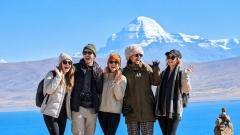
Winter: November to March
Winter gives Tibet its strongest traditional “snow mountain” appearance.
The surrounding landscape can become much whiter, while cold and dry conditions sometimes produce remarkably clear skies.
There are also fewer tourists, which can make popular viewpoints feel much quieter.
However, winter travel comes with challenges:
- Very low temperatures
- Colder nights at high altitude
- Possible road disruptions in remote areas
- Shorter daylight hours
For travelers who are comfortable with the cold, winter can be rewarding. But you do not need to wait until winter to see snow-covered peaks.
Where Can You See the Best Snow-Covered Mountains in Tibet?
Mount Everest
For many travelers, Mount Everest is the ultimate destination.
On the Tibet side, the Everest region offers several excellent viewpoints, with Everest Base Camp and Rongbuk Monastery among the most memorable.
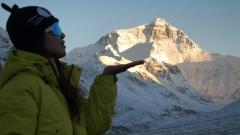
Clear autumn mornings can offer spectacular views of the mountain’s north face. Sunrise is especially popular, when the first light gradually reaches the summit.
If Everest is your main reason for visiting Tibet, it is worth building some flexibility into your itinerary because mountain visibility can change quickly.
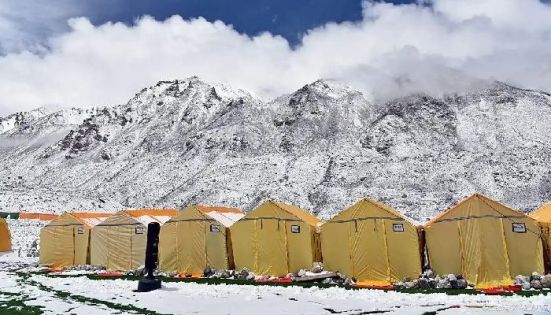
Tents at Mount Everest Base Camp
Mount Kailash
Mount Kailash is very different from Everest.
It is smaller, but its distinctive pyramid-like shape and deep religious significance make it one of the most famous mountains in Tibet.
For travelers completing the Mount Kailash Kora, the mountain appears from different angles throughout the trek.
The combination of:
- Snow-covered peaks
- High-altitude wilderness
- Ancient pilgrimage routes
- Religious traditions
makes this one of the most unique mountain experiences in Tibet.
Namcha Barwa
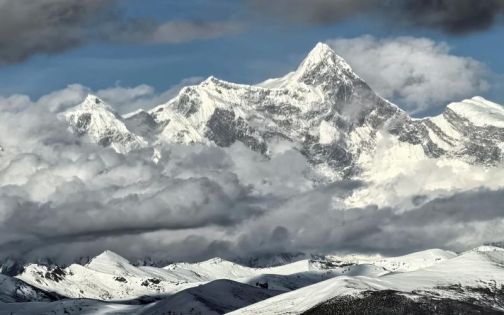
Located in eastern Tibet’s Nyingchi region, Namcha Barwa rises to 7,782 meters.
It is famous not only for its dramatic pyramid-shaped summit, but also because it is notoriously difficult to see clearly. Clouds often gather around the peak, which is why spotting its complete shape can feel like a lucky encounter.
Autumn is a particularly good season for visibility, while spring offers another special experience when peach blossoms appear in the valleys below.
Popular viewing areas include:
- Sejila Mountain Pass
- Suosong Village
- Yarlung Tsangpo Grand Canyon
Namcha Barwa
Nyenchen Tanglha Mountains
The Nyenchen Tanglha range is one of the most impressive mountain systems in central Tibet.
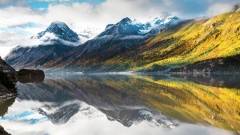
It is particularly beautiful around Namtso Lake, where snow-covered mountains rise behind the deep blue waters.
The combination of lake and mountain is one of the classic landscapes of Tibet, and autumn often provides excellent visibility.
Why Does the Weather Matter More Than the Season?
Even during the best travel season, nobody can guarantee a clear mountain view.
High-altitude weather changes quickly. A mountain may be clearly visible in the morning and completely covered by clouds a few hours later.
This is particularly important for destinations such as Namcha Barwa and Everest.
If seeing a specific mountain is your top priority, it is worth giving yourself some flexibility.
For example, staying overnight near the mountain rather than visiting as a quick day trip can give you more than one opportunity to see the peak.
In many cases, patience is the key.
Best Time of Day to See Snow Mountains
Early morning is usually your best chance.
Before the day’s temperatures rise, mountain air is often more stable and cloud cover may be thinner.
Early morning also offers better lighting for photography. The first sunlight can gradually turn snow-covered peaks golden, creating the famous “golden mountain” effect seen in many Tibet travel photos.
Late afternoon can also be beautiful, particularly for sunset photography, but clouds are often more likely to build during the day.
For Everest and Namcha Barwa, waking up early is often worth it.
Tips for Getting Clear Snow Mountain Views
A few simple choices can improve your chances:
Choose the right season.
September and October are excellent choices if clear skies are your priority.
Check the weather before traveling.
Mountain forecasts are more useful when considered alongside local conditions.
Visit viewpoints early.
Morning often provides the clearest conditions.
Allow some flexibility.
A spare day can make a big difference when visiting a mountain that is frequently covered by clouds.
Stay overnight when possible.
This gives you more chances to see the mountain at different times of day.
Bring a camera with enough zoom.
Many of Tibet’s most famous mountains are viewed from a considerable distance.
Can You See Snow-Covered Mountains in Tibet in Summer?
Absolutely.
This is a common misconception. The snow does not disappear simply because it is summer.
The real issue in July and August is visibility, not whether the mountains still have snow.
On a clear summer morning, you can still see dramatic snow-covered peaks above:
- Green grasslands
- Turquoise lakes
- Alpine valleys
Summer can actually provide some of the most colorful mountain scenery in Tibet.
Plan Your Tibet Trip Around the Mountains
If seeing snow-covered mountains is one of the main reasons for your trip, it is better to plan around visibility rather than temperature alone.
A simple approach is:
Choose the season → select the mountain → check the best viewpoint → allow enough time → prioritize early mornings.
For Everest, combine the mountain with Shigatse and Yamdrok Lake. For Namcha Barwa, consider Nyingchi, Lulang, and Basum Tso. For Mount Kailash, the Kora and Lake Manasarovar can turn a mountain visit into a much deeper experience.
Tibet’s snow mountains are not limited to one season. Whether you visit during the golden days of autumn, the green landscapes of summer, or the quiet winter months, the peaks remain one of the region’s greatest attractions. The real reward is simply being there on the morning when the clouds clear and the mountain finally reveals itself.